
Moon Song
Rev. Douglas Taylor
August 18, 2024
Sermon Video: https://youtu.be/BWU0-RgOWwI
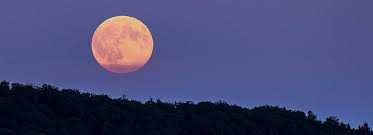
There will be a full moon tomorrow night (8-19-24).
It is known as the Sturgeon Moon. Nomenclature for the full moons follows local culture. Indigenous people around the great lakes call it the sturgeon moon, as that fish is in abundance in August. But if you are in the Southeast US, the Cherokee call it the fruit moon. In northern Europe, the August full moon is known as the corn moon, the grain moon, or even the lightning moon. In China, August’s full moon is the Harvest Moon – but around here we save that name for September. In the southern hemisphere the August moon is the snow moon, the storm moon, or sometimes the hunger moon. Naming the moon is done regionally, and is often about ourselves rather than about the moon.
Someone once said “Tell me how you feel when the full moon is in your window and your lantern is burning low, and I’ll tell you your age and if you are happy.”
I had a friend who used to howl at the moon. When we were teenagers and able to be out at night on our own, he could get us all howling with him with little provocation. It was a bit of childhood fun. In the way of teenagers, it was equal parts silliness and a serious claiming of our space together.
As adults, many of us do not spend much time thinking about or noticing the moon. Our society has put the moon in a box for witches and werewolves. It is spooky and hidden, mysterious and maybe a bit romantic when we want it to be. But mostly it is just a representation of the nighttime and rest. Which is to say – we do not give it much value in our society.
Or perhaps, more accurately, we hold it with a hidden value. But I tell you, we should love the moon. We do well to celebrate it and admire it and spend time learning from it and sing praise for its presence in our lives.
Storytellers and poets tell us the moon is mysterious and beautiful, changing and strange, compelling, and romantic. Why do we love the moon so? And yet our society dismisses it as lesser? What is the draw we feel toward it?”
Poet William Cullen Bryant: “The moon is at her full, and riding hight, Floods the calm fields with light. The airs that hover in the summer sky Are all asleep tonight.”
The moon is roughly 239,000 miles from the earth and about one quarter the size of our planet. The gravity of our celestial partner pulls our tides in and out around our globe, and is thus significantly responsible for keeping our waters in dynamic balance. By an interesting twist of physics, its orbital period and its rotation period are the same causing the same side of the moon to always face the earth. This means there is a ‘dark’ side of the moon, a fact which had left us a lot of opportunity for speculative imaginings – at least until the late ‘60’s when we sent rockets and satellites around to that side to take pictures. Did you know it wasn’t until five years ago (2019) that we landed an unmanned craft there to actually poke around.
There was a time when the moon was for more than witches and werewolves – it was also for astronauts. For two and a half years, back fifty years ago, we sent people in rockets to the moon. As President Kennedy proclaimed, “We choose to go to the moon in this decade and do the other things, not because they are easy, but because they are hard.” (1962 that US President John F Kennedy) That was a heady time.
24 people visited to the moon in that two-and-a-half-year timespan, half of them got out of the crafts to walk around a bit on the moon. “One small step for man, one giant leap for mankind.” (July 20, 1969, Neil Armstrong) It was a time of demythologizing. It was a time of moon rocks and rocket fuel.
Since that time, it has been deemed more efficient and effective to send robots to learn more about the moon and other places beyond our planet. While sending robots has been more efficient, having a human on the moon captures our imagination as few things can. And that, my friends, is the really exciting part of all this.
Around the time of the moon landings, philosophy professor Emmanuel G. Mesthene quipped, “Ten years ago, the Moon was an inspiration to poets and an opportunity for lovers. Ten years from now, it will be just another airport.” How wrong he was. Not only did the focus of our progress and greed shift away from the moon, but our romance with the moon never did and never will wane.
Modern poet Chrissie Pinney says, “She held the moon the way she held her own heart, as if it was the only light that could guide her through the darkest nights.”
Even as we restart manned moon missions, we will not surrender our fondness and fascination for the moon. And, if you did not already know, NASA’s Artimis Program is slated to send humans to the moon again this decade. So, keep an ear out for news of another round of moon landings soon.
Interestingly, one of the four astronauts slated for the Artimis Program is a woman. I think that is very fitting because throughout history, culture, and myth, there has been a strong feminine association with the moon.
Did you know, for example, about tally sticks? They are some of the earliest artifacts we have of prehistoric people measuring time. Tally sticks were often animal bone and a common form was to have 28 tally marks to count the days of a moon cycle. It is not that hard to connect the dots to know that marking a moon cycle is something women were doing to be able to track menstrual cycles.
We track the cycle of the moon and call it a month. The English word ‘month’ has an etymological connection back to the word ‘moon.’ And while today we use a calendar with a solar month, it was surely the original form to use a lunar month. There are cultures still that mark time with lunar months such as the religious calendars of Islam and Judaism.
English is not the only language with this etymology between month and moon. Greek and Latin have this connection, as does Chinese. But it goes further: in English our words ‘measure’ and ‘menstrual’ share a common root – a root which unsurprisingly also ties back to the word for moon. Because the tally sticks of 28 marks were an early way to measure a lunar month and the reason to measure that was for our menstrual cycles.
I make a point to say ‘our’ menstrual cycles because women are too often listed as secondary humans in culture and science. But it seems clear that women were leading the way by following the moon. Perhaps we can break away from our binary thinking of either the sun or the moon – in which one is better and the other lesser. Men and women, light and dark. When we recognize the dynamic balance in all things and honor the darkness as much as the light – particularly in the interplay of dark and light – then perhaps we will not be so shy about the moon or misogynistic about women.
Tomorrow night is a full moon. It is also a blue moon and a super moon – quite special.
Blue moon is a concept to reconcile the solar calendar and the lunar cycle. A blue moon happens either when we have two full moons in one calendar month or four full moons in one season. If the lunar and solar calendars lined up perfectly, there would be one full moon a month and three each season for a total of twelve in a year. But 12 times 28 equals 336 days, which is 29 days shy of our solar calendar … which leads me to expect we would always have 13 full moons a year … but the lunar rotation is not actually 28 days as I had been once taught, it is 29.5 days – because the universe doesn’t really care about our even numbers. So, we really have a difference of roughly 11 days, meaning there is not a blue moon every year. But there is one this year. And it’s tomorrow night. But I don’t think blue moons are all that interesting because they are really just a math problem rather than circumstance of physics.
A super moon, on the other hand, is a circumstance of physics and worth noticing. And tomorrow night’s moon is also a super moon. A super moon is when the full moon occurs when the moon is closest to the earth. Remember, orbits are elliptical instead of circular, so a super moon is when the moon is physically closest to the earth – only 226,000 miles which is 13,000 miles closer than the average distance. In short – it’s closer and will appear bigger. We will experience a super moon for the next four consecutive months.
I add all this scientific information about the moon so as to encourage you to spend a little extra time with the moon over the next few months. Notice it, admire it, howl – if you are drawn to do so.
What can we learn about ourselves from the moon? Poet Anand Thakur writes, “Let the moon teach you the art of being beautiful and lonely at the same time.”
Perhaps you can consider the way the moon offers guidance for us during the darkness. Or the ways you also might have a hidden side, and how you might begin to explore it more. Or perhaps your lesson is in the changing faces of the moon, the waxing and waning through its cycles and yet it remains the same throughout. Or even the ways the moon effects its partner the earth with the ebb and flow of tides – how do you affect others around you?
Daniel Ladinsky, writing in the spirit of Persian poet Hafez of Shiraz, has said:
Admit something: Everyone you see, you say to them, “love me.” Of course you do not do this out loud otherwise someone would call the cops.
Still though, think about this, this great pull in us to connect. Why not become the one who lives with a full moon in each eye that is always saying, with that sweet moon language, what every other eye in this world is dying to hear?
We can learn about relationships and connections from the moon, from all the universe really – but why not the moon? We can learn about our connections with each other and how we tug on each other’s tides. We are meant to be connected.
Go commune with the super moon tomorrow night. It is the sturgeon moon, a blue moon, your moon and mine. Look at that moon, maybe howl a little. Let its reflected light reflect in you.
In a world without end
May it be so.
 Rev. Douglas Taylor