
The Cost of Kindness

The Cost of Kindness
Rev. Douglas Taylor
October 18, 2026
Sermon Video: https://youtu.be/7LIM-p5rNCU
It costs you nothing to hold the door for the next person, right? The simple kindnesses we can offer one another do not have a fee attached. There are small kindnesses that will cost money – buying a coffee for someone or a meal – sure. But a moment of thoughtfulness is fee-free. We can return an extra shopping cart or greet a retail worker by the name they have on their name tag. We can shovel a snowy walk for a neighbor or offer a compliment for a stranger’s cool hat. These things take time and effort, attention; but generally are not connected to the grand capitalist scheme at play. Such actions do not add or subtract from anyone bottom line. It costs you nothing to be kind.
And yet, kindness is noteworthy. Kindness is noticed. Kindness stands out against the backdrop of all the other interactions we have in a day. Kindness can sometimes feel scarce. There is so much cruelty and meanness on display, so much self-serving and exploitative behavior that kindness seems a little lost.
To be fair, we don’t always call these behaviors “kindness.” We don’t always think of them that way. What I am calling kindness, the behaviors of being kind to others, may feel more like something else for you. Kindness is about doing something positive or good for someone else in a way that is not transactional.
You many call such behaviors civility or basic human decency – “all people deserve the same respect I want from the world. That’s just how we make society work.” Or you may think of such actions as good character or personal integrity – “I am treating others this way because of who I am as a person.” What I am calling kindness, you may think of as compassion or generosity or helpfulness or even justice – “I will treat the vulnerable the way I would want to be treated if I were in their shoes.”
You may even think of it theologically – there is a whole branch of theology in existentialism that distinguishes between two types of relationship – “I-It” and “I-thou” relationships. Basically, we can treat other people like objects or like people. Think again about the cashier from your last visit to the grocery store … and we have a whole theology that says, ‘maybe we treat that person like a person instead of as an object that happens to be in our path.’
Kindness is not only a mindset, a way of thinking. Kindness is essentially a behavior. It is a behavior that does not benefit you directly. And, I’m arguing, does not cost you anything to do. Granted, there is a whole mess of examples in which kindness does literally cost you something – buying a gift or paying someone’s parking fee and so on. Yes – that version of kindness has a financial component. My point is not that there is zero money involved. My point is that there doesn’t have to be. People are not being unkind because they can’t afford to be kind.
And on the flip side of it, they are not choosing to be kind for the financial benefits, for the pay off. Here I will pause for a brief tangent and admit there are studies that show some benefits to the person who is offering kindness.
Studies show that being kind is good for your heart, it boosts your immune system, lowers anxiety, and even slows the effects of aging. There are several studies about something that has been called the “kindness feedback loop” which essentially reveals that being kind increases our happiness; and when we are happier, we tend to be more kind – the results suggest kindness and happiness are entangled.
So, being kind is good for you, being good to other people is good for your health and happiness. In case you needed a selfish reason to behave unselfishly.
And now I want to take a bit of a leap and maybe you’re willing to come with me. What if it did cost you something to be kind. What if there was a cost, would you pay it? We used poet Naomi Shihab Nye’s excellent poem on Kindness as our opening words, with the reminder that “Before you can know kindness as the deepest thing inside, you must know sorrow is the other deepest thing.” What if you made choices to be kind that followed the deep sorrows you experience in the world? What if that were the cost?
This has me thinking about one of my granddaughter’s favorite kid’s shows: Ms. Rachel’s Songs for Littles. Ms. Rachel, if you don’t know, is an educator Youtuber, and activist. She started making videos for infants and toddlers, and her work blossomed during the pandemic. People have likened her to Mr. Rogers both in style and impact.
Lately Ms. Rachel has been speaking out against the harm children are suffering in Gaza and in our American immigration detention centers. She wants children to live free and to grow, to be able to eat and be healthy. She is an incredibly kind and generous person. And she has a deep sorrow for the suffering of children. “Before you can know kindness as the deepest thing inside, you must know sorrow is the other deepest thing.”
She has gotten a lot of support and a lot of accusations. About a year and a half ago, she posted on social media about a group calling her evil. https://www.theguardian.com/us-news/2025/apr/09/stop-antisemitism-ms-rachel-doj-investigation
“They called for me to be investigated by the DOJ because I care about Palestinian children, along with all children.
It’s lead to me getting threats, needing security & they tried to ruin my career. It’s been incredibly painful.
But the pain doesn’t compare in the slightest to what the children of Gaza experience. And my dedication to children & their human rights is stronger than any of it.”
Ms. Rachel – or Rachel Griffin Accurso if you want to be specific – is advocating that the hungry children in Gaza deserve food, they deserve to not be targeted, they deserve to not be bombed. And she says all children deserve the same. Israeli children deserve the same. She says this. And people react saying she should stick to her kid’s show, she should be quiet, she should die.
I’ve brought up the example of Ms. Rachel to highlight how her sorrow for the suffering of children has led her to kindness on behalf of children. Her example highlights something of the cost of kindness.
And along the way, Ms. Rachel’s example highlights a second way kindness can have a cost. Be mindful to whom you are kind because that’s the part that may get you in trouble. Kindness itself is not radial. But who you are kind too may make it radical. Kindness can become a radical behavior if you choose to be kind to certain people whom society has deemed unacceptable.
Everyone will love it if you buy a coffee for the next person in line behind you are the coffee shop because that person, while random, is likely to be comfortably part of society still. But if you start buying coffees for the homeless – watch out. Everyone will love you if you hold the door open for someone with mobility struggles, but if your kindness leads you to advocate for better systems to support folks with disabilities, the praise may be mixed with accusations.
Dom Hélder Câmara, a Brazilian Catholic archbishop and champion of human rights who died a quarter of a century ago once said it quite clearly: “When I feed the poor, they call me a saint, but when I ask why the poor are hungry, they call me a communist.” Who you are kind too is where we often discover a cost.
But that is exactly our work, is it not? Jesus called people to love their neighbors as themselves. When asked to clarify who counted as a neighbor – the question of who we should be kind to is an old question – when asked to clarify, Jesus told the story of the Good Samaritan. And even with this parable resonating so centrally in Christian belief, it is still hard for people to be kind to those society deems unworthy. And there will be a cost.
And we can remember what Rev. Debus told us in the reading this morning (“Kindness over Niceness.”) “Kindness doesn’t calculate the return on investment or the risk to reputation or the fear of comments.” Kindness calls us to behave in ways that may have a cost – but we don’t look to the cost to know if we should do it or not.
You and I are not celebrities and will likely not experience the costs incurred by folks like Ms. Rachel. But we can act with kindness toward all people, toward who ever happens to be near us, toward particular people who are vulnerable and in need. We can call those behaviors kind, or we can say we are just offering basic human decency. Or call it love, because love changes everything, and Love Is Resistance, and ‘love is patient, love is … (kind).’
But here’s the thing: We are offering our attention and our actions in the service of making things better. We are acting with kindness. There may be a cost, a cost of acknowledging the sorrow we feel for the plight of others. There may be a cost to reputation or some threat from those who don’t like us being kind to those people.
But still, we act with kindness. We offer our kindness not for praise or reward, but because it is the thing to do in a hurting world. And we do not count the cost. We hold the door for the next person, we treat others as humans instead of object, we cry out with the sorrow we see and experience in the world, and then we help the next person and do the next kind thing. Because that’s how we make the world better. It’s just what we do.
In a world without end,
May it be so.
Keep the Circle Unbroken

Keep the Circle Unbroken
Rev. Douglas Taylor
September 27, 2026
Sermon Video: https://youtu.be/c6wPZP6yKH4
I wonder how many of us have a memory about coloring outside the lines as a child, or learning about the importance of staying inside the lines. I don’t have such a memory myself, but it is a common enough experience that many adults can reflect back on it.
My colleague Rod Richards says
“We humans are the line-drawers. We are the border makers … the census-takers. We draw a line to separate this from that, so we can see clearly what each is. We create a border to define our place, so we can take care of what’s there.”
Rod goes on to say, however, that compassion does not have such boundaries, “God has no borders.” “The lines we draw,” he says, “disappear when viewed with eyes of compassion.” We can say, perhaps, that God loves those who color outside the lines.
In the September 17th issue of Braver/Wiser from last year, UU leader Clint Nicely https://www.uua.org/braverwiser/crossing-lines reflected on this, sharing his experience at the Smithsonian at age 8:
“I learned that lots of great art doesn’t have clearly defined lines. It was an epiphany, and within a few years I was questioning everything. Some musicians, as it turned out, didn’t always play the music as written. Teachers didn’t always follow the textbook. My mother often took liberties with recipes. Though I was not yet consciously aware of it, crossing and blurring the lines had become a metaphor for everything in my life, a new way of experiencing the world.”
Last week I preached a sermon about breaking out of unhelpful cycles, patterns of harm. https://douglastaylor.org/2026/09/21/breaking-the-cycle/ I urged us to break with tradition. Following Nicely’s reflection, I urged us to not play the music as written, to not follow the textbook, to take liberties with the recipes. As Unitarian Universalists, I think we’ve come to expect this sort of perspective from our pulpits. It was Ralph Waldo Emerson, after all, advising the Harvard Divinity School graduates to
“Let me admonish you, first of all, to go alone; to refuse all good models, even those which are sacred in the imagination of [humanity], and dare to love God without mediator or veil.”
Eschew tradition, break the cycle, dare to be original, color outside the lines! Allow me to moment to acknowledge the power and importance of all that, and to say – we don’t need to do that every time. It is worth learning when to cross the line and when to hold it. There is a value in knowing how the break the cycle and how to keep the circle unbroken – because both behaviors are needed depending on the circumstance.
I was at a multi-day minister’s conference a few years back, the topic was on leadership and authority. There were a few dozen of us participating, and when we came in to the room after our lunch break on the second day, the presenters had set up a game for us.
There was masking tape on the floor dividing the room into thirds. We were each assigned a section with most of us in one section, a smaller number in the middle section, and about five people in the last section. We were given only one rule – don’t cross the lines.
At first, knowing the course was about leadership and authority, we played along. After about ten minutes, we started crossing the lines just to see what would happen. When nothing obvious happened, most of us roamed the room. Some people pulled up the tape and used it to make art or create new boundaries. I started at the big end, but over the course of the activity I occupied every section of that room you can be assured. Eventually I sat down and started a rousing hymn sing.
Some of what we learned while processing the experience is that when left with no direction or aim, no leadership, people tend to accomplish a significant amount of nothing in particular. We also learned from our experience something about our basic anti-authoritarian streak so prominent among folks in our faith tradition.
We Unitarian Universalists tend to be ‘boundary crossers.’ We are iconoclasts. Our favorite stories from our history are the ones about the rebels, the heretics, the trail blazers, and tradition breakers. A. Powell Davies, the Unitarian preacher serving in Washington D.C. during the McCarthy Era, wrote “How strange and foolish are these walls that separate and divide us.” But are all walls foolish?
My middle child is an artist. He draws with ink and pencil, and more recently has learned to draw digitally. When he was little, he spent months tracing pictures out of books. We had a reem of that really thin printer paper – the kind that was all connected but folded along perforated lines … and it had the punched holes along the edges to spool through the printer which you would need to tear off after it was ready. Do you remember that paper? It was very thin and we had a lot of it. Our son would hold a piece against one of his books about whales and trace the creature. Month after month! We had so many sheets of traced whales. So many! He spent so long just tracing other people’s art.
And now he can freed-hand all manner of creature. He can sketch a heron in a few minutes. I saw him create a frameable drawing of three bears climbing a tree in an afternoon based on just a conversation in the morning with someone. My point is that he started by not even coloring inside the lines – he just drew the lines exactly as they were. Not all walls are foolish, not all lines need to be crossed, we don’t need to break every rule. Such boundaries are supposed to serve a purpose, to protect something important or support someone in need.
We had a shift in our Unitarian Universalist ministry when we were training new ministers to be change-makers, border-crossers. This was when immigration was becoming a central issue in national politics, when authoritarianism was beginning to take root. A few prescient teachers in our seminaries saw that we needed to develop this mindset and these skills in our communities.
I admit when I first learned about the focus of ‘border crossing,’ or ‘boundary crossing’ as it was called originally, I was concerned. I had spent my seminary training and the first handful of years as a minister navigating the impact on our ministry of inappropriate boundary crossing. My seminary training occurred in the shadow of the clergy sexual misconduct scandals. I learned the importance of ‘healthy boundaries.’ While I have never had a personal or direct connection to any such misconduct, the reality of it impacted the breadth of society. Not all boundaries are bad; there are useful walls that divide.
Useful dividing walls serve for when we want to make the lines clear between what is mine and what is yours, such as with your bank account or my body. Conversations of consent and rape culture are a response to a type of ‘boundary crossing’ that is harmful.
Tearing down a wall can be a good thing and it can be a bad thing depending on the boundary, what it was meant to protect, and why it is being crossed. In our game at that minister’s conference, we tore up the tape boundary without establishing first what the boundary was for or clarifying if it was a boundary in the service of justice or of injustice.
Becca Beorger, the author of our reading this morning, reminds us of lessons from cell biology – lessons that are analogously applicable to maintaining individual integrity and the health of a community. She wrote that the reality for our cells, and a goal for our communities, is to have boundaries that are flexible. That our lines, walls, circles, what have you, give us both support and stability as well as the ability to change and grow; protection for what is precious and invitation to something new.
When Jesus exhorted his followers “love your neighbor as yourself,” it was less about tearing down the division between Jews and Samaritans, and more about finding one’s integrity and compassion given the divisive social structures of the day.
“A certain man was going down from Jerusalem to Jericho, and he fell among robber.” Priests refused to help the man, passing on the other side of the road instead of stopping to help; until finally, a Samaritan came by. “When he saw him, he was moved with compassion.” (Luke 10)
The parable of the Good Samaritan recognizes that humanity must find a way to deal with the divisive instinct within us. The deeper question is not if the boundary should be held or torn down. The deeper question is how can you live with integrity given the reality of the walls around us. That is the discernment question to know how to respond to our walls, which to maintain and mend, which to challenge and tear down.
Crossing boundaries is good and just when we are partnering with the oppressed, when we are meeting the ‘other’ across our differences, when we challenging a status quo that causes harm. Crossing boundaries is bad when we are abusing our power or other people, when we are taking advantage of the trust that has been given to us, when we see every boundary as just a challenge rather than as a guide to navigate the needs of the individual with the needs of the group.
Boundaries are a tool, how we use them is the question. We do need to break harmful cycles. We also need to hold close to the unbroken circle of love and connection which is the tap root of what we are building as a community. With all the destruction and division that abounds in our world, yes, we need to also tear down the barriers that cause harm. But more importantly, I contend, we must hold the line for the integrity of our values, keep the rule of kindness and inclusion, mend the wall that holds up the world we are building together.
We must stay within the unbroken circle, because that is where we all heal and grow.
In a world without end
May it be so
Breaking the Cycle
Breaking the Cycle
Rev. Douglas Taylor
9-20-26
Sermon Video: https://youtu.be/I_c87tdRZPk
Breaking a harmful cycle is not simple. One of the tricks life can play on us is when we grow up or move away or in some way leave a situation that has been harmful, we too often carry the patterns with us unwittingly. We may have gotten away from whatever was going on that we didn’t like, that was causing harm … but too often people fall back into an old pattern even when we don’t want to. Breaking a cycle is not simple.
This topic can get us thinking about therapy or healing or how we can help people get out of bad relationships. But today, I’ve gone down the path of leadership. I am thinking more systemically than personally. I want to build a better world. I want to be a leader who helps people build that better world together. And … sometimes we unwittingly carry patterns – patterns of how to be a leader, for example – that continue to be harmful. The models of leadership that are celebrated in society are not always models I want to follow.
This summer I attended a workshop about the “Transforming Hearts Collective.” https://www.transformingheartscollective.org/ This is a faith-based organization that support queer and trans people (particularly those with multiple marginalized identities) to survive and thrive. Offering workshops and classes, they work to bring liberation, healing justice, and radical welcome. The workshop I attended was led by two of the three collective co-leaders, Rev. Mykel Slack and Alex Kapitan.
Throughout the workshop, these two leaders shared about the work they’ve done and the impact their organization has had. They also talked about the ‘behind-the-scenes’ aspect of being leaders creating the organization. Later, during the open questions time of the workshop, someone asked them the question that prompted this sermon for me. Someone asked them to talk about how to be a leader without perpetuating harm, without re-inscribing the patterns of patriarchal power that run counter to the goals or healing and liberation expressed in the mission of their organization.
So many of us only have experience with the basic patriarchal version of leadership. It is tangled up with authoritative decisiveness and dominance, commanding a sense of loyalty and obedience from others. This basic patriarchal model of leadership (which most of us have witnessed and experienced) comes with the leader’s ego calling the shots, in which they wield their authority to gain control over other people. In which they use their position to cause harm. Many of us have experiences of bosses or teachers, politicians or parents who use authoritarian tactics to enforce compliance, to control those they are leading.
These queer, trans leaders hosting this workshop I attended were leading in a different way. And they acknowledged that it is not always easy to break out of the patterns we grew up in, to break the cycle of “the way things are done,” especially if no one has offered us an alternative way.
How did they do it? How did they break the cycle. To paraphrase Audre Lorde: what tools did they use, if not the master’s tools, when they dismantled the master’s house? https://theanarchistlibrary.org/library/audre-lorde-the-master-s-tools-will-never-dismantle-the-master-s-house
For Audre Lorde, back in 1979, she was suggesting better tool such as the experiences and wisdom of marginalized people. She was suggesting the tools of intersectionality and the power of a collective community built across our differences – specifically our racial and sexual differences. This is not the first time I’ve circled around this conversation. What are the better tools we need to build the world we long for? What are the characteristics of an alternative leadership style?
I came into the ministry at a time when Unitarian Universalism was a decade or two in to the influx of women in ministry and the influence of feminism on our collective leadership expectations. I remember an elder male colleague reflecting back on his ministry saying if not for that influence on our UU ministry, he would not have been able to be a minister among us. And that made perfect sense to me, too.
He referred to the shift away from a competitiveness among ministers toward more supportive collegiality. He talked about our ministry becoming more relational and storied, less dry and academic. I’m sure there were male ministers who were supportive storytellers throughout the ages, and certainly there have been women ministers who were dry and academic. But this colleague was talking about a general shift in the culture among UU ministers, a shift influenced by the feminism of the 80’s and 90’s.
When I heard this elder colleague talk about this shift and how it allowed an opening for him, I resonated with that. I too feel my ministry, my leadership style, is relational and supportive and storied. And I just thought it was normal. And I now recognize it was the culture around me as I came into leadership.
You know the movie “9 to 5” starting Jane Fonda, Lily Tomlin, and Dolly Parton? That came out in 1980. It showed an innovative workplace at the climax of the movie that “including an in-office daycare center, equal pay for everyone, flexible hours, and a job-sharing program allowing employees to work part-time.” https://en.wikipedia.org/wiki/9_to_5_(film) And at the time it was not an outlandish fantasy – those innovations were real possibilities. They seemed not only possible, the ideas seemed smart. And yet we have regressed over the past 45 years. Granted, those innovations in the movie were less about dismantling systemic oppression and more about allowing women to be more equally oppressed in the workforce. But still. Even that is less attainable today.
And that is an example of the models I saw for how to be a leader when I was growing up. How has it been for you? Are you now, or have you at times been, a leader? Or perhaps you are reflecting on this from the perspective of someone on the receiving end of these leadership styles. I want the world to be a better place, and part of how that is going to happen is for us to get better leaders, to have leaders who are responsive and relational; who don’t just want control and power, but want healing and empowerment for people.
And here is an exciting point I’ve stumbled into while thinking about this and reading about this and talking with people about this. There are so many alternatives around us to draw from.
The recent death of Wendell Berry drew me back to his work, his poems and his perspective. And I consider the wisdom of a farmer as a model for leadership. Wendell Berry called for us to slow down. The farmer calls us to invest in the ground and trust that the yield will sustain us. A farmer’s model of leadership is about sustainability. Not the agribusiness model, but the model of an actual farmer working the actual earth. Leadership focused on sustainability through the years is counter-cultural to our mainstream understanding of leadership.
Or consider the leadership lessons from the Tao Te Ching that talk about not meddling and instead allowing the people to rise to their work. The Tao Te Ching talks about not forcing or coercing. Reading the Tao Te Ching gave me insight into my spiritual yearning as a young adult, but it also offered me a model of leadership that shaped my perspective.
There are many ways to be a leader that do not involve force or exerting control. Of course, one trick is to still be effective. There is a frail model of leadership that riddle with conflict avoidance leading to nothing getting happening, nothing much getting accomplished. And such ineffectiveness is seen as reason enough to cause harm, an excuse to be cruel – to make an omelette you have to break a few eggs. But human beings are not eggs and perhaps breaking people does not make you a good leader.
What makes someone a good leader? Can you name some of the qualities? Can you break out of the cycle that assumes there is only one way to be an effective leader and that includes some casualties?
I listened during that workshop about the Transforming Hearts Collective and wondered about what these trans and queer leaders are doing that I could learn from. They offered leadership that was relational and collaborative, as I had learned to be through the feminist lens of leadership.
But they also had an emphasis on healing and liberation. The empathy they drew on to bring their leadership to the people and communities they were serving caught my attention. These trans leaders knew what their communities needed and it wasn’t just about being in relationship and being treated with equity. The folks they served also needed healing. I suspect a lot of us could benefit by a space to heal. I suspect many people who consider themselves leaders could learn more about leading from trans and queer leaders. I have been learning.
Perhaps we can break the cycle and build a better sense of what a good leader does, how a good leader is with people. Perhaps our best leaders are also healers.
In a world without end,
May it be so.
The World We Long For
The World We Long For
Rev. Douglas Taylor
8-30-26
Sertmon Video: https://youtu.be/iDr2ybW7LlA
Last Sunday, after leading worship here in morning, I met up with other people of faith for a Peace Walk in Otsiningo Park. This was our second annual interfaith Peace Walk. It feels good to have this positive activity together. The local interfaith group has been struggling in recent years. After covid and the shut downs, many faith communities felt the need to focus internally. We did. As folks were beginning to reach out again, the war between Israel and Gaza erupted, and locally we did not have the strength of relationship in place to navigate that together. It has been slow work to rebuild trust and come back together across our various communities of faith.
As one of the leaders in the interfaith community, I was pushing for us to keep it simple; to have discussions about the simple value of interfaith connections. In essence I suggested we not talk about the big divisive topic of the day, at least initially. Delightfully, last year we invited people to come together to offer prayers and walk together for peace. With wars and violence happening in the name of faith, we decided to meet each other in an activity for peace in the name of faith.
This is indirect – we’re not talking about genocide or about who is harming whom. We are not addressing the problem we all recognize, though we recognize it from different directions to be sure. But we are talking about what we’d like to see happening instead of the war and violence. We are talking together about the world we long for. It is a step. We are rebuilding local connections and relationships.
About three dozen of us gathered, Muslim, Christian, Pagan, Jewish, and Unitarian Universalist. A few of the clergy and lay leaders offered prayers. Then we split up into pairs or small clusters to walk around the park together with the conversation prompt: “What does your faith say about Peace?”
I walked with a retired doctor of the Muslim faith. He talked about what Islam teaches him about peace, about how his healing work as a doctor is a form of being true to the teachings of his faith about peace. I spoke about how my Unitarian Universalist faith calls me to practice justice and compassion on the road toward peace. I talked about how my faith says peace will come if we can build a true Beloved Community where all are cared for and injustices are addressed.
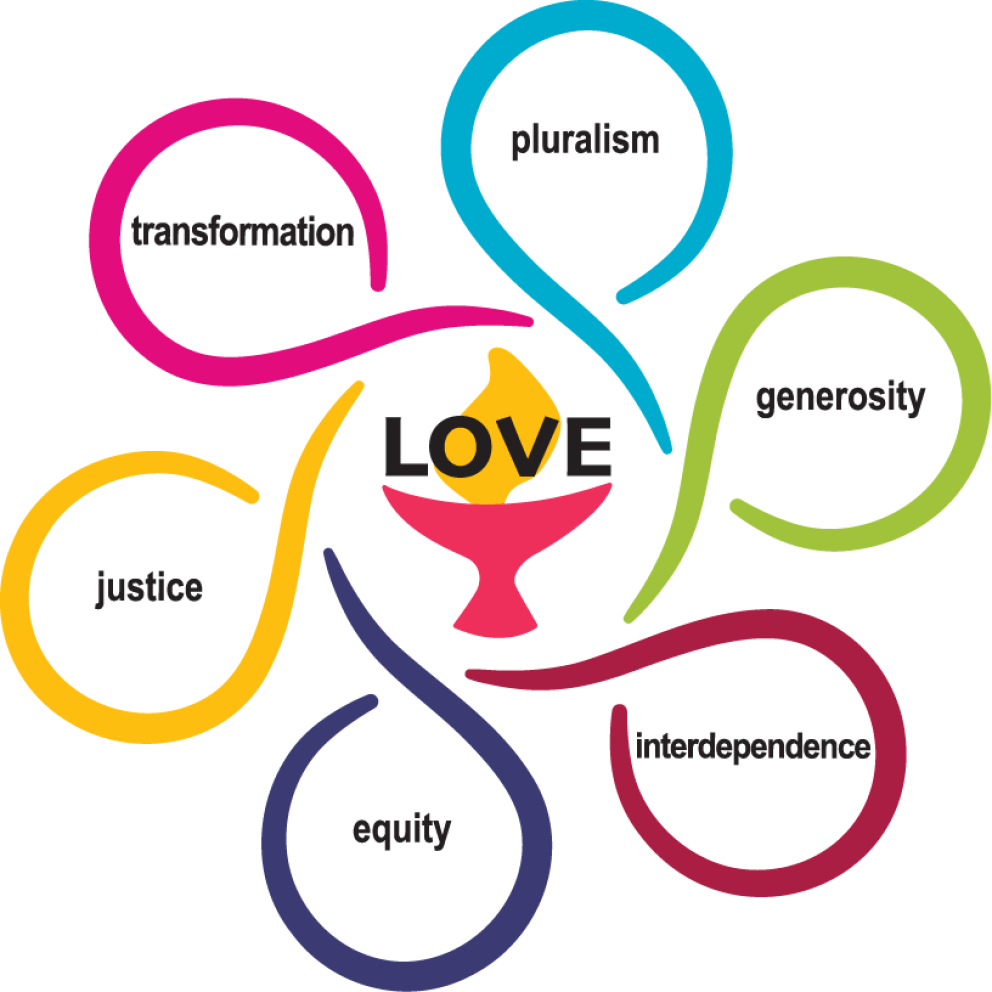
One of the deep values of Unitarian Universalism is Pluralism – the celebration of our diverse cultures, experiences, and theologies. We strive to live that value among ourselves as well as out in the community. We have an insert in the order of service today which shows the official Unitarian Universalist statement of values. https://www.uua.org/beliefs/shared-values You’ll see that Pluralism is one of the values we share.
If anyone asks you, “What is Unitarian Universalism? What do you all believe?” You can say – we are not a belief-centered religion, we are a values-centered religion. We have many different beliefs, but we gather around a set of values centered by Love.” And Pluralism is one of the values on our list.
And thinking back to the conversation I was having at the peace walk, Justice is one of the values on our list. When injustices are addressed, peace can occur. As Unitarian Universalist we pay attention of systemic oppressions and work to build something better in response. Over this past week, for example, we’ve had roof work done on our building. This meant we also had to be careful about Immigration and Customs Enforcement. The way ICE shows up is different depending on the community – around here lately, they have been targeting roofers who are brown and black.
So our leadership made a commitment to make our property a little bit safer for our roofers by blocking our driveways and stationing volunteers to sit out front whenever the roofers were here working. This was a good deal of added labor on our part and very inconvenient for everyone – not just ICE. It impacted our ability to prepare for our annual Veggiefest. The prep work for Veggiefest is fairly extensive and involved. With the added difficulties around accessing the building and concerns about an ICE raid – preparing for Veggiefest was untenable. So, we canceled.
We do still have musicians playing Porchfest today; and the Flea Market sale is still on along with some root beer float sales. And we are giving away ice pops along with conversations about the negative impact of ICE on our communities. But we’re not having Veggiefest this year. Which helps highlight how living our values will sometimes mean things don’t work out the way we want. Living our values doesn’t mean there are no conflicts. But our values help us navigate these conflicts and difficulties among us. Our values also help us respond to what’s going wrong in the world.
I have several complaints about what’s going wrong in the world around me. The way ICE is roaming our cities like masked and armed gangs is deeply troubling. The way unhoused people are treated by our local government and police is inhumane and cruel. The constant and casual lying and corruption is infuriating. The erosions of our democracy, the predatory capitalism, the plundering of our environment, the deregulation of food and drug safety, and the rampant bigotry and hypocrisy of this current administration is staggering.
And! … and I believe it is vital to have a clear vision of what I DO want. I have a long list of what is happening that I don’t want. But I cannot allow anger and indignation be my only response to it all. A set of values such as the official list of Unitarian Universalists values, gives me the framework for that affirming vision of the world we long for.
Here’s another example: This summer I had some back trouble which landed me in several doctors’ offices. Things are better now, but the suffering has shifted from physical pain to economic pain. We do not need to burden people with unreasonable medical debt – many other countries have figured this one out, yet we still do it. Economically, the country is in trouble. Many basic expenses like food and gas continue to rise, while medical debt, student loan debt, and housing costs sky rocket. It’s not sustainable – unless you happen to be one of the billions syphoning wealth off the rest of us. It’s sick.
But notice we have listed Generosity among our central Unitarian Universalist values. We, as a whole community, do what we can to share what we have to make the world a better place. We work to counter the avarice around us with compassion and attention. We are using our resources and several individuals are giving their time and energy to support vulnerable people in the community, to feeding people, bringing clothes and necessities to folks, treating people with dignity and respect. Generosity is not just about money; it’s about all our resources and how we share them.
The world we long for is a world rooted in the values that lift us up. Our Unitarian Universalist faith has constructed a list of values we hold as central, as defining for our identity as a religion. These values guide how we want to be as a religious community; and I argue they guide how us into the world we long to live in. I talked about and gave examples of Pluralism, Justice, and Generosity.
(And briefly, to say a word about each of the other values in our list…) We celebrate our Interdependence with our connectedness with nature and with each other. We honor the value of Equity with the way we treat all people with respect and dignity – each other and all those we partner with and who experience our activities in the community around us. And I am excited for the coming year and the offerings I will co-create for transformation and learning. All of this threaded though the central value of love!
And I want to be clear – this list of values we have is not exclusive or limiting. It’s just the list we came up with together through discussion and debate among thousands of UUs from hundreds of congregations over a span of more than 5 years just recently. But it is not to say there aren’t other values you find compelling or central to your understanding of love and faith.
We have some posters around the building that we made internally, they say
“Do you believe in kindness, peace, equality, love, inclusion, hope, and diversity? So do we.” Unitarian Universalist Congregation of Binghamton.
I want to be sure my list of values includes joy and grace and a sense of agency. I happen to like the term interconnected better than interdependent – but I still support the values listed in the official version of our UU values. I don’t need everything to fit me specifically or for every part of me to fit here – that’s just not realistic or necessary. This list is good, and good is good enough for us to heal each other and heal the world together.
In closing, I want to recast the reading we heard before the sermon. Rev. Scott Alexander’s “We Need a Religion” https://www.uua.org/worship/words/reading/we-need-religion paired various troubles in the world with the Seven UU Principles – that’s what we used to talk about our religion for about forty years before writing the new articulation about our values. I needed a new version, following Rev. Alexander’s structure, but following the values instead of the principles.
We Need a Religion inspired by Scott W. Alexander (by Douglas Taylor)
In a world with so much tyranny and oppression,
We need a religion that values justice, and works to be diverse multicultural Beloved Communities where all thrive.
In a world with so much fear and violence,
We need a religion that values transformation, and calls us to grow spiritually and ethically, adapting to a changing world.
In a world with so many persons abused and neglected,
We need a religion that values equity, and declares that every person is inherently worthy and has the right to flourish with dignity, love and compassion.
In a world with so much dogmatism and falsehood,
We need a religion that values pluralism, and embraces our differences while celebrating our free and responsible search for truth and meaning.
In a world with so much greed and corruption,
We need a religion that values generosity, and cultivates in us a spirit of gratitude and hope, where we are connected to one another in mutuality.
In a world with so much personal isolation and environmental degradation,
We need a religion that values interdependence, and leads us to acknowledge our place in the great web of life with reverence and humility.
In a world with so much uncertainty and despair,
We need a religion that is centered on the value of love, and teaches our hearts to hope, and our hands to care.
—
In a world without end,
May it be so
Wild Wonder
Wild Wonder
Rev. Douglas Taylor
8-23-26
Sermon Video: https://youtu.be/KhREu2uqyb8
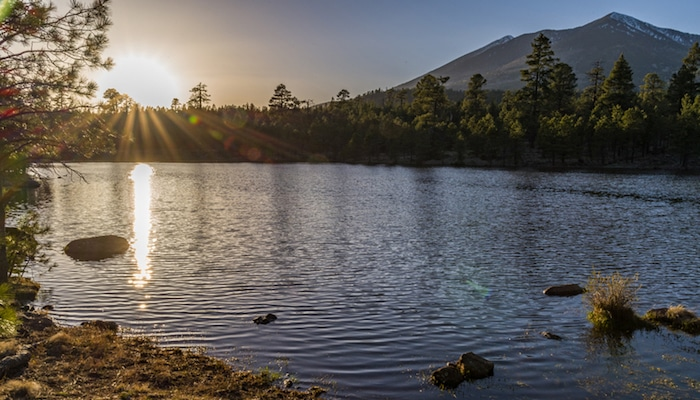
Researchers call it “soft fascination.” Which makes it sound like a new-age meditation technique. Soft fascination is a state of effortless, gentle attention. Which is almost, maybe a meditation technique. But really, Soft Fascination is when your mind focuses on gentle environmental stimuli: think dappled sunlight on trees or creek water trickling around stones or branches swaying in the breeze. We are drawn to such sounds and movement in nature – not as a meditation technique, simply as a reality. We all do it. And it’s not because they are loud and amazing or demanding of our attention; but precisely because they are not.
Evolutionarily, these sounds and motions are a sign that all’s well – no danger or threat looming. Watching a thunder storm from a dry porch is certainly an amazing experience. Standing at the Grand Canyon is a phenomenal way to gain perspective. But that’s not the experience researchers are talking about. It is instead the soft, gentle, effortless stimuli we are naturally drawn to which allow our otherwise overtaxed minds to rest and heal.
And, I will add – this is not just cool background sounds like from a white noise machine – although such devices are not unhelpful. It’s not background. This experience of “soft fascination” is when your attention is on the experience. Studies have shown for decades that experiences of Soft Fascination are calming and restorative.
Other studies highlight benefits with stress reduction and anxiety reduction. There are studies about blood pressure, and pain perception, and general immune support. One hitch is that folks struggle to determine exactly why being in nature this way helps. We just know that it does.
I have always loved the woods and wilderness. I love the wilderness from my experiences growing up with many opportunities to explore and play and (every now and then) to simply be in the woods near my home. I grew up in the Bushnell Basin near to where the Erie Canal runs through the southern suburbs of Rochester, NY. Glaciers created the basin long ago, which accounts for the many sudden hills and lowlands. Across the street from my house was one such lowland. The ground dropped down several dozen feet to a broad swath of trees and clearings that we called The Flats. (not really enough to count as ‘wilderness’ but as a child it was enough.)
Every spring and fall the Flats would become a maze of flooded creeks and overgrown puddles, and all winter there would thick patches of ice everywhere. The land was not useful for farming or development and so was left to go wild with trees and shrubs, left to grow wild for the imagination and exploration of children.
Once I was old enough to be outside on my own, I spent nearly every nice afternoon down in the flats. I wandered a stretch of several miles, sometimes with a friend or sibling, more often alone. I explored, learning the boundary of the creek, memorizing where flats turned to cornfield, finding the biggest trees, making up games, having adventures.
I developed a strong sense of ownership to the Flats. ‘Ownership’ is too possessive a word – I developed a strong sense of identifying with the Flats. Like the wilderness was a gift for me to open anew each day. I spent years down there, like it was an extension of my own home.
When I read about environmental psychologists studying the benefits of being in nature, I am reminded of the woods of my youth. When I hear people talk about hiking or camping, I am reminded of the woods of my youth. When I venture out into the woods as an adult, I am reminded of the woods of my youth.
There is a potion of Walt Witman’s poem, Leaves of Grass that I’ve always identified with. “There was a child went forth every day,” Whitman wrote. And I was that child.
And the first object he looked upon and received with wonder or pity or love or dread, that object he became, And that object became part of him for the day or a certain part of the day … or for many years or stretching cycles of years. The early lilacs became part of this child, And grass, and white and red morning glories, and white and red clover, and the song of the phœbe-bird
Whitman continues, listing many things in nature and people that became part of this child. The point he makes is that such encounters form our identities. Time in nature, or in any setting really, shapes who we become. I think we tend to down play the impact such experiences can have on children in particular. As adults we can still have formative experiences, but our brains are most ready for such things when we are younger.
When people think about ‘spiritual experiences’ we usually imagine big events, like a grand epiphany or dramatic turning point. What if a regular childhood practice like rambling through the woods could count as a spiritual experience. What if we’re talking about simple quiet experiences? Not just the grand dramatic ones?
In her most recent book The Wonder Paradox, philosopher, poet, professor Jennifer Michael Hecht writes about the value of poetry for non-religious people to engage in the thing religious people call ‘spiritual experiences.’ Her book explores how poetry can open us to wonder and awe. She offers a biographical context for herself early in the book:
My physicist father didn’t believe in God by kept quiet about it when we kids were young. I believed from the time my mother told me God was there until one day when I was twelve, standing in my parents’ living room, when I had an uncanny mental shift. I suddenly knew I might be anybody, anywhere, but instead I happened to be here, being me.
The proximate cause was ordinary loveliness: a steep slant of late-afternoon light serrated in the folds of a diaphanous blue curtain; nylon maybe. Yellow sunlight in a glowing fabric curlicue. I saw that we are just one species among great nature, and as the trees very slowly rot, so do our pampered haunches. That’s it. There is no reason to imagine a guy in the sky bowling to make thunder and brooding over how we fail him. Then the sounds of the world returned to my hearing. I never lost interest in such perspective shifts and I never again believed. (pp5-6)
I was fascinated by her description. One person can see a shaft of sunlight through the curtains and interprets a loving God, another the utter lack of a God, and still another can take no meaning whatsoever beyond that it is lovely. My point is less about the conclusions we may reach and more about honoring that such moments can and do shape us profoundly.
Hecht called what she experienced a ‘perspective shift.’ Perhaps it is this perspective shift that makes an ordinary experience of “soft fascination” into a spiritual experience. I’m beginning to devolve into analysis of semantics, for which I apologize. I’m very interested in our experiences of the natural world that lead us into wonder and healing.
I recently pawed through an old copy of the book The Geography of Childhood (1994). The book is a series of essays by naturalists Gary Nabhan and Stephen Trimble in which they present their hypothesis that children need wild places in their lives. Using mostly stories from their own lives and the lives of their children along with a sound base of theory, the authors make a compelling case. The hypothesis is not that everyone needs wild places, but that children need wild places.
Children in particular need wild places for developmental reasons. Surveys claim that less that ten percent of adults see the quality of the environment as an important issue, “over ninety percent of our children feel it is the major issue in their lives.” (p 40) They are drawn to wild places like moths to a flame. My experiences and feelings about nature fit well with what these authors suggest.
I remember how they talked about studies done around how young children use school playgrounds. In one situation, they replaced “an acre and a half of asphalt with a diverse group of traditional playground swings and bars; structures and sitting area; and a half-acre of fishing ponds, streams, woods, and meadows.” (p 66) Then they watched the children to see where and how they played. One aspect they found was how “the natural area of the playground saw wider ranges of activities and more mixing of the genders.” (Ibid) The bit of asphalt they left was used primarily by boys for competitive ball games. This is how some of the children described the natural area: “It’s a very good place. Really quiet. Lots of kids just sit around there and talk.” “It’s just perfect.” (Ibid) Children make themselves at home in the wilderness.
Slides and swings and playground climbing equipment are all really great. Kids love those things. They are exciting. And there is something altogether different and important found in wild spaces. All experiences of wonder are important and valuable. That experience of pumping on the swing and getting up so high! Holding on to a powerful ATV or snowmobile as the landscape flies past! Visiting the elephants at the zoo! All of these experiences can be experiences of wonder. They are curated, contained, commercialized. And they’re good.
But wild wonder is something else. Wild wonder is nourished by chirping crickets and shifting patches of sunlight, burbling creek water and fields of undulating wheat moving like waves on the ocean. Wild wonder hums and shines in a way that eases our minds and brings spiritual restoration. Wild wonder allows your nervous system to settle and heal. We are drawn to these natural experiences. We don’t need to force our minds to be empty or to recite the supplication in the correct way. We simply need to show up and allow our brains to do would they might naturally do when offered the context of the gentle natural world – to experience wonder.
May we each fall in love anew with the quiet murmurings of the natural world. May we ‘rest in the grace of the world.” May we be led into the presence of “green pastures” and “still water.” May we re-acquaint ourselves with the companionable ease found in being present where we belong – in nature, among the dappled leaves and gentle buzz of life. May you slip into moments of Soft Fascination. May it bring you rest. May it restore your soul.
In a world without end
May it be so
—

