
The Modern Abolition Movement
The Modern Abolition Movement
Emily Richards and Douglas Taylor
3-29-26
Sermon Video: https://youtu.be/phpQUnoJUh0
Emily: Part 1
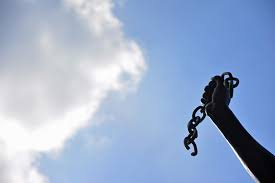
When we hear the word abolition we immediately think about tearing something down. Abolition in this country in the 18th and 19th centuries was the movement that sought to end slavery and continues to be what first comes to mind for many people when we talk about abolition.
Today the conversations about abolition have shifted and it is common to see and hear messages such as abolish the police. Abolish ICE. Demands that we get rid of the systems that are in place.
Dr. Crystal T Laura shared “I think of abolition as the deliberate and intentional removal of imprisonment, isolation, punitive institutionalization as the foremost way that we address issues of harm and healing.”
Abolition is the deliberate and intentional removal of systems that cause harm yes, but abolition justice inherently also has to include the building of something new.
Not REbuilding, which in many ways was what happened during reconstruction after the abolition of slavery in the United States, the old systems were simply shifted to continue to allow for the oppression and profit off of the people who were freed from chattel slavery.
True abolition means creating something totally different. And ideally better. In order to do that you have to tear down these systems and start from scratch.
The challenge there is that these systems, these ideologies, are so ingrained into the society in which we live that we cannot imagine what we would create to replace them.
Eric Stanley wrote:
“Abolition is not some distant future but something we create in every moment when we say no to the traps of empire and yes to the nourishing possibilities dreamed of and practiced by our ancestors and friends.
Every time we insist on accessible and affirming health care, safe and quality education, meaningful and secure employment, loving and healing relationships, and being our full and whole selves, we are doing abolition.
Abolition is about breaking down things that oppress and building up things that nourish. Abolition is the practice of transformation in the here and now and the ever after.”
Abolition is building things up. What do we want to build? What are we called to build as UUs? As a people who value justice and equity and generosity? As a people who believe in transformation, of our selves, our communities and our society?
Douglas: Part 2
This conversation about Abolition grew out of a “Congregational Study Action Issue” at our UUA General Assembly this past summer (2025). In general, a Congregational Study Action Issue (or CSAI for short) is a multi-year process intended to have people in our congregations talk about and consider a justice issue most of us do not already know a lot about. The point is to encourage sermons and workshops to get us talking and thinking before we draft any statements or work toward any changes.
When I heard the Abolition proposal, my initial thought was ‘prison reform is a worthy goal, I agree we should talk about that.’ But this is not simply a conversation about making changes to how prisons work in our society.
At root, it is about crime and punishment – yes. But theologically it asks us to look at what we mean by the idea of ‘crime,’ to recognize that not all behaviors we categorize as ‘crimes’ are about harm and not all harm is categorized as a crime. Digging deep we can ask: what do we do with people who cause harm? Are some people disposable? What would redemption look like, or rehabilitation, or repair?
One aspect of this conversation I eventually realized is that we’re also talking about the issues in our society that lead people to ‘break the law’ and end up in prison. Can we recognize that issues of poverty, racism, addiction, and homelessness are connected to this issue of abolition?
If we abolish prisons, we will also need to abolish the conditions that too often lead people to ‘break the law.’ If we had universal health care and affordable housing and minimum basic income – a lot fewer people would be at risk of incarceration.
This conversation leads us to consider all the harm that happens that never gets labeled as criminal. Can we recognize that climate degradation, wage theft, and income inequality are not ‘criminal’ but are issues we’ll want to tackle if we are going to seriously build a just world without relying on our current prison industrial complex.
Abolition has a holistic vision bringing in a broad swath of justice issues we Unitarian Universalists tend to be actively working on already. We talk about intersectionality and how often our struggles in one area overlaps with other areas in our lives.
This conversation about abolition touches on LGBTQ issues and immigration and reproductive rights and human trafficking and political corruption and addiction and so much more because it starts with the question of ‘what counts as a crime?’ and how will we respond as a community?
What might society look like if we began with responses to those questions that take our Unitarian Universalist values seriously? This isn’t merely about abolishing the systems that do not work – that are in fact causing us harm. It is also about imagining what we might do when we start to build something new.
Emily: Part 3
Frederic Jameson said “It’s easier for us to imagine the end of the world than the end of capitalism.” Really sit with that. “It’s easier for us to imagine the end of the world than the end of capitalism.”
We can include capitalism when talking about abolition. We can include it along with the abolishment of modern day slavery, of the prison industrial complex, of human trafficking, of forced labor, of family policing. Of all of these systems.
It was my youngest’s birthday this past week and they wanted McDonald’s for dinner. Wednesdays are a busy day for us so we went through the drive through on our way home from rehearsal and they noticed that there was a sign on the window that said that they didn’t accept bills larger than a $50.
And they asked why. I replied that it was probably because they don’t keep much cash in the register so they wouldn’t have change for a larger bill. And then I kind of flippantly added, they probably empty the registers regularly so there isn’t much in there if they get robbed.
And my kids were so offended that someone might rob McDonald’s. To which I responded, wouldn’t it be great if we lived in a society where people didn’t need to resort to robbing McDonald’s.
When we talk about abolition that is what we mean. Can we imagine a society where no one is living in poverty? Where no one feels like they need to steal to survive?
Alan Detlaff, a professor, author, and abolitionist, shares that statistics show that nearly three-quarters of children in foster care are there because of neglect, which is largely associated with poverty and disproportionately affects brown and black children.
Can we imagine a society where there is no need for children to be removed from their families for the crime of being poor?
Douglas: Part 4
In two weeks, on Sunday April 12, we will have a workshop based on Mariam Kaba’s book We Do This ‘Til We Free Us. We used an excerpt from the book as our reading this morning. Alex Compton and Catherine Magdala will lead the class with the support of our Social Action Huub.
We’ll crack open this conversation around abolition together. If you already have this figured out, maybe this class isn’t for you. But if you are curious or are beginning to see some connections and want more – then we can start a serious conversation about abolition and what might be possible together.
Last week in my sermon on “The Rejected Stone” I said:
“We are called to take care of each other, to build a society in which we all can thrive – not just some, but all. We are called to denounce the idea that some people are disposable or unworthy. The rejected and the outcast are more than welcome here – we are celebrated, central.” (3-2-6)
If that’s true, then we will want to start talking seriously about abolition together.
Last month in my sermon “Do We Have Enough Love” I shared this:
“Friends, our theology does not call us to be among the respected classes. We are not called to whisper sweet platitudes of God’s love to the oppressors. Instead, we are called to remember that our love is radical. … Our faith calls us to build just and loving communities. Our faith calls us to get out among people in need and get our hands dirty, to let our days be the evidence of our hearts on fire.” (2-15-26)
If that rings true, then we will want to start talking seriously about abolition together.
Last fall in my sermon “Sometimes Things Break” I reminded us:
“Sometimes things break. That doesn’t mean we are bad people. We can thrive and grow when broken, (perhaps only when we are broken.) How we respond to the brokenness builds the world around us. It’s not the brokenness that matters. What matters is our response. What matters is the love.” (9-28-25)
And if that sounds right to you, then we will want to start talking seriously about abolition together.
Friends, this is something we’ve been building up toward for a while. It only seems impossible because it is a big idea. But all the pieces are in front of us and we’ve been talking about them together for a few years. Abolition only seems radical because it is. But that’s what we’re here for – radical love, the kind of love that can get all of us free.
Emily: Part 5
W.E.B. du Bois wrote, at the beginning of Looking Forward, “How two theories of the future of America clashed and blended just after the Civil War: the one was abolition democracy based on freedom, intelligence and power for all men, the other was an industry for private profit directed by an autocracy determined at any price to amass wealth and power.”
The rise of autocracy and an industry determined to amass wealth and power, at any cost, has created a society where only the few can truly thrive and the rest of us are confined within systems that judge our worth based solely on our monetary assets, and find us lacking.
Abolition goes beyond making a few changes to the systems that already exist. Abolition requires a fundamentally different way of living. It requires building up things that nourish everyone. It requires transformation in the here and now and the ever after.
And to get there we need to start the demolition.
In a world without end,
may it be so.
The Rejected Stone

The Rejected Stone
Rev. Douglas Taylor
3-22-26
Sermon video: https://youtu.be/kpLsfnerOnc
Unitarian Universalism is known for our inclusivity. We take pride in being a home for outcasts and non-conformers, radicals and misfits. Inclusivity, nested within the layers of love and kindness, is a centering value among us. We are not unique in this; we are not the only religion for which this is true. It is unfortunate, however, how many religions get lost in wanting to control everyone instead of love everyone.
I notice how comfortably the patriarchy and empire have coopted Christianity in our modern culture because Christianity also had – for a long time – a proclivity for outcasts and radicals, for those rejected by the respected and protected religious people of their day.
Jesus often spoke about the lost sheep, the least of these, and how ‘the last will be first, and the first will be last.’ He talks about needing to be as humble as a child to enter the kingdom of God and that it is easier for a camel to fit through the eye of a needle than for a rich man to enter heaven. He says the poor are blessed, the meek, the merciful, the peacemakers – not the warriors, the wealthy, or the rulers. No. The poor. The rejected. The vulnerable. Some folks refer to it as the upside-down kingdom of God.
Next week is Palm Sunday, marking Jesus’ triumphal entry into Jerusalem. He goes to the temple and flips the tables, chasing out the money lenders. A little bit after that he tells a parable about wicked tenants in a vineyard followed by this quote which is the heart of my reflections this morning:
“The stone the builders rejected has become the cornerstone” – Matthew 21:42
It is a rebuke of the current leadership. Jesus is quoting from Psalm 118 at this point. And the religious leaders of his day began to grumble. It is soon after this, combined with his table-flipping behavior in the temple and all those parables about hypocrisy and how we shouldn’t abandon the poor, that the religious leaders decide to have him arrested. The stone the builders rejected has become the cornerstone. The outcast and the rejected are central to who the people of faith will be going forward.
In his day, Jesus was rebuking the religious leaders for being coopted into supporting the empire. Fast forward a few millennia and the religion of Jesus has been too often coopted into supporting the empire.
I am aware that among traditional interpretations and conservative interpretations his parables are often used to speak of God’s judgement rather than of God’s love. But those are just interpretations, and when reviewing the fullness of the message I believe the power of love is a better guide than the power of fear and hate. It matters what we use to guide our interpretations of scripture. I lean strongly in the direction of love.
We Unitarian Universalists are not a Christian community, strictly speaking. Historically we grew up out of Protestant Christianity, and we have evolved and shifted over the decades beyond those roots. As such we have varying understandings of Jesus and varying relationships with the Bible and Christian doctrines. But the core ethic of caring for the most marginalized, the vulnerable, the ‘least of these,’ the rejected … that part of Jesus’ message is the same thing we’re talking about when we Unitarian Universalists say we inclusivity is a central value.
We are called to take care of each other, to build a society in which we all can thrive – not just some, but all. We are called to denounce the idea that some people are disposable or unworthy. The rejected and the outcast are more than welcome here – we are celebrated, central.
Earlier this week I was listening to a sermon by Rev. Dr. William Barber. Barber is a preacher and activist, president of the Poor People’s Campaign. He preached on this passage about the Rejected stone saying “Rejoice! The rejected will lead the revival – this is God’s way.”
One point he raised that inspired me was this: Dr. Barber said when God chooses the marginalized, when God chooses the rejected – it’s important to note that “it’s not that God is choosing the unfit!” Barber clarifies, “It’s that society has declared them unfit but God knows better.”
I love this. It reminds me of all the ridiculous arguments against Diversity Equity and Inclusion. The people being lifted are not unfit. Society has been stacked against them for generations, but we can offer a correction. And, in point of fact, the diversity is an important feature not a nice extra. We don’t want staid conformity, our thriving depends on our differences.
Dr. Barber said It’s not that God chooses the unfit – it’s that society has declared them unfit but God knows better. When it looks like God chooses the weak, it is that God chooses what our society calls weak. When it looks like God chooses what is broken or rejected or lost or the last in line – it’s that God chooses what society calls broken or rejected or lost or the last in line. God knows better. We can know better too.
This is not about finding all the folks who are too flawed for their own good; or rescuing the useless people of little value. No. What a sour notion. I’ve never met such a person. That sounds to me like the framework of a toxic theology, parsing out who is worthy of God’s love and who is not, or who is worth enough as a person and who is not. That sounds to me like the language of the oppressor, the language of empire. It’s a lie.
Adrienne Maree Brown once said, “If the goal was to increase the love, rather than winning or dominating a constant opponent, I think we could actually imagine liberation from constant oppression.”
I want us to witness to how those parts of us that get labeled as flaws, as brokenness, as a disability or a problem – those parts are usually assets to our thriving, blessings among us. Being rejected can lead to strength. Experiences of brokenness can lead to wisdom and empathy. I often find that people who have struggled are the people who know things about life that others have missed. I don’t mean this as some twisted theological version of what doesn’t kill you makes you stronger. I mean it the way they do in the parable of the bookshelf.
Now, this parable is not from a scripture, it’s from tumblr. I found it online, posted by someone who goes by “Luulapants.” They wrote this:
My dad and I once had a disagreement over him using the adage “what doesn’t kill you makes you stronger.” I said, “That’s just not true. Sometimes what doesn’t kill you leaves you brittle and injured or traumatized.”
He stopped and thought about that for a while. He came back later, and said, “It’s like wood glue.”
He pointed to my bookshelf, which he helped me salvage a while ago. He said, “Do you remember how I explained that, once we used the wood glue on them, the shelves would actually be stronger than they were before they broke?”
I did.
“But before we used the wood glue, those shelves were broken. They couldn’t hold of [anything]. If you had put books on them, they would have collapsed. And the wood glue had to set awhile. If we put anything on them too early, they would have collapsed just the same as if we’d never fixed them at all. You’ve got to give these things time to set.”
It sounded like a pretty good metaphor to me, but one thing I did pick up on was that whatever broke those shelves, that’s not the thing that made them stronger. That just broke them. It was being fixed that made them stronger. It was the glue.
So my dad and I agreed, what doesn’t kill you doesn’t actually make you stronger, but healing does. And if you feel like healing hasn’t made you stronger than you were before, you’re probably not done healing. You’ve got to give these things time to set.https://www.facebook.com/photo/?fbid=1112325616603576&set=a.633770597792416
So don’t think of us as the church of misfits or of outcasts. Think of us as the church of healing, the congregation where we take care of each other, where we grow and thrive – not because nothing is wrong – but because we know love is strong and we are loved and we are strong.
You may be poor, or queer, or disabled, or an immigrant, or a woman, or not White, or young, or old, or neurodivergent, or addicted, or wounded, or suffering. You may have been told you are somehow second class because of some aspect of your living. Society may have spent years pouring lies upon you about your identity or your ability or your worth. You may have been rejected. There may be obscene amounts of money being spent to enact laws and policies that deny your place in society. That is fear. That is the lying liars trying to dominate you on behalf of the empire, because you represent something glorious that frightens them.
Here we acknowledge that love is strong and you are loved and you are strong. Here we know that the rejected will lead the revival. Our diversity is not a nice extra, it is central to our thriving.
I’m not claiming we have it figured out perfectly. We are still learning how to do this well, we are still bringing new voices into the center, we are still uncovering our hypocrisies and discovering how we’re causing harm. Yes. But we set our sights on love, on listening and learning from each other, on living better today than yesterday – because our thriving is dynamic.
The stone the builders rejected has become the cornerstone. Not because we showed up late and couldn’t find a better stone. Not because we are poor and couldn’t afford a better stone. But because we know better – God knows better. Because the rejected stone is blessed and you are exactly where you need to be for us to thrive together, building the better world we long for together, creating a beloved community together – stone by stone, blessing by blessing, healing and growing, with you and all these here now and more still to come.
In a world without end,
May it be so.
Know, and Be Not Still

Know, and Be Not Still
March 8, 2026
Rev. Douglas Taylor
Sermon video: https://youtu.be/HrUGJuAzVP4
Friends, there is a great amount of trouble swirling around us in our lives. Wars and violence, corruption and greed. I hear from many of you that you are struggling. With all that is going on, it is healthy – physically and spiritually – to step back from it all from time to time and breath. I asked you all a few months back to find your center, to build an altar, to get grounded. One simple and profound path is simply to breath with intention. To be still for a moment and breath.
One of my favorite meditations is by a colleague from a previous generation named Jacob Trapp who offers a lyrical ode to quiet stillness:
Let this house be quiet.
Let our minds be quiet.
Let the quietness of the hills, the quietness of deep waters, be also in us.
So quiet that the noise of passing events and present anxieties, of random recollections and wandering thoughts, is stilled. …
So quiet that we are renewed, we feel at one with all others, at home in a tabernacle of stillness.
So quiet that we sense the ripples of this pool of quietness and healing pass through us and out to the farthest star.
-Jacob Trapp
Do you have times of healing stillness in your life? The advice from Psalm 46 comes to mind. It is really a song about the protection God offers.
God is our refuge and strength, [it begins]
a very present help in trouble.
The Psalm goes on to say we need not fear because even though the mountains may shake and the waters roar, and even if the very earth should change – God is our refuge and strength. If nations are in turmoil and kingdoms seem about the fall – we need not fear. And near the end of the psalm we hear the line, sung as a quote directly from God,
Be still and know that I am God.
We can almost imagine what it is like during times of great turmoil and disaster – there is panic. People are in danger from the natural disaster or political upheaval. Perhaps we feel powerless and hopeless. Be still and know that I am God. When faced with trouble – the first thing to do, according to this Psalm, is to do nothing, to slow down, to look for God. Many people take this advice when the danger is less an actual earthquake and more the metaphorical kind. It is often good when in turmoil to take a beat, to stop or at least pause, allow your prefrontal cortex to catch up to what your amygdala has already suggested for solutions to the situation.
It is sound advice. I read once that the reason a long pause like this works is because your amygdala triggers your limbic system causing the ‘fight or flight’ response. But while the amygdala turns on like a switch, it does not turn off the same way. Instead, we must wait for the neurochemicals to dissipate. So, scientifically, being still and knowing God is an effective technique for dealing with situations like this. Being still and knowing God allows us to make a choice instead of having a reaction. It allows us to choose a response instead of a thoughtless reflex.
In our Unitarian Universalist circles, I suspect more of us nod in recognition about the amygdala than we nod in agreement about God. Allow me a moment on this point.
We Unitarian Universalists function as a multi-faith community. We gather around shared values such as love, justice, and transformation instead of gathering around shared beliefs about God or the Human Condition. I encourage us to become fluent in theological translation together.
If you believe in God and use that language when talking about your beliefs and spirituality – you may need to translate most Sundays when I am preaching. I will say ‘the holy’ or ‘Love’ or talk about our communal values that call us to be in the world in particular ways. When you hear me do that, you may need to stop and say to yourself – “Oh! He’s talking about God.”
If you are a pagan and you hear me talk about the caring for the environment or the beauty of nature, you may need to stop and say to yourself – “Oh! He’s talking about the Goddess.”
If you are an atheist and you hear me talk about ‘God’s love’ or quote from the bible, you may need to stop and say to yourself – “Oh! He’s talking about the high principles and deep values that guide our living.”
If you are a Buddhist and you hear me say, ‘be still and know that I am God,’ you may need to stop and say to yourself – “Oh! He’s talking about our Buddha-nature which we uncover through meditation and dharma study.”
I encourage us to all become fluent in theological translation here. Because we each have our own knowing and understanding. We each have experiences that have led us to see the world in certain ways that help us find meaning.
What does it look like in this exact example? “Be still and know that I am God.” Well, the Buddhists as I mentioned already have a deep understanding of what can be known when we are willing to be still. For pagans it might sound less like being still and more like going through the rituals or practices to reach the place psalmist is pointing toward. For atheists, the translation may sound like ‘be still and allow inner clarity to arise,’ or ‘be still and recognize what really matters in life before reacting.’
The important part is to tap into your centering values, our spiritual ground, the loving presence of God, that aspect of life that helps displace your ego and set you firmly in alignment with Love. You do not need to have a particular theology to have access to this experience.
“Be still,” the psalmist sings, “and know that I am God.” The advice is sound. It is good to stop and refocus when things are hard. And after the stillness, after the knowing, what’s next? It is worth noting that stillness is abnormal. When we are willing to ‘be still,’ we are doing something unusual – unnatural even.
Rev. David Bumbaugh once wrote “Silence is an abnormal state.” The same point applies to stillness, but hear what he says about silence:
Silence is an abnormal state.
The world is nowhere silent: the wind calls from the tree tops and whispers in the beach grass. …
Were our ears more finely attuned, we could hear the crack of granite as boulders are reduced to pebbles, pebbles to sand, sand to dust. …
The world is nowhere silent: birds sing and chirp, squirrels chatter, insects hum and whir.
They fall quiet only briefly at our approach, a suggestion that silence is a sign of fear.
Is it not strange that even as Gaia sings to us, calls to us, shouts at us, we seek wisdom in silence?
It is not a measure of our alienation that we retreat into silence, withdraw from the chorus, in order to hear the endless eternal song?
-David Bumbaugh
We are silent, Bumbaugh suggests, as a form of withdrawal from the ordinary way of things. And so it is with stillness too. Nothing is ever really still. We seek stillness as a temporary state to find clarity – not because we want to achieve stillness for stillness’ sake.
Painter Paul Gardner once said, “A painting is never finished. It simply stops in interesting places.” And the same could be said of nearly everything. It’s never finished; it simply stops in interesting places. The whole of existence is dynamic and changing.
Mount Everest, the huge mountain standing as a perfect symbol of massive, unyielding, constant, solid reality is “growing” about 2 millimeters per year as the continental plate under India pushes under the Asian Plate to its north. Meanwhile, sea levels around New York City are rising faster than in other places because the island hasn’t finished sinking into the earth’s crust after the glacial ice melt from the last ice age.
Nothing is still. The whole universe is alive and pulsing with sound and movement. Life is always changing and it is to life that we must stay true. Everything is in motion. Be still – God says. I can’t! My heart is beating, my atoms are swirling, my planet is spinning. I cannot be still. But I will pause, briefly, Oh God, I will pause and listen for what might be next.
Author Scott Russell Sanders writes a little about this in his book of essays entitled Earth Works (2012),
Since Copernicus, we have known better than to see the earth as the center of the universe. Since Einstein, we have learned that there is no center; or alternatively, that any point is as good as any other for observing the world. I take this to be roughly what medieval theologians meant when they defined God as a circle whose circumference is nowhere and whose center is everywhere. If you stay put, your place may become a holy center, not because it gives you special access to the divine, but because in your stillness you hear what might be heard anywhere… All there is to see can be seen from anywhere in the universe, if you know how to look. (p123)
The point of being still is to better learn how to listen, how to look, how to know life. Don’t be still, thinking if you can only be still enough for long enough you will somehow win. The universe doesn’t work that way. God doesn’t work that way.
Be still and know. Yes. And after the stillness, after the knowing … be not still. All the world is in motion. There are wars and violence happening around the world and in our own streets. There is trouble clamoring for our attention. When anger or impatience arises in your heart, when your neighbor or your kin causes you to want to lash out, when the mountains shake and the waters roar, when nations are in turmoil – when you feel lost or hopeless, unmoored – be still, be still, be still.
Say a prayer. Go walk in nature. Write in your journal. Perform a ritual. Sit in meditation. Gaze upon a beloved. Light a candle. Seek God. Be still. And know … know you are loved, know you have power still to affect your days, know you are not in this alone, know we can and will rise to better days, know God. Be still and know. And then … then … rise up and move.
In a world without end
May it be so
Songs of the Civil Rights
Songs of the Civil Rights
2-22-26
Rev Douglas Taylor and Dr. Sarah Gerk
Sermon video: https://youtu.be/tkNKonpW4yk
Sermon part I
Sarah
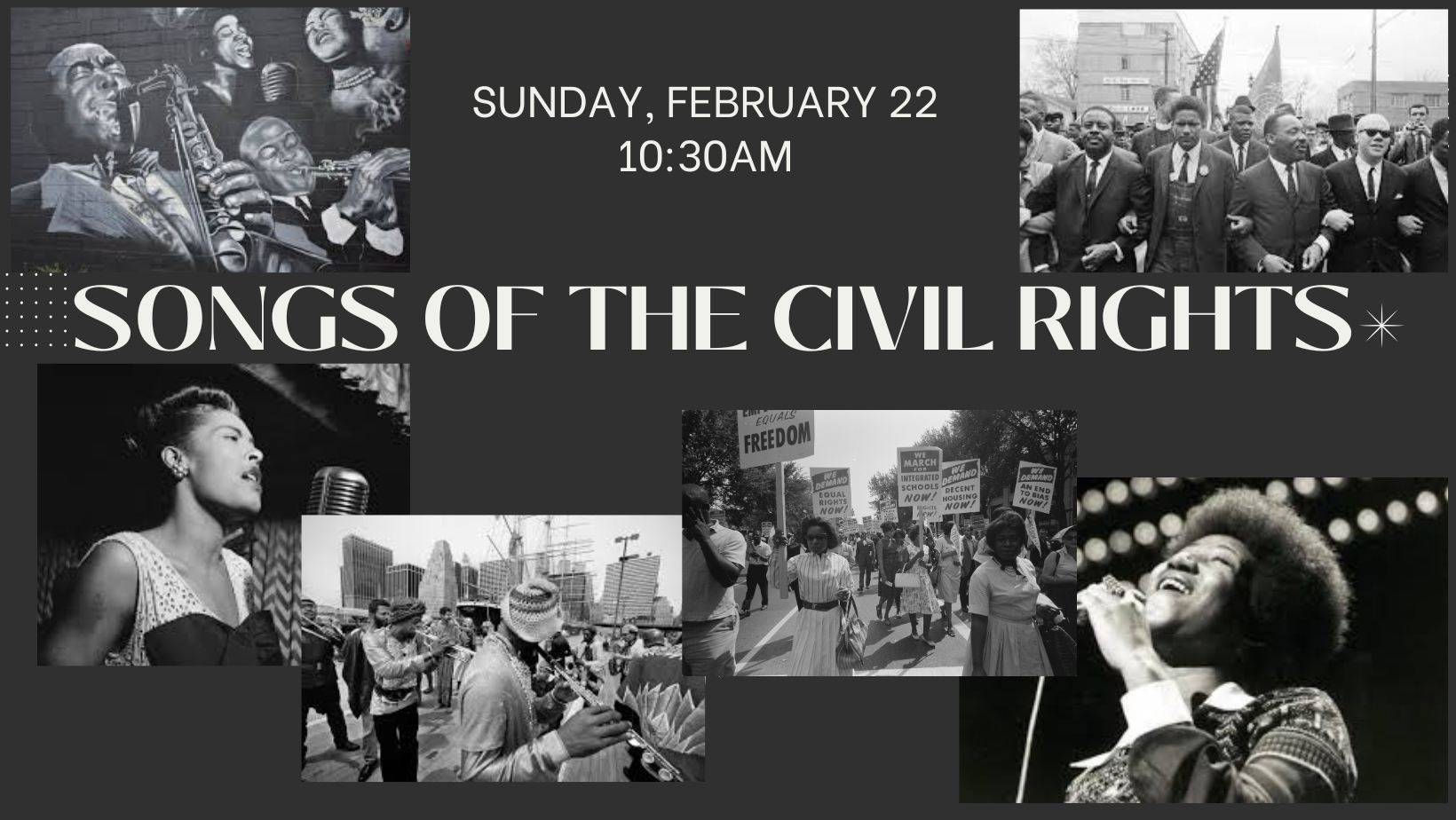
We are here today to consider how musical practices supported the Civil Rights movement. I am a musicology professor at BU. I study how music works within communities, primarily considering immigration, diaspora, and race in the United States during the 1800s.
When many of us hear “music of the Civil Rights movement,” we think about the music of protest actions. But it is a small part of the wide body of music that we professionals consider significant to the work of the Civil Rights movement. Music helps us in so many ways to regulate or foment emotional experiences, to form communities, and to broadcast information across a large community. In the 1960s, the popular music industry and recorded sound were relatively new, incredibly powerful tools for disseminating historical, emotional, and social information across the world, and we call your attention to this.
Today, Doug and I wish to explore how Black communities used jazz and popular music styles to create and assert their narratives. One of the most celebrated examples from the 1960s is John Coltrane’s Love Supreme, a jazz album that takes no received forms (so, it doesn’t adhere to the verses and choruses or blues chord progressions that are more familiar) to communicate Coltrane’s spiritual awakening to Islam in the early 1960s, finding his peace and sobriety in a violent and loss-filled moment.
My piece in this is to help you to understand the sound world of Black American music—how music that is not organized like our hymns and choir songs, which are typically conceived through music notation by thinking about melody, harmony, steady tempos, and song form, but instead on practices that stem from Africa and have developed in the New World, that come to us through Black churches and that place a lot of value on individual testimonies of spiritual experiences and personal narratives that would not survive or be understood in any other way. As we go along, I will help you to hear the ways that the music itself—the sound and not just the words—is working on us as it did in the 1960s to advance empathy, to help us process difficult information, and to find resilience.
Douglas
Dr. King once said,
It may be true that the law cannot change the heart, but it can restrain the heartless. The law cannot make a man love me, but it can restrain him from lynching me, and I think that’s pretty important also (Ware Lecture, 1966)
There were clear goals during the Civil Rights movement. People wanted desegregation, equality, real access to voting, access to education and jobs – they also wanted to put a stop to lynching. One goal we don’t talk about a lot was to have white people stop murdering black people with impunity. Which is still a conversation through the Black Lives Matter movement in our current time.
The song Strange Fruit is from 1939. It is based on a poem by Abel Meeropol, child of Russian Jewish immigrants, and it is a shocking song about the racial terrorism of lynching. Some say Holiday’s version marks the beginning of the civil rights movement. It is an unsettling and profound witness that can move you if you’ll let it. Consider that the trigger warning.
Sarah
Billie Holiday, one of jazz’s most celebrated vocalists, had an incredibly powerful voice. The grit of her voice itself, shaped by her strength to perform across Jim Crow’s America as well as adverse childhood experiences and substance abuse, contains a powerful message about who she is and how she feels. Billie’s expressivity comes in the ways in which she treats what would be a musical score—the map of the song—quite freely. Billie hardly ever stays on pitch, or in tempo. She scoops and slides her way around what would be a notated pitch. With the difficult material of “Strange Fruit,” she is often sagging below the scalar pitch, and lagging behind the tempo.
The first words of this song are “southern trees bear strange fruit.” The fruit are the corpses of lynched people. Listen to the words “bear strange fruit” and how they sag below the Western pitch. You may not be able to hear with your ear the gradations of microtone, and that’s ok. You can also feel it. It sounds off. Distressing. Clashing. Also hear or feel how she takes her time with those words, emphasizing them and slowing down a little, while the orchestra maintains a steady tempo. That is Holiday’s musical testimony to her own grief.
Video Strange Fruit by Billie Holiday
Douglas
One list I found, ranking the important songs of the Civil Rights Movement puts Sam Cooke’s A Change Is Gonna Come as the number one, most enduring song of the movement. https://www.azcentral.com/story/entertainment/music/2025/01/28/best-civil-rights-protest-songs/77978742007/
Sam Cooke was certainly among the most influential soul singers of all time. His murder in 1964 was tragic, and the conclusions of the investigation are questionable. His death is sadly one of many Black murders during the movement.
A Change Is Gonna Come talks about Cooke’s experiences with segregation and racism. He performed the song on the Tonight Show with Johnny Carson in February is 1964, but the network did not keep a copy of the tape from that night. And when the Beatles played at the Ed Sullivan theater two days later – Sam Cooke’s performance was overshadowed.
The song was in the album he released that spring, but it was not released as a single until after his death in December of ’64. And yet, despite the many ways the release missed the audiences – this song ranks among the most influential songs of all time. The song is both anguished and hopeful, a remarkable blend of despair and defiant resilience.
Choir A Change Is Gonna Come by Sam Cooke
Sermon part II
Sarah
Part of the work of Black musicians in the 1960s was to assert Black identities and Black power in a musical world that had been heavily shaped by white commercial interests. Rock ‘n’ roll of the 1950s was an incredible moment in which Black music got lots of attention and some people made a lot of money. But we can also name it as a historical moment of white appropriation of a powerful tool for Black communities.
Funk represents a backlash to this. Structured around an interlocking rhythmic pattern in the electric bass [MAYBE DO A LITTLE BOOTSY COLLINS IMITATION] and the drum set, the remaining instruments and vocalists layer their own patterns on top. Repetition is the structure, and that allows for individual and group emotional expressions or testimonies on top of that structure. Again, pitches and melodies are significantly less important than much of the music we practice here on Sundays.
Significantly for this particular song, James Brown invites Black communities to say repeatedly together “I’m Black and I’m Proud.” Musicologists have a term “unisonance” that describes the ways in which creating sound together can be a powerful tool for fostering a feeling of connectedness. Here, James Brown uses the tools of the American music industry—recording technology and widespread touring–to disseminate that feeling of “unisonance” ubiquitously across Black America.
Douglas
The songs of the civil rights range from hopeful to grief-soaked, triumphant to profound. And all of them helped lift the message and galvanize the people, and keep the movement moving forward! Music carries a message and brings it into a part of the brain that responds differently to speeches and text. Music can get in, where other forms of communication cannot.
James Brown’s style of funk was powerful, there was so much joy and pride flowing from his music. Black pride was an essential component of the Civil Rights movement. It helped people remember that the movement was not just about injustices and harm and what’s wrong with society. James Brown was celebrating what’s good, about Black beauty and Black joy, Black pride.
There is a lot of great music from the Civil Rights movement that will sting the conscience, that will being hope and unity, that will reveal the harm and lament the injustice. But if you are looking for unapologetic Black joy, you’re going to love James Brown.
Video Say It Loud – I’m Black and I’m Proud by James Brown
Douglas
We had a hard time limiting ourselves to the songs we are featuring this morning. Many songs were given a featured place by many people in the movement. There are numerous ‘unofficial anthems’ of the movement. It’s heartening, I think, to have so many songs lifted up as important. It is a testament to the importance of music to the Civil Rights movement.
The Staple Singers’ Freedom Highway, Gil Scott-Heron’s The Revolution Will Not Be Televised, Nina Simone’s Mississippi Goddam, and Marvin Gaye’s Inner City Blues are songs for the playlist I’m going to put out tomorrow – but regrettably did not make the cut for our brief hour together this morning. And white artists like Bob Dylan and Pete Seeger are important. But I want to be sure we keep our attention on the black artists this morning.
What music do you think is the music of today’s movements? Even if it is not music you regularly listen to – do you know about the artists? Have you heard, for example, Childish Gambino’s This is America? Or Shea Diamond’s Don’t Shoot? Are you aware of Kendrick Lamar’s Alright? Aware of the story behind it, the context of it, the message offered?
Pay attention to the music around you, notice how it serves beyond mere entertainment. Music has a way of getting into our brains in a way regular speech or text cannot. Music connects us, uplifts us, unifies us, and moves us forward. What are you listen to these days?
May the music be strong and may the movement be strong. May we be strong together.
In a world without end, may it be so.
—
Postlude All You Fascists Bound to Lose sung by Resistance Revival
Do You Have Enough Love?

Do We Have Enough Love?
Rev. Douglas Taylor
2-15-26
Sermon Video: https://youtu.be/RKg38pB8EKw
“Let your days be the evidence of a heart on fire,” artist and activist Danielle Balfour tells us from our Opening Words this morning. ‘Your days,’ she says specifically. Not something vague like your ‘thoughts and prayers,’ and not something general like ‘your whole life’ – your days – today, even. “Let your days be the evidence of a heart on fire.” In another piece she writes, “What do I do with all of this terrible news?” And she gives a very similar answer: “I will let it inflate my capacity to love.”
Balfour’s message of engagement, of loving your neighbor, of caring about what is going on to people around you and not growing numb in the face of harm and tragedy, … it is a key tenet of liberal theology. As we say now about our theology as Unitarian Universalists: “Love is at the center,” but it should be more than a slogan, yes? How does that look today? Are your days evidence of that love?
I mentioned in my description of today’s service that I’m going to talk about a theologian, but in doing so, I want us to remain grounded and connected to this moment we are living in. There are terrible things happening around us and among us today – does our faith have what we need to see us through? Is our theology strong enough to oppose Fascism, to spur us to rebuke oppression? Is liberal religion up to the task we have before us?
Or, let me frame this from a contemporary artist. Grandson is a modern hip hop and rock musician. He has a song from 2020 called “Dirty” that I discovered about a year ago which frankly inspired this whole sermon. The chorus has a line that led to my title; he sings “Do you have enough love in your heart to go and get your hands dirty?” “Do you love your neighbor?” he asks, “Is it in your nature? Do you love a sunset? Aren’t you fed up yet?” The song is a call for getting active in the face of apathy. Sure, we can say ‘Love is at the center,’ but do you have enough love in your heart to go and get your hands dirty?
We have good historical precedent to answer yes. Unitarian Universalism has a proud lineage of resisting tyranny and fascism. Of revealing hope, of holding out a promise to treat all people – particularly the marginalized and the vulnerable – as beloved and precious. Unitarian Universalism does have a potent message to offer in face of rising tyranny.
And … sometimes our liberal theology lets us off the hook; sometimes it allows us to misconstrue freedom as ‘personal freedom;’ sometimes it shields us from experiencing the discomforts of being complicit and even culpable. We are sometimes accused of being soft on sin, accommodating to evil, tolerant of atrocities, enamored with our own comforts because we say God loves everybody and we all have inherent worth and dignity – even the worst among us. Who am I to judge?
In the early 1900’s Unitarian theologian James Luther Adams asked if our theology was strong enough to oppose Fascism. He pushed us to dig deep into our beliefs and values, to check our mettle against the needs of the time. In his critique, he did uncover an affirmative answer, though he did caution us to be wary of the diversions and perversions so readily available among us.
James Luther Adams was a liberal theologian and ethicist from the 20th century. In the 1920s he graduated seminary and became a Unitarian minister in MA for roughly a dozen years. In the late 1930’s he became a professor at Meadville Lombard Theological School, my alma mater. Almost 20 years later he moved back east and joined the faculty at Harvard teaching Christian Ethics. He wrote several books and essays. He had died a few years before I entered seminary, but his legacy still loomed throughout the school and throughout my reading lists.
In the summer of 1941, when the United States was still playing isolationist to the war in Europe, Adams warned that liberal theology was at risk of being coopted by the culture of middle-class values – namely the value of ‘respectability.’ We were in danger of losing our radical edge in favor of being respectable. He said this as the keynote speaker for a prestigious lecture among Unitarians called the Berry Street Address.
He warned, back then in the 40’s, that we were in danger of losing a central element of our theology that called us to stay fresh, to allow change to overtake us, to be so moved as to make a complete change – to allow for religious conversion. This was not only an argument for being radical in the realms of justice and social change – but of religious and spiritual change as well. He warned us that in over-valuing respectability, we undercut an important aspect of our theological heritage.
I would say when we shift from radical to respectable, we soon become irrelevant. And I am grateful for the radical movements of the 60’s which brought many of our Unitarian Universalist communities back into relevance. And … we’ve been at risk of becoming respectable again in recent years. I echo the concern Adams raised nearly a century ago on this point. And I’ll echo Grandson’s question: “Do you have enough love in your heart to go and get your hands dirty?” Do you have enough love at the center to take risks for the vulnerable, to protect the marginalized, to decenter your comfort and get your hands dirty? Are you willing to grow?
One aspect of what is changing among us, I think, is a shift along the lines of theology from strongly liberal to fiercely liberation. By this I mean: Where Liberal Theology traditionally focuses on personal autonomy and agency, intellectual freedom, and the use of reason; Liberation Theology emphasizes communal freedom, prioritizing the experiences of the marginalized, and a struggle against systems of oppression. My theology leans strongly toward liberal, but my preaching in recent years has become more decidedly liberation.
I have been watching this theological shift happening among us (and within me) for a while, honoring that both liberal and liberation theologies are alive and vibrant among us in our UU communities right now. And I wonder if the dynamic is actually less about the labels of liberal and liberation, and more about this point of shifting out of being respectable and back toward our heritage of being theologically radical.
One particular essay James Luther Adams wrote that has remained a gravitational center among us is a list of five qualities at the heart of Religious Liberalism. https://www.uua.org/lifespan/curricula/wholeness/workshop1/167560.shtml He called them the Five Smooth Stones – a reference to the story of David and Goliath in Hebrew Scripture. I suspect they remain impactful by the fact that they work for both liberal and liberation thought – although written from the perspective of a liberal theologian.
Hear the list Adams made of these five theological qualities: As a liberal religious community we affirm that we are always learning; that there is always more truth unfolding in our understanding. We see that being together matters, relationships are more important than doctrine. We further state that how we are together – how we are in consensual relationship – also matters. We are committed to the notion that to be good we must do good. And finally, we are always hopeful. (For more on the Five Smooth Stones, see this sermon I delivered in 2012 https://douglastaylor.org/2012/05/27/five-stones/) These five points are not a theology of personal freedom, as sometimes happens among us. Instead Adams calls for a communal theology that carries us all.
This is a solid articulation of our theological ground as religious liberals, a statement of how we are human in community together – theologically. And it is that last piece, the fifth point, that will occasionally derail us. ‘We are always hopeful.’
It can be naive. We Unitarian Universalists can allow our optimistic hopefulness to blind us to the depth of our complicity with what is causing harm in the world. But that is something Adams experienced and cautioned against.
Allow me to share the full text from Adams on this fifth point he made about our optimistic hope.
“Liberalism holds that the resources (divine and human) that are available for the achievement of meaningful change justify an attitude of ultimate optimism. This view does not necessarily involve immediate optimism. In our century we have seen the rebarbarization of the masses, we have witnessed a widespread dissolution of values, and we have seen the appearance of great collective demonries. Progress is now seen not to take place through inheritance; each generation must anew win insight into the ambiguous nature of human existence and must give new relevance to moral and spiritual values.” (From J. L. Adams, “Guiding Principles for a Free Faith,” in On Being Human Religiously, 1976)
It is worth noting that Adams spent time in Germany during the mid-1930’s with friends like Karl Barth and Albert Schweitzer who were actively resisting the rise of Nazism. https://en.wikipedia.org/wiki/James_Luther_Adams He was well aware of our human capacity for cruelty and brutality. When he made a theological claim that we have cause for hope – he was saying we have the resources to effect positive change. We have the resources and need to use them.
To augment this point from other quarters, recall that Helen Keller said “Although the world is full of suffering, it is full also of the overcoming of it.” Or as MLK said “The arc of the moral universe is long but it bends toward justice.” Or remember Anne Frank who wrote “I don’t think of all the misery, but of the beauty that still remains.”
Our hope is not encased in denial or shielded by blinders. It is a full-throated hope in the face of trouble. When I was in Minneapolis protesting against ICE last month, I learned several street songs and protest chants. I’ve kept my ears open as I learn more since returned home. And sometimes these songs are angry and profanity-laden. Sometimes they are defiant and boisterous. And sometimes they are calm and hopeful:
Hold on – by Heidi Wilson
Hold on, hold on
my dear ones here comes the dawn.
‘Here comes the dawn,’ they are singing throughout these recent weeks as things have been terrible. …my dear ones here comes the dawn.
The hope they are singing is a companion to the clear-eyed awareness of injustice. James Luther Adams is far from the only person reminding us that our liberal religious commitment to an optimistic hope is not soft or naïve. It is instead a power that spurs us to move closer to the trouble we see. It is a willingness to get our hands dirty because we know our love must show up in the streets, must move alongside the suffering, must companion the vulnerable and share the risk they face.
We are called, because of this hope, because of this love at our center, to go and get our hands dirty. We are called by this love to rise up against hate and get a little messy. Our hope is in recognizing evil, naming it and rebuking it. Our hope is in the clarity of our love.
Friends, our theology does not call us to be among the respected classes. We are not called to whisper sweet platitudes of God’s love to the oppressors. Instead, we are called to remember that our love is radical. Our faith calls us to grow. Our faith calls us to build authentic relationships. Our faith calls us to build just and loving communities. Our faith calls us get out among people in need and get our hands dirty, to let our days be the evidence of our hearts on fire. Our faith calls us to remain hopeful, to choose love, to not hide from evil, but to face it clear-eyed.
To rise, to heal, to grow, to love.
In a world without end,
May it be so.
 Rev. Douglas Taylor