
Poohsticks Is the Way
Poohsticks Is the Way
Rev. Douglas Taylor
June 16, 2024
Sermon Video: https://youtu.be/UL5J6M6QBFw
Back when I was in seminary, I took a survey course on Eastern religions traditions, learning about Buddhism, Taoism, Confucianism, and Shinto primarily – a hint of Hinduism was included at the beginning. But the tradition that most captivated me was Taoism. And I remember my final paper was about the difference between the grand traditional gardens of Europe and the traditional gardens of China and Japan. The difference in the gardens illustrates a key difference in the worldview between the east and the west.
Traditional European gardens are all straight lines and rows, manicured box-shaped bushes, and flowers in matching colors. Traditional Japanese gardens on the other hand are echoes of the natural world brought into cities and homes – they are asymmetrical and feature rocks and water along with various plants.
When a gardening style rises to the level of being considered ‘traditional,’ it is in part because the garden represents something about the culture and how people see themselves. Where traditional European gardens are meant as an improvement on nature, the traditional Japanese gardens are in interpretation of nature. In our western philosophy, the natural world is seen as something that must be stewarded, improved upon, and controlled. It is a resource or an obstacle. But in eastern philosophy, Taoist philosophy in particular, the natural world is in balance and our goal is to emulate it, to learn to be in balance as well. It is perhaps fair to say they are both seeking a balance; but the balance of the European garden is static with sharp lines while the Japanese garden’s balance is dynamic and reflective of the natural world.
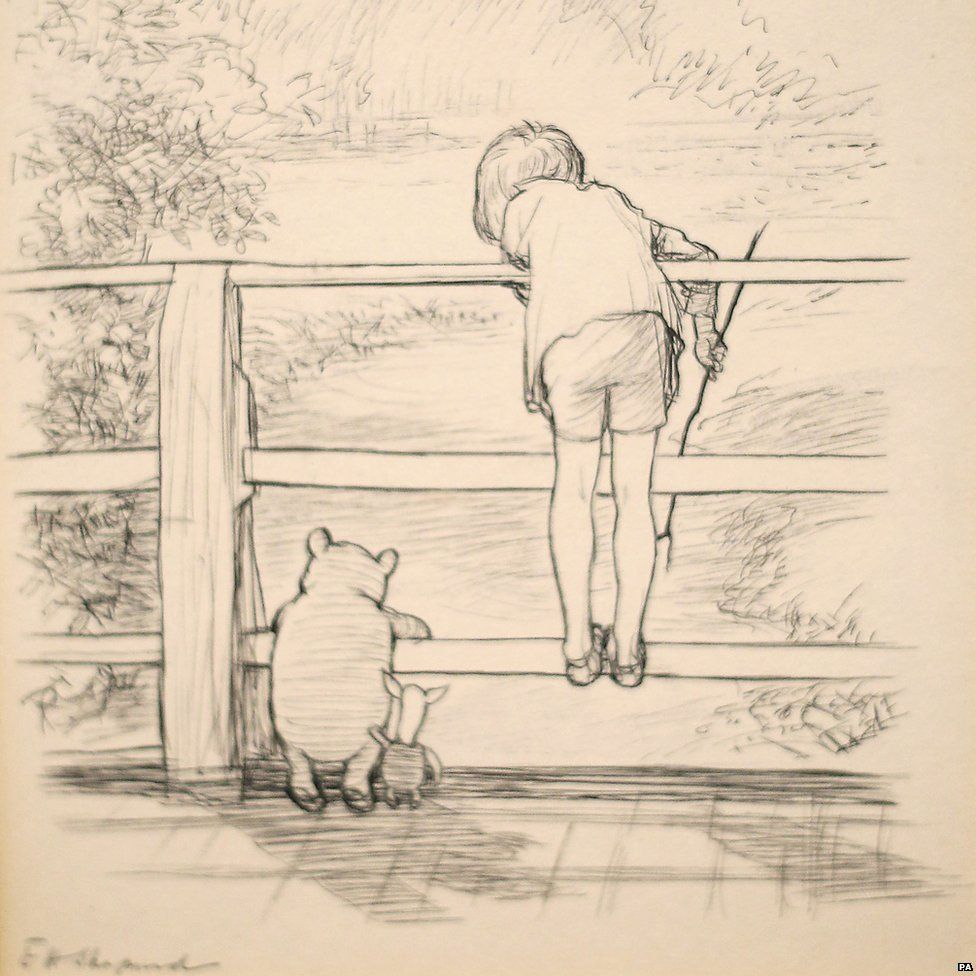
This more dynamic form of balance is a key theme in Taoism. And, in a playful way, is exemplified by the story of Poohsticks (which we heard at the Time for All Ages).
Lao Tzu is the first teacher of Taoism and the author of the book the Tao Te Ching. The first chapter of the Tao Te Ching states: “The Tao that can be expressed is not the true Tao. The name that can be named is not the true name.” This first stanza of ineffability has confounded and enlightened countless people through the centuries. It is a central theme throughout the text.
A second theme, the theme that is my focus this morning, is balance. In the second chapter we hear about a series of polarities: when we know about beauty, we become aware of the ugly. When we understand one thing to be good, that naturally means another thing is wicked. Long and short, high and low, before and after. The first two stanzas of the chapter carefully delineates the relationships that make our living. And then it says this:
“That’s why the wise soul does without doing, teaches without talking. The things of this world exist, they are; you can’t refuse them. To bear and not to own; to act and not lay claim; to do the work and let it go; for just letting it go is what makes it stay.” (Le Guin translation)
In Taoist philosophy the goal of life, the grand purpose, is balance. So much of our living is out of balance. The wise soul seeks to maintain and even restore balance. And there is a nuanced way to understand what is meant by this Taoist idea of balance. Toward that end, the wise soul – as it says in chapter 2 of the Tao Te Ching – ‘does without doing.’
How does one ‘do without doing’? The Chinese phrase being translated is “Wu-wei” and the literal translation is “Not doing” but the tone of the phrase is still about doing something. It is not inaction. It is not ‘doing nothing.’ Many translators have used the English translation ‘effortless action.’ This phrase highlights how the action not being forced or pushed. Another way to think of it is to see the difference between the European garden and the Japanese garden. Both involve quite a bit of work; but one style forces nature into an unnatural form while the other is an interpretation of nature along natural lines.
Philosopher and author, Benjamin Hoff writes: “Literally, Wu Wei means ‘without doing, causing, or making.’ But practically speaking, it means without meddlesome, combative, or egotistical effort.” (The Tao of Pooh, p 68)
In his popular book The Tao of Pooh, Benjamin Hoff argues that A. A. Milne’s Winnie the Pooh character is an example of Taoist practice – Pooh accomplishes a lot throughout the stories but he mostly stumbles into the solutions. He is just being Pooh. Milne makes Rabbit clever and Piglet anxious and Tigger incorrigible. Pooh just sails through the stories not really doing anything and yet that is his charm.
In our reading this morning, (https://www.mrdbourke.com/wu-wei/) Daniel Bourke titles his piece “The Art of Not Forcing.” He uses the distinction between rowing and sailing to make the point. “While the rower uses effort, the sailor uses magic.” When he says magic, he means the way the sailor does not push or force the boat to move; instead, the sailor arranges for the wind to move the boat. Wu-wei is still an action, but it is an action that does not force or push or run counter to the natural world. It seeks to move along natural lines.
What does this look like in our lives? In the Tao Te Ching, the concept is applied most directly to leadership and being the ruler of a country. The text often refers to ‘kings and princes’ and ‘the people.’ The best rulers do not impose or force the people to be in a certain way. Instead they assure that the people are not hungry.
Or think of this in terms of other leadership roles such as being a parent or a supervisor or a teacher. Maybe you are president of a board or chair of a department. Perhaps you are the point person or lead for a project or campaign. Whatever it is where you get to make the decisions that can impact not just yourself but other people as well; a role in which you wield some power.
How can you apply these ideas of the Tao and Wu-wei to your leadership role? Is there a natural wholeness and balance you can promote? Are there choices you can make that enhance the lives of the people?
Remember the goal is not to do nothing. It is to offer ‘effortless action.’ In a Japanese garden, the goal is not to let the space go wild. It is to craft an interpretation of nature; to shape a space along natural lines that reflects the dynamic balance of the natural world.
And here I will circle back to a small moment in from the reading by Daniel Bourke and the analogy of rowing and sailing. Perhaps you heard the acknowledgement that one could still row when needed.
To approach everything with Wu-wei. To not force. To let let let it happen. (Bourke wrote,) To put up a sail and ride the winds. But to row if you need to. Because even effort can be applied effortlessly. When you know the grand source.
Another author, Stephan Joppich, https://stephanjoppich.com/wu-wei/ also lifts up the warning against seeing Wu-wei as non-action or surrender. Joppich says that what Wu-wei advises is we give up on forcing things, not that we give up altogether.
For instance, when you’re experiencing injustices, Wu-wei doesn’t suggest resignation. It’s quite the opposite. We-wei suggests a persistent amount of pressure. This pressure isn’t a metaphorical jackhammer or wrecking ball. It’s a soft strike in the right spot. It’s like water quietly working through the toughest cliffs and rocks.
Taoism does return to the metaphor of water quite a bit. Chapter 66 and 78 talk about water as a model for how to be in the world. Bruce Lee has a great quote about being like water.
“Be like water making its way through cracks. Do not be assertive, but adjust to the object, and you shall find a way around or through it.”
But perhaps the best example is from Chaung-Tsu, a Chinese philosopher and Taoist whose importance to the founding of Taoism is considered second only to Lao Tzu. Chaung-Tsu offers this story. (paraphrased from the Tao of Pooh, p68-9).
There was a great waterfall in a turbulent river. A wise teacher was watching the waters one day and saw an old man being tossed about by the water. The teacher called to his disciples and together they rushed down to the river to help the man, though they feared there was little they could do. By the time they reached the waters’ edge, “the old man had climbed out onto the bank and was walking along, singing to himself.”
Shocked and a little awed, the teacher inquired of the old man, “What secret power do you have?” But the old man laughed it off and said, “I go down with the water and come up with the water. I follow it and forget myself. I survive because I don’t struggle against the water’s superior power. That is all.”
In another chapter of Winnie the Pooh, in which Christopher Robin Leads an Expotition to the North Pole, one character has a very similar experience. Christopher Robin takes everybody on an expedition to discover the North Pole. They pack provisions and head out together in a line. Eventually, they stop for lunch in a nice grassy spot by a stream. After everyone is finished eating, a scene unfolds that is strikingly similar to that of Chaung-Tsu’s old man in the river.
—
Piglet was lying on his back, sleeping peacefully. Roo was washing his face and paws in the stream, while Kanga explained to everybody proudly that this was the first time he had ever washed his face himself, and Owl was telling Kanga an Interesting Anecdote full of long words like Encyclopaedia and Rhododendron to which Kanga wasn’t listening.
“I don’t hold with all this washing,” grumbled Eeyore. “This modern Behind-the-ears nonsense. What do you think, Pooh?”
“Well,” said Pooh, “I think—”
But we shall never know what Pooh thought, for there came a sudden squeak from Roo, a splash, and a loud cry of alarm from Kanga.
“So much for washing,” said Eeyore.
“Roo’s fallen in!” cried Rabbit, and he and Christopher Robin came rushing down to the rescue.
“Look at me swimming!” squeaked Roo from the middle of his pool, and was hurried down a waterfall into the next pool.
“Are you all right, Roo dear?” called Kanga anxiously.
“Yes!” said Roo. “Look at me sw—” and down he went over the next waterfall into another pool.
Everybody was doing something to help. Piglet, wide awake suddenly, was jumping up and down and making “Oo, I say” noises; Owl was explaining that in a case of Sudden and Temporary Immersion the Important Thing was to keep the Head Above Water; Kanga was jumping along the bank, saying “Are you sure you’re all right, Roo dear?” to which Roo, from whatever pool he was in at the moment, was answering “Look at me swimming!” Eeyore had turned round and hung his tail over the first pool into which Roo fell, and with his back to the accident was grumbling quietly to himself, and saying, “All this washing; but catch on to my tail, little Roo, and you’ll be all right”; and, Christopher Robin and Rabbit came hurrying past Eeyore, and were calling out to the others in front of them.
“All right, Roo, I’m coming,” called Christopher Robin.
“Get something across the stream lower down, some of you fellows,” called Rabbit.
But Pooh was getting something. Two pools below Roo he was standing with a long pole in his paws, and Kanga came up and took one end of it, and between them they held it across the lower part of the pool; and Roo, still bubbling proudly, “Look at me swimming,” drifted up against it, and climbed out.
“Did you see me swimming?” squeaked Roo excitedly, while Kanga scolded him and rubbed him down. “Pooh, did you see me swimming? That’s called swimming, what I was doing. Rabbit, did you see what I was doing? Swimming. Hallo, Piglet! I say, Piglet! What do you think I was doing! Swimming! Christopher Robin, did you see me—”
But Christopher Robin wasn’t listening. He was looking at Pooh.
“Pooh,” he said, “where did you find that pole?”
Pooh looked at the pole in his hands.
“I just found it,” he said. “I thought it ought to be useful. I just picked it up.”
“Pooh,” said Christopher Robin solemnly, “the Expedition is over. You have found the North Pole!”
“Oh!” said Pooh.
—
Effortless action. Pooh was not trying to find the North Pole. He was trying to help Roo. If you have some power, some role in which you have an impact on the lives of others – use it with, I would say, compassion. Use it in a way that will enhance the natural way of things. Or, as the Tao Te Ching keeps saying, use it to be sure the people are not hungry.
May we learn the difficult art of acting in ways that are true to our nature and in balance with the natural world. May we always work for the true natures of others to blossom and grow. When we see injustice or cruelty, may we recognize it as imbalance and seek to offer guidance and correction to restore balance rather than to add more harm. May we learn to do without doing. To teach without talking. To act and not lay claim. May we do the work and let it go. Then do the work again tomorrow and tomorrow and tomorrow – each day doing our part to restore balance to our too-often broken and unbalanced living.
In a world without end,
May it be so.
Whom Would Jesus Cancel?
Whom Would Jesus Cancel?
Rev. Douglas Taylor
May 19, 2024
Sermon Video: https://youtu.be/syGdJrre53Q
So, the obvious, and easiest, answer to this question is: Jesus would cancel anyone with whom I disagree. This is how a lot of people use God for their ethics and moralizing. It is Anne Lamott who said “You can safely assume you’ve created God in your own image when it turns out that God hates all the same people you do.”
Let me unpack this idea of ‘cancelling’ here at the beginning, because it is a relatively new way of describing a human social behavior that’s been around for a long time. You know I don’t do this a lot but I went to the dictionary for help. Merriam Webster says to cancel is: (https://www.merriam-webster.com/dictionary/cancel#h1; particularly entry 1, sense e).
To withdraw one’s support for (someone, such as a celebrity, or something, such as a company) publicly and especially on social media … as a way of expressing disapproval and exerting social pressure.
To me, that sounds quite similar to boycotting or protesting, with a heavy dose of shaming thrown in. It is an effort to exert control by having someone or something removed, silenced, or shut down. I think that is the newer element in ‘canceling’ – the work is not just to refute or oppose a person, company, or an idea. The work is to shut them down, to silence them. This morning, my question is this: what is the spiritual value of canceling? Whom would Jesus cancel?
Here is my first answer: No one. As Peter Mayer says in the song we had just now – Jesus said let everybody in.
Jesus is a kind and forgiving person. All that stuff Paul says about Love in 1st Corinthians, most people think that all applies to Jesus’ character too – and serves as a list of the virtues we want to embody in ourselves.
“Love is patient; love is kind.” Well, say the same for Jesus. Jesus is patient; Jesus is kind. We want to also be patient and kind. Right? I’m not just making this up from nowhere, right? This is what Paul was aiming at when he wrote this. Paul was saying we should be like Jesus, we should be loving. And what that looks like is for us to not be “envious or boastful or arrogant or rude.”
Whom would Jesus cancel? No one. Whom should we cancel? No one. Because love “does not insist on its own way; it is not irritable; it keeps no record of wrongs; it does not rejoice in wrongdoing but rejoices in the truth.”
Cancelling someone is about keeping that record and maybe a little rejoicing when it works, when someone who deserves to be canceled gets canceled.
But that’s not the way Jesus would do it. Jesus is all about forgiving those who persecute us. He calls us to love our neighbors, to love even our enemies. Jesus said “Blessed are the peacemakers.” He didn’t say blessed are they who can prove they are right on the internet.
Blessed are the merciful, the pure of heart, the peacemakers, those who are persecuted … He said
Blessed are you when people insult you, persecute you and falsely say all kinds of evil against you because of me. Rejoice and be glad, because great is your reward in heaven, for in the same way they persecuted the prophets who were before you. (Matt 5:11-12)
He called on us to turn the other cheek. There is not a lot of room for rejoicing in people getting canceled, let alone for us to be doing the cancelling. So that is my first answer: No one.
On the other hand … Here is my second answer. A careful reading of scripture reveals that Jesus did get into it with some folks. He rebuked people, he called them hypocrites, he argued with them. He flipped tables and chased people out of the temple.
In a 2022 article in the Atlantic on this very question, ethicist and editor James T. Keane writes: “Even a cursory look at Scripture shows that Jesus was not at all afraid to repudiate those who deserved it.” https://www.americamagazine.org/faith/2022/03/18/jesus-cancel-culture-242588 So this idea that Jesus is just a really nice guy who loves everyone and is sweetness and light to everyone is just not true.
He rebukes his disciples (Matthew 8:23-27, Luke 9:37-56,) and Peter specifically (Mark 8:27-38), and at one point he rebukes the wind and the sea (Mark 4:39). But those examples are usually about Jesus getting frustrated with his disciples and wanting them to be better people, more faithful and good. He wasn’t trying to ‘cancel’ them
But there’s more. Jesus is often portrayed as criticizing and condemning the Scribes and Pharisees of the church (Luke 11:37–54; Matthew 23:1–39; Mark 12:35–40; and Luke 20:45–47). He says ‘woe unto you …’ and he calls them hypocrites. Jesus did that because he said they were preaching the law but not practicing it, because they were enriching themselves off the people, because they gave the appearance of being godly, clean, righteous, loving, and yet they did not behave as such. Then there is all the name calling Jesus does. He calls the Scribes and Pharisees names like vipers, serpents, fools, blind guides, “whited graves…full of dead men’s bones, and of all uncleanness”
In all four gospels, Jesus is seen getting very upset at the merchants and money changers in the temple (Mark 11:15–19, Matthew 21:12–17, Luke 19:45–48, John 2:13–16) and in John it describes him not only flipping the tables but also using a whip to chase people out.
It feels like Jesus, when pressed, singled some people out based on their hypocrisy; he expressed his disapproval and he exerted pressure to get them to change. So, perhaps there are some people Jesus would cancel. That’s my second answer: maybe there are some people – hypocrites perhaps – who Jesus would cancel.
And here is my third answer: No. Canceling is not what Jesus was doing in the gospels. He was challenging them, arguing with them instead of silencing them. Jesus was not shutting them down or silencing them. He argued with them, debated them, tricked them when they tried to trick him.
Jesus argued with people, prophesied against them, called them names; yes. But he never demanded their silence. Keane, again, in that article from the Atlantic:
The only times Jesus tells someone to shut up, to get lost, it’s Satan or it’s his pal Peter—’get thee away from me.’ Everyone else is free to argue with Jesus.
Jesus would not advocate ‘canceling.’ He would certainly advocate for argument, for consequences. But he didn’t silence people. He engaged with them.
Look, this level of biblical interpretation is always fraught with personal bias. Our modern interpretations are always loaded with our modern expectations and assumption. In truth, what Jesus was saying and doing 2000 years ago has very little that is directly applicable to most of what we’re dealing with today. Not directly. It always takes a few steps, a few leaps, of interpretation.
So here is the hermeneutic behind my statement that Jesus would not cancel anyone. I’m doing that thing where I have a guiding value – to be clear it is the idea that God is Love – and this guiding value is the lens I use in every interpretation. Period. I don’t look at scripture to figure out how to be loving. I look at love to figure out how to interpret scripture. If you have a different way of interpreting, that’s great. Own it. Be up front about it. Mine is love.
If there is something going on in the world or in your neighborhood that bothers you, the lesson from Jesus is not to shut it down or try to silence your adversary. The lesson is to engage and come up with a better argument.
Now, here’s a grain of salt – most of the time, on the internet, such arguments are not real and designed to waste your time and energy. Just like most complaints about ‘being canceled’ are fake – like complaints about the ‘war on Christmas,’ such complaints of being canceled are exaggerated and contrived so conservatives can appear like victims. In such cases, it is wise to not engage and not waste your time and energy.
But if the situation is real, then I encourage you to move closer to the situation and engage! That’s what Jesus would do. I’m not going to recommend you call people names or flip tables – but to be fair, that is what Jesus would do in certain situations. So there is that.
Truly, my advice is this: when you see trouble, move closer and engage. Life is messy. My life is messy, my heart is messy – yours is too! I still encourage us to emulate the side of Jesus that is the embodiment of kindness, patience, and love. As Adrienne Maree Brown said in our reading: “If the goal was to increase the love, rather than winning or dominating a constant opponent, I think we could actually imagine liberation from constant oppression.”
We are not going to build the Beloved Community by kicking some people out or shutting them down. We can change the world, but we’ll do it through relationships. That includes some arguments and conflict, some consequences and calling for people to be better. But the good parts of all of that happens only if we move closer to each other when we have trouble.
Let us start here, among ourselves. Let us engage across our differences, through the conflicts that arise, moving closer when we begin to see trouble. Our experience can then be a model for each other out in the world as we work to become more of a Beloved Community together. Let us start here. Let us begin again today.
In a world without end, may it be so.
Real Pro-Life Is Pro-Earth

Real Pro-Life is Pro-Earth
April 21,2024
Rev. Douglas Taylor
Sermon Video: https://youtu.be/0fT5t3xZ4ls
Tomorrow is Earth Day and I will focus today on the earth our interconnected relationship with the earth. But first, I must acknowledge the twist in my title. The real Pro-Life, I say, is pro-earth. But of course, ‘Pro-Life’ means something else to most people.
“Pro-Life” is a slogan, a stance that specifically refers to the anti-abortion stance in the Reproductive Rights debate happening in our country. Pro-Life is one side of a debate between two sides. My convictions land me on the Pro-Choice side when we are limited to picking sides in this debate.
I remember years back reading an argument that in terms of slogans, (not the actual position – just the slogan,) Pro-Life was a clear winner. Who doesn’t support life? It is similar to the argument that the name Universalism is a winner – you mean ‘everything?’ How can you argue against everything? Just in terms of the name, the slogan ‘Pro-Life’ is a great idea to get behind. Yes. I am in favor of life.
And I am far from the first to suggest that in truth the Pro-Life crowd is not really pro-life, they are pro-birth. That stance known as Pro-Life is really a small, narrow focus to promote birth, and when I allow my more suspicious side to speak, I would say it is a contrived power play to control women more than anything else.
And this idea that life begins at conception is a very western Christian philosophy. Other religious traditions have different answers. Judaism, for example, claims that life begins with the first breath. And science seeks a definition between conception and birth when scientists speak in terms of viability outside the uterus. It really is a very Christian argument at base to say life begins, that ensoulment occurs, at conception. There is not a universal agreement about the point of when life begins, especially as it pertains to termination of a pregnancy – but I’m not all that interested in that part of the debate, if I’m honest.
When we can step back from slogans and debates of when life begins, when we really allow an honoring of life to lead us, then I can joyful claim a Pro-Life stance. I can see a person’s choice to terminate a pregnancy as a choice made while authentically honoring life. I can do this because I see life and death intertwined. Because I have a larger understanding of life than merely birth.
Because a real pro-life stance expands far beyond a debate about reproductive rights and abortions. A real pro-life stance cares for people every day after birth as well. A real pro-life stance also promotes universal healthcare and fair housing. A real pro-life stance works to build systems of support for children and families and communities. A real pro-life stance fights against poverty and racism. A real pro-life stance acts to combat hunger and the spread of disease. A real pro-life stance protects our earth and our water from poisons and oil spills and the ravages of capitalist greed. A real pro-life stance is also pro-earth – not merely pro-birth.
And the earth is brimming with examples of the interplay of life and death; the ebb and flow of the tides, the turning of the seasons each year, and the lifecycle of dragonflies. The natural world shows us the way of life – the way filled with beginnings and endings and returning, cycles of growth and decay and new life. In this perspective, the termination of a pregnancy is held within the ongoing give and take of life. In this perspective, the urgency of denying death, of refusing endings, is eased by the contexts of cycles and circles of life ever returning.
Is this an earth-day sermon? Yes. Is this a pro-choice sermon? Yes. Both? Yes. Because this is about intersectionality and interdependence. I want to not compartmentalize the conversations into little boxes as if they don’t overlap. Because what we know of the earth can help us understand the complexity of a situation involving abortion.
Why, for example, do we argue between the life of the fetus and the life of the mother as if the two are not deeply intertwined? It is such an individualistic perspective to assume the best way to decide is to pick one over another. When we turn people into ‘the other’ we build distance and disconnection – that is where hatred and oppression can thrive. But a person working through the choice to terminate a pregnancy is perhaps the most elegant example of interdependence. There are layers of impact and import in such scenarios. Why would we isolate people in situations like this, demanding they value only one thing – this life or that life – when all life is interconnected?
Philosopher Charles Taylor talks about the balance of positive and negative aspects of individualism.
We live in a world where people have a right to choose for themselves their own pattern of life, to decide in conscience what convictions to espouse… The dark side of individualism is a centering on the self, which both flattens and narrows our lives, makes them poorer in meaning, and less concerned with others or society.
Too often we push ourselves or push others into that flattened and narrowed place of isolation. What can support really look like for someone facing this decision?
Every choice is a story. Here is what I do not know: I have never been and never will be pregnant. I will never experience new life growing within me like that. I will never face that choice to terminate the pregnancy or not. What I do know is that every choice is a story. What I do know is that whichever way such a decision goes, none of us are truly alone. We may be isolated, but we are not alone.
When we are feeling stuck or isolated or pressured by society – it can be of great help to reconnect with nature. I know it can sound like a non-sequitur to suggest that. “I struggling with a decision.” “Have you checked in with the rushing river or the ants? Have you taken your troubles to the maple trees or the dandelions?” I know how that might sound. But we can reframe it to ask the same question with slightly different words. We can ask, “When is your next appointment with your therapist?” or “Have you prayed with God about it? Or made art or done journaling or checked in with your mother or your best friend about it?” Really the question is this: when you are struggling with a decision, have you connected?
For me, the earth is a connection to Life. For you it may be different, you may find your connections in other ways. But I will still smile and say we all can grow in our connection with the earth.
Buddhist monk Thich Nhat Hanh has written:
When we suffer, the Earth embraces us, accepts us, and restores our energy, making us strong and stable again. The relief that we seek is right under our feet and all around us. Much of our suffering can be healed if we realize this. If we understand our deep connection and relationship with the Earth, we will have enough love, strength, and awakening to look after ourselves and the Earth so that we both can thrive.
The suffering is about not being connected. When I can slow myself enough to remember my deep connection and relationship with the earth, I find the resources and the reasons for all my efforts to build a better world – a more connected world. When I can sit among the tall trees and the undergrowth, breathe in the breeze and the beauty, these things become part of me and keep me grounded.
My small, isolated self expands and I become part of the intricate and connected pattern that is Life. Experiencing life this way is why I care about the environment and about reproductive rights and about racism and peace and clean water. When I see myself as part of the pattern, as part of Life, as part of God, I become a partner with all that is: the beauty and the pain, the ebb and the flow, the war and oppression, and the gentle breeze and the songs of birds. This is why I care, because I feel the connections.
When things are tight, where there is pressure to be isolated. Reach out and get connected. When I can slow myself down enough to really experience Life, then I find myself in the pattern of things. And every isolated, lonely act becomes reframed and held in a grace of connection. And together we thrive, even through the heartbreak and hard decisions, we thrive.
May we lean into our connections, may we move closing to what looks like trouble, and may we thrive.
In a world without end,
May it be so.
Deeper into the Well

Deeper into the Well
Douglas Taylor
3-24-24
Sermon video: https://youtu.be/LKJZAGz27lc
“Well, … Looking for the water from a deeper well.”
“Well, … Looking for the water from a deeper well.”
This is a little snippet of a song by Emmy Lou Harris I heard on public radio once several years back and it has stuck with me.
“Well, … Looking for the water from a deeper well.”
The rest of the song has never hooked me musically, for whatever reason. The overall message of the song had a sort of an Ecclesiastes feel to it: Been there, done that, didn’t help.
“Well, … Looking for the water from a deeper well.”
Ecclesiastes says, “I applied my mind to seek and to search by wisdom all that is done under heaven; it is an unhappy business that God has given to human beings to be busy with. I saw all the deeds that are done under the sun; and see, all is vanity and a chasing after wind” (Ecclesiastes 1:12-14.)
“Well, … Looking for the water from a deeper well.”
Why? What’s going on that we need to look for a deeper well? This is not a new song; written back in ’99. It picks up on the growing desire for depth and meaning in life. This yearning has been bubbling among us for some time now, a yearning for more depth, for more connection.
There has also been a narrowing happening around us. We are driven into consumer niches, sold divisiveness and fear. And yet, along with this increase in fear in politics and public morality, there has also been more reaching out to other cultures and between different faith traditions. Many walls have been built up, but many more have been torn down. Interesting isn’t it, the parallel explosions of very shallow, surface level exclusivity and narrow-mindedness alongside unprecedented cultural exchange and a startling openness and mingling of religious practices and understanding. I remember reading an article in a conservative Christian magazine that warned its Christian readers against the practice of Yoga because it could lead people to Hindu beliefs and away from pure Christianity. Like Yoga is some massive secret plot against Christianity!
More and more, people are experiencing other cultures and other religious practices and mixing things together to create a satisfying spiritual life independent of the exclusive rules of most religions. Religious conservatives and fundamentalist see this as a big problem. I see it as people yearning and searching for something meaningful, for something deeper. So many people come through our doors searching for connection and meaning. They are lonely and empty. So many people, to one degree or another, feel empty and they hunger for something more.
“Well, … Looking for the water from a deeper well.”
Why the increased interest in looking for a deeper well? What’s wrong with what we’ve already got? The problem is: it’s empty. What do you do when you’ve spent your life trying to gain financial security, only to lose the reason why you wanted to be secure? What do you say when you spend your life making a name for yourself, only to forget what your name means. What do you do when your well is empty?
“Well, … Looking for the water from a deeper well.”
Our society actually encourages this emptiness. Your emptiness is not a problem, only an as-yet unmet market opportunity! So many people buy into this success-oriented, achievement-driven, market-manipulated, soul-draining way of life. When we find that we are empty, we reach for anything that we think can fill the void… romance, work, a fast car, a big TV, status, power; anything, even religion. And yet, we remain lonely, we remain yearning for something more.
Everybody gets lonely. Everyone gets that gnawing emptiness every now and then. When nothing works and no one seems to understand or care. When the students don’t respond to your carefully prepared lectures, when your parishioners doze through your thought-provoking sermons, when that attractive person you’ve tried to impress doesn’t pick up on your obvious hints, when your boss dismisses your suggestions, when the committee you’ve been steering still can’t get anything done. We all know that sense of futility, where you burn with such a passion for something, only to get burned out. And we find ourselves alone and empty. What was it all for, anyway? And it doesn’t matter if it is burn out, depression, or just general aridity, it is borne out of desperate encounters with loneliness and emptiness.
So what do we do? Where are we to turn? Where do you go when you are empty?
Well, there was one time when my life seemed particularly empty and dry, and I jumped into Lake Michigan in the middle of December. I remember I was in the midst of a very difficult time with depression at that time. Different people experience depression different ways. For me, there is a Psalm I have found which really hits the nail right on the head and describes what it feels like.
I am poured out like water, and my bones are all out of joint. My heart is like wax; it has melted away within me. My strength is dried up like a potsherd, and my tongue sticks to the roof of my mouth; I am laid in the dust of death (Psalm 22:14-15.)
This is the same Psalm that begins: “My God, my God, why have you forsaken me?” Number twenty-two. The next one is number 23, famous number 23, “The lord is my shepherd, I shall not want, …” great psalm, beautiful psalm. But the one just before it, number 22, oh! So, after a week of my life tasting like ashes in my mouth, a friend suggested that, as a winter solstice ritual, we jump into Lake Michigan. I have pictures.
I don’t know if any of you are familiar with Chicago, but my friend Daniel and I went out to the beach next to Lakeshore Dr., just off of 57th street. We stripped down to our swim trunks and Daniel looks at me solemnly and says, “This is my way of letting winter know I’m not going to hibernate.” I looked out at that cold, churning lake and tried not to think about what I was about to do. “Ready?” he asked. “Yeah,” and I took off running down the beach to the water with Daniel right next to me. I bounded in, ten feet, twenty feet, I got in up to my waist, (it was shallow) about forty feet out I’d guess, when suddenly I stopped. I looked down at my legs and said “What?!?” My legs looked up at me and said “Hey, we’re cold. Besides, he said we could stop.” I looked behind me and sure enough; there was Daniel about ten feet back shouting: “Uh, I think this is far enough. Let’s get this over with.” So we dunked under and ran back to shore as fast as we could.
As I dried myself off and wrapped up in a towel, I yelled something like, “So there, Winter!” (Not the most eloquent of prose or protest, but I was quite numb at the time.) I had exposed myself to the bitter winter wind and waves, and was still able to cry out in response. From the depth of my wintering soul, I was able to respond.
So, you’re lonely, you’re empty. Find a way to respond. Find a way to get meaning into the equation. Reach out. The answer almost seems too simple. We need to get out and do more together. We should be community-oriented. To starve the emptiness, we must engage with other people; respond to the loneliness by reaching out.
Unfortunately that is only half of the possible answer. The other half centers around the idea that to really respond to the emptiness we must first be truly empty. To relieve the loneliness we must learn to be alone. Sometimes the answer is to climb out of the well, expand our experiences, our engagement. Other times, the answer is to go deeper into the well.
We seem to have this notion that we are called to relieve one another’s loneliness, to eradicate all the emptiness. Not so. We need lonely times. Loneliness is powerful. It keeps us grounded in who we are. Henri Nouwen, the author of “Reaching Out” writes: “When all our attention is drawn away from ourselves and absorbed by what happens around us, we become strangers to ourselves, people without a story to tell or to follow up (p. 96 Reaching Out.)” The empty times in our lives are often openings into greater depths, or at least clues that such openings are available.
If you are following me, you’ll see I said at the beginning that in our loneliness we lose sight of who we really are. Now I say that only in our loneliness can we see our true selves. This is not a paradox or a religious puzzle sort of thing. It is simply this: to counter this epidemic of emptiness, to stop it from enveloping you, you need to embrace it. It is within moments of withdrawal and lonely silence that you find both the emptiness and the hunger; the emptiness that will pull you down and the hunger that free you if you will but follow it out.
Henri Nouwen says in another book, “Somewhere we know that without a lonely place our lives are in danger. Somewhere we know that without silence words lose their meaning, that without listening speaking no longer heals, that without distance closeness cannot cure. Somewhere we know that without a lonely place our actions quickly become empty gestures. The careful balance between silence and words, withdrawal and involvement, distance and closeness, solitude and community forms the basis of the [religious] life and should therefore be the subject of our most personal attention.” (pp 14-5 Out of Solitude)
We talk a lot about community and service and justice here in our congregation. But I say that all of that action needs a source, a source from within you; a source that will not simply drain you and burn you out.
I am reminded of the parallel which I love that brings the opposite element – I’ve been talking about water from the well and for a minute I want to tell the same thing but with fire. In the early part of the Moses story, God appears as a burning bush. I think that is a fantastic image: what is God like? God is like a bush on fire, but the fire doesn’t consume the bush, it’s just on fire. You’ve got to watch out; I should have warned you earlier to watch for the Biblical references, see how many you find in the sermon this morning.
One parallel of the story of the burning bush is found in the chapter immediately preceding. Moses, witnesses an Egyptian beating one of the Hebrew slaves. Moses gets angry at the injustice; he gets hot, and he rises up against the Egyptian and kills him. Then he gets scared thinking that he’ll be found out, so he runs off to the desert for a few years, working as a simple shepherd, which is where he bumps into the burning bush. And it’s like God is saying, I burn and do not consume. Moses, you burn with your passion and it burns you up. You burn and all you do is consume. Your fire burns from that empty desperation. You need to be tapped into the source of life, that source from within you that is a hunger.
You’ve got to watch out, though. I don’t want to make this seem to easy. You need to watch out because the emptiness and the hunger can look a lot alike. If the fire that burns within you burns from an empty desperation, then it is a fire that will consume you. And that is not why this community is here. We are not here to fill up people’s empty places; we are not here to serve your burning need to consume. Ours is not a consumer religion. This is not a consumer congregation. Ours is a community of faith and justice where people come with longing, thirsty souls to get away from the emptiness, to get away from your market niche, to tap into your source and to find your hunger.
As Ecclesiastes says, “It is an unhappy business that God has given to human beings to be busy with. I saw all the deeds that are done under the sun; and see, all is vanity and a chasing after the wind” (1:13-14). Anything you set yourself to do, any task or dream you pursue, any injustice you seek to make right, anything can be motivated by vanity and the need to fill that emptiness. Likewise anything can be motivated by a hunger from your soul. One of my favorite quotes is from Howard Thurman who said, “Do not ask what the world needs, instead, ask what makes you come alive; then go do it. Because what the world most needs is people who have come alive.”
To fight against this invasive loneliness, this epidemic of emptiness, you need to find a lonely place, a place of solitude: a source. You need to know the well that will give you deep water. Before you can love your neighbor as yourself, you must love yourself. For this, you will need to learn how to sit with your solitude comfortably. Embrace the yawning cavern of emptiness with you; do not seek to fill it. Move through it unto your very source and find there your hunger. Find your way to give pout your whole heart with extravagances and endlessly renewing love.
I know my source. I am familiar with the lonely places in my life, with the wells I can go to for deep water when I am in need. That lonely place in my life is where I find the strength to then go out to the world and serve others. I know I’ll be able to see and recognize my emptiness and my hunger. When I can stand even in the bitter winter of my soul and remember that I am not alone, I can be about the business of healing the brokenness in the world. I put it to you then, find your source and your hunger, and take it to the world.
“Well, … Looking for the water from a deeper well.”
“Well, … Looking for the water from a deeper well.”
In a world without end, may it be so.
Faithful Anxiety
Faithful Anxiety
Rev. Douglas Taylor
3-10-24
Sermon video: https://youtu.be/LaGRs84tPK8
The big summer blockbuster movie for kids scheduled for this coming June is Pixar’s “Inside Out 2.” The original movie all about feelings debuted in 2015, almost ten years ago. The premise was that we all have a base set of emotions: happiness, sadness, anger, fear, and disgust. Now, with puberty, our protagonist also gets anxiety along with envy, embarrassment, and ennui! I do not doubt that I will be seeing this new Pixar at some point.
Because we can relate! We all get anxious and worried at times. And I don’t mean the level that gets to Generalized Anxiety Disorder. Anxiety Disorders are real and some people have an experience of anxiety that is beyond what most folks experience and it is debilitating. What I want to talk about today is more that sense of anxiety that we all get.
As we heard in our reading this morning, “Anxiety is nervous apprehension about the uncertain future.” And we live in uncertain times. There is so much going on in our world and in our lives that can lead us to feel anxious.
When I was a young minister, I learned a great deal about how to be a Non-Anxious Presence. When counseling a person dealing with uncertainty, or leading a congregation through uncertain times, we were taught the importance of being a non-anxious presence. This phrase comes from Ed Friedman and the Family Systems school of thought. Life has a share of trouble for everyone. But we are alone, we can support each other in our trouble. And it can be surprisingly helpful, supportive, and empowering to be a non-anxious presence with people. To be a non-anxious presence is to be calm in the face of trouble – to not try to fix or save or move or defend anything. It is instead to simply be present to what is going on; to be open and curious with people.
It is not much of a leap to hear in this the message that anxiety is bad and that we need to tamp down and get rid of all our fear and anxiety. In her book When Things Fall Apart Pema Chödrön shares this story about facing our fears.
Once there was a young warrior. Her teacher told her that she had to do battle with fear. She didn’t want to do that. It seemed too aggressive; it was scary; it seemed unfriendly. But the teacher said she had to do it and gave her the instructions for the battle. The day arrived. The student warrior stood on one side, and fear stood on the other. The warrior was feeling very small, and fear was looking big and wrathful. They both had their weapons. The young warrior roused herself and went toward fear, prostrated three times, and asked, “May I have permission to go into battle with you?” Fear said, “Thank you for showing me so much respect that you ask permission.” Then the young warrior said, “How can I defeat you?” Fear replied, “My weapons are that I talk fast, and I get very close to your face. Then you get completely unnerved, and you do whatever I say. If you don’t do what I tell you, I have no power. You can listen to me, and you can have respect for me. You can even be convinced by me. But if you don’t do what I say, I have no power.” In that way, the student warrior learned how to defeat fear.
(When Things Fall Apart, Pema Chödrön; pp33-34)
Fear and anxiety live on the same wedge of the emotion wheel. They are similar. This Buddhist story of the young warrior is written with ‘fear’ as the adversary. It is worth noticing the distinction made by Tracy Dennis-Tiwary in our reading this morning. (Excerpts from an interview) Fear, she said, is rooted in the present moment while anxiety is about an uncertain future. But the description from the story is still apt: “My weapons are that I talk fast, and I get very close to your face.”
Anxiety is a normal part of our lives – we worry about things. We all feel fear. When faced with problems and trouble, we can get caught up worrying about what might happen. Anxiety prompts us to imagine the worst, to borrow extra fear in the form of worry over uncertainty before anything has happened.
Shantideva, an 8th century Buddhist monk said, “If you can solve the problem, then what is the need of worrying? If you cannot solve it, then what is the use of worrying?” Or as a contemporary proverb has it: “Don’t trouble trouble until trouble troubles you.” But the twist that anxiety plays on us is when you don’t know if you can solve it yet.
This leads us to have a lot of energy and attention around how to get rid of anxiety. Buddhist thought, however, leads us away from the idea that we need to stop having such feelings and experiences. Buddhist thought suggests instead that we embrace them, accept them not as good or bad but simple a fact. This way, when we feel anxious, we can – in good Buddhist manner – accept the feeling as simply something we are feeling.
When we can separate the experience from judgement, we can receive it as information. If we can receive it, even as it ‘talks fast and gets very close to your face,’ we can take a breath and be curious. What is this anxiety revealing to me? I won’t pretend this is an easy practice. In my own experience, the information takes a lot of interpretation and translation and usually just sounds like alarms and panic. But with practice, we can learn the language of our anxiety and what it has to offer.
When we can step back from the anxiety and take a breath, we open up the possibility that our anxiety is not just a stumbling block or burden. It can be information that reveals something important to us. Anxiety can be a source of energy for change in our lives and in our communities.
A few years back there was an article in the UU World magazine by psychologist and author Robert Rosen entitled, “Do you have just enough anxiety?” Rosen suggest that there is a health level of anxiety, just enough. It is the “amount you need to respond to danger, tackle a tough problem, or take a leap of faith.”
He acknowledges that anxiety is usually unhealthy. Anxiety can interfere with our good judgment and normal functioning. Anxiety blocks our ability to respond, it can close us off to possibilities that would serve us well, it narrows our vision and focuses us on our fears, our inadequacies, our failures, and our feeling of insignificance. That is our anxiety talking fast and getting close to our faces. Anxiety can close us down or send us off frantically in strange directions. Too much anxiety is a bad thing for our physical and psychological health.
This much is well known and acknowledged by psychology and common sense. What Rosen adds to the conversation is this:
Too little anxiety … is the face of complacency. It comes from the belief that all is well, and an unfounded expectation that good times will continue unabated, with no need for change or improvement. Too little anxiety leads to passivity, boredom, and stagnation.
https://www.uuworld.org/articles/do-you-have-just-enough-anxiety
What are the things that trigger your anxiety? What makes you anxious? Often our anxiety is tangled up with our sense of self – but as often it is about the news and worries have about war and politics.
Buddhism teaches us to take a step back from the heaviness of our fears and anxieties. The step back is not a disassociation however – it is not a disengaging or ignoring. It is a way to keep your own footing and remain within your integrity.
To touch back on that Pixar movie I mentioned at the begin, I’ll illustrate my point. In the original movie, the five base emotions all shared a ‘control panel’ inside a person. Sometimes Anger would seize control of the buttons and other times, fear would jump in and deal with something when the others froze up.
So my invitation to you is to imagine your anxiety – when you feel it – has taken over the control panel. When I say we can take a step back, take a breath, and just receive the anxiety as information, it is like moving anxiety away from the control panel of our brains. I’m just saying don’t let anxiety drive the bus whenever possible. It’s still there, it’s still the alarm sounding, it’s just not at the controls.
It is important to acknowledge that what I’m describing is not a technique to get rid of your anxiety – it is a technique to give your anxiety a proper hearing without turning over the reins.
And I’ll also touch back on the idea of being a non-anxious presence – or at least a less-anxious presence perhaps. I’d like us to noticed that sometimes I am not sufficient alone to regulate my own anxiety and could benefit from having another person nearby to co-regulate with me. Simply from a physiological level – if I am with a person who is breathing slowly and easily, has a calm presentation, and is simply being present with me; then my breathing slows, my body begins to calm to match the calm of the person I am with. Co-regulation is a powerful way to keep anxiety out of the driver’s seat.
Having another person helps when I am struggling on my own. Perhaps you’ve heard this inspirational story before, it’s been floating around social media for a few years:
“I was 13-years-old, trying to teach my 6-year-old sister how to dive into a swimming pool from the side of the pool. It was taking quite a while as my sister was really nervous about it. We were at a big, public pool, and nearby there was a woman, about 75-years old, slowly swimming laps. Occasionally she would stop and watch us. Finally she swam over to us just when I was really putting the pressure on, trying to get my sister to try the dive, and my sister was shouting, ‘but I’m afraid!! I’m so afraid!!’ The old woman looked at my sister, raised her fist defiantly in the air and said, ‘So be afraid! And then do it anyway!’” https://www.facebook.com/lovewhatreallymatters/photos/a.710462625642805/1113400108682386/?type=3
Do it afraid. The trick is not to avoid all anxiety. The trick is to learn, instead, to acknowledge my anxiety but not let it determine my actions. Anxiety, like fear or guilt or anger or any other unwanted emotion, is information about what matters to me and what has a hold of my heart. But anxiety should not be given free rein on my response to situations. I can instead have faith that a little anxiety can be a healthy. It can keep me just uncomfortable enough that I’m paying attention. And there is always the option for us to support each other in maintaining our balance.
Change and uncertainty will always unsettle us and make us anxious. And if we always avoid anxiety then we will always avoid change and uncertainty in life. Allowing for just enough anxiety – allowing anxiety a seat at the table, just not a hand on the controls – we can lean in to the trouble, trusting our own centered integrity to hold us. With both faith and a little anxiety, we can respond to all the challenge and the beauty that comes our way.
In a world without end,
May it be so.
 Rev. Douglas Taylor