
The People’s Peace

The People’s Peace
Rev. Douglas Taylor
May 18, 2025
Sermon Video:https://youtu.be/254crtZ9Bio
I know my title suggests I will be talking about peace – and I will be. And I know my sermon description suggests this will be a history sermon – and it will be. But really, this morning is all about integrity and the freedom of conscience.
Rev. John Haynes Holmes is likely not a well-known figure from our religious history, but his impact has been significant. He was born almost 150 years ago and was an influential pacifist minister during the first and second World Wars. He served the Community Church of NYC for nearly four decades.
As I mentioned in my description of the service, Holmes was a staunch pacifist, and notably a co-founder of both the NAACP and the ACLU. Yet he was a controversial figure, his relationship with Unitarianism and with his colleagues was tumultuous. We effectively pushed him out of Unitarianism for being a non-conformist in his pacifism. Which is wild. I want to share with you the story of how our Unitarianism got caught up in the fervor of supporting the war and nearly lost our moral center as a tradition.
On both the Unitarian and Universalist sides of our heritage, we have prided ourselves on our commitment to freedom of belief and freedom of conscience. I have several times preached about the foundational value of honoring our theological diversity, of allowing for variety among our beliefs together, of insisting that we do not exclude based on such differences. Freedom of belief and freedom of conscience are central to our way of faith. Yet we have not always practice these freedoms well. My sermon today begins in one of our failures on this count.
I need to set the scene. This is 1917 – right at the time the United Staes had joined the war in Europe, the Great War, the War to End All Wars, or what we later came to call the First World War. The Unitarians met for their general conference meeting and the topic of supporting the war is put forth for discussion and resolution. The moderator of the conference 1917 is former president of the United States, William Howard Taft. Taft is the most recent of our four Unitarian US presidents, serving from 1909-1913. Taft strongly encouraged the Unitarian conference to support the war effort. Taft gave an opening address at the conferences, calling on the clergy to preach the righteousness of the war, to say it is necessary to preserve a peaceful world, and that we should all get behind President Wilson.
John Haynes Holmes is the young minister of what was then known as Church of the Messiah, NYC – a prominent Unitarian pulpit. Holmes was a strong advocate for justice and the modern social message of religion. He was in the position to bring a report about the perspectives and attitudes of Unitarians toward the war. As a staunch pacifist he called for the clergy to mourn the dead, cry out at the destruction, and seek the path of reconciliation.
Taft did not like Holmes’ report and setting the moderator gavel aside, took the floor to argue against Holmes’ pacifism and propose a motion saying “That it is the sense of this Unitarian Conference that this war must be carried to a successful issue, … that we … approve the measures of President Wilson and Congress to carry on this war.”
In the debate, Holmes rose and said, “I am a pacifist, I am non-resistant, I hate war, and I hate this war; so long as I live and breathe I will have nothing to do with this war or any war, so help me God.” Taft said “Our house is afire and we must put it out, and it is no time for considering whether the firemen are using the best kind of water.” The motion was adopted by a vote of 236 to 9. (Stream of Light, Conrad Wright, ed; p103)
There are times in history when we feel a fervent need to take some communal action, to stand against some evil. It is not a stretch to say many people, myself included, feel we are in just such a moment for our country today. Yet to refuse a space for conscientious dissent feels unimaginable. Everything in me would rebel if there were a resolution from the UUA proclaiming that all of us must agree with this or that policy or proposal or action.
In 1918, the year following the debate between Taft and Holmes, the leadership of the American Unitarian Association issued sanctions against any congregation employing a minister who was not “a willing, earnest, and outspoken supporter of the United States in the vigorous and resolute prosecution of the war.” They withheld all aid to such congregations. Holmes withdrew his fellowship with the Unitarians and the church likewise left the Association, changing its name to Community Church, NYC.
A decade or so after that war, the Unitarians struck down those sanctions. And as he neared retirement, Holmes was courted by Unitarian leadership to reinstate his fellowship among the Unitarians, which he did. The broader story includes this reconciliation.
In recent years, pro-war UUs are far from the majority. The counter-cultural movements of the ‘60’s became our bread and butter in the following decades – peace, civil rights, equality, diversity – these values and their accompanying justice issues became bedrock cultural aspects of our Unitarian Universalist identity. Holmes’ ministry predated all of that by a few decades.
Over the years I have bumped into people who assumed Unitarian Universalists were always anti-war. One person was aghast to hear a colleague suggest we are not considered one of the Peace Churches.
The Peace Churches are denominations such as the Brethren, the Quackers, the Amish and the Mennonites who have historically held a biblical commitment to non-resistance and pacifism as a core tenet of their faith. I am reminded of James Baldwin’s quip, “If one believes in the Prince of Peace one must stop committing crimes in the name of the Prince of Peace.”
Unitarians have, in more recent times, shifted to a more anti-war stance, a more reconciling perspective. In recent conflicts, for example, the UUA has been very supportive of Ukraine’s resistance to Russian aggression but was noncommittal for several month when talking about the war in Gaza. The UUA has been nuanced and cautious about asserting a stance – perhaps as a reflection of the experience of Holmes, but I doubt it. I don’t think the story of John Haynes Holmes’ pacifism and refusal to toe the line with conformity take up much space in how we remember our history. It is not a story we tell very loudly among ourselves.
I will note that throughout our early history, Unitarians in particular have been in the thick of the establishment of our government. Many of the ‘founding fathers’ of the United States have some Unitarian connections. We were owners of business and leading academics in the early formation of our nation. We were influencers. We were the establishment.
The past hundred years, however, has seen a pivot away from Unitarians holding significant political influence. We have – most notably during the 60’s and onward – shifted toward being a voice of resistance. And circling back to Holmes I would credit his ministry as having an indirect impact on our progress as a religious tradition.
I would not say we have become anti-establishment, however. I think we’ve grown into a faith community that is not simply against something, we are working to establish a kind of community that serves the needs of all people through our values. I would not say Holmes’ greatest attribute was his pacifism. Yes, his stance against the war precipitated his withdrawal from the Unitarian Association. But that particular stance was grounded in a broader vision for what could be when we set militarism aside.
In one of his 1917 sermons he said “War and democracy are incompatible.” He spoke about how the mindset of war tramples the values we are wanting to protect by going the war. While we may not be actively at war in the way we were in 1917, it is not hard to see how great an impact militarism has had on the erosion of our democracy. Can you see how the state’s use of force has eroded our freedom? It is this broader vision of what could be that lead me to want to learn more about Holmes.
It was not just his radical pacifism; his vision of ministry and of the nature of religion was also radical for the time. He was far from the only Unitarian minister calling for a modernization of our theology – indeed the Humanist movement of the 1930’s may have been influenced by Holmes’ writings. The part I found more prescient for our current situation is his call for “a religion that moved from concentration on the individual and focused instead on the social nature of every individual.” (Unitarian Universalism, a narrative history, by David Bumbaugh; p137)
Our current Unitarian Universalist conversations about collective liberation and Beloved Community are fed by indigenous perspectives as well as from people like Holmes who swim counterwise from within the dominant stream of our history. His non-conformity was not a simple one-sided complaint against one specific aspect of evil. Holmes offered a wholistic vision of a better world.
Witness his fuller story. He was approached by W.E.B. Debois to join in the creation of the NAACP – one of about 60 people who are never listed among the founders. Holmes was committed to integration and the rights of people of color. Later he was part of forming the American Civil Liberties Union. In both cases, his name is not at the center. If you look up the history of the founding of the NAACP, you will not find his name among the founders – because he was not front and center, he was in a supportive role as a partner and ally.
I highlight his non-conformity, his refusal to set aside his conscience. But his ministry cannot be reduced to one issue or one fight against the establishment. He was a builder of new possibilities. In this way, he is a role model to me. He heeded the promptings of the spirit, lived within his integrity, insisting not that everyone agree with him but that everyone be free to agree with their own conscience.
I’ve never been what you might call an activist preacher. I can preach a good justice sermon, but my calling has always been to build that certain sort of community where all souls shall grown strong and together we move toward a more Beloved world. Holmes did that too.
And I see it in many of you. And together we can bring more peace, more grace, move love each day. And God help us – together we can make this place beautiful.
In a world without end,
may it be so
Poetry of Joy and Laughter

Poems of Joy and Laughter
Rev. Douglas Taylor
4-27-25
Sermon Video: https://youtu.be/IOskXW4Zg9E
Part I
Poetry helps us understand the meanings of things. Poetry, through metaphor and the turn of phrase, opens us to grasping reality in a way that regular talking does not. All art, really, allows for this, but poetry is particularly fun.
When considering the topic of joy, it is valuable to ask the dictionary to take a seat and tell the philosophers to wait outside. Set the spotlight on the poets instead and learn wisdom from a sideways glance.
John Keats wrote, “A thing of beauty is a joy forever.” Mother Theresa explained “Joy is a net of love by which you catch souls.” While Rumi reminds us “An eye is meant to see things. The soul is here for its own joy.”
What does any of that mean? I will smile slyly and ask, what do you all think it means? Billy Collins, in his poem “Introduction to Poetry” explains it like this.
I ask them to take a poem
and hold it up to the light
like a color slide
or press an ear against its hive.
I say drop a mouse into a poem
and watch him probe his way out,
or walk inside the poem’s room
and feel the walls for a light switch.
I want them to waterski
across the surface of a poem
waving at the author’s name on the shore.
But all they want to do
is tie the poem to a chair with rope
and torture a confession out of it.
They begin beating it with a hose
to find out what it really means.
—
So, instead of interrogating, let’s explore, let’s have some fun. Perhaps we’ll learn something along the way; perhaps not what we intended to learn. Yet the journey will be worth it all the same.
Poems of Joy and Laughter. We begin with advice from Mary Oliver who warns us with her title – Don’t Hesitate.
If you suddenly and unexpectedly feel joy,
don’t hesitate. Give in to it. There are plenty
of lives and whole towns destroyed or about
to be. We are not wise, and not very often
kind. And much can never be redeemed.
Still, life has some possibility left. Perhaps this
is its way of fighting back, that sometimes
something happens better than all the riches
or power in the world. It could be anything,
but very likely you notice it in the instant
when love begins. Anyway, that’s often the
case. Anyway, whatever it is, don’t be afraid
of its plenty. Joy is not made to be a crumb.
—
Joy was not made to be a crumb, she says. Yes, there is pain and cruelty, and, Mary Oliver admits, we are “not very often kind.” And yet, life continues. “Perhaps,” she continues, “this is its way of fighting back.” Joy remains plentiful. Certainly our laughter is often borne of a moment of frivolity and lightness. And other times it bursts out of a depth despite its surroundings. Joy is not merely a happy prank or playful joke. Joy is a reclaiming of life in the face of death. Some note that happiness is transient, reflective of circumstance. While joy is a container for both happiness and sorrow. In this way, joy is a response to life. Listen to the wisdom of African American poet, Lucille Clifton’s in her piece entitled “Homage to My Hips”
these hips are big hips
they need space to
move around in.
they don’t fit into little
petty places. these hips
are free hips.
they don’t like to be held back.
these hips have never been enslaved,
they go where they want to go
they do what they want to do.
these hips are mighty hips.
these hips are magic hips.
i have known them
to put a spell on a man and
spin him like a top!
—
Joy is something we sometimes must claim for ourselves when the world would rather have us feeling shamed and small. Remembering Keats, we revel in beauty because “A thing of beauty is a joy forever.” So forget the world’s judgment, embrace your beauty, and live in your joy.
In scripture, joy is listed as one of the fruits of the spirit (Galatians 5:22) and in proverbs (17:22) we read “A joyful heart is good medicine.”
Joy arrives in the juxtaposition, the unexpected, the pairing of light and dark, the surprises large and small. And … joy most appears most often in the simple rounds of daily living. Consider the gift of socks. You may know I am partial to socks myself – odd socks, silly socks, colorful and fun socks – I delight in playful socks. Consider Pablo Neruda’s poem, “Ode to My Socks.”
Maru Mori brought me
a pair
of socks
which she knitted herself
with her sheepherder’s hands,
two socks as soft
as rabbits.
I slipped my feet
into them
as though into
two
cases
knitted
with threads of
twilight
and goatskin.
Violent socks,
my feet were
two fish made
of wool,
two long sharks
sea-blue, shot
through
by one golden thread,
two immense blackbirds,
two cannons:
my feet
were honored
in this way
by
these
heavenly
socks.
They were
so handsome
for the first time
my feet seemed to me
unacceptable
like two decrepit
firemen, firemen
unworthy
of that woven
fire,
of those glowing
socks.
Nevertheless
I resisted
the sharp temptation
to save them somewhere
as schoolboys
keep
fireflies,
as learned men
collect
sacred texts,
I resisted
the mad impulse
to put them
into a golden
cage
and each day give them
birdseed
and pieces of pink melon.
Like explorers
in the jungle who hand
over the very rare
green deer
to the spit
and eat it
with remorse,
I stretched out
my feet
and pulled on
the magnificent
socks
and then my shoes.
The moral
of my ode is this:
beauty is twice
beauty
and what is good is doubly
good
when it is a matter of two socks
made of wool
in winter.
—
Have you ever found joy in an ordinary moment? Ponder this question. Have you ever found joy in an ordinary moment. Consider this next poem, a captured glimpse of joy among horses and young children, written by our own Christine O’Donnell entitled “Old Logging Road.”
The old logging road
meandered through the forest,
like a slow, moving reptile,
plodding along, one mighty
step at a time.
General, the palomino, stepped,
lightly along the overgrown trail,
or leap over fallen tree trunks,
keeping his balance.
Topper, the sweet, gentle Morgan,
tiptoed, light as a feather,
gracefully maneuvering the trail,
He refused to be startled by the racoon,
that ran across the ancient road.
The children, Chrissie and Mavis,
laughed and giggled,
unaware of the power
of the old logging road.
—
I have so many poems to share this morning. And here is one more before we wrap up Part One of this poetry reading in the guise of a sermon, with a poem that feels to me like a beloved classic, although I don’t recall ever sharing it in worship before. It continues the theme of where we find joy. “Welcome Morning” by Anne Sexton.
There is joy
in all:
in the hair I brush each morning,
in the Cannon towel, newly washed,
that I rub my body with each morning,
in the chapel of eggs I cook
each morning,
in the outcry from the kettle
that heats my coffee
each morning,
in the spoon and the chair
that cry “hello there, Anne”
each morning,
in the godhead of the table
that I set my silver, plate, cup upon
each morning.
All this is God,
right here in my pea-green house
each morning
and I mean,
though often forget,
to give thanks,
to faint down by the kitchen table
in a prayer of rejoicing
as the holy birds at the kitchen window
peck into their marriage of seeds.
So while I think of it,
let me paint a thank-you on my palm
for this God, this laughter of the morning,
lest it go unspoken.
The Joy that isn’t shared, I’ve heard,
dies young.
—
Part II
When I was researching – looking for poetry and more, looking for how poetry leads us into understanding – I found an article in a magazine called “Rethinking Schools” focused on promoting equity and racial justice in the classroom.
The article was about how a teacher was using poetry to empower the learners and bring more joy into the learning process. The teacher uses the work of poets such as Langston Hughes and Maya Angelou, encouraging the kids to write their own poetry in response to and in conversation with their great works. Lucille Clifton’s poem about her hips is included in the curriculum. They read Pablo Neruda’s Ode about the socks in English as well as in the original Spanish. They discussed his descriptive imagery and how he offers praise for an ordinary object.
I want to share one of the student’s poems this morning. Sarah Scofield, found particular joy in reading Neruda’s poetry in Spanish and sparked her write about the linguistic pleasure she had found. “Ode to Spanish” by Sarah Scofield
A language
As beautiful as music:
Melodious verbs
Harmonious adjectives
Rhythmic nouns
Intertwine as I speak.
An orchestra of words
Conducted by my tongue.
I compose
A new song
As those around me listen.
Musical sentences
Rich with the notes
Of culture.
A romance language stirring the hearts
of its listeners.
The music plays on
As I watch with wonder how
My untrained yet experienced tongue
conducts the orchestra,
and the music pleases me.
—
For some, the joy of poetry is in the rhythms and cadence, the rhymes and phrasing. For others, it is the subtle twist revealing a message. If we were talking about music, I would be talking about how some like the beat while others like the lyrics. Carol Finch sent me a poem someone had given to her many years back that has continued to feel bright and enlightening to her after all this time. It is called “Bugs in a Bowl” by Han-shan
We’re just like bugs in a bowl.
All day going around
never leaving their bowl.
I say: That’s right! Every day
climbing up the steep sides,
sliding back. Over and over again.
Around and around.
Up and back down.
Sit in the bottom of the bowl,
head in your hands, cry, moan,
feel sorry for yourself.
Or.
Look around.
See your fellow bugs.
Walk around. Say,
Hey, how you doing?
Say, Nice Bowl!
—
A wisdom poem, inviting us to enjoy the delivery of the message and to uncover the content of the message as well – there are riches all around us awaiting our discovery. “Hey, nice bowl!”
Here is a silly one from children’s author and poet Judith Viorst. Karen Manzer submitted this for us this morning. “Mother Doesn’t Want a Dog” by Judith Viorst
Mother doesn’t want a dog.
Mother says they smell,
And never sit when you say sit,
Or even when you yell.
And when you come home late at night
And there is ice and snow,
You have to go back out because
The dumb dog has to go.
Mother doesn’t want a dog.
Mother says they shed,
And always let the strangers in
And bark at friends instead,
And do disgraceful things on rugs,
And track mud on the floor,
And flop upon your bed at night
And snore their doggy snore.
Mother doesn’t want a dog.
She’s making a mistake.
Because, more than a dog, I think
She will not want this snake.
—
A lot of joy is found in relationship. The love of a good animal companion is a source of joy indeed. I know I already brought you a Mary Oliver poem and I’m straining our Mary Oliver Quota to bring you a second one, yet that is exactly what I about going to do. Mary Oliver does not limit her poetry to moss and bugs and birds – she was a small set of poems about her little white dog Percy. The third one in the set is “Little Dog’s Rhapsody in the Night (Percy Three)”
He puts his cheek against mine
and makes small, expressive sounds.
And when I am awake, or awake enough
He turns upside down, his four paws
in the air
and his eyes dark and fervent.
Tell me you love me, he says.
Tel me again.
Could there be a sweeter arrangement? Over and over
he gets to ask it.
I get to tell.
—
I had the great pleasure to hear Mary Oliver recite poetry back in 2006. Almost 20 years later, when thinking about this service, I remembered hearing her recite the Percy poems – they still make me smile. I’m not a dog person, I confess. But I do understand the draw and appreciate the love and joy. The second Percy poem was written back in the early 2000’s – an important point of context for the poem, although many of the references remain recognizable and relevant today.
Percy (two)
I have a little dog who likes to nap with me.
He climbs on my body and puts his face in my neck.
He is sweeter than soap.
He is more wonderful than a diamond necklace,
which can’t even back.
I would like to take him to Kashmir and the Ukraine,
and Jerusalem and Palestine and Iraq and Darfur,
that the sorrowing thousands might see his laughing mouth.
I would like to take him to Washington, right into
the oval office
where Donald Rumsfeld would crawl out of the president’s
armpit
and kneel down on the carpet, and romp like boy.
For once, for a moment, a rational man.
—
Might we all need reminders from time to time that joy is not just a break, an escape, a small bit of fun when everything else is so serious. Might we all need reminders now and then that joy is one way we stay human. Experiencing joy is a way we keep our spirits alive when we live in soul-deadening times. When we say joy is a form of resistance, we mean that joy helps us stay connected to ourselves and others.
And poetry is a form of communication that is revelatory; poetry lifts us beyond the ordinary and reveals to us insights we might otherwise miss. Our final poem is by my elder colleague Mark Morrison-Reed, entitled “Let Me Die Laughing.”
We are all dying,
our lives always moving toward completion.
We need to learn to live with death,
and to understand that death is not the worst of all events.
We need to fear not death, but life—empty lives, loveless lives
lives that do not build
upon the gifts that each of us has been given, lives that are like living deaths,
lives which we never take the time
to savor and appreciate,
lives in which we never pause to breathe deeply.
What we need to fear is not death,
but squandering the lives we have been miraculously given.
So let me die laughing, savoring one of life’s crazy moments. Let me die holding the hand of one I love, and recalling that I tried to love and was loved in return. Let me die remembering that life has been good, and that I did what I could.
But today, just remind me that I am dying so that I can live, savor, and love with all my heart.
—
Let me die laughing, that I may better love with all my heart.
In a world without end,
May it be so.
Spending Your Privilege

Spending Your Privilege
Rev. Douglas Taylor
March 23, 2025
Sermon Video: https://youtu.be/2tZED6qed5A
There was a reddit post that’s been around for a few years about how dads are native to Home Depot while lesbians are native to Lowe’s. The premise being that these two common types of home improvement shoppers can’t mix. But then a follow up post claimed it was perhaps true at one point but they’ve mixed around so much that trying to separate them back out into their respective original ranges would do more harm than good to the delicate ecosystem of chain hardware stores. https://www.reddit.com/r/tumblr/comments/a0yj5o/dads_are_an_invasive_species/?rdt=59894 Personally, I’m glad for the mix because I am a dad but like hanging out with the lesbians.
I was recently at one of these big chain hardware stores buying a few things. The cashier was a big man who smiled as he was ringing me up, complimented my t-shirt, and commended my brave choice to wear it in the store. I looked down because I had forgotten what t-shirt I was wearing. “Have a Gay Day” it says in big letters on a rainbow background. The cashier went on to say he didn’t have a problem with my shirt, liked it in fact. But he knew other guys in the store would take issue with my attire.
Honestly I had not spent much time that morning thinking about the message on my shirt before he brought it up. It did not feel like a risk to me. That’s part of my privilege. I felt safe wearing a shirt that could conceivably trigger a unpleasant response – possibly a verbally threatening response, or more. But I didn’t even think twice about it when I walked out the door on my way to the hardware store.
Now, that’s not entirely true. I did think about it way back when I bought the shirt at Hot Topic. I thought about it when I was walking around in a park and a pair of younger people said ‘cool shirt’ as they walked past me. I thought about it when my gay niece said “Uncle Douglas has more gay shirts than I do.” I thought about it when a Methodist colleague nodded in appreciation a month or so before their General Conference voted to lift the ban on LGBTQ clergy and same-sex marriages.
I was aware of the impact my t-shirt might have when I bought it, and was reminded a few times along the way of the impact my t-shirt did have. But up until the comments of the cashier saying I was brave to wear my ‘Have a Gay Day’ t-shirt at the hardware store, all my thoughts had been about the positive impact my shirt could have.
Sometimes being an ally means showing up in ways that can make me uncomfortable, or to take a risk that a more vulnerable person, a less privileged person, might not be safe taking. In the reading this morning [“What’s the Difference Between an Ally and Accomplice?” by Annalee Schafranek
https://www.ywcaworks.org/blogs/ywca/tue-12212021-1103/whats-difference-between-ally-and-accomplice], one of the definitions of an ally was this: “Being an ally is about recognizing your privilege, then using it in solidarity with marginalized groups to challenge the status quo.”
That word ‘privilege’ is important in this conversation. I have noticed that sometimes conversations about privilege can be misinterpreted as conversations about guilt or about making people ashamed. If your conversations about oppression – about land acknowledgments or bathrooms or reparations – if your conversations as a person of privilege get stuck in guilt and shame, something is off about those conversations.
It doesn’t serve you or any vulnerable communities for you as an ally or potential ally to get stuck in feelings of guilt or shame. It serves the status quo. It serves the oppressor. It serves the dominant culture that does not want change when good liberals to get stuck and stop trying to change. James Baldwin once said “People can cry much easier than they can change.”
Remember, the point is about changing the situation so the people who are getting hurt stop getting hurt. The point is not to flip who gets hurt. The point is not to start oppressing the oppressors. White people feeling bad about slavery is not the point. Straight people feeling unsafe in the bathrooms is not the point. The point is not to flip who gets hurt. The point is for the people who are getting hurt to stop getting hurt.
In a 1966 speech, delivered at Illinois Wesleyan University, Dr. King said,
It may be true that the law cannot change the heart but it can restrain the heartless. It may be true that the law cannot make a man love me, religion and education will have to do that, but it can restrain him from lynching me. And I think that’s pretty important also.
-Dr. Martin Luther King, Jr.
What Dr. King is highlighting is how changing attitudes is important, but changing behaviors is often enough. Usually when we think about Inclusion and Diversity, we are talking about perspectives and attitudes, frameworks, ways of looking at the world. I would like to shift that conversation into behaviors, practices that promote these attitudes and perspectives.
I’ve been thinking about this for a bit and here are a few practices I’ve found. To be an ally and eventually perhaps an accomplice, an important practice of inclusion we can do regularly is about listening.
I need to listen, but I am listening with a specific goal: to learn more, to educate myself about what’s going on and about the experiences of people different from me – experiences of people with marginalized identities in our society. This is a great tip for life in general. Listen to children, listen to your neighbor, listen to the cashier, listen to elders, listen to anyone out there … with the goal of learning more about the experiences of people who are different.
And then, here is a justice twist: give a little extra credence to people who are marginalized and vulnerable in our society. Any listening is good and worthy. And, listen with a little preference for people who historically marginalized and vulnerable. I’m not saying people who share my identity are always wrong and people different from me are always right. There are liars and con artists among all types of people. But when people say things like: ‘amplify the voices of people of color’ and ‘believe women’ and ‘walk a mile in another person’s moccasins;’ the suggestion is to counter the near-universal bias people have to dismiss the experiences of those who are suffering.
One regular practice of inclusion is to listen in this way. A companion practice is to get into relationships with people who have identities that are different from your own. It will help with the listening. You can’t get everything second hand – meet people and learn from them.
Another practice is to spend your privilege. Once you have a good understanding of your privilege, the thing to do is use your privilege for something good. I remember a scene from a movie I’d watched years back but can’t remember the title or much else about it. Two friends had grown up in the same neighborhood and are teenagers now – one black, one white. They are getting into trouble together and police show up. The cops have caught the black teen and his white friend jumps on the cop. The black friend gets free and runs off while the white friend is arrested. In an unjust incarceration system, the white friend will have an easier time in prison than the black friend.
That’s certainly accomplice-level behavior. I’m still working on the ally-level work walking around in my gay t-shirt. But my point is we can all find ways to leverage our privilege for the good of vulnerable people and communities. “Being an ally is about recognizing your privilege, then using it in solidarity with marginalized groups to challenge the status quo.” (Annalee Schafranek)
When we talk about Diversity, Equity, and Inclusion, we are refuting the values of Uniformity, Inequity, and Exclusion. The goal is to build something that is more fair, allows more people at the table, that expands the circle.
And do you know what else a person needs to do to be a good ally? Do you want more practices you can do? Heal, rest, the world does not need your exhaustion. The better world we are building includes being better for you. Give love, receive love. It’s not all shouting in the streets. It’s mutual aid and highlighting resources. It’s laughter and holding space for others to just breathe.
Aboriginal elder, activist, and educator Dr. Lilla Watson has a fabulous quote that sums it up well: “If you have come here to help me, you’re wasting your time. If you have come because your liberation is bound up in mine, then let us work together.”
Step up and engage with the injustice you see. Because it is an injustice that includes you. Spend your privilege to make things better. Through practices of inclusion, through actions of equity, through behaviors that build the beloved community.
As a congregation, we’ve been trying to serve the needs of the broader community without reinventing the wheel. Instead of creating our own community dinner, we are partnering with another organization that already knows what they are doing. Instead of becoming the folks who visit the encampments of unhoused and homeless people, we are hosting the folks who are already doing that work. Instead of trying to be the center for Trans people to gather, we are becoming one of the places Trans leaders know they can call on for space. We are using our building to support good work. We are spending our privilege.
When I eventually level up to being an accomplice as described in the reading from this morning, I’ll probably offer another sermon about how to be an accomplice. I know several of you are already functioning as accomplices. But the goal here is not for me or any of us to climb the liberal achievement ladder. Our goal is to build the Beloved Community. For that we need to each keep doing the piece we have for us to do. For that we need each other as we are, listening, learning, healing, acting for justice.
Ina world without end,
May it be so
The Chrysalis Space
The Chrysalis Space
March 9, 2025
Rev. Douglas Taylor
Sermon video: https://youtu.be/RAHteJRrRy0
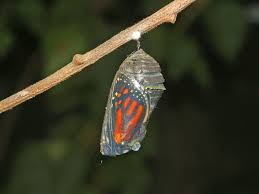
It can be hard to trust the change as it is happening. It is that in between time of no-longer and not-yet. For many years I have heard encouraging descriptions of the caterpillar-to-butterfly metamorphosis. Change and transformation are not only possible, the experience is magical and beautiful. Just look at that butterfly! Let go of what was and embrace who you are meant to be; who you are becoming!
But as anyone who has experienced being a teenager can tell you, becoming yourself is not easy. As anyone who has transitioned their gender can share – if you are respectful enough to stop and listen – transformation is not a simple process like flipping a switch.
More recently I’ve been reading about how in the chrysalis, the caterpillar does not just sprout pretty wings – it must completely dissolve itself down into goo before reforming into a butterfly. This goo-phase, this chrysalis space, is what I’m talking about this morning. The goo-phase: in which we are no longer a caterpillar but we are certainly not yet a butterfly. It can be hard to trust change as it is happening.
Paul Tillich was a 20th century Existentialist Theologian I studied significantly while in seminary and beyond. His theology takes psychology seriously, for example. So, I find his work helpful when taking about topics like growth and transformation. Tillich writes about the relationship between growth and chaos, saying this:
“Nothing that grows is without form. The form makes a thing what it is … Every new form is made possible only by breaking through the limits of the old form. In other words, there is a moment of ‘chaos’ between the old and the new form, a moment of no-longer-form and not-yet-form.” (Tillich, Systematic Theology Vol. III; p 50)
Here’s a fascinating thing: for the caterpillar, it is obvious when they are in this time of transformation. For people, it can be hard to spot. When you or I or someone you know is in goo- phase, there is no cocoon or chrysalis. We don’t have the silky pouch or hard shell around us as we go into the goo-phase. Instead, it looks like this: we are waking up in the morning, brushing our teeth, checking our email, going to work or to school. Or whatever it is different people do during an otherwise normal day.
The chrysalis space for us looks a lot like a normal day to someone else. There may be some outward signs in some cases, some clues might appear – but not necessarily. One clue is this: when I was in the goo-phase of my identity as a young adult, there was a lot of chaos around me. Chaos is a clue for when a person is in a chrysalis space.
Often the message I hear – and in my experience this holds true – is that the struggle is worth it. The goo-phase is a time of uncertainty, chaos, and disorientation. But it is worth it. The chaos is present during small changes, and when we undergo large changes – transformations – the chaos scales larger as well. And the transformation available in the chrysalis space is worth it.
In her book Trusting Change, my UU colleague Karen Hering talks about how we can find our way through personal and global transformation. The first step, she says, is finding the courage to start. To illustrate, she tells the story of going down into the unfinished basement when she was a child.
“A single lightbulb hung from the ceiling in the middle of the room, but the only way to turn it on was by pulling the string dangling from it at least eight feet from the doorway. I had to move fully into the darkness to reach it, reluctantly letting go of the door jamb as I did, feet stepping cautiously, arms flailing in from of me, sweeping the shadows to find the light’s string.
“This is the feeling I often get when embarking on any creative project.” (p21)
Usually, these conversations are about personal transformation. We talk about personal growth and the creative process. And I don’t want to make every sermon about the current political situation, but let me offer just a short bit about how the same dynamic we recognize on a personal level can also happen on the macro scale.
In recent years I’ve heard some of my radial progressive friends proclaim that the whole political show is corrupt, not just the left or the right, the red or the blue – everything. These friends advocate tearing the whole system down and starting fresh. While I understand this concept and – to an extent – agree with the theory. I don’t trust it in practice.
Because, it feels a bit like the current administration is attempting to do exactly that. They are not just moving the deck chairs; they are making dramatic changes with far-reaching and long-lasting consequences to fundamental aspects of our political system. Politically, we are in or at least approaching the goo-phase.
It can be hard to trust change as it is happening. But I’m not sure it is a good idea to trust these changes. What is the basis for my assessment? Am I just playing politics and supporting ‘my team?’ Or is there something about these changes that prompts me to be untrusting?
Progressive politician, Pete Buttigieg was talking with a late show host this past week and said this about the changes happening in the government workforce and their structures.
“The randomness is the real problem. I would be the first to say […] that there are some things in the government that need to be shaken up, that need to be changed. We worked a lot on that when I was there. […] We took whole departments and took them apart and put them back together, and actually some people had to be let go as part of that process. But it was a careful process to make sure we could serve people better. This is not that.” (March 5th, 2025 – Late Show with Stephen Colbert) https://www.youtube.com/watch?v=fVNKasTrY_4&ab_channel=TheLateShowwithStephenColbert
Buttigieg describes a careful process of change. What he describes is the regular, slower work of government. He is arguing against the radical, transformative chrysalis space of change for our national government. And I am mostly persuaded by that argument.
Part of the trouble, I think, is that not everyone consented to get into the goo our current national administration is trying to create. For a communal version of such transformation, it needs to be rooted in mutuality and it doesn’t necessarily need to be slow, we do need to move at the speed of trust – so that we’re together in the work and less harm is inflicted on the vulnerable among us. Communal transformation is as much a risk as personal transformation, and it takes a shared goal and mutual flourishing and trust.
Not all goo is the goo of transformation. Sometimes it is the goo of destruction, with no magical metamorphosis following after. There are countless examples in nature of a hungry organism digesting another organism into a goo.
Here’s a fascinating thing: Biologists know a little bit about what is going on during that metamorphosis inside the chrysalis. We’ve known for centuries that there are a few things that do not dissolve into goo during the transformation. Biologist talk about Imaginal Discs that have all the information about the butterfly anatomy ready and waiting inside the caterpillar. During the transformation, when most the caterpillar’s body is digested down to goo, the latent Imaginal Discs awaken and begin to form the adult butterfly.
In other words – there is a blueprint, a map for where the organism is headed. This is a critical element to being able to trust change as it is happening. It makes a big difference to step into uncertainly and chaos if you know the transformation is taking toward a place you plan to go.
As Erik Martinez Resly tells us in our reading this morning. “The question is not whether we will get lost in life, but rather how we will move through it in faith.” https://www.uua.org/worship/words/reflection/found-while-lost And as we may recall from a sermon I gave a few weeks back – faith is not about trusting when there is zero evidence. Faith is about believing in love even when love hidden or masked, and we decide to believe in love anyway.
Resley reminds us that we will always have times in our lives when things fall apart, when relationships sour or at least fade, when work grows dissatisfying, when we are disappointed. When whatever we are doing is no longer working. We become “disheartened, dispirited, we feel disoriented. We get lost.” And then he writes this sentence: “The question is not whether we will get lost in life, but rather how we will move through it in faith.”
Resly frames this whole reading as the entrance to the labyrinth. I think that is an important framework when we talk about trusting change. We may need an ending, but we can’t simply end. We must also enter the labyrinth – we must begin.
In Alice and Wonderland, Alice has this conversation with the Chesire Cat:
“Would you tell me, please, which way I ought to go from here?”
“That depends a good deal on where you want to get to,” said the Cat.
“I don’t much care where–” said Alice.
“Then it doesn’t matter which way you go,” said the Cat.
“–so long as I get SOMEWHERE,” Alice added as an explanation.
“Oh, you’re sure to do that,” said the Cat, “if you only walk long enough.”
This is often paraphrased (and then attributed to Lewis Carrol) as: “If you don’t know where you are going, any road will get you there.”
Most often we are prompted to embark on a change when we recognize a need to end, to leave, to stop something that is no longer working or is harmful or simply does not bring joy the way it used to. But to really step into change and trust that process, you need to be headed somewhere. You need to know where you are going.
When we are in the chrysalis space, whether we are in it personally or sharing it communally or witnessing it in someone we love, the greatest question is not if we will get through the transformation, but how. To make it through and emerge as a butterfly, it is not enough to simply dissolve everything to goo, we must also have our metaphorical Imaginal Discs. We must not only leave behind the no-longer; we must also reach toward the not-yet. Pay attention to what is growing, not what is dying.
It can be hard to trust the change as it is happening. But trusting the change is key to the path through the change. The chrysalis space is certainly chaotic and disorienting. We can feel lost. But the way through is like reaching out in the darkness for that pull string to turn on the light. It takes courage and discernment. Trusting the process we are in, trusting that we have the tools and powers we need to see our way through to reach the goal we are after.
In a world without end
May it be so
Berries of Abundance
Berries of Abundance
Douglas Taylor
3-2-25
Sermon Video: https://youtu.be/V-DreMzzl1A
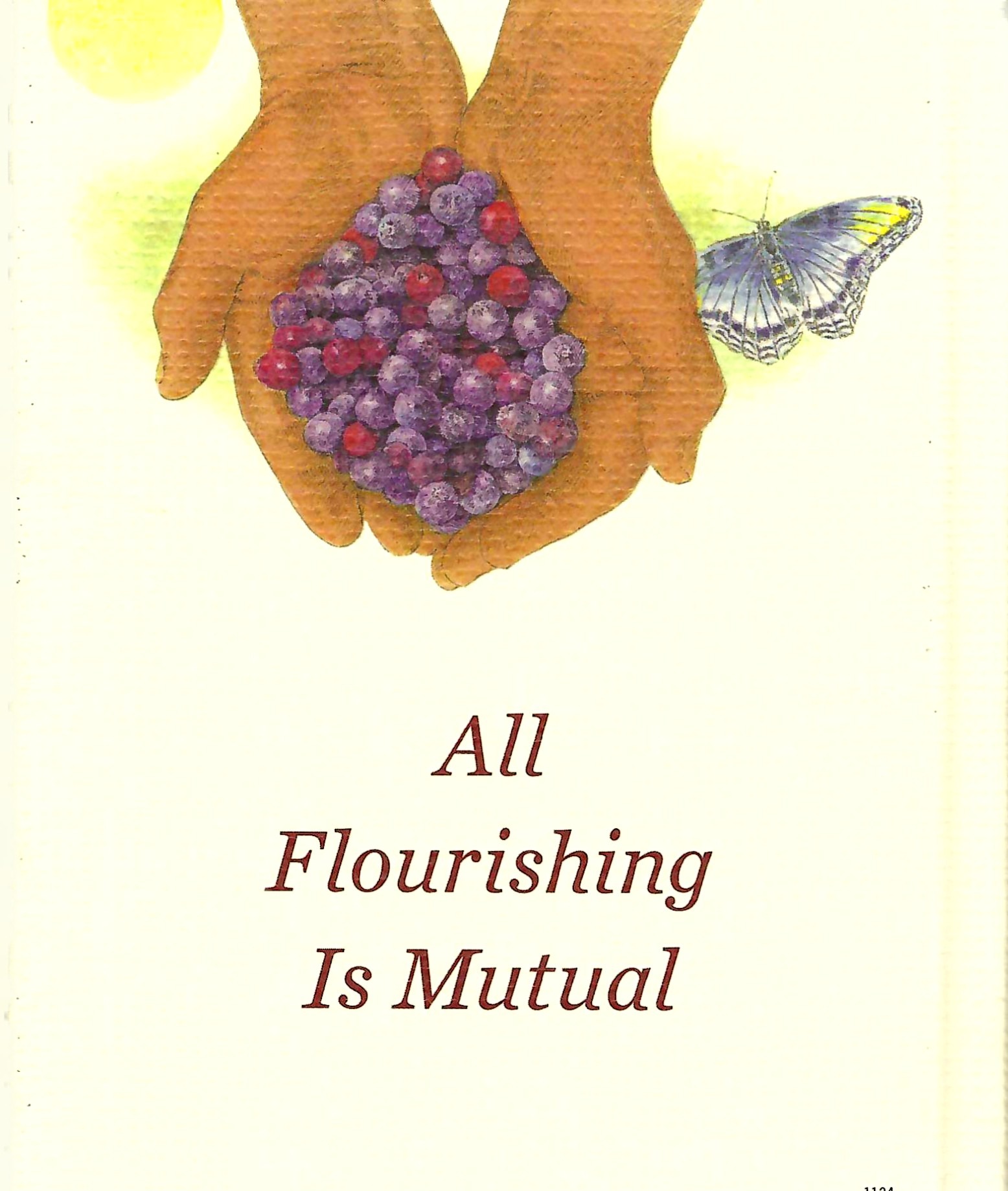
This morning, I invite us to imagine our congregation as an abundant berry patch. Dr. Robin Wall Kimmerer’s latest book The Serviceberry describes a natural world of abundance and reciprocity. She uses berry bushes to highlight the way a Gift Economy works. Our congregation runs on the model of a gift economy. We are flourishing and all flourishing is mutual. We are like a berry bush in full season.
Do you like berries? Do you have a favorite berry? Maybe strawberries or raspberries? I’m partial to blueberries myself. Do we have any cranberry fans? How about lingonberries or huckleberries?
Renown storyteller Joesph Bruchac (brew-shack) tells the story of the First Strawberries. And, I love this story. In this Cherokee tale, the Creator made the first man and the first woman at the same time so neither would be lonely. They marry and are very happy together. The story, however is about their first argument and the berry that helps them reconcile. The story says the man returns home after hunting and finds the woman has not prepared a meal, instead she is out picking flowers. He gets angry. “I am hungry” he says, “Do you expect me to eat flowers?” She also gets angry, “Your words hurt me. I will live with you no longer.” And she walks away.
A chase ensues, but she is a faster walker than he is. He tells the Sun that he is sorry but can’t catch up to her to tell her that. So the Sun takes pity on him and puts berries in her path to try to tempt her to slow down.
The Sun makes raspberries to grow. She pays the no attention. Blueberries, she walks on by. Blackberries, still nothing. Finally: strawberries. She sees them, stops, tastes them – and oh they are good. She starts collecting them to share with her husband. He catches up to her and apologies, they share the strawberries and all is well. And that’s why we have strawberries.
“To this day,” Bruchac concludes, “when the Cherokee people eat strawberries, they are reminded to always be kind to each other; to remember… friendship and respect are as sweet as the taste of the ripe, red berries.”
Other stories from myth and folklore relate the origins of berries, yes. There’s often magic involved, or some divine power. But I love this one about the strawberries because it also teaches us about kindness and a path toward reconciliation. Strawberries are a gift.
Robin Wall Kimmerer, in her book The Serviceberry, writes about berries as part of the Gift Economy of nature.
This abundance of berries (she writes) feels like a pure gift from the land. I have not earned, paid for, nor labored for them. There is no mathematics of worthiness that reckons I deserve them in any way. And yet here they are – along with the sun and the air and the birds and the rain.
Our congregation is like a berry bush in full season. All that we do is offered up as a gift. You don’t incur any debt by attendance on a Sunday morning. The berries are ripe and ready for you, all you need do is show up and they are yours. The berries benefit from being eaten, that’s how nature works. The energy needs to keep flowing, the gift needs to keep moving.
In the book, Dr. Kimmerer talks about her farmer neighbors, Paulie and Ed, who plant some Saskatoons – a western variety of this berry that goes by many names: Juneberry, Shadblow, Sugarplum, Sarvis, Chuckley Pear, Saskatoon, and Serviceberry. “Ethnobotanists know,” Kimmer writes, “that the more names a plant has, the greater its cultural importance.”
This pail of Juneberries represents hundreds of gift exchanges that led up to my blue-stained fingers: the Maples who gave their leaves to the soil, the countless invertebrates and microbes who exchanged nutrients and energy to build the humus in which the Serviceberry seed could take root, the Cedar Waxwing who dropped the seed, the sun, the rain, the early spring flies who pollinated the flowers, the farmer who wielded the shovel to tenderly settle the seedling. They are all parts of the gift exchange by which everyone gets what they need.
She writes about how Paulie and Ed, her farmer neighbors, planted those Saskatoon bushes – and the first season the berries were harvestable, they put out a call for a free ‘pick-your-own’ day for anyone.
Paulie and Ed had put in real labor, had invested money to buy, plant, and care for the trees. But when the berries were ready the first event was free. They broke the rules of capitalism and shifted those berries into the gift economy. Ed and Paulie’s goal was to build relationship in the community around them.
Kimmerer goes on to say that gratitude is the appropriate response to the abundance. “Well,” [Paulie] said, “They are so abundant. There’s more than enough to share and people could use a little goodness in their lives right now.” (p87-8)
Have you experienced something like this? Maybe you can recall time spent with friends when you were nourished body and soul yet needed no debit card at the end of the evening to pay for all you received. You simply received the gifts of love and nourishment. How wondrous. Gratitude is our natural response to abundance.
Reciprocity follows. Kimmerer’s book is subtitled, “Abundance and Reciprocity in the Natural World.” Reciprocity comes in many forms, offered in return through gratitude for the gifts we have received.
Reciprocity is not to be confused with a quantified exchange of some sort. There is no obligation taken on by receiving the gift. There is an exchange, but there is no payment required. There are no receipts. Instead, it is something dynamic in which the gift keeps moving. As Kimmerer writes: All flourishing is mutual. We all get what we need in the exchange.
There is an anecdote in Lewis Hyde’s seminal book The Gift, about an anthropologist studying a hunter-gatherer community in the South American rainforest. The researcher saw a hunter bring home a large kill, more than he and his family would be able to eat. The researcher asked the hunter about how he would store the excess. The hunter was confused by the question. He threw a feast and invited the neighboring families, and every morsel was eaten. The anthropologist assumed the smarter tactic would have been for the hunter to store the meat for himself. The hunter responded, “Store my meat? I store my meat in the belly of my brother.” (See pp 31-2 of Serviceberry)
Our congregation runs on the model of a gift economy. We are like a berry bush in full season. I’m not going to stop. We are here to be a berry bush so you all better be ready for a feast because there is no better place to store the excess of our care than in you. Where is there flourishing in your life now?
When you hear an invitation into our stewardship campaign, you are being invited to take part in caring for the berry bush, that it will continue to flourish for all of us.
Yes, we’re talking about money, but also talking about so many other things – the safety we are creating together, the awareness and education, the warmth of community, the joy and laughter, the rituals and blessings, the rest and the resistance. All of it is the berry bush and your reciprocity is yours to discern. What gift do you offer? What is your favorite berry? Where is there flourishing in your life now?
We have an insert in the order of service with that exact question. You are invited to write a response and turn it in so we can post our answers. Where is there flourishing in your life now?
Perhaps we will bless each other in the natural abundance of our care.
In a world without end,
May it be so.
 Rev. Douglas Taylor