
Start with the Science

Start with the Science
Rev. Douglas Taylor
10-24-21
Sermon video: https://youtu.be/0jCN8x6HGR4
This past spring, while the pandemic was surging and our building renovation was about half done, I was invited into conversations with some theologians and philosophers in California through the Claremont Center for Process Studies. It was pretty cool to get that invitation. I felt a bit like the country doctor invited to sit in at a medical symposium in the big city.
It was enjoyable for me to reengage with Process theology again, to learn a bit more about it all. One piece I found most interesting is the Faith and Process goal of expanding the conversation beyond their usual Christian circles. Process Theology began within Christianity. I have appreciated that goal because I have the same goal. And I was included in their circle as a Unitarian Universalist because of that goal.
I recall an informal conversation at one point when several of the regular attendees were talking about how they were confused by the Unitarian Universalist Atheists in our mix. They had heard we UUs were excited about the version of Process Theology that did not have a God component. And they wondered together how that could be. How could you remove God from Whitehead’s basic theology?
Well, I was excited by this question. I think, in that informal chatting moment, I said something in response, but not anything all that helpful. I remember saying something about how I have seen a non-theistic version of Process Theology that makes a lot of sense. And that several people in my congregation have talked about it. And I may have said at the time that I felt the secret is to start with the science and go from there.
Of course, before I go into detail about that, I need to give a little context. Process Theology is a modern theological offshoot of liberal protestant theology. It says that everything is in process, changing and becoming. The world, the universe, is wholly and fully natural and creative. The implication here is that God, also, is in process, is changing and becoming. In Process Theology, God is not outside of the universe. God is not immutable or supernatural. This is a God who is not judgmental or controlling; instead, God is creative and loving and part of the unfolding natural universe.
You’ll notice, perhaps, the description I’ve given is very God-centric. Fair enough. Here are some key characteristics of Process Theology that are not about God: Everything in interconnected. Everything is part of the natural universe. Human beings have full free will, there is no determinism. And the biggie: events are the primary building blocks of the universe, not substances. That last one about events is where the real fun and notable distinction settles in.
The father of Process Theology is Alfred North Whitehead (1861–1947). He trained in mathematics, logic, and science, but he had a spiritual bent. He developed his metaphysics about 100 years ago.
His theology was rooted in the modern breakthroughs of physics and science which had undergone seismic shifts leading up to his lifetime. In the 1600’s the church served as the custodian of science. The Holy Roman Church provided a complete worldview for science that remained safely within the framework of biblical teachings. But with Copernicus, Bruno, and Galileo, the church began to lose it’s hold on the scope of scientific exploration. From that time through to Darwin’s theory of evolution in the nineteenth century, scientific inquiry continued to break free from the church’s control.
So in the early 1900’s, when Newtonian Physics began to crumble under Einstein’s explorations, Alfred North Whitehead took a remarkable step. Instead of letting his science be confined within his religion, he let his religion be confined within his science.
Science was revealing some very interesting possibilities about the basic foundation of reality as we know it. And this circles back to that key idea in Process Theology about events being the primary reality rather than substances. This is an idea rooted in physics.
We tend to think of things as things, as substances. Traditional philosophy and physics talk about how the universe is made of substances. We are organisms made of organ systems which are made of tissues which are made of cells which are made of molecules which are made of atoms which are made of sub-atomic particles. As Physicist Richard Feynman once said “All things are made of atoms.”
But ‘things’ are not all there is to the universe. Yes, all things are made of atoms, but there is also energy, for example. In his book A Short History of Nearly Everything, Bill Bryson writes:
“It is a slightly arresting notion that if you were to pick yourself apart with tweezers, one atom at a time, you would produce a mound of fine atomic dust, none of which had ever been alive but all of which had once been you.”
Energy is not a substance, not a thing. It is what exists between the things or in them perhaps, I don’t really know. But the relationship dynamic is essential. It is what makes that ‘mound of fine atomic dust’ into you. The relational interaction of the parts is what matters, (pardon the pun.)
The basic building blocks of life are not the things, but the relationships among the things. I am essentially, in physical terms, an organism of about 50 trillion cells. Each cell is differentiated into the various tissues and organs that make up the ten major systems of my body. But ultimately the important part is not any of those individual cells. The important part is the collection of relationships those cells have which comprise me.
There is a second big piece I need to add here to make sure we get where we are going this morning. A huge piece of Process Theology is our free will. Tying this back to the conversation about God, this comes out as God not being ‘all powerful’ and in control of the universe. We are really free to make choices about our lives. This comes out in the physics as well. The deeper scientists get into experiments trying to predict the orbit of an electron in an atom, for example, the more they are confounded because subatomic particles so often behave in very weird, almost chaotic ways. Expanding that up to the human level, and we’re talking about free will, choice, and agency.
So we have these two big ideas found in modern physics and in Process Theology. One idea reveals interrelatedness, that the interaction of events is the essential element of life. The other idea that life is not predetermined, the between chaos and agency, we have free will to make choices in our lives.
Now let me tell you about ‘the lure.’ Because without the lure, everything is random and purely chaotic and yet somehow there is life.
In process Theology, God’s power is not a matter of control or dominance. God can’t make anything happen. But God is a loving power, a transformative power. God is persuasive, not coercive. God lures us toward the good, toward love, toward justice.
When we talk about how the arc of the moral universe is long but it bends toward justice … in Process Theology it would be bending because God is luring us to behave in more just ways. But in every case, it is up to us to be just.
You can think of the timeline of your life like a tree in winter. The trunk is a single line showing what has already happened, it is written. The rest of what will happen in your life has many branches of possibilities. In some theologies, God has already determined your whole life and this tree metaphor is more like a simple telephone pole to demonstrate that God has already written everything. It’s predetermined.
Process Theology strongly disagrees with that idea. Process Theology says instead that God is luring you to follow one branch in particular, but it is up to you to do that or not. When we talk about ‘living your best life’ it suggests there is a version we can choose that is better than other versions. We have options. And, we are drawn toward certain options. It is God luring us toward being and just and loving.
That is Process Theology. There is, of course, a great deal more to it, but for our purposes this morning, this is Process Theology. Events and experiences are the root element of reality. We are free to choose our path. And there is a lure toward being our best selves.
And for most people, the source of that lure is God. So how do you have Process Theology without God. Certainly, you can still have an honoring and recognition of events and experiences, of free will, even of the centrality of change in life. But how do you not include God?
I can imagine three ways to do it. I can imagine three different ways to hold a Process Theology perspective without a god element. Without there being a divine ‘will’ serving as the lure toward the good.
First, we can keep a purely atheistic and naturalistic perspective. This keeps every explanation about life solidly in the realm of science. We have found that Biology, Psychology and Sociology can provide a lot of insight into what we call “good.”
Most people want to be good people. That’s just how we, as social creatures, are. There are other forces in us that are destructive or divisive. We can see that and we can understand the value of goodness without it being entangled with some concept of God. For some people that’s enough.
Next, we can take a sematic pass on the question. We won’t use the word “god” but might refer to something like Life with a capital “L,” or the Holy with a capital “H.” This is a substitution that puts some distance from the word “god” because whatever it is we mean; it is not what most people think of when we use the word “god,” with a personality and maybe a thunder bolt. Certainly not.
And this is not merely pretending we’re not talking about God, either. This about trying to avoid the assumptions too often tangled up with the language. It is an attempt to include certain characteristics and not others in this conversation about the holy. And for some people that’s enough.
And then there is a third option. We can just talk about a mystery, an unknown. It is to acknowledge that what we know now does not yet satisfy us, but doesn’t mean we need to jump to using the word God to cover whatever we don’t understand.
There seems to be a lure. In my experience I am drawn to behave with compassion and I want to be just and good and kind – even when I am not good at it, I want to be. Why? Not sure. And for some people that’s enough.
Now, I say all that as someone who does believe in God. I am not trying to suggest you should or should not believe in any of this. I am instead suggesting you work out your own understanding as best you can in keeping with your experiences and your faith.
We are interconnected and dynamic and always expanding. We grow and learn by asking more questions and testing what we think we know. So, explore. Consider how you are drawn to behave, how you might feel a tug to be in the world in a certain way. Consider the lure to being good.
Process Theology asks us to keep seeking, to let science define the natural world while we stay true to that knowledge. And it asks us to allow the love that is God to lure us into a better way of being in the world.
And some people, it is enough to simply follow the lure; to live justly, to offer compassionate mercy, and to follow your path with humility in the face of all that is holy.
In a world without end,
May it be so
Punishing the Poor

Punishing the Poor
Rev. Douglas Taylor
10-10-21
Sermon video: https://youtu.be/OiJnp10sb0o
I remember a Junior High school curriculum our congregation used a decade or two back as part of our Religious Education program. It is called “Living in UUville” written by Rev. Jeff Liebmann. In this curriculum, students work together to build a town based on our Unitarian Universalist principles. It involved a little roleplaying which was an extra bit of fun. The students actually create a school first, a town in later sessions, and work up to creating a country and ultimately a global community – all based on our UU principles and values.
Each class had to figure out different things together. What laws would we put in place? How would we structure your school system? What would our tax policy look like? How would our values of interdependence and compassion play out in creating UUville? It is interesting to think about.
Would we have a police department in UUville? What would we do with lawbreakers, with liars or murderers? What training would our UU principles and values require of people becoming police officers? What obligations would law enforcement have in UUville? How would we deal with fear-mongering or disinformation campaigns? What would it be like to be poor in UUville? It is interesting to think about.
In our reading this morning, Dr. Takiyah Nur Amin, a lay-leader in Unitarian Universalism and scholar of dance in her work-life, reminded us that:
“In every moment, life is giving us an invitation. I really believe that; I really believe that in every moment, life is giving us an invitation to do the things that are the most loving and life-affirming.”
She says we have this invitation from life and that our Unitarian Universalist faith calls us to respond to this invitation in a particular way. She writes:
“That is a part of the call: the mandate of what it is to be Unitarian Universalist: to figure out how we live together in loving, equitable, just relationship with each other.”
As we ponder what laws we might create and what a police force may look like in UUville, we will do so with a goal of “liv[ing] together in loving, equitable, just relationship.”
We are not the only ones looking at our police departments and wondering if there might be another way to do that work. Since the killings of George Floyd and Breonna Taylor last spring, there has been a call to defund the police. Defunding the Police is a slogan and it means slightly different things depending on who is saying it. In some versions Defunding the Police is just an effort to halt the acquisition of military grade equipment. In other versions, it is a step toward abolishing the police altogether. Most people are aiming for something in between. More than a solution for a single problem and less than burning the whole thing to the ground.
Ultimately, however, all versions of this rally cry are rooted in a recognition that something is off, something is broken in our police departments, something needs to be done to realign our police with our better values as a nation.
In his influential book Between the World and Me, Ta-Nehisi Coates writes this about the police:
“You may have heard the talk of diversity, sensitivity training, and body cameras. These are all fine and applicable, but they understate the task and allow the citizens of this country to pretend that there is real distance between their own attitudes and those of the ones appointed to protect them. The truth is that the police reflect America in all of its will and fear, and whatever we might make of this country’s criminal justice policy, it cannot be said that it was imposed by a repressive minority. The abuses that have followed from these policies—the sprawling carceral state, the random detention of black people, the torture of suspects—are the product of democratic will.”
In short – the situation we are in is not an aberration. Our situation is the product of the principles and values that were in place as we created the modern policing system. What we need is a systemic transformation, to reset the way we do things. And, that is a lot to expect. It is almost impossible to make that level of change. Yet that is what we really need.
So, when I find myself in the middle ground on this conversation, I am still aiming for systemic transformation. I am not ready to throw in with the call for full abolition of the police departments. And I don’t want to stop at just halting the radical militarization of our police. That militarization in both attitude and in equipment concerns me. But that’s not all I think we need to deal with just that is not enough. So, I am in that middle camp calling for defunding.
There was a scene in one of the recent Batman movies, I don’t recall exactly which one, but the bad guys are making a move on Gotham City and they come in with a tank and the police are like “Oh, no! They have a tank!” And that’s why they needed Batman to come in and help them. But it’s ironic because so many city police departments have their own tanks now. It is as if the police departments are trying to equip themselves better than Batman.
It is interesting to notice, the original TV Batman in the late 60’s featured a superhero who was super not because he could fly or had a ‘magic lasso of truth’ or could turn into a big green monster. He was super because he had amazing gadgets. So, what do we do fifty years later when the average city cop has access to the same level of equipment?
The Binghamton Police have a tank. How much longer before they have armed drones? Ponder that for a minute.
Armed military drones have had a dramatic impact on how our modern military operates, as well as on the devastating levels of civilian casualties. It was reprehensible during the Obama administration to witness the normalization of drone warfare. And predictably, during the administration after that, the use of armed military drones escalated dramatically. And now, with Biden, already the casualties from drone attacks are in the news. But for today, my concern is less about which political party is worse on this count. I have an opinion about that, but that’s not my point. My concern is more about how long before our police departments are using armed drones.
Don’t get me wrong, I’m not against drones per se. We could use drones and traffic cameras to eliminate the need for police to physically issue traffic tickets. Imagine how many black and brown people would be saved if we didn’t need human beings pulling people over. We could just send a ticket in the mail the way they do on interstate 90 if you don’t have an EZPass. I’m not against better technology. I just don’t want our police officers to be decked out with tanks and armed drones. Dictators use their military against their own people. When we arm our police in the manner of a military, we are courting dictatorship.
But that’s just the starting point. Defunding the police, in my mind, is not just a call to halt spending on certain equipment, it is also about what we do want to spend the money on instead – better training, more unarmed responders for non-violent situations, more community-building and trust-building efforts. It is about a cultural change in the attitude of officers and the public in general.
There is a split along racial lines about how the police are generally viewed. It is like there are two different experiences of the cops – white people like me tend to view the police as a source of protection. People of color tend to view them as a source of danger and oppression. It is as if the police have two different ways to dealing with the public.
I heard one analysis suggesting the Police are behaving more like warriors and less like protectors. A protector would seek to keep all the people safe – at least that’s the way I hear the distinction in this analysis. Our UU values call for protectors. Warriors, on the other hand, are out to get the bad guys – the goal for them is to catch someone and punish them for wrong-doing. That is not in keeping with our UU values. In UUville, we would train our police to be protectors, not warriors.
Listen to this way to draw that same distinction but with different words. Aberjhani, an American historian and poet, has said:
“On either side of a potentially violent conflict, an opportunity exists to exercise compassion and diminish fear based on recognition of each other’s humanity. Without such recognition, fear fueled by uninformed assumptions, cultural prejudice, desperation to meet basic human needs, or the panicked uncertainty of the moment explodes into violence.” (Aberjhani, Splendid Literarium: A Treasury of Stories, Aphorisms, Poems, and Essays)
Some of the most exciting possibilities in this conversation about Defunding the Police is the talk of funding social workers to respond to non-violent calls. Even the violent calls, as Aberjhani suggests, could benefit from a mindset of compassion and recognition of each other’s humanity, But how much more so for the situations that are not a threat to begin with, but when an armed cop shows up, things easily escalate.
Across our nation over the past year, partly in response to the pressure from activists and protestors, and partly as part of decades long work to change the systems, several cities did cut or reallocate funding from police departments. Austin, Minneapolis, San Francisco, New York City, Chicago, and Baltimore, along with dozens of others.
The exciting shift is to see the impact when the work is shifted away from armed police officers over to other agencies that deploy social workers to respond to situations involving homelessness, mental health crises, and drug addiction related issues.
I certainly understand the critique that taking money away from the police departments will not magically create better police officers. But that critique is based in fear and a seemingly intentional misunderstanding of the goal. The point is not to make the police continue to do everything with less money – it’s not like we are saying we will treat them like public school teachers. No. The message is that we want to move the funding to better align with our values.
So let’s talk about getting rid of Qualified Immunity and watch what happens in Colorado as they work through that reality. Let’s look at the budget of our city and our county and talk about reallocating funds. Let’s debate some of the pros and cons – but let us always keep in mind the values we are using to create this society together. Let us acknowledge that the problematic and harmful conditions in place when we began this country and later when we established what we know as police departments today.
Our Unitarian Universalist values and principles compel us to not just hunker down and hide in the privileges we currently have. Our values and principles compel us to not simply go along with whatever is happening in society around us. But let us not be tricked into thinking our whole faith is merely an argument against the establishment. We are called not be of or against the world around us. Instead, we are called to be transformative. We are called to participate in and advocate for the better values among us to foster transformation around us.
Step into the conversation. Ask more questions. Drill down to our values of compassion, justice, peace, and love. Let those values focus your thinking and your actions. We are called to be transformative. We are called to participate in and advocate for the better values among us to foster transformation around us.
In a world without end
May it be so
Spiritually Promiscuous

Spiritually Promiscuous
Rev. Douglas Taylor
10-3-21
Video: https://youtu.be/T26rrK6XRIg
Annie Dillard has a way of writing provocatively. She often tackles themes of God and the natural world, spirituality and suffer, in her works. We Unitarian Universalists have something from her in our current hymnal (SLT #420); something that can be used as opening words. It is from one of her early works:
We are here to abet creation and witness to it, to notice each other’s beautiful face and complex nature so that creation need not play to an empty house.
The word ‘abet’ is interesting. It is usually a term with a criminal implication – to aid and abet a crime. It means you didn’t actually do the crime but you were a willing participant in the crime happening, that you assisted.
Dillard says we are here to abet creation. You did not do creation yourself, but you helped, you were a willing participant. Dillard is very good at creating a provocative image with her choice of words.
Annie Dillard is also the inspiration for my title today. She used the phrase “spiritually promiscuous” to describe herself when she was in her 30’s. At first blush, this feels like a good descriptor for many Unitarian Universalists including myself. I partake in multiple spiritual sources as part of my search of the intimate and ultimate values in life. I’ve long identified with Dillard’s work, and not just because we share a birthday.
I must admit, however, the word ‘promiscuous’ may be off-putting. It is Dillard, again, being provocative. The word promiscuous suggests a lack of commitment, a frivolous rather than serious exploration of the matter. We Unitarian Universalists have been accused before of being ‘a mile wide and an inch deep;’ meaning we will take in a lot of diverse sources of spiritualty but not go deep with any of them. The critique is that we UUs are dabblers and tourists in other people’s deep faith traditions. I confess, there is a cautionary note worth hearing in this assessment. It is not an unfounded critique.
I would argue, however, Annie Dillard’s exploration of spiritualty has never been shallow or lacking in commitment. I would further argue that our free and responsible search for truth and meaning must likewise have depth and consequences, and my own experience has been so. We ought not be dabblers in the intimate and ultimate matters of life.
All the same, I will continue along my original line of thinking which this provocative phrase “Spiritually Promiscuous” has sent me along. The spiritual heritage of world’s faith traditions has nourished me well over the years. As it has many of us, I am sure. As Unitarian Universalists, we lean into a multiplicity of ways to be spiritual, and find teachings and lessons along the way as we work to become better people, truer to the promptings of the Spirit, more awake and aware.
This past week my neighbor complimented me on the article we had in the local newspaper about our renovations and the way our congregation navigated the pandemic. He said he had spent some time on our website and my own site where I post my sermons. He said he liked the way I described myself on my website as a Buddho-Humanist, Christo-Pagan with occasional bouts of mysticism. It caught his attention and made him think.
His compliment got me thinking, too. Annie Dillard is not the only one out there trying to be provocative. But what if I am serious? What if that clever line about being a ‘Buddho-Humanist, Christo-Pagan with occasional bouts of mysticism’ is not just a way for me to say ‘I can’t decide so I’ll take all the flavors.’ What if I mean it? Allow me to unpack my spiritual promiscuity this morning.
While it is not always my own personal starting point, let me begin with the pagan side of my spirit. In a meditation about calling the Four Corners, my colleague, Julia Hamilton writes this:
In the pagan tradition, which is grounded in a respect and reverence for the natural world, calling upon the four directions is the usual way to begin any ceremony. Each direction is associated with an element of the natural world, and represents some part of our human nature as well. The directions are not seen as separate and isolated, but rather as part of the interdependent system that makes up the world…
We have moved through these four directions, given them shape and meaning:
East: Air, breath and inspiration.
South: Fire, transformation and action.
West: Water, feeling and reflection.
North: Earth, balance and wisdom.
I need to be out in nature to stay grounded and balanced in my life. I often experience inspiration and reflection when I take myself out into nature, when I associate with the elements of the natural world. Being in nature helps me become a better person, and hopefully a better minister. It helps me be at peace and happy.
And when I say that, when I talk about being at peace, my mind is drawn toward another tradition and a different practice. Vietnamese Buddhist Thich Nhat Hanh wrote quite a bit about having peace and being at peace. He did not find peace being out in nature, he found it through meditation. I find his writing illuminating. Here is a small meditation he wrote entitled “Being Peace.”
Being Peace
If we are peaceful,
If we are happy,
We can smile and blossom like a flower.
And everyone in our family,
Our entire society,
Will benefit
From our peace.
We can be at peace and we can be happy; and our peace and happiness can have an impact on those around us. I often try to pair this idea with something I hear a lot from a non-theist or Secular Humanist perspective which says when we are grateful, we become happy, not the other way around. Happiness does not lead to gratitude. Gratitude is what leads us to happiness.
And from there I swing into some the Christian and Jewish ethical traditions which say having peace and gratitude is borne out of being in a community of justice and prosperity. It is not something one can do alone; one becomes free only in community. Gratitude and happiness and peace are all relational experiences, communal practices.
And that thought circles me back Mahayana Buddhism, which talks about how full enlightenment is an unachievable goal until all sentient beings are ready and we can all transcend together. It is a communal practice. Meaning no one person is ever fully enlightened, but one person can become more enlightened. As philosopher Ken Wilbur once wrote, “You are never ‘fully’ enlightened, any more than you could say that you are ‘fully educated.’ It has no meaning.” (Wilbur, Ken, A Brief History of Everything p216)
I find my spirituality is a blend, a weaving of various traditions and multiple voices. I value the lessons I find in Secular Humanism as much as those I find in Paganism, and they are intwined for me. In many ways it is because I am striving to be more educated, more peaceful, more just and kind. I will not limit where I seek for wisdom because I always have more to discover.
This perspective of being a seeker is very helpful to me, in part because humility built in to it. Many people get caught up in exclusionary spiritual ideas about being special and chosen and better than others. A healthy spirituality ought to keep me humble. A healthy spirituality ought to keep me striving to be better.
If you have found that following one particular path is what serves for you, then I commend you. I am not suggesting your fidelity is in any way a bad idea. My practice of wandering along many paths is not meant to suggest it is a bad idea to stick to one path. Instead I am suggesting the important part is how you move along your path. Follow one path or many, it is about how you follow.
In Paul’s letter to the congregation in Phillipi, one of the epistles in Christian scripture, we can read advice which outlines what I’m talking about.
Philippians 2:3–4
Do nothing from selfish ambition or conceit, but in humility count others more significant than yourselves. Let each of you look not only to his own interests, but also to the interests of others.
I like the way the second sentence is structured there. It is similar to the phrasing Jesus used when he said “Love your neighbor as yourself;” implying we do need to love ourselves, and in that same way love our neighbors. Look not only to your own interests, but also to the interests of others, Paul wrote.
Unitarian Universalism holds that all the great religions of the world are not in competition for describing the truth. Instead, we see them as different paths toward understanding the ineffable reality interwoven through the human experience. All the religions lift up the various key threads of value found in the human experience: justice and compassion, suffering, hope and renewal. Each share, with their own distinct patterns, practices and beliefs that can make us whole.
Some of the wisdom leads me to prayer, some leads me to working for justice, and some leads me to regain my balance, and some helps me to learn to let go.
In the fifth chapter of the Tao Te Ching, we read:
Countless words count less than the silent balance between yin and yang. The space between yin and yang is like a bellows – empty, yet infinitely full. The more it yields, the more it fills.
What I need in my spiritual life is both the yin and the yang, both the emptying and the filling, the words and the silence. Different practices from varied traditions serve to help me find that dynamic balance.
As Unitarian Universalism, we honor and accept the difference of each individual, drawing on the beauty of our differences to enhance our understanding of life, God, meaning, and truth. Every person experiences and interacts with that which is holy, with the sacred, with God, in the way that fits for that person. Expanding that basic premise, we say that every religious path, when it is travelled with good intention and integrity, can lead you where you need to go.
I’ll close with a final piece from Annie Dillard again. From her book Teaching a Stone to Talk in which she is grappling with prayer and nature and silence.
The silence is all there is. It is the alpha and the omega. It is God’s brooding over the face of the waters, it is the blended note of the ten thousand things, the whine of wings. You take a step in the right direction to pray to this silence, and even to address the prayer to “World.” Distinctions blur. Quit your tents. Pray without ceasing.
May you find, in your searching for meaning and truth, resources from all the world’s scriptures and humanity’s storehouse of spiritual poetry. May you be fed and challenged. And may each day of your searching bring you to a deeper understanding of yourself, of our world, and the grand mystery woven through it all.
In a world without end
May it be so
Uncharted
Uncharted
Rev. Douglas Taylor
September 26, 2021
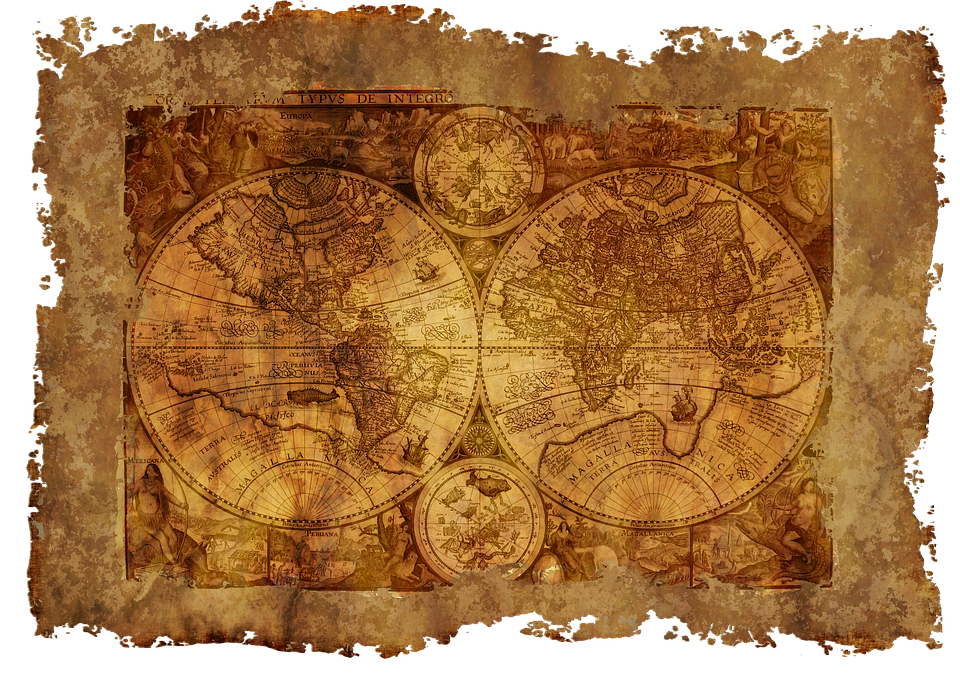
Centuries back, when cartographers reached the edge of the known world on their maps, they occasionally draw a sea monster and label the area “Here there be dragons.” It was a creative way of saying “We don’t know what’s over here.” It was uncharted. There were unknown risks that way. It can serve as a remarkable apt metaphor of experiences like grief and trauma.
I am, of course, going to talk about how this pandemic has been like sailing in uncharted waters. But the metaphor applies for so many other situations of fear and suffering in our lives. Whether it is a personal crisis like illness, sudden job loss, or the death of a loved one; or a more systemic tragedy such an unexpected experience of systemic oppression or an abrupt impact of capitalism run amok – we can be caught off guard and thrown unexpectedly into uncharted waters. This ongoing pandemic is certainly one such example we are all experiencing now. We are off the edge of the map. We are in uncharted waters. Beware, here there be dragons!
Thankfully, many of us have a healthy capacity to manage risk and uncertainty. Many of us can deal with quite a bit, can be resilient, and can reframe things to keep moving forward when faced with trouble. And there are also times when it can be too much, when we can become lost and floundering in the chaotic surge of trauma and uncertain difficulties. I want to talk about what we can do at such times.
During our Time for All Ages this morning, I showed the children an old navigation instrument, a sextant. I talked with them a bit about the geometry involved and how it works. But more, I shared with them how we can ‘find our way’ by the stars and that the stars are like our values, our guiding ideals that can lead us through uncertainty. With the stars as our values, the tools and instruments such as a sextant or a GPS are like the people around us who can help us discern and sort out our situations with us.
When I say we have people around us who can help, I mean a friend or family member or therapist, all good choices when seeking help with your trouble. I would like to suggest someone a little different. I want to lift up an exemplar from history. Historic figures can serve as exemplars with lessons to help us through our troubles. Sir Ernest Shackleton is one such person who is like a navigation instrument for me, helping me understand the impact of my values in a given situation.
If you are unfamiliar with Shackleton, let me offer you this brief sketch of him. He was a polar explorer. He and his shipmates set out to cross Antarctica in 1914. A few years before the Endurance sailed from England, two other explorers had already reached the South Pole within a few weeks of each other. Apropos of my larger point, Amundsen is considered the first man to have reached the South Pole, Scott is considered the second, arriving 5 weeks after Amundsen. But in truth, Scott was not the second, he was the 6th. Amundsen was part of a team of five people to reach the South Pole in December of 1911. History ought to be more attentive to the team rather than just the intrepid leader.
My point in bringing up that small tangent is to highlight how Ernest Shackleton is remembered, not for crossing the continent, but for bringing his entire team back home alive. I don’t look to Amundsen for wisdom in troubled times. I look to Shackleton. When I am struggling with this pandemic, for example, I think on Shackleton and how he brought his whole team home.
It is worth noting, Shackleton was an adventurer. He was not just someone who stayed safe and therefore kept his team safe. “A ship in harbor is safe from the storm, but staying in harbor is not what is ship is for.” Shackleton took great risks, not foolish risks, but certainly risks.
The advertisement Shackleton put out to secure a crew for the endurance is amazing to read today: “MEN WANTED: FOR HAZARDOUS JOURNEY, SMALL WAGES, BITTER COLD, LONG MONTHS OF COMPLETE DARKNESS, CONSTANT DANGER SAFE RETURN DOUBTFUL, HONOUR AND RECOGNITION IN CASE OF SUCCESS.” And with that he had 5,000 people apply. Ah! The call to adventure and exploration! Shackleton was able to pick his crew carefully.
The 28 men aboard the Endurance sailed south from England through the Atlantic to South Georgia Island, a small bit of land near the tip of South America. The ensuing expedition can be considered a trip away from that small island and back, lasting roughly a year and a half. The Endurance left South Georgia in early December 1914, crossed into the Antarctic circle a week later, and about 5 weeks after that, was well and truly trapped in the solid pack ice less than a hundred miles from the continent itself. In all that happened after that, the expedition never reached Antarctica proper.
I find it most interesting that this expedition to cross Antarctica through the South Pole is not remembered by what they failed to accomplish but by the remarkable thing they did instead. They failed to cross the continent. It was another 40 years before a team succeeded in crossing the continent through the pole. What Shackleton accomplished instead, the reason he is remember is that the expedition team survived and made it home. 6 weeks in, he and his team were stuck the remainder of the 18-month story was spent working to get back out alive.
It is very similar to the Apollo 13 space flight in that regard. NASA described the 1970 Apollo 13 mission a “successful failure.” They did not accomplish their original goal and the mission almost ended in disaster, but they survived. The ingenuity, resourcefulness, and commitment of everyone involved made it possible for the astronauts to return to earth alive. They never made it to the moon – that part was a failure. They learn a lot about how to respond to the extreme crises and everyone made it back home – that part was the success.
This is one of the lessons I learn from Shackleton. We should still strive, still take risks, still attempt for the wild and improbable goals. And if it all falls apart, we can step back and make new goals, and keep going.
We are in this pandemic now and our congregation has chosen to take the risk of meeting in person indoors. Many UU congregations are making many different choices in this regard. Some are meeting outside only, others are indoors, in person and online like us, and others are online only.
There is no guiding rule from the UUA at this point because each congregation’s situation is a little bit different in terms of what’s happening in the communities around our congregations and in terms of the needs and ‘capacity for risk’ of the people in the congregation. The in-person component of our worship is a risk we’ve chosen to take at this point. It is good to take risks in life. It is also good to make changes when new information about that risk comes to light. That’s what Shackleton did. That’s what I aim to do. I’m not saying we are making a change to our in-person worship today, but I am saying it is something we know may become necessary.
For now, we – like Shackleton – are settled in to our new normal. For the men on the endurance, the situation was a waiting game. They were stuck in the ice. Shackleton imagined they might have to spend the season there, waiting for warmer weather. That became the new plan, to wait it out. It turns out they were trapped in the ice for ten months, drifting with the pack.
Shackleton had invested a lot of time and energy keeping the spirits of the crew up. He set work for the crew, creating and maintaining a camp on the ice pack as well as keeping the ship in good shape and ready for when the ice broke. He visited with every member of the crew regular. In the evenings they played chess and bridge, sang songs, and occasionally put together events like feasts and skits and a derby.
It was the end of October 1915 when the ship was finally crushed by the pressure from the ice; and a month later it sank. But that’s not the end of their story. We’re only halfway through their tale. The second half of their voyage occurred without their ship.
When the Endurance finally broke apart and sank, Shackleton ordered them to abandon the ship. He said to the crew: “Ship and stores have gone – so now we go home.” Just like that, the plan to wait out the ice with the ship fell apart and Shackleton came up with yet a new plan. They took the three long boats and struck out, dragging the boats across the ice or rowing through the treacherous ice lanes. The ultimate goal remained unchanged: bring the crew home.
That new plan lasted another five months as they made their way north slowly and carefully, Eventually, they reached the end of the pack ice and struck out into the open ocean. They spent another week dodging icebergs and ice floes and made it together to Elephant Island. They set up camp again. Then five of the men took one boat and sailed 800 miles back for South Georgia Island to secure a rescue for the rest of the crew.
All told, it was an amazing journey filled with danger and heroism. Part of what we learn in the story is how we always have another choice we can make from moment to moment. We have within us the capacity to tap into remarkable strength and perseverance. And when we stick together and take care of each other, our chances of success expand.
We have been in a crisis – several crises actually: the Pandemic, fascist attempts to deconstruct our democracy, Institutional Racism pushing against our attempts to bring a progressive vision into reality. Our values lead us to speak the truth about what is happening. Our faith calls us to participate in the struggle, but not get lost in it. There is a lot going on that could cause us to get overwhelmed and lost.
The example of Shackleton reminds us that it is worth it to take risks. Such risks are the heart of living. We are also reminded, however, to not be foolish in our risks; We do well to have our risks tempered by the wisdom of science and guided by the commitment to our communal wellbeing.
Shackleton also reminds us that when we have made a plan and put ourselves into it fully, it is possible the plan will fall apart. And when that happens, our work is to let go of that old plan in favor of new information, to let go and make a new plan.
And most poignantly for this pandemic, and perhaps no less poignant for our nation, the ultimate goal is to keep the whole team in mind as you go. This is heartbreaking to me because so many people have already died from Covid-19. But in my heart, that is still my highest guiding star – to keep the whole community in mind. We may cross the continent, we might not. We may meet in-person from now on, we might not. We may grow as a faith community, we might not. We may dismantle White Supremacy in our culture during my lifetime, we might not. But this I know: we will see each other through this as best we can together. We will take our ship into dangerous and uncharted water. And we will do all we can to bring us all back home.
In the end, Sir Ernest Shackleton summarized the expedition of the Endurance thus:
“We had entered a year and a half before with well-found ship, full equipment, and high hopes. We had ‘suffered, starved and triumphed, groveled down yet grasped at glory, grown bigger in the bigness of the whole.’ We had seen God in His splendours, heard the text that Nature renders. We had reached the naked soul of man”
And I notice we here in our congregation entered this pandemic a year and a half before with high hopes and a well-found building on the verge of being refitted. We’ve not had the harrowing journey Shackleton experienced, but we have had our share of struggle and suffering. Our journey is not finished. But with the wisdom and clarity of such good examples, I trust we will make our way through the rest of this adventure together, ready for what awaits us next.
Be wise, reach out, and stay true!
In a world without end,
May it be so
I Am Because We Are

I Am Because We Are
Rev. Douglas Taylor
September 19, 2021
Archbishop Desmond Tutu related the following story in one of his earlier sermons from more that forty years ago.
There was once a man who was a staunch churchgoer and a deeply committed Christian. He supported most of the activities of his local church. And then for no apparent reason he stopped attending church and became just a hanger on. His minister visited him one wintery evening. He found him sitting before a splendid fire with red glowing coals, radiating a lovely warmth round the room. The minister sat quietly with his former parishioner gazing into the fire. Then he stooped and with the tongs, removed one of those red glowing coals from the fire and put it on the pavement. The inevitable happened. That glowing coal gradually lost its heat, and turned in a while into a grey lump of cold ashes. The minister did not say a word. He got up and walked away. On the following Sunday, the old man turned up in church. A solitary Christian is a contradiction in terms.”
-Tutu, “My Search for God” 1979
When my mother shared with me a version of this same story, she adjusted it a bit so the minister moved the coal back to the fire where it came back to life; a good Universalist edit which I think supports the point of the story. “A person is a person through others persons.”
I stumbled across a delightful Huffington Post article from 2 years back entitled “Why the Phrase ‘Pull Yourself Up by Your Bootstraps’ is Nonsense.” https://www.huffpost.com/entry/pull-yourself-up-by-your-bootstraps-nonsense_n_5b1ed024e4b0bbb7a0e037d4
The article tackles the origins of this phrase used to suggest that gumption and a ‘go-getter’ attitude is all one needs to be a self-made person in this world. By self-sufficiency and determination, you can elevate yourself without the help of others. Of course, this is nonsense.
Our culture has become too enamored with the false idea of the Lone Wolf and the Rugged Individualist. The usual reason a wolf is alone and separated from their pack is not because they are strong loners. They leave their pack because they are mature adolescents ready to form a pack of their own. Being a Lone Wolf is not a symbol of self-sufficiency and strength. It is a symbol of transition. It means you should be looking for a new pack!
And the idea of being a rugged individualist is also a bit bunk. That phrase originates from just before the Great Depression to say a person doesn’t need any help from the government to get by. That kind of ‘go-it-alone’ attitude became inexorable entangled with the stock market crash of ’29 – at least until enough people forgot that part of our history. And are we surprised to find ideas of toxic individualism circulating among modern conservatives given the times we are in today?
But let me get back to the bootstraps. It is not uncommon for an idiom to be a little confusing on face value. Why would anyone ingest hair of the dog that bit you? If someone says they ‘slept like a baby,’ does that mean they woke up every two hours crying? And pulling yourself up by your bootstraps – that is literally impossible. Why would people use this bootstrap phrase to imply that something is hard but manageable?
Well, as it turns out, the phrase was originally used to suggest something was impossible – he might as well pull himself over a fence by the straps of his own boots. It was meant to be heard as an absurdity. The Huffington Post article suggests the shift from describing something absurd to something attainable occurred in the early 20th century. You know, right around the Great Depression and all that.
And this is not simply a historic rant by your pastor against some old-timey bygone notions. These ideas and false narratives undermine our capacity for collective action. The culture of hyper-individualism is hampering our country’s response to Covid-19, for example. Friday evening, I drove past a few dozen protestors with flags and signs saying they would not be guinea pigs and refused to be vaccinated. Crassly, they were protesting outside Lourdes Hospital rather than at city hall as decent protesters usually do.
The image of the Rugged Individualist has a strong pull in our national psyche. This form of toxic individualism gets trotted out as patriotic and lifted up a what helped us build our nation and tame the west. Which is not only blatantly wrong, it is harmful.
In truth, our national culture has been most strongly influenced by the work of teams and of people banding together. The image of a barn-raising is far more indicative of our culture than a lone deputy on the horizon smoking a Marlboro.
I understand the values of personal liberty and independence through grit and resourcefulness. But ultimately our goal here is to build a just and thriving society. At times like this I find it helpful to consider wisdom of a different source on how to be a community.
We could learn a lot from the African teachings of ubuntu as we heard about in the reading this morning. Ubuntu teaches us: “a person is a person because of other persons.” My humanity is caught up with the humanity of every other person. Ubuntu tells us that we need each other and we are all connected. It promotes the greater good rather than individual success. We have strength in our unity. I am not able to be myself without you also being yourself.
Interestingly, when we start to look, we find this idea popping up in all manner of places, running counter to the dominant culture of toxic individualism. The ideas in ubuntu are not exclusive to African philosophy and wisdom.
In his Letter from the Birmingham Jail, Dr. King wrote:
“In a real sense all life is inter-related. All men are caught in an inescapable network of mutuality, tied in a single garment of destiny. Whatever affects one directly, affects all indirectly. I can never be what I ought to be until you are what you ought to be, and you can never be what you ought to be until I am what I ought to be…This is the inter-related structure of reality.”
Many of the teachings of indigenous people of North America offer a similar lesson. The message that we are all children of one spirit, we all belong to Mother Earth, is a message that arises from many of the speeches and teachings across many different tribes and nations. We are one strand in the web of life. Consider the impact of seven generations. We are called to recognize our interdependent place in the grand design.
And from another corner of the globe, Vietnamese monk Thich Nhat Hanh talks about a similar Buddhist perspective which he calls Inter-being.
“If you are a poet, you will see clearly that there is a cloud floating in this sheet of paper. Without a cloud, there will be no rain; without rain, the trees cannot grow; and without trees, we cannot make paper. The cloud is essential for the paper to exist. If the cloud is not here, the sheet of paper cannot be here either. … If we look into this sheet of paper even more deeply, we can see the sunshine in it. If the sunshine is not there, the forest cannot grow. …. And if we continue to look, we can see the logger who cut the tree and brought it to the mill to be transformed into paper. And we see the wheat. We know the logger cannot exist without his daily bread, and therefore the wheat that became his bread is also in this sheet of paper. …
“When we look in this way, we see that without all of these things, this sheet of paper cannot exist. Looking even more deeply, we can see we are in it too.”
– Thich Nhat Hanh, excerpt from Teach Breathe Learn by Meena Srinivasan
Wisdom from Vietnamese Buddhism, American Indian elders, Civil Rights activists, and a multitude of African tribes coalesce around a different message, a different set of values, a different way to be a society and community together. It is a message that we are all connected, and that we all need each other. You won’t be surprised, perhaps, to hear me suggest our Unitarian Universalist principles align well with the concept of ubuntu. I am because we are.
Ubuntu calls for qualities such as empathy and compassion, listening and solidarity, nonviolence and mutual respect. These are the qualities we need for building a just and thriving society. These are the values which can heal our communities. Archbishop Desmond Tutu has said:
A self-sufficient human being is subhuman. I have gifts that you do not have, so, consequently, I am unique – you have gifts that I do not have, so you are unique. God has made us so that we will need each other. We are made for a delicate network of interdependence.
-Desmond Tutu, “God’s Dream”
Now, there is, of course, a healthy version of individualism. There is an important value worth celebrating and cultivating that leads us to think for ourselves, to be innovative and take risks. A healthy version of ubuntu would not stifle that. Tutu has noted that communism has never taken root in Africa because the communal element of ubuntu nurtures healthy individuality. Yes, Ubuntu emphasizes the community as what defines a person. But notice it is still about defining a person.
Western civilization defines a person as an individual with a capacity for reason and self-determination. Ubuntu defines a person by their relationships with other persons. Consider this interesting impact of that difference.
In our society, when there has been violence, we talk about the impact on the individual. Using ubuntu, the conversation would be not only about the injury to the individual but the injury to the community as well. The violence weakens society. The impact of the school shootings is not only on those students who were shot. The impact of a rape is not only on the one woman. The impact of a police officer’s use of excessive and even lethal force is not only on the one black or brown body. These acts of violence weaken our society. We know this, we experience this. But our society does not like to talk about it. We receive the message that the impact was just on those personally impacted. As if we are not all connected. As if our communities and our relationships don’t shape and define us. As if we do not all feel that impact.
I invite you to take a moment in reflection on the events of your morning, on just the past few hours of your day. How many threads of connection were woven into your experience? Where did your pillow come from? Did you eat breakfast? Who paved the road you traveled or built the computer through which you watch the worship service? Where might you send your gratitude? How might you put a little more out into the world for the next person?
I invite you to have an ubuntu perspective. Consider your relationships and how you are supported and connected. You are not alone. You will not become a lump of grey ash. Others are here to offer their glow for you and others are in need of your glow which you have to offer.
In a 1993 commencement speech at Morehouse college, Archbishop Tutu delivered the following words, and I offer them as the closing of my sermon and our ‘sending forth’ this morning.
This is how you have ubuntu – you care, you are hospitable, you’re gentle, you’re compassionate and concerned. Go forth as a new doctor, conscious that everybody is to be revered, reverenced as created in God’s image whether inner-city, and rural areas; go forth to demonstrate your ubuntu, to care for them, to heal them especially those who are despised, marginalized. Go forth to make the world a better place for you can make a difference. The task is daunting, of course, but it is our necessary struggle.”
(Tutu, Morehouse commencement speech, ’93)
The task is daunting, of course, but it is our necessary struggle.
In a world without end
May it be so.
 Rev. Douglas Taylor