
Uncharted
Uncharted
Rev. Douglas Taylor
September 26, 2021
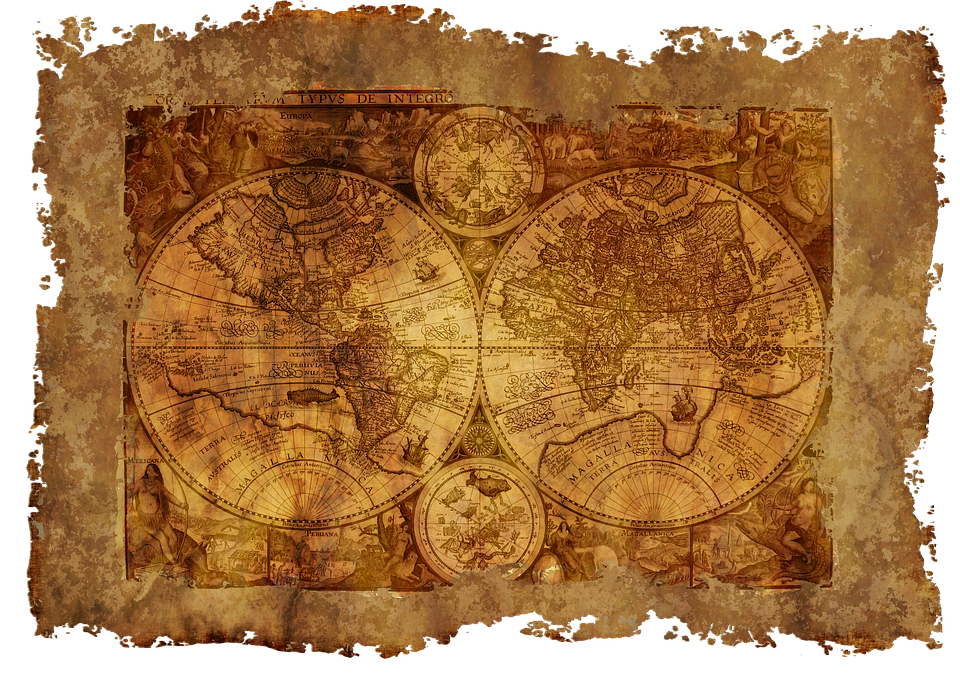
Centuries back, when cartographers reached the edge of the known world on their maps, they occasionally draw a sea monster and label the area “Here there be dragons.” It was a creative way of saying “We don’t know what’s over here.” It was uncharted. There were unknown risks that way. It can serve as a remarkable apt metaphor of experiences like grief and trauma.
I am, of course, going to talk about how this pandemic has been like sailing in uncharted waters. But the metaphor applies for so many other situations of fear and suffering in our lives. Whether it is a personal crisis like illness, sudden job loss, or the death of a loved one; or a more systemic tragedy such an unexpected experience of systemic oppression or an abrupt impact of capitalism run amok – we can be caught off guard and thrown unexpectedly into uncharted waters. This ongoing pandemic is certainly one such example we are all experiencing now. We are off the edge of the map. We are in uncharted waters. Beware, here there be dragons!
Thankfully, many of us have a healthy capacity to manage risk and uncertainty. Many of us can deal with quite a bit, can be resilient, and can reframe things to keep moving forward when faced with trouble. And there are also times when it can be too much, when we can become lost and floundering in the chaotic surge of trauma and uncertain difficulties. I want to talk about what we can do at such times.
During our Time for All Ages this morning, I showed the children an old navigation instrument, a sextant. I talked with them a bit about the geometry involved and how it works. But more, I shared with them how we can ‘find our way’ by the stars and that the stars are like our values, our guiding ideals that can lead us through uncertainty. With the stars as our values, the tools and instruments such as a sextant or a GPS are like the people around us who can help us discern and sort out our situations with us.
When I say we have people around us who can help, I mean a friend or family member or therapist, all good choices when seeking help with your trouble. I would like to suggest someone a little different. I want to lift up an exemplar from history. Historic figures can serve as exemplars with lessons to help us through our troubles. Sir Ernest Shackleton is one such person who is like a navigation instrument for me, helping me understand the impact of my values in a given situation.
If you are unfamiliar with Shackleton, let me offer you this brief sketch of him. He was a polar explorer. He and his shipmates set out to cross Antarctica in 1914. A few years before the Endurance sailed from England, two other explorers had already reached the South Pole within a few weeks of each other. Apropos of my larger point, Amundsen is considered the first man to have reached the South Pole, Scott is considered the second, arriving 5 weeks after Amundsen. But in truth, Scott was not the second, he was the 6th. Amundsen was part of a team of five people to reach the South Pole in December of 1911. History ought to be more attentive to the team rather than just the intrepid leader.
My point in bringing up that small tangent is to highlight how Ernest Shackleton is remembered, not for crossing the continent, but for bringing his entire team back home alive. I don’t look to Amundsen for wisdom in troubled times. I look to Shackleton. When I am struggling with this pandemic, for example, I think on Shackleton and how he brought his whole team home.
It is worth noting, Shackleton was an adventurer. He was not just someone who stayed safe and therefore kept his team safe. “A ship in harbor is safe from the storm, but staying in harbor is not what is ship is for.” Shackleton took great risks, not foolish risks, but certainly risks.
The advertisement Shackleton put out to secure a crew for the endurance is amazing to read today: “MEN WANTED: FOR HAZARDOUS JOURNEY, SMALL WAGES, BITTER COLD, LONG MONTHS OF COMPLETE DARKNESS, CONSTANT DANGER SAFE RETURN DOUBTFUL, HONOUR AND RECOGNITION IN CASE OF SUCCESS.” And with that he had 5,000 people apply. Ah! The call to adventure and exploration! Shackleton was able to pick his crew carefully.
The 28 men aboard the Endurance sailed south from England through the Atlantic to South Georgia Island, a small bit of land near the tip of South America. The ensuing expedition can be considered a trip away from that small island and back, lasting roughly a year and a half. The Endurance left South Georgia in early December 1914, crossed into the Antarctic circle a week later, and about 5 weeks after that, was well and truly trapped in the solid pack ice less than a hundred miles from the continent itself. In all that happened after that, the expedition never reached Antarctica proper.
I find it most interesting that this expedition to cross Antarctica through the South Pole is not remembered by what they failed to accomplish but by the remarkable thing they did instead. They failed to cross the continent. It was another 40 years before a team succeeded in crossing the continent through the pole. What Shackleton accomplished instead, the reason he is remember is that the expedition team survived and made it home. 6 weeks in, he and his team were stuck the remainder of the 18-month story was spent working to get back out alive.
It is very similar to the Apollo 13 space flight in that regard. NASA described the 1970 Apollo 13 mission a “successful failure.” They did not accomplish their original goal and the mission almost ended in disaster, but they survived. The ingenuity, resourcefulness, and commitment of everyone involved made it possible for the astronauts to return to earth alive. They never made it to the moon – that part was a failure. They learn a lot about how to respond to the extreme crises and everyone made it back home – that part was the success.
This is one of the lessons I learn from Shackleton. We should still strive, still take risks, still attempt for the wild and improbable goals. And if it all falls apart, we can step back and make new goals, and keep going.
We are in this pandemic now and our congregation has chosen to take the risk of meeting in person indoors. Many UU congregations are making many different choices in this regard. Some are meeting outside only, others are indoors, in person and online like us, and others are online only.
There is no guiding rule from the UUA at this point because each congregation’s situation is a little bit different in terms of what’s happening in the communities around our congregations and in terms of the needs and ‘capacity for risk’ of the people in the congregation. The in-person component of our worship is a risk we’ve chosen to take at this point. It is good to take risks in life. It is also good to make changes when new information about that risk comes to light. That’s what Shackleton did. That’s what I aim to do. I’m not saying we are making a change to our in-person worship today, but I am saying it is something we know may become necessary.
For now, we – like Shackleton – are settled in to our new normal. For the men on the endurance, the situation was a waiting game. They were stuck in the ice. Shackleton imagined they might have to spend the season there, waiting for warmer weather. That became the new plan, to wait it out. It turns out they were trapped in the ice for ten months, drifting with the pack.
Shackleton had invested a lot of time and energy keeping the spirits of the crew up. He set work for the crew, creating and maintaining a camp on the ice pack as well as keeping the ship in good shape and ready for when the ice broke. He visited with every member of the crew regular. In the evenings they played chess and bridge, sang songs, and occasionally put together events like feasts and skits and a derby.
It was the end of October 1915 when the ship was finally crushed by the pressure from the ice; and a month later it sank. But that’s not the end of their story. We’re only halfway through their tale. The second half of their voyage occurred without their ship.
When the Endurance finally broke apart and sank, Shackleton ordered them to abandon the ship. He said to the crew: “Ship and stores have gone – so now we go home.” Just like that, the plan to wait out the ice with the ship fell apart and Shackleton came up with yet a new plan. They took the three long boats and struck out, dragging the boats across the ice or rowing through the treacherous ice lanes. The ultimate goal remained unchanged: bring the crew home.
That new plan lasted another five months as they made their way north slowly and carefully, Eventually, they reached the end of the pack ice and struck out into the open ocean. They spent another week dodging icebergs and ice floes and made it together to Elephant Island. They set up camp again. Then five of the men took one boat and sailed 800 miles back for South Georgia Island to secure a rescue for the rest of the crew.
All told, it was an amazing journey filled with danger and heroism. Part of what we learn in the story is how we always have another choice we can make from moment to moment. We have within us the capacity to tap into remarkable strength and perseverance. And when we stick together and take care of each other, our chances of success expand.
We have been in a crisis – several crises actually: the Pandemic, fascist attempts to deconstruct our democracy, Institutional Racism pushing against our attempts to bring a progressive vision into reality. Our values lead us to speak the truth about what is happening. Our faith calls us to participate in the struggle, but not get lost in it. There is a lot going on that could cause us to get overwhelmed and lost.
The example of Shackleton reminds us that it is worth it to take risks. Such risks are the heart of living. We are also reminded, however, to not be foolish in our risks; We do well to have our risks tempered by the wisdom of science and guided by the commitment to our communal wellbeing.
Shackleton also reminds us that when we have made a plan and put ourselves into it fully, it is possible the plan will fall apart. And when that happens, our work is to let go of that old plan in favor of new information, to let go and make a new plan.
And most poignantly for this pandemic, and perhaps no less poignant for our nation, the ultimate goal is to keep the whole team in mind as you go. This is heartbreaking to me because so many people have already died from Covid-19. But in my heart, that is still my highest guiding star – to keep the whole community in mind. We may cross the continent, we might not. We may meet in-person from now on, we might not. We may grow as a faith community, we might not. We may dismantle White Supremacy in our culture during my lifetime, we might not. But this I know: we will see each other through this as best we can together. We will take our ship into dangerous and uncharted water. And we will do all we can to bring us all back home.
In the end, Sir Ernest Shackleton summarized the expedition of the Endurance thus:
“We had entered a year and a half before with well-found ship, full equipment, and high hopes. We had ‘suffered, starved and triumphed, groveled down yet grasped at glory, grown bigger in the bigness of the whole.’ We had seen God in His splendours, heard the text that Nature renders. We had reached the naked soul of man”
And I notice we here in our congregation entered this pandemic a year and a half before with high hopes and a well-found building on the verge of being refitted. We’ve not had the harrowing journey Shackleton experienced, but we have had our share of struggle and suffering. Our journey is not finished. But with the wisdom and clarity of such good examples, I trust we will make our way through the rest of this adventure together, ready for what awaits us next.
Be wise, reach out, and stay true!
In a world without end,
May it be so
I Am Because We Are

I Am Because We Are
Rev. Douglas Taylor
September 19, 2021
Archbishop Desmond Tutu related the following story in one of his earlier sermons from more that forty years ago.
There was once a man who was a staunch churchgoer and a deeply committed Christian. He supported most of the activities of his local church. And then for no apparent reason he stopped attending church and became just a hanger on. His minister visited him one wintery evening. He found him sitting before a splendid fire with red glowing coals, radiating a lovely warmth round the room. The minister sat quietly with his former parishioner gazing into the fire. Then he stooped and with the tongs, removed one of those red glowing coals from the fire and put it on the pavement. The inevitable happened. That glowing coal gradually lost its heat, and turned in a while into a grey lump of cold ashes. The minister did not say a word. He got up and walked away. On the following Sunday, the old man turned up in church. A solitary Christian is a contradiction in terms.”
-Tutu, “My Search for God” 1979
When my mother shared with me a version of this same story, she adjusted it a bit so the minister moved the coal back to the fire where it came back to life; a good Universalist edit which I think supports the point of the story. “A person is a person through others persons.”
I stumbled across a delightful Huffington Post article from 2 years back entitled “Why the Phrase ‘Pull Yourself Up by Your Bootstraps’ is Nonsense.” https://www.huffpost.com/entry/pull-yourself-up-by-your-bootstraps-nonsense_n_5b1ed024e4b0bbb7a0e037d4
The article tackles the origins of this phrase used to suggest that gumption and a ‘go-getter’ attitude is all one needs to be a self-made person in this world. By self-sufficiency and determination, you can elevate yourself without the help of others. Of course, this is nonsense.
Our culture has become too enamored with the false idea of the Lone Wolf and the Rugged Individualist. The usual reason a wolf is alone and separated from their pack is not because they are strong loners. They leave their pack because they are mature adolescents ready to form a pack of their own. Being a Lone Wolf is not a symbol of self-sufficiency and strength. It is a symbol of transition. It means you should be looking for a new pack!
And the idea of being a rugged individualist is also a bit bunk. That phrase originates from just before the Great Depression to say a person doesn’t need any help from the government to get by. That kind of ‘go-it-alone’ attitude became inexorable entangled with the stock market crash of ’29 – at least until enough people forgot that part of our history. And are we surprised to find ideas of toxic individualism circulating among modern conservatives given the times we are in today?
But let me get back to the bootstraps. It is not uncommon for an idiom to be a little confusing on face value. Why would anyone ingest hair of the dog that bit you? If someone says they ‘slept like a baby,’ does that mean they woke up every two hours crying? And pulling yourself up by your bootstraps – that is literally impossible. Why would people use this bootstrap phrase to imply that something is hard but manageable?
Well, as it turns out, the phrase was originally used to suggest something was impossible – he might as well pull himself over a fence by the straps of his own boots. It was meant to be heard as an absurdity. The Huffington Post article suggests the shift from describing something absurd to something attainable occurred in the early 20th century. You know, right around the Great Depression and all that.
And this is not simply a historic rant by your pastor against some old-timey bygone notions. These ideas and false narratives undermine our capacity for collective action. The culture of hyper-individualism is hampering our country’s response to Covid-19, for example. Friday evening, I drove past a few dozen protestors with flags and signs saying they would not be guinea pigs and refused to be vaccinated. Crassly, they were protesting outside Lourdes Hospital rather than at city hall as decent protesters usually do.
The image of the Rugged Individualist has a strong pull in our national psyche. This form of toxic individualism gets trotted out as patriotic and lifted up a what helped us build our nation and tame the west. Which is not only blatantly wrong, it is harmful.
In truth, our national culture has been most strongly influenced by the work of teams and of people banding together. The image of a barn-raising is far more indicative of our culture than a lone deputy on the horizon smoking a Marlboro.
I understand the values of personal liberty and independence through grit and resourcefulness. But ultimately our goal here is to build a just and thriving society. At times like this I find it helpful to consider wisdom of a different source on how to be a community.
We could learn a lot from the African teachings of ubuntu as we heard about in the reading this morning. Ubuntu teaches us: “a person is a person because of other persons.” My humanity is caught up with the humanity of every other person. Ubuntu tells us that we need each other and we are all connected. It promotes the greater good rather than individual success. We have strength in our unity. I am not able to be myself without you also being yourself.
Interestingly, when we start to look, we find this idea popping up in all manner of places, running counter to the dominant culture of toxic individualism. The ideas in ubuntu are not exclusive to African philosophy and wisdom.
In his Letter from the Birmingham Jail, Dr. King wrote:
“In a real sense all life is inter-related. All men are caught in an inescapable network of mutuality, tied in a single garment of destiny. Whatever affects one directly, affects all indirectly. I can never be what I ought to be until you are what you ought to be, and you can never be what you ought to be until I am what I ought to be…This is the inter-related structure of reality.”
Many of the teachings of indigenous people of North America offer a similar lesson. The message that we are all children of one spirit, we all belong to Mother Earth, is a message that arises from many of the speeches and teachings across many different tribes and nations. We are one strand in the web of life. Consider the impact of seven generations. We are called to recognize our interdependent place in the grand design.
And from another corner of the globe, Vietnamese monk Thich Nhat Hanh talks about a similar Buddhist perspective which he calls Inter-being.
“If you are a poet, you will see clearly that there is a cloud floating in this sheet of paper. Without a cloud, there will be no rain; without rain, the trees cannot grow; and without trees, we cannot make paper. The cloud is essential for the paper to exist. If the cloud is not here, the sheet of paper cannot be here either. … If we look into this sheet of paper even more deeply, we can see the sunshine in it. If the sunshine is not there, the forest cannot grow. …. And if we continue to look, we can see the logger who cut the tree and brought it to the mill to be transformed into paper. And we see the wheat. We know the logger cannot exist without his daily bread, and therefore the wheat that became his bread is also in this sheet of paper. …
“When we look in this way, we see that without all of these things, this sheet of paper cannot exist. Looking even more deeply, we can see we are in it too.”
– Thich Nhat Hanh, excerpt from Teach Breathe Learn by Meena Srinivasan
Wisdom from Vietnamese Buddhism, American Indian elders, Civil Rights activists, and a multitude of African tribes coalesce around a different message, a different set of values, a different way to be a society and community together. It is a message that we are all connected, and that we all need each other. You won’t be surprised, perhaps, to hear me suggest our Unitarian Universalist principles align well with the concept of ubuntu. I am because we are.
Ubuntu calls for qualities such as empathy and compassion, listening and solidarity, nonviolence and mutual respect. These are the qualities we need for building a just and thriving society. These are the values which can heal our communities. Archbishop Desmond Tutu has said:
A self-sufficient human being is subhuman. I have gifts that you do not have, so, consequently, I am unique – you have gifts that I do not have, so you are unique. God has made us so that we will need each other. We are made for a delicate network of interdependence.
-Desmond Tutu, “God’s Dream”
Now, there is, of course, a healthy version of individualism. There is an important value worth celebrating and cultivating that leads us to think for ourselves, to be innovative and take risks. A healthy version of ubuntu would not stifle that. Tutu has noted that communism has never taken root in Africa because the communal element of ubuntu nurtures healthy individuality. Yes, Ubuntu emphasizes the community as what defines a person. But notice it is still about defining a person.
Western civilization defines a person as an individual with a capacity for reason and self-determination. Ubuntu defines a person by their relationships with other persons. Consider this interesting impact of that difference.
In our society, when there has been violence, we talk about the impact on the individual. Using ubuntu, the conversation would be not only about the injury to the individual but the injury to the community as well. The violence weakens society. The impact of the school shootings is not only on those students who were shot. The impact of a rape is not only on the one woman. The impact of a police officer’s use of excessive and even lethal force is not only on the one black or brown body. These acts of violence weaken our society. We know this, we experience this. But our society does not like to talk about it. We receive the message that the impact was just on those personally impacted. As if we are not all connected. As if our communities and our relationships don’t shape and define us. As if we do not all feel that impact.
I invite you to take a moment in reflection on the events of your morning, on just the past few hours of your day. How many threads of connection were woven into your experience? Where did your pillow come from? Did you eat breakfast? Who paved the road you traveled or built the computer through which you watch the worship service? Where might you send your gratitude? How might you put a little more out into the world for the next person?
I invite you to have an ubuntu perspective. Consider your relationships and how you are supported and connected. You are not alone. You will not become a lump of grey ash. Others are here to offer their glow for you and others are in need of your glow which you have to offer.
In a 1993 commencement speech at Morehouse college, Archbishop Tutu delivered the following words, and I offer them as the closing of my sermon and our ‘sending forth’ this morning.
This is how you have ubuntu – you care, you are hospitable, you’re gentle, you’re compassionate and concerned. Go forth as a new doctor, conscious that everybody is to be revered, reverenced as created in God’s image whether inner-city, and rural areas; go forth to demonstrate your ubuntu, to care for them, to heal them especially those who are despised, marginalized. Go forth to make the world a better place for you can make a difference. The task is daunting, of course, but it is our necessary struggle.”
(Tutu, Morehouse commencement speech, ’93)
The task is daunting, of course, but it is our necessary struggle.
In a world without end
May it be so.
Do I Have to Love Everyone? (2)

Do I Have to Love Everyone? (2)
Rev. Douglas Taylor
9-5-21
Link to video of sermon: https://youtu.be/cWJ-KWHi8p8
—
“Do I have to love everyone?” A Valentine’s Day sermon by Rev. Douglas Taylor. Part I
Yes!
(Turn and walk away from pulpit as if sermon is over; turn back to pulpit and continue.)
—
“Do I have to love everyone?” A Valentine’s Day sermon by Rev. Taylor. Part II
Yes. Because love, love will keep us together; love is a many splendored thing; love makes the world go ‘round; all we need is love; and love hurts. And Valentine’s Day has come upon us as the ultimate Hallmark holiday celebrating this romantic fancy we call love. I read somewhere that roughly 145 million cards will be exchanged this coming February 14th. One could almost suggest that we as a culture are love-obsessed.
The origin of our modern Valentine’s Day comes from the Roman festival “Lupercalia,” a day in mid-February when each young man in town drew lottery for the name of the young woman who would become his ‘sexual companion’ for the next year.
Around 500 C.E. Pope Gelasive decided that was not a good custom and swapped the Lupercalia festival for the feast day of a minor Christian saint – a common practice used to win over the local pagans. So, instead of drawing the name of a young woman, the men were supposed to draw the name of a Christian saint whom they would emulate for the coming year. For the life of me I can’t imagine how the Christians were so successful using strategies such as this.
They must have been experts at the ‘hard-sell,’ especially considering the full legend of the saint the church chose to host the day!
St. Valentine was a priest in the third century (or maybe a composite of several priests.) The Emperor Claudius had outlawed marriage for young men because he instead wanted to conscript them into the military. The priest Valentine continued to marry young couples in secret. Discovered, he was sent to jail and sentenced to death for disobeying the emperor. The legend continues that he fell in love with the jailor’s daughter, and wrote her a note, signed “from Your Valentine”, prior to his beheading on February 14, 270 C.E. (From Rev. Debra Haffner)
Then, over 200 years later, this defiant priest who lost his life to help young lovers is enlisted to be the poster boy to reign in the promiscuous habits of young lovers!
And so, our modern Valentine’s Day has gravitated away from a day to emulate saints but not entirely back to the original pagan custom. Arguably we strive on this day to emulate St. Valentine, I suppose. It has settled into our culture as a day of rejoicing for Romantic Love. And we teach our children, as Blanchard demonstrated in our reading, that indeed we need to give a Valentine’s Day card to everyone. But is this suggesting that we are to affect a romantic love for everyone we know? That would be ridiculous. You don’t need a degree in the humanities to know what a disaster that would be! That can’t possibly be what is suggested.
Perhaps the word ‘love’ is too broad a word to use with the assumption of clarity. Love is a much misused and misunderstood word. A friend once suggested we ban the word from the pulpit because it has grown meaningless and impotent through excessive exhibition. Indeed this is a common practice among Unitarian Universalists it seems. Great words like God, Peace, and Love can be overused and misused and worn-out to the point of either cliché or idolatry. One remedy is to throw the word out for a while, let it cool off, then later pick it up again, dust it off and discover again its depth of power. So allow me to do some dusting.
What first excited me about preaching on the topic of Love again was a scientific article in the National Geographic from 15 years ago about the Biochemistry of love. (National Geographic, Feb 2006: pp 32-49.) The description reads, “Scientists are discovering that the cocktail of brain chemicals that sparks romance is totally different from the blend that fosters long-term attachment.” This is another area of study where the hard sciences of biology, chemistry and physics offer corroborating evidence for what the soft sciences of psychology, sociology, and anthropology have been saying for decades; and which theology and philosophy have been saying for centuries!
The article begins with the story of Anthropologist Helen Fisher who is “looking for love, quite literally, with the aid of an MRI machine.” She and her colleagues look for couples who have recently fallen in love, pop one of them into the MRI machine and show them a neutral photograph and then a photo of their sweetie. Then the scientists watch to see which parts of the brain light up! (For the record – that would be the ventral tegmental area and the Caudate nucleus.) They note that the ‘madly in love’ areas of the brain are linked with the reward centers and the pleasure centers – a lot of dopamine spreads from those spots. Thus, “falling” in love is like an exciting amusement park ride. But, be warned, the figurative rollercoaster can make you sick, same as the literal one!
Another break-through demonstrating this is found in the work of Donatella Marazziti, a professor of psychiatry from Italy. Professor Marazziti has been studying what she calls the biochemistry of lovesickness. Not surprisingly, she has found similarities in the serotonin neurotransmitters and the chemical profile of both love and obsessive-compulsive disorder. I can’t stop thinking about you; night and day, you are the one; only you can make my dreams come true; I’ll sleep on your door step all night and day, just to keep you from walking away. Yeah, having a crush on someone comes out your neurotransmitters like OCD.
So, that is interesting, but the best stuff comes later in the article. While novelty triggers dopamine in the brain and thus feelings of attraction, it is a different chemical entirely that stimulates attachment. “Oxytocin is the hormone that promotes a feeling of connection, bonding.” Oxytocin is released in abundance when a mother nurses her infant, when you give or receive a massage, and when a couple makes love. Attraction and attachment happen in different parts of the brain with different sets of hormones. The chemicals in the brain that conspire to bring you together are not the same ones that work to keep you together.
So far, this indicates there are at least two forms of love expressed in the biochemical levels of brain function. Typically a serious philosophical or theological exploration of different forms of Love will consider at least three forms of love. The three categories are typically developed to follow the three significant Greek words that are generally translated as love: Eros, Philia, and Agape.
Romantic or sexual love was called Eros; this is easily linked with the production of dopamine and serotonin. ‘Friendship’ in Modern Greek is Philia, which in Ancient Greek denoted a love for friends, family, and community distinguished by loyalty and familiarity. Certainly this sounds like the sort of bond-strengthening love that is associated with oxytocin production in the brain. Well, this leaves me wondering if they could find the biochemical signature of Agape love. Which neurotransmitters are firing in the Dali Lama’s brain or in Thich Nhat Hanh’s Brain? Which bio-chemicals flooded the brains of Mother Theresa and Martin Luther King Jr.?
Agape is a type of love where the object to be loved does not need to possess any particular qualities such as beauty or familiarity. It is unconditional love. The New Thayer’s Greek to English Lexicon of the New Testament describes Agape as: “to love, to be full of goodwill and exhibit the same; to have a preference for [and] regard for the welfare of others; of the benevolence which God in providing salvation for men, has exhibited by sending His Son to them and giving Him up to death; of the love which led Christ, in procuring human salvation to undergo sufferings and death”
When I was in seminary I had a Methodist professor of New Testament say to the class of mostly Christians that the difference between Unitarian Universalists and most Christians is that Christians focus on Jesus’ death and resurrection while UUs focus on Jesus’ life and teachings.
The teachings of Jesus, in particular the ethical sayings found in the Sermon on the Mount, have stirred the souls of Unitarian Universalists through the centuries. It is in the Sermon on the Mount (Matthew 5:43-48) that Jesus says to love your enemies. He asks “If you love only those who love you, what good is that?” The Greek word in these verses is Agape, not Eros or Philia. The most famous discourse on Agape love is found in Paul’s first letter to the congregation in Corinth. “Love is patient; love is kind; love is not envious or boastful or arrogant or rude … It does not rejoice in wrongdoing, but rejoices in the truth. It bears all things, believes all things, hopes all things, endures all things.” In this letter from Paul, the word he uses is Agape, the same word the gospel writer used in writing down Jesus’ Sermon on the Mount. Of course, Jesus spoke Aramaic, not Greek – so I can’t tell you that Jesus was steering at this particular interpretation of Love, only that the authors of the gospels intended us to see it as such. Though, in fairness to them, the context of Jesus’ words about loving our enemies does fit with the Greek concept of love as defined in the word Agape.
Agape love is not a feeling, it is a choice. Perhaps that is why we haven’t uncovered the biochemical signature of Agape love yet: it is a choice, a decision. If it were a feeling it would have a hormone linked to it. Instead it is a choice to be concerned for the well-being of others, to treat them with dignity and respect. A person may be difficult, obnoxious, and completely undeserving but you can still choose to offer this form of love to her or him by extending respect and a wish for that person’s well-being. With a modern global perspective, we might translate Agape using the Buddhist concept of loving-kindness. While loving-kindness is not quite synonymous with what Agape is meant to convey, they both carry the tone of unconditional regard.
And that, I believe, is the aspect of love that we are called to offer to everyone. Are there difficult people in your life? Are there folks you find “irritating, obnoxious, mean, aggravating, anxiety-producing, hostile, difficult, stupid, disturbing, or some alarming combination of the aforementioned attributes.”? (Blanchard.) Perhaps there are people from work or school or in your extended family you would fit in this category. Maybe there are certain politicians or celebrities for whom you’ve taken a particular distaste. Perhaps some of them are members of this congregation with you. Who would you balk at sending a Valentine’s card to? Do you hate anybody?
Our faith calls us to treat all people with compassion, to recognize the inherent dignity of each person, and to discern the ways in which our individual lives are interdependent with all life – including the life of that irritating, obnoxious, mean, aggravating, anxiety-producing, hostile, difficult, stupid, or disturbing person you have to deal with. This largely stems from our Universalist heritage that says we are all accepted, we are all loved – even the irritating, obnoxious, mean, aggravating, anxiety-producing, hostile, difficult, stupid, and/or disturbing people. Especially them, if for no other reason than that you may be one of them according to another person’s perspective.
Universalism since its inception has rejected not only the eternal punishment of hell, but also the reason for such a punishment in the first place: the concept of original sin. Hosea Ballou, an early leader in the Universalist denomination, said that the consequences of sin are manifest in this life alone; that “hell is not a place of punishment, but a state of rebellion against God and against the unity of humans and God.” (Robinson, David The Unitarians and the Universalists, p 65) The implication here is that we choose to make of life a heaven or hell. This is not exactly free will as the Unitarians would see it, but it does leave in the hands of humanity the capacity to respond to the love of God by loving one another or by making of this life a hell. We hold that power, and that responsibility!
When you withhold your Valentine from some people, you are in rebellion against the unity of humans and God; you are in rebellion against the interdependent web of existence; you are in rebellion against the nature of life; you are in rebellion against your better self – whatever theological framework you need me to set this in the outcome is still the same: Yes, you do have to love everyone. That’s part of the work. We have the capacity and the responsibility to respond to God’s love by loving one another. That is what life is all about: to further the human venture, to help each other and all life to become the beloved community.
So look through that list of names I know you’ve begun while I’ve been preaching. Make a choice. Find one that is really bugging you. Send them a Valentine’s card. Go ahead, give it a try. Take that step toward ushering in the beloved community.
In a world without end
May it be so.
In Our Image We Create Them

In Our Image We Create Them
July 18, 2021
Rev. Douglas Taylor
“God is queer”
The interviewer followed up, asking, “Would you care to elaborate on that?”
To which the person responded, “no.”
I looked all over the internet to find the source of this exchange. It would be good to provide a source for this quote; but alas, I have none. Instead, I will pick up the thread and offer an elaboration of my own. God is Queer. Let me explain.
First, let me acknowledge the word ‘queer.’ It may feel out of place to hear it in the pulpit, it may not. There was a time when it was used as an insult, as a slur against LGBTQ+ people. There was a time when it was not a kind term. You may remember such a time and find it jarring to hear me say it even though you know times have changed and our uses of words and language evolves. It has been a few decades now that the term queer has been used for self-identification. The way people are using the word queer to describe themselves is the way I am using the word to describe God.
God is not locked in a descriptive box or label. God does not always line up with our expectations. God is not what we would call normal or ordinary. God is changing from one day to the next and what we thought we knew about God last week may not be quite accurate anymore this week. That’s what it is like for people who identify as queer. That’s what it is like with my experience of God. God is queer.
I remember some radical conversations a few decades back asking what if God was a woman? Why were people always talking about God in the masculine? And it wasn’t just pronouns, it was the cultural valuing of men over women because God was a man, or at least that’s what we were reading in the books.
So, the Feminist Theology of the day said ‘Let’s do away with the he/him pronouns for God. Let’s say she/her instead.’ It was pretty cool. It was a way of reclaiming holiness for women. It was a way not only of challenging a theological idea, it also challenged cultural expectations and values of what it meant to be a man or a woman.
It was wild stuff to reject the masculine dominant version of the divine. Of course, I was in seminary around the end of the 90’s and feminist theologies had been raging for several decades by then. The conversations were not whispered by people in fringe groups. The conversations had arrived in the Mainline and middle-of-the-road communities. Feminist theology was respectable.
In fact, by the time I was paying attention in the late 1990’s, the conversation had begun to shift. Some people were still very strong advocates for using female pronouns for God. But I was not the only one at that time to refuse to ascribe masculine or feminine pronouns to the divine. I did not think of God as female any more than I thought of God as male. Putting a gender on God just did not fit my experience of the holy.
Early in my spiritual growth I decided God was non-binary, certainly in terms of gender and now that I consider it, likely in every other binary I could imagine. For such is life.
But let me drift, for a moment, into some interesting Biblical commentary. There is this moment in the Bible, right at the front in that first story, that has caused confusion and consternation to scholars throughout the ages. In that opening poem about creation, the one that happens over the course of seven days, there is a moment when the text has God say these words: “Let Us create humanity in Our image.” This is verse 26 of the first chapter of Genesis. In the very next verse, it says “So God created humanity in his own image.” The pronouns shift quickly back to the masculine singular, but for a brief moment God was plural.
There have been some interesting interpretations of this moment. If you were raised in a Christian church, you likely heard the interpretation that the ‘we’ is the trinity; that this is a hint way back at the beginning of Jesus. I don’t find this argument compelling. This bit of scriptural revisionism is untenable for anyone who will acknowledge Genesis as Jewish scripture instead of merely a pre-Christian text.
If you were raised in a Jewish community, you likely heard the interpretation that the ‘we’ is the celestial court of angels who accompany God in the creation of everything. This second explanation is also a little hard to take in given there is no mention of angels anywhere nearby this text.
A third possibility I’ve heard is the idea that God is using the ‘royal we’ that kings and queens will eventually start using around the late 12th century. This third option is only possible if you think God fancies themselves to be a 12th century European monarch. So, no.
A non-sensational option is that the author of this passage used the Hebrew word Elohim for the word God, which loosely translates to a generic role rather than a name or title – and according to the grammatical rules of that language, the 1st person plural pronouns were required; grammatically. I actually like this explanation best. The delightful stumbling block in this ancient text is not a hint or vague clue to doctrine and theology. It is a matter of little-known grammatical necessity.
Anyway, even though I am comfortable with the interpretation that says it’s a simple grammatical glitch, I can’t help but wonder about God’s pronouns. What if God is transgender and people just didn’t know how to talk about it back then? What is God is genderqueer and folks simply did not have words in the language at the time to say that?
Consider with me the context of this whole poem right at the top of the scroll of Genesis. The creation poem is filled with binaries and dualities. But when we really consider the world and how we experience it, these binaries are not as rigid as we think. Yes there is the binary of gender ‘male and female he created them,’ and I’ll get to that part in a minute. But first let me start with light.
And here I want to quote to you this elegant analysis by a non-binary Christian on Twitter named Michaela Nicola. https://wordsfrommichaela.blogspot.com/2021/06/a-little-reflection-on-genesis-1.html
“God made “day and night.” this sounds like a binary, similar to “male and female,” right? but that isn’t quite all we experience in 24 hours. sunrises and sunsets do not fit into the binary of day or night. yet God paints the skies with these too.
“On the second day God separated the sky from water. seems like another binary. yet the clouds hold water for us in the sky, the condensation and rain cycle refreshing our earth constantly. the sky, separate from water, contains and releases water.
“God also said “Let the waters under the sky be gathered together into one place, and let the dry land appear.” that isn’t the full story, either. consider marshes, swamps, bogs, and fens. not fully land, not fully waters. there is such glorious variety in God’s creation.“
That’s pretty cool, yes? Our experiences of the world reveal such binaries and divisions to always have blurring and blending at what some think of as the edges. But what if those are not the edges? What if the words we’ve been using to describe our experiences were simply the best words we could find at the time? What if those lines we drew were just our attempts at understanding, at figuring this all out?
I have found that’s what it’s like for everything. We draw a line between land and water. There is either land or there is water – and yet, as Michaela Nicola put it “That isn’t the full story… consider marshes, swamps, bogs, and fens.” Nicola continues to reveal the binaries of that creation poem. The creation of the sun and the moon are written as if they are a binary, when in truth they are merely the closest bright objects in a vast multitude of “planets, asteroids, black holes, supernovae.” They continue to unpack the next days of creation with the creatures of the sea and winged birds of the air. To which Michaela directs our attention to the reality of the penguin; “definitely a “winged bird,” they write but do not fly and instead walk and swim.”
I love that they mention penguins. I love penguins. Consider all the other flightless birds and all the diving birds. Consider the amphibians and those creatures that transform from land to air like a caterpillar to butterfly. These are not exceptions and anomalies. We live in the blended experience of these so-called binaries. We are not limited by them.
So, when we come into this conversation of gender non-binary, of trans and queer people – how can we refuse to see this blending and blurring of this binary! The world is bursting with examples of how this works.
“Male and female he created them.” Sure, that’s what it says. But we live in a world of sunsets and penguins. How can we pretend God is so creatively limited as to not allow a profusion of ways to be people in this glorious world?
Michaela Nicola wrote their post to honor God and to honor those people who don’t fit into the boxes of “male” or “female.” It just means there is more to the story. They conclude saying: “and so we worship the God of more. The God of the marsh, the penguin, the God of the sunrise, the cloud, the supernovae. The God of the nonbinary.”
Nicola names God as “God of the nonbinary.” And I work my way through this argument to say that God is nonbinary. God is love, and is in all things. God must be queer. I know that small textual curiosity in Genesis where God uses ‘we/us’ pronouns is not God revealing their non-binary status. I know. But I still believe that the rest of the story points toward a God not contained by either/or binaries.
Scripture is a form of seeking. What we have in this Good Book is the earnest efforts of people seeking to understand the worthy mysteries of God and life and our wonderous experiences of the universe. It is not a book of answers. It is a book of seeking. We are all just trying to figure this out. And life does not line up evenly. How can we conceive of a God that lines up evenly when most things in creation do not? When things that do line up evenly are considered note-worthy rather than normal?
And when we give such value to God, we will, by extension, give such value to people who live in the blurring and blending of the binaries such as gender. All of creation sings of this blending. If you don’t feel like you fit – consider the sunrise and the beauty of that blending. You are beautiful, you are part of God’s love.
As my colleague Rev. Leslie Takahashi wrote in our reading for today,
“The day is coming when we will all know that the rainbow world is more gorgeous than monochrome. That a river of identities can ebb and flow over the static stubborn rocks in its course. That the margins hold the center.“
Following this wisdom, I say God is in that river with us, ebbing and flowing over the stubborn rocks of ignorance, injustice and exclusion. I say, God is in the margin; God is in the rainbow and the supernovae, God is queer. And everyone is included. If you think you don’t fit, if you have been told you are not right – hear me when I say, you are included and God’s love is not bound by our small boxes and expectations.
Let us all learn to love the blended beauty beyond the binary
In a world without end,
May it be so
Wisdom of the Woods
Wisdom of the Woods
Rev. Douglas Taylor
Installation Sermon for Rev. Aileen Fitzke
6-6-21, 4:00 pm
Two years back I attended and participated in Aileen’s Ordination Ceremony in Ithaca, NY. I recall well the sermon our colleague Rev. Darcey Laine had offered. It was a sermon filled with lessons about faith and community through the topic of mushrooms. Yes, mushrooms. Knowing I cannot measure up to that, I offer a message focused on really big trees. This afternoon I offer what I hope might be a descant to that elegant sermon from two years back. I offer some wisdom of the woods. I begin with a parable – well, it’s not really a parable because it is entirely true and historically accurate. I offer it as a metaphor and a teaching story for it reveals the wisdom of the woods. And the story I share is from the life of John Muir.
John Muir, some of you may know, was the great naturalist from the late 1800’s. He is the “Father of our National Parks” and founder of the Sierra Club. He was also a bit of a thrill seeker. He loved to really get out into nature and experience it as fully as possible. He would climb trees, scramble up rocky inclines, and he got out in all manner of weather to experience nature. I offer remarks from his own journal to reveal the teaching story I present this afternoon.
“One of the most beautiful and exhilarating storms I ever enjoyed in the Sierra,” Muir wrote in A Wind-Storm in the Forests, “occurred in December, 1874, when I happened to be exploring one of the tributary valleys of the Yuba River.”
He was on his way to visit a friend that day, but when he noticed a fine wind-storm brewing he decided to instead push out into the woods to enjoy it. I don’t know about you, but when I see a wind storm coming, I like to have some shelter. John Muir was led by a different impulse. “For on such occasions (he wrote) Nature has always something rare to show us, and the danger to life and limb is hardly greater than one would experience crouching deprecatingly beneath a roof.” After spending a good while walking around the woods in the midst of this great windstorm it occurred to him “that it would be a fine thing to climb one of the trees to obtain a wider outlook.”
So he hunted for a good choice. He found a stand of tall Douglas Spruces growing close together. He knew that the wind was strong enough to uproot a single tree standing alone, but a dozen or more trees together served to protect all the trees in the copse.
“Though comparatively young, (he writes in his journal) they were about 100 feet high, and their lithe, brushy tops were rocking and swirling in wild ecstasy. Being accustomed to climb trees in making botanical studies, I experienced no difficulty in reaching the top of this one, and never before did I enjoy so noble an exhilaration of motion.”
He clung to the high slender tree as it bent and swirled in the storm. The tree bent from 20 to 30 degrees in arc but he trusted the companion stand around him to keep his tree rooted and upright throughout the experience. He describes it as exciting and beautiful. He felt the wind in his pulse. He described light and wind sweeping across the valley spread before his eyes as if he were watching waves on the open sea; the trees undulating and swaying in concentric circles, lines of wind chasing each other in a water-like flow from one end of valley to the other. “I kept my lofty perch for hours, (he writes) frequently closing my eyes to enjoy the music by itself, or to feast quietly on the delicious fragrance that was streaming past.”
This experience was a seminal moment for Muir’s sense of connectedness with all nature. “We all travel the milky way together,” he wrote, “trees and men; but it never occurred to me until this storm-day, while swinging in the wind, that trees are travelers, in the ordinary sense. They make many journeys, not extensive ones, it is true; but our own little journeys, away and back again, are only little more than tree-wavings–many of them not so much.”
I wonder if you can relate? Perhaps not to the thrill-seeking element in John Muir’s character. But perhaps to the experience of being tossed about in a storm? Perhaps you can relate to the experience of seeing trouble brewing and making your way to a safe spot. John Muir’s idea of a safe spot may be different from yours.
Religion, through the ages, has offered its adherents shelter in the metaphorical storms of life. Religion offers assurances and safe harbor. People speak of clinging to their rock, holding fast to their sure anchor. But what if this is not the best analogy? What if this religious metaphor is off? What if we could embrace the experience and still be safe, or at least safe enough? What if we were to seek out not a firm and immobile stone but a fine copse of trustworthy trees in which to weather our storms?
I suggest Muir’s experience in the wind-storm could be a parable for what our congregational life could be. In our hymnal there is a reading #591 if you like to take notes (“I Call That Church Free”) in which Unitarian theologian James Luther Adams says, “I call that church free which enters into covenant with the ultimate source of existence, that sustaining and transforming power not made with human hands.” This reading clarifies the theological and covenantal nature of our gathered religious communities. Adams says “I call that church free which brings individuals into a caring, trusting fellowship.” And he goes on to describe it as “a pilgrim church, a servant church, on an adventure of the spirit.” And then he closes quoting scripture saying, “It aims to find unity in diversity under the promptings of the spirit ‘that bloweth where it listeth (John 3:8) … and maketh all things new. (Rev 21:1)’”
My story about John Muir in the wind, my parable is not about you as an individual clinging to your own safe place. My story is about the free church. It is about how we create communities that can serve as trustworthy places in which we can weather our storms. Tis grace that brought me safe thus far … James Luther Adams described the Free Church as a body of seekers freely joined in a covenant of loyalty to the spirit of love.
John Muir clung to the top of a tall pine to feel the wind blowth where it listeth. It is not an insignificant piece of the story that the tree was a good and safe choice because it was a copse of trees – a community of trees supporting each other. Or to read it metaphorically, “a gathering of individuals in a caring and trusting fellowship!” For our theology of the Spirit to be made real in this world it is best enacted in community.
Yes, trees do fall down, by age, by ax, by storm. But the forest continues. The community of faith still thrives in the face of plague and illness, through the winds of political turmoil and insurrection, despite the scourge of racism and bigotry – our faith communities are strong because we are not alone; I am not left to rely on only my own strength to persevere. We are like a trustworthy copse of trees. Our roots are strong and deep. Our shelter does not stop the wind and the trouble, but it does keep us secure all the same. You and I bend in the wind and the community bends too. Let the cares of the world blow across the face of your deep souls and know that you thrive because you are connected in a trustworthy copse of fellow travelers.
Let the wind blow – the winds of trouble and the breath of Spirit both. Listen to the wisdom of the woods. Let trouble come and go. Let the Spirit move among us. Stay present and stay relevant, for the world needs strong communities of truth and trust, of hope and healing, of compassion and action. Our world needs communities such as this one. But it is not just the world who needs this, you and I need such communities as well. And you and I participate in the creation of such communities.
Let the wind come. We will persevere and and even be renewed. Together we will build the beloved forest of faith that will always be our home. We create this together and in partnership with the Spirit ‘that bloweth where it listeth (John 3:8) … and maketh all things new. (Rev 21:1)’”
In a world without end, may it be so.

