
Spending Your Privilege

Spending Your Privilege
Rev. Douglas Taylor
March 23, 2025
Sermon Video: https://youtu.be/2tZED6qed5A
There was a reddit post that’s been around for a few years about how dads are native to Home Depot while lesbians are native to Lowe’s. The premise being that these two common types of home improvement shoppers can’t mix. But then a follow up post claimed it was perhaps true at one point but they’ve mixed around so much that trying to separate them back out into their respective original ranges would do more harm than good to the delicate ecosystem of chain hardware stores. https://www.reddit.com/r/tumblr/comments/a0yj5o/dads_are_an_invasive_species/?rdt=59894 Personally, I’m glad for the mix because I am a dad but like hanging out with the lesbians.
I was recently at one of these big chain hardware stores buying a few things. The cashier was a big man who smiled as he was ringing me up, complimented my t-shirt, and commended my brave choice to wear it in the store. I looked down because I had forgotten what t-shirt I was wearing. “Have a Gay Day” it says in big letters on a rainbow background. The cashier went on to say he didn’t have a problem with my shirt, liked it in fact. But he knew other guys in the store would take issue with my attire.
Honestly I had not spent much time that morning thinking about the message on my shirt before he brought it up. It did not feel like a risk to me. That’s part of my privilege. I felt safe wearing a shirt that could conceivably trigger a unpleasant response – possibly a verbally threatening response, or more. But I didn’t even think twice about it when I walked out the door on my way to the hardware store.
Now, that’s not entirely true. I did think about it way back when I bought the shirt at Hot Topic. I thought about it when I was walking around in a park and a pair of younger people said ‘cool shirt’ as they walked past me. I thought about it when my gay niece said “Uncle Douglas has more gay shirts than I do.” I thought about it when a Methodist colleague nodded in appreciation a month or so before their General Conference voted to lift the ban on LGBTQ clergy and same-sex marriages.
I was aware of the impact my t-shirt might have when I bought it, and was reminded a few times along the way of the impact my t-shirt did have. But up until the comments of the cashier saying I was brave to wear my ‘Have a Gay Day’ t-shirt at the hardware store, all my thoughts had been about the positive impact my shirt could have.
Sometimes being an ally means showing up in ways that can make me uncomfortable, or to take a risk that a more vulnerable person, a less privileged person, might not be safe taking. In the reading this morning [“What’s the Difference Between an Ally and Accomplice?” by Annalee Schafranek
https://www.ywcaworks.org/blogs/ywca/tue-12212021-1103/whats-difference-between-ally-and-accomplice], one of the definitions of an ally was this: “Being an ally is about recognizing your privilege, then using it in solidarity with marginalized groups to challenge the status quo.”
That word ‘privilege’ is important in this conversation. I have noticed that sometimes conversations about privilege can be misinterpreted as conversations about guilt or about making people ashamed. If your conversations about oppression – about land acknowledgments or bathrooms or reparations – if your conversations as a person of privilege get stuck in guilt and shame, something is off about those conversations.
It doesn’t serve you or any vulnerable communities for you as an ally or potential ally to get stuck in feelings of guilt or shame. It serves the status quo. It serves the oppressor. It serves the dominant culture that does not want change when good liberals to get stuck and stop trying to change. James Baldwin once said “People can cry much easier than they can change.”
Remember, the point is about changing the situation so the people who are getting hurt stop getting hurt. The point is not to flip who gets hurt. The point is not to start oppressing the oppressors. White people feeling bad about slavery is not the point. Straight people feeling unsafe in the bathrooms is not the point. The point is not to flip who gets hurt. The point is for the people who are getting hurt to stop getting hurt.
In a 1966 speech, delivered at Illinois Wesleyan University, Dr. King said,
It may be true that the law cannot change the heart but it can restrain the heartless. It may be true that the law cannot make a man love me, religion and education will have to do that, but it can restrain him from lynching me. And I think that’s pretty important also.
-Dr. Martin Luther King, Jr.
What Dr. King is highlighting is how changing attitudes is important, but changing behaviors is often enough. Usually when we think about Inclusion and Diversity, we are talking about perspectives and attitudes, frameworks, ways of looking at the world. I would like to shift that conversation into behaviors, practices that promote these attitudes and perspectives.
I’ve been thinking about this for a bit and here are a few practices I’ve found. To be an ally and eventually perhaps an accomplice, an important practice of inclusion we can do regularly is about listening.
I need to listen, but I am listening with a specific goal: to learn more, to educate myself about what’s going on and about the experiences of people different from me – experiences of people with marginalized identities in our society. This is a great tip for life in general. Listen to children, listen to your neighbor, listen to the cashier, listen to elders, listen to anyone out there … with the goal of learning more about the experiences of people who are different.
And then, here is a justice twist: give a little extra credence to people who are marginalized and vulnerable in our society. Any listening is good and worthy. And, listen with a little preference for people who historically marginalized and vulnerable. I’m not saying people who share my identity are always wrong and people different from me are always right. There are liars and con artists among all types of people. But when people say things like: ‘amplify the voices of people of color’ and ‘believe women’ and ‘walk a mile in another person’s moccasins;’ the suggestion is to counter the near-universal bias people have to dismiss the experiences of those who are suffering.
One regular practice of inclusion is to listen in this way. A companion practice is to get into relationships with people who have identities that are different from your own. It will help with the listening. You can’t get everything second hand – meet people and learn from them.
Another practice is to spend your privilege. Once you have a good understanding of your privilege, the thing to do is use your privilege for something good. I remember a scene from a movie I’d watched years back but can’t remember the title or much else about it. Two friends had grown up in the same neighborhood and are teenagers now – one black, one white. They are getting into trouble together and police show up. The cops have caught the black teen and his white friend jumps on the cop. The black friend gets free and runs off while the white friend is arrested. In an unjust incarceration system, the white friend will have an easier time in prison than the black friend.
That’s certainly accomplice-level behavior. I’m still working on the ally-level work walking around in my gay t-shirt. But my point is we can all find ways to leverage our privilege for the good of vulnerable people and communities. “Being an ally is about recognizing your privilege, then using it in solidarity with marginalized groups to challenge the status quo.” (Annalee Schafranek)
When we talk about Diversity, Equity, and Inclusion, we are refuting the values of Uniformity, Inequity, and Exclusion. The goal is to build something that is more fair, allows more people at the table, that expands the circle.
And do you know what else a person needs to do to be a good ally? Do you want more practices you can do? Heal, rest, the world does not need your exhaustion. The better world we are building includes being better for you. Give love, receive love. It’s not all shouting in the streets. It’s mutual aid and highlighting resources. It’s laughter and holding space for others to just breathe.
Aboriginal elder, activist, and educator Dr. Lilla Watson has a fabulous quote that sums it up well: “If you have come here to help me, you’re wasting your time. If you have come because your liberation is bound up in mine, then let us work together.”
Step up and engage with the injustice you see. Because it is an injustice that includes you. Spend your privilege to make things better. Through practices of inclusion, through actions of equity, through behaviors that build the beloved community.
As a congregation, we’ve been trying to serve the needs of the broader community without reinventing the wheel. Instead of creating our own community dinner, we are partnering with another organization that already knows what they are doing. Instead of becoming the folks who visit the encampments of unhoused and homeless people, we are hosting the folks who are already doing that work. Instead of trying to be the center for Trans people to gather, we are becoming one of the places Trans leaders know they can call on for space. We are using our building to support good work. We are spending our privilege.
When I eventually level up to being an accomplice as described in the reading from this morning, I’ll probably offer another sermon about how to be an accomplice. I know several of you are already functioning as accomplices. But the goal here is not for me or any of us to climb the liberal achievement ladder. Our goal is to build the Beloved Community. For that we need to each keep doing the piece we have for us to do. For that we need each other as we are, listening, learning, healing, acting for justice.
Ina world without end,
May it be so
The Chrysalis Space
The Chrysalis Space
March 9, 2025
Rev. Douglas Taylor
Sermon video: https://youtu.be/RAHteJRrRy0
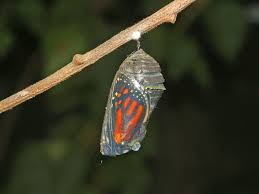
It can be hard to trust the change as it is happening. It is that in between time of no-longer and not-yet. For many years I have heard encouraging descriptions of the caterpillar-to-butterfly metamorphosis. Change and transformation are not only possible, the experience is magical and beautiful. Just look at that butterfly! Let go of what was and embrace who you are meant to be; who you are becoming!
But as anyone who has experienced being a teenager can tell you, becoming yourself is not easy. As anyone who has transitioned their gender can share – if you are respectful enough to stop and listen – transformation is not a simple process like flipping a switch.
More recently I’ve been reading about how in the chrysalis, the caterpillar does not just sprout pretty wings – it must completely dissolve itself down into goo before reforming into a butterfly. This goo-phase, this chrysalis space, is what I’m talking about this morning. The goo-phase: in which we are no longer a caterpillar but we are certainly not yet a butterfly. It can be hard to trust change as it is happening.
Paul Tillich was a 20th century Existentialist Theologian I studied significantly while in seminary and beyond. His theology takes psychology seriously, for example. So, I find his work helpful when taking about topics like growth and transformation. Tillich writes about the relationship between growth and chaos, saying this:
“Nothing that grows is without form. The form makes a thing what it is … Every new form is made possible only by breaking through the limits of the old form. In other words, there is a moment of ‘chaos’ between the old and the new form, a moment of no-longer-form and not-yet-form.” (Tillich, Systematic Theology Vol. III; p 50)
Here’s a fascinating thing: for the caterpillar, it is obvious when they are in this time of transformation. For people, it can be hard to spot. When you or I or someone you know is in goo- phase, there is no cocoon or chrysalis. We don’t have the silky pouch or hard shell around us as we go into the goo-phase. Instead, it looks like this: we are waking up in the morning, brushing our teeth, checking our email, going to work or to school. Or whatever it is different people do during an otherwise normal day.
The chrysalis space for us looks a lot like a normal day to someone else. There may be some outward signs in some cases, some clues might appear – but not necessarily. One clue is this: when I was in the goo-phase of my identity as a young adult, there was a lot of chaos around me. Chaos is a clue for when a person is in a chrysalis space.
Often the message I hear – and in my experience this holds true – is that the struggle is worth it. The goo-phase is a time of uncertainty, chaos, and disorientation. But it is worth it. The chaos is present during small changes, and when we undergo large changes – transformations – the chaos scales larger as well. And the transformation available in the chrysalis space is worth it.
In her book Trusting Change, my UU colleague Karen Hering talks about how we can find our way through personal and global transformation. The first step, she says, is finding the courage to start. To illustrate, she tells the story of going down into the unfinished basement when she was a child.
“A single lightbulb hung from the ceiling in the middle of the room, but the only way to turn it on was by pulling the string dangling from it at least eight feet from the doorway. I had to move fully into the darkness to reach it, reluctantly letting go of the door jamb as I did, feet stepping cautiously, arms flailing in from of me, sweeping the shadows to find the light’s string.
“This is the feeling I often get when embarking on any creative project.” (p21)
Usually, these conversations are about personal transformation. We talk about personal growth and the creative process. And I don’t want to make every sermon about the current political situation, but let me offer just a short bit about how the same dynamic we recognize on a personal level can also happen on the macro scale.
In recent years I’ve heard some of my radial progressive friends proclaim that the whole political show is corrupt, not just the left or the right, the red or the blue – everything. These friends advocate tearing the whole system down and starting fresh. While I understand this concept and – to an extent – agree with the theory. I don’t trust it in practice.
Because, it feels a bit like the current administration is attempting to do exactly that. They are not just moving the deck chairs; they are making dramatic changes with far-reaching and long-lasting consequences to fundamental aspects of our political system. Politically, we are in or at least approaching the goo-phase.
It can be hard to trust change as it is happening. But I’m not sure it is a good idea to trust these changes. What is the basis for my assessment? Am I just playing politics and supporting ‘my team?’ Or is there something about these changes that prompts me to be untrusting?
Progressive politician, Pete Buttigieg was talking with a late show host this past week and said this about the changes happening in the government workforce and their structures.
“The randomness is the real problem. I would be the first to say […] that there are some things in the government that need to be shaken up, that need to be changed. We worked a lot on that when I was there. […] We took whole departments and took them apart and put them back together, and actually some people had to be let go as part of that process. But it was a careful process to make sure we could serve people better. This is not that.” (March 5th, 2025 – Late Show with Stephen Colbert) https://www.youtube.com/watch?v=fVNKasTrY_4&ab_channel=TheLateShowwithStephenColbert
Buttigieg describes a careful process of change. What he describes is the regular, slower work of government. He is arguing against the radical, transformative chrysalis space of change for our national government. And I am mostly persuaded by that argument.
Part of the trouble, I think, is that not everyone consented to get into the goo our current national administration is trying to create. For a communal version of such transformation, it needs to be rooted in mutuality and it doesn’t necessarily need to be slow, we do need to move at the speed of trust – so that we’re together in the work and less harm is inflicted on the vulnerable among us. Communal transformation is as much a risk as personal transformation, and it takes a shared goal and mutual flourishing and trust.
Not all goo is the goo of transformation. Sometimes it is the goo of destruction, with no magical metamorphosis following after. There are countless examples in nature of a hungry organism digesting another organism into a goo.
Here’s a fascinating thing: Biologists know a little bit about what is going on during that metamorphosis inside the chrysalis. We’ve known for centuries that there are a few things that do not dissolve into goo during the transformation. Biologist talk about Imaginal Discs that have all the information about the butterfly anatomy ready and waiting inside the caterpillar. During the transformation, when most the caterpillar’s body is digested down to goo, the latent Imaginal Discs awaken and begin to form the adult butterfly.
In other words – there is a blueprint, a map for where the organism is headed. This is a critical element to being able to trust change as it is happening. It makes a big difference to step into uncertainly and chaos if you know the transformation is taking toward a place you plan to go.
As Erik Martinez Resly tells us in our reading this morning. “The question is not whether we will get lost in life, but rather how we will move through it in faith.” https://www.uua.org/worship/words/reflection/found-while-lost And as we may recall from a sermon I gave a few weeks back – faith is not about trusting when there is zero evidence. Faith is about believing in love even when love hidden or masked, and we decide to believe in love anyway.
Resley reminds us that we will always have times in our lives when things fall apart, when relationships sour or at least fade, when work grows dissatisfying, when we are disappointed. When whatever we are doing is no longer working. We become “disheartened, dispirited, we feel disoriented. We get lost.” And then he writes this sentence: “The question is not whether we will get lost in life, but rather how we will move through it in faith.”
Resly frames this whole reading as the entrance to the labyrinth. I think that is an important framework when we talk about trusting change. We may need an ending, but we can’t simply end. We must also enter the labyrinth – we must begin.
In Alice and Wonderland, Alice has this conversation with the Chesire Cat:
“Would you tell me, please, which way I ought to go from here?”
“That depends a good deal on where you want to get to,” said the Cat.
“I don’t much care where–” said Alice.
“Then it doesn’t matter which way you go,” said the Cat.
“–so long as I get SOMEWHERE,” Alice added as an explanation.
“Oh, you’re sure to do that,” said the Cat, “if you only walk long enough.”
This is often paraphrased (and then attributed to Lewis Carrol) as: “If you don’t know where you are going, any road will get you there.”
Most often we are prompted to embark on a change when we recognize a need to end, to leave, to stop something that is no longer working or is harmful or simply does not bring joy the way it used to. But to really step into change and trust that process, you need to be headed somewhere. You need to know where you are going.
When we are in the chrysalis space, whether we are in it personally or sharing it communally or witnessing it in someone we love, the greatest question is not if we will get through the transformation, but how. To make it through and emerge as a butterfly, it is not enough to simply dissolve everything to goo, we must also have our metaphorical Imaginal Discs. We must not only leave behind the no-longer; we must also reach toward the not-yet. Pay attention to what is growing, not what is dying.
It can be hard to trust the change as it is happening. But trusting the change is key to the path through the change. The chrysalis space is certainly chaotic and disorienting. We can feel lost. But the way through is like reaching out in the darkness for that pull string to turn on the light. It takes courage and discernment. Trusting the process we are in, trusting that we have the tools and powers we need to see our way through to reach the goal we are after.
In a world without end
May it be so
Berries of Abundance
Berries of Abundance
Douglas Taylor
3-2-25
Sermon Video: https://youtu.be/V-DreMzzl1A
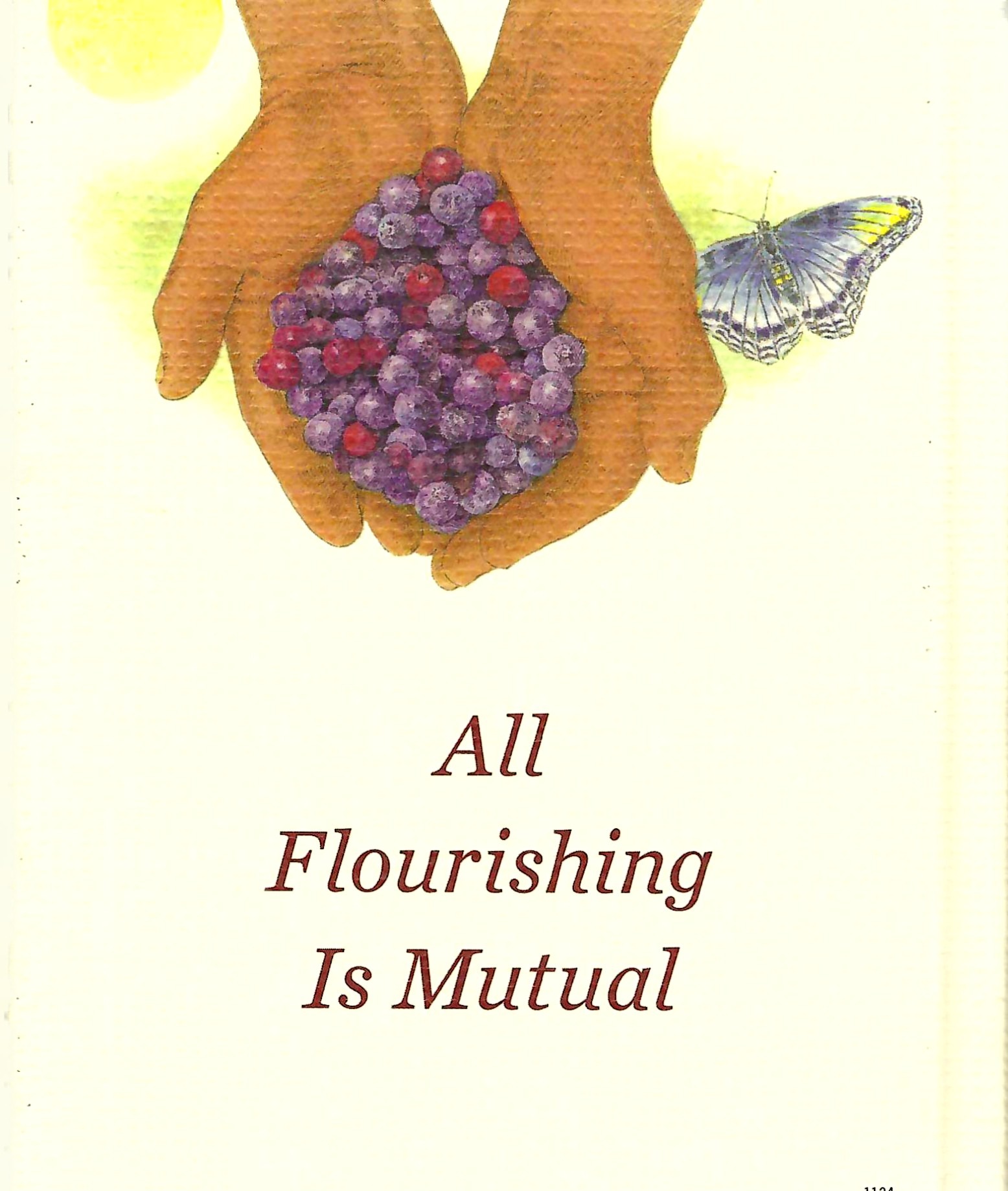
This morning, I invite us to imagine our congregation as an abundant berry patch. Dr. Robin Wall Kimmerer’s latest book The Serviceberry describes a natural world of abundance and reciprocity. She uses berry bushes to highlight the way a Gift Economy works. Our congregation runs on the model of a gift economy. We are flourishing and all flourishing is mutual. We are like a berry bush in full season.
Do you like berries? Do you have a favorite berry? Maybe strawberries or raspberries? I’m partial to blueberries myself. Do we have any cranberry fans? How about lingonberries or huckleberries?
Renown storyteller Joesph Bruchac (brew-shack) tells the story of the First Strawberries. And, I love this story. In this Cherokee tale, the Creator made the first man and the first woman at the same time so neither would be lonely. They marry and are very happy together. The story, however is about their first argument and the berry that helps them reconcile. The story says the man returns home after hunting and finds the woman has not prepared a meal, instead she is out picking flowers. He gets angry. “I am hungry” he says, “Do you expect me to eat flowers?” She also gets angry, “Your words hurt me. I will live with you no longer.” And she walks away.
A chase ensues, but she is a faster walker than he is. He tells the Sun that he is sorry but can’t catch up to her to tell her that. So the Sun takes pity on him and puts berries in her path to try to tempt her to slow down.
The Sun makes raspberries to grow. She pays the no attention. Blueberries, she walks on by. Blackberries, still nothing. Finally: strawberries. She sees them, stops, tastes them – and oh they are good. She starts collecting them to share with her husband. He catches up to her and apologies, they share the strawberries and all is well. And that’s why we have strawberries.
“To this day,” Bruchac concludes, “when the Cherokee people eat strawberries, they are reminded to always be kind to each other; to remember… friendship and respect are as sweet as the taste of the ripe, red berries.”
Other stories from myth and folklore relate the origins of berries, yes. There’s often magic involved, or some divine power. But I love this one about the strawberries because it also teaches us about kindness and a path toward reconciliation. Strawberries are a gift.
Robin Wall Kimmerer, in her book The Serviceberry, writes about berries as part of the Gift Economy of nature.
This abundance of berries (she writes) feels like a pure gift from the land. I have not earned, paid for, nor labored for them. There is no mathematics of worthiness that reckons I deserve them in any way. And yet here they are – along with the sun and the air and the birds and the rain.
Our congregation is like a berry bush in full season. All that we do is offered up as a gift. You don’t incur any debt by attendance on a Sunday morning. The berries are ripe and ready for you, all you need do is show up and they are yours. The berries benefit from being eaten, that’s how nature works. The energy needs to keep flowing, the gift needs to keep moving.
In the book, Dr. Kimmerer talks about her farmer neighbors, Paulie and Ed, who plant some Saskatoons – a western variety of this berry that goes by many names: Juneberry, Shadblow, Sugarplum, Sarvis, Chuckley Pear, Saskatoon, and Serviceberry. “Ethnobotanists know,” Kimmer writes, “that the more names a plant has, the greater its cultural importance.”
This pail of Juneberries represents hundreds of gift exchanges that led up to my blue-stained fingers: the Maples who gave their leaves to the soil, the countless invertebrates and microbes who exchanged nutrients and energy to build the humus in which the Serviceberry seed could take root, the Cedar Waxwing who dropped the seed, the sun, the rain, the early spring flies who pollinated the flowers, the farmer who wielded the shovel to tenderly settle the seedling. They are all parts of the gift exchange by which everyone gets what they need.
She writes about how Paulie and Ed, her farmer neighbors, planted those Saskatoon bushes – and the first season the berries were harvestable, they put out a call for a free ‘pick-your-own’ day for anyone.
Paulie and Ed had put in real labor, had invested money to buy, plant, and care for the trees. But when the berries were ready the first event was free. They broke the rules of capitalism and shifted those berries into the gift economy. Ed and Paulie’s goal was to build relationship in the community around them.
Kimmerer goes on to say that gratitude is the appropriate response to the abundance. “Well,” [Paulie] said, “They are so abundant. There’s more than enough to share and people could use a little goodness in their lives right now.” (p87-8)
Have you experienced something like this? Maybe you can recall time spent with friends when you were nourished body and soul yet needed no debit card at the end of the evening to pay for all you received. You simply received the gifts of love and nourishment. How wondrous. Gratitude is our natural response to abundance.
Reciprocity follows. Kimmerer’s book is subtitled, “Abundance and Reciprocity in the Natural World.” Reciprocity comes in many forms, offered in return through gratitude for the gifts we have received.
Reciprocity is not to be confused with a quantified exchange of some sort. There is no obligation taken on by receiving the gift. There is an exchange, but there is no payment required. There are no receipts. Instead, it is something dynamic in which the gift keeps moving. As Kimmerer writes: All flourishing is mutual. We all get what we need in the exchange.
There is an anecdote in Lewis Hyde’s seminal book The Gift, about an anthropologist studying a hunter-gatherer community in the South American rainforest. The researcher saw a hunter bring home a large kill, more than he and his family would be able to eat. The researcher asked the hunter about how he would store the excess. The hunter was confused by the question. He threw a feast and invited the neighboring families, and every morsel was eaten. The anthropologist assumed the smarter tactic would have been for the hunter to store the meat for himself. The hunter responded, “Store my meat? I store my meat in the belly of my brother.” (See pp 31-2 of Serviceberry)
Our congregation runs on the model of a gift economy. We are like a berry bush in full season. I’m not going to stop. We are here to be a berry bush so you all better be ready for a feast because there is no better place to store the excess of our care than in you. Where is there flourishing in your life now?
When you hear an invitation into our stewardship campaign, you are being invited to take part in caring for the berry bush, that it will continue to flourish for all of us.
Yes, we’re talking about money, but also talking about so many other things – the safety we are creating together, the awareness and education, the warmth of community, the joy and laughter, the rituals and blessings, the rest and the resistance. All of it is the berry bush and your reciprocity is yours to discern. What gift do you offer? What is your favorite berry? Where is there flourishing in your life now?
We have an insert in the order of service with that exact question. You are invited to write a response and turn it in so we can post our answers. Where is there flourishing in your life now?
Perhaps we will bless each other in the natural abundance of our care.
In a world without end,
May it be so.
The Substance of Things Hoped For

The Substance of Things Hoped For
Rev. Douglas Taylor
2-23-25
“I believe in the sun even when it is not shining,” our choir sings. “I believe in love even when I don’t feel it.” This phrase, repeats over and over. And “I believe in God,” they offer at the end, “even when God is silent.” This piece was composed roughly 10 years ago by Mark Miller, and was added to the Whitbourne choral work about Anne Frank life as an uplifting coda to the emotional performance. https://www.youtube.com/watch?v=PT-VdH2lwZk&ab_channel=maestroz25
The text which serves as the basis for the lyrics of this choral work comes from an inscription on the wall of a cellar in Cologne, Germany where a number of Jews hid themselves during World War II. Composer Mark Miller said he wrote the musical arrangement during a troubling time in his life.
“I was feeling down about a few things in my life and in the country [… the] government, being black, being gay…when I discovered the words again. […] And I decided, I’m still going to believe in love. I sat down at the piano, and five minutes later, it just came.” https://morristowngreen.com/2014/03/02/bold-choices-define-harmoniums-anne-frank-tribute-in-morristown/
My sermon title is from that well-known passage in scripture from Hebrews, “Faith is the substance of things hoped for, the evidence of things not seen.” (Hebrews 11:1) I believe in the sun even when it’s not shining. There is a lot going on in our world and in our hearts that is not good. And faith calls us to believe in love, even when we do not feel it.
I want to pause and step back from the poetry and dig into what this means. First, I’ll remind us that faith and belief are two different things. Poetry is important and we all understand what the line is saying. But I’m parsing it out to lift up a point about how we can understand faith in a Unitarian Universalism perspective.
Faith is a form of trusting, a confidence in life or in God or in yourself. Saying ‘I believe in God’ can translate as ‘I have faith in, trust in, a reliance upon, God.’ And saying “I believe in God’ can translate as ‘I believe God exists.’ And the second interpretation is more etymologically accurate, while the first interpretation is more common in our vernacular use – certainly in the way the song is offering.
Christian theologian and ethicist H. Richard Niebuhr put it this way: “The belief that something exists is an experience of a wholly different order from the experience of reliance on it.” This song is about the reliance upon the sun, love, and God. It is a song about faith.
In his classic book Stages of Faith, James Fowler writes about the human development of faith as something separate from beliefs and a person’s religious tradition. Fowler writes about faith as an ongoing journey of deepening and maturing. The opening pages of his book ask questions like:
What commands and receives your best time, your best energy? What power or powers do you rely on and trust? To what or whom are you committed in life?
From this perspective we can talk about faith not as a set of beliefs but as the way we live a life. We can talk about faith as what we trust, what we rely upon. And it is important to notice the context of how faith shows up. It is not when the sun is shining, but when it is not shining. Faith shows up when we have trouble and pain, when things are broken or messy or in chaos.
I remember watching my mom while I was growing up in the church. Churches are always messy, busy, slightly chaotic places when things are going well. Some people would respond with much anxiety and running around. There would be always several things up in the air and none of them were going as planned, or at least they were demanding the full attention of several people who could not give their full attention. I’m sure many of you know what that can be like because that happens here in our congregation as well.
Anyway, while I was a youth, my mother, who was the Director of Religious Education for many years and then Minister of Religious Education for a few more years, she would remain calm in midst of all this and just continue to do the next thing that needed to be done. She was a walking example of the axiom: this too shall pass. I’m not sure I would have used these words then to describe what I was seeing; but now I can tell you, I learned a great deal about faith watching my mother move through church chaos with such calm. She trusted that we would get done those things that needed to get done; and whatever we didn’t get done, well, we would figure that out when we got there.
In the face of recurring struggle and trouble, my mother’s leadership style did not rely on frantic panic or reactive posturing. She kept calm, did the next right thing, and trusted that we would get where we needed to be in good time. Even when it was hard.
Buddhist writer Sharon Salzberg says “Faith is about opening up and making room for even the most painful experiences.” She says one of the meanings of the Pali word translated as ‘faith’ is hospitality. And Lea Morris sings: You gotta keep your heart wide open. Though these wave wanna push you around.
The part where your heart stays open is faith. Finding your way back to solid ground will come, but first, be open.
If I could be willing to make room (Salzberg continues) for my aching numbness, and the river of grief it covered, allowing it, even trusting it, I would be acting in faith. Perhaps this is how suffering leads to faith. – Sharon Salzberg
Til your faith brings you back to solid ground. Faith is not the solid ground. Faith is the openness while you are out in the storm. Faith is not the solid ground, but it will travel with you back to the solid ground.
Brene Brown said it like this:
I thought faith would say, “I will take away the pain and the discomfort.” But what it ended up saying is “I will sit with you in it.”
When you turn and face the struggle with an open heart, it is an act of faith. Admittedly, this is not a guarantee. That’s part of how it is an act of faith. But remember what James Baldwin once wrote:
Not everything that is faced can be changed, but nothing can be changed until it is faced.
Keep you heart wide open. Even when the sun is not shining. Even when the evidence to date does not support your conclusion that something good can still come. Even when the God you love has been silent. Even when the struggle is all you can experience at the moment: the struggle and the suffering and the cruelty and the hate. Even when, even when you don’t feel it, you can still believe in love.
I uncovered a powerful story about the lyrics of the choir piece we had this morning; about that inscription found on the wall of a cellar in Cologne. “I believe in the sun even when it’s not shining.”
The small poem has a complicated history and has been at the center of many stories. Sometimes the story says it was scrawled on the wall of a cave outside the Warsaw ghetto, or in a prison at Auschwitz, or at a shelter where some Jews were harbored by Catholics. Sometimes the poet is unknown, sometimes the poet is part of a collection of Jews who survived in hiding, sometimes the poet is a dead girl. Each version of the story adjusts the details a little bit in the telling.
My colleague Everett Howe had a blog “The Humanist Seminarian” which he kept while studying to become a Unitarian Universalist minister. Back in 2017 he wrote a four-part series about this poem – he did a remarkable amount of research. Interestingly, it was a fifth post he made four years later in which he wrote about finally finding the original source of the poem. https://humanistseminarian.com/2021/04/04/i-believe-in-the-sun-part-v-the-source/
Rev. Howe found a 1946 Swiss newspaper which contained the story and the poem in its earliest form. In the article, the reporter talks about visiting an old underground shelter where nine Jewish fugitives had lived for several month.
When I visited the shelter, I had the opportunity to see the emergency housing, fully equipped with a kitchen, bedroom, living room, radio, a small library, and oil lamps — evidence of a stunning experience. Meals could only be prepared at night so as not to attract the Gestapo’s attention, who would have noticed the smoke during the day. Food had to be supplied by friends who willingly gave up a portion of their rations to help those unfortunate people living for weeks in utter darkness.
The following inscription is written on the wall of one of these underground rooms […] “I believe in the sun, though it be dark; I believe in God, though He be silent; I believe in neighborly love, though it be unable to reveal itself.”
This version of the story is more human, I think; more relatable. I believe in the sun even when I must hide. The fugitives had to stay underground to remain safe. The darkness was protection. The darkness was not the problem. In fact, the darkness is part of the action they had taken to be safe. Their faith is not a crying out in powerlessness. It is trusting that they are doing the next right thing to get through the struggle.
Analogously, the line about believing in God even when God is silent can be heard not as an indictment against God’s silence, but as recognition that perhaps God is with them in hiding. That is a stretch, I’m just saying it is possible.
World War II certainly produced many indictments against God from Jewish people – so that line could easily be that. But I note that the line doesn’t say God is absent, or that God has abandoned us; only that God is silent. The atrocity is ongoing around them. The injustice has not been answered yet. The war continues. And God is silent.
And finally, in the third line – the climax of the poem rather than stuck in the middle, our author writes: I believe in Love. And translating from the German, it might be charity or compassion or neighborly love, Rev. Howe points out. Much like the Greek word Agape getting translated as ‘love’ but is best understood to mean a particular form of love.
The fugitives did experience charity or neighborly love from those who helped them remain hidden. I believe in love even when it “must remain hidden,” even when it is “unable to reveal itself.” Rev. Howe suggested a few possible translations to amplify the more likely intention of the original scribe.
Perhaps faith is not asking us to believe in love when there is zero evidence for it. Perhaps faith is asking us to believe in love even when it is hidden or masked, even when the injustice has not yet been answered. And we decide to believe in love anyway.
Yes, the storms are raging, chaos is erupting around us and we struggle to maintain our balance. Yes, evil does prosper. Truth be on ‘the scaffold and upon the thrown be wrong’ But that is not the whole story.
What do you rely upon? Keep faith that you can do the next good thing; that we can keep our hearts wide open through any struggle. Trust that our faith will bring us back to solid ground. And perhaps you also will discover that even in hard times, you still believe in love.
In a world without end,
May it be so.
Spiritually Queer

Spiritually Queer
Rev. Douglas Taylor
2-9-25
Sermon video: https://youtu.be/4M7hXgnhhzI
This is the day to start living your authentic life. If you have not yet already started on the journey – this is the day to leave behind all that blocks you from becoming your true self. Refuse that callous call to hate what you do not understand around you and even within you. This is the day to live as your authentic self.
In her book Black Liturgies, Cole Arthur Riley has a prayer that begins:
God of our truest names,
We confess that too often we have encountered liberation in a person and chosen hatred. We confess our own jealousy at a person capable of living into their true self, when we ourselves are suffocating. We are in bondage to binaries that limit our imaginations for full liberation.
This is my focus this morning. The suffocating binaries we bind ourselves and others into, the cages and boxes we build around the abundant variety that is God and our own true selves – we don’t need those boxes and cages.
Let us encounter the divine (Riley continues in that prayer) … Let us encounter the divine that refuses to be contained by human definition or imagination… Protect those with the courage to stay near to themselves. May their liberation be multiplied in all who encounter it. (from Black Liturgies by Cole Arthur Riley, p10)
She gave this prayer the title “For Trans and Non Binary Lives.” Can we accept that being trans is an act of liberation? That being openly gay or queer in any way can even spill out liberation for others? “May their liberation be multiplied in all who encounter it.” Can we accept that God’s love is not limited by your love.
Last year I was in the big bookstore over in Vestal looking for a copy of Cole Arthur Riley’s Black Liturgies, but could not find it. I had forgotten her last name and so could not rely on the alphabetical shelving system. So, I asked for help. I stopped an employee and described what I was looking. “The author is Arthur Cole or Cole Arthur … something, The book is called Black Liturgies, she’s a queer black woman writing prayers for liberation.” The employee perked up at the description and gave me a glance and asked, “Are you fam?” I smiled and, God help me, I said Yes. I’ll come back to that in a minute.
She brought me down the scripture and devotional aisle to a shelf focused on LGBTQ+. She helped me find my book and suggested a second one as well, House of Our Queer by Bex Mui. I left the store with both books.
Am I fam? Am I part of the family? Am I LGBTQ+? “Is our minister about to come out?” Kinda. I live in this world as a cis-het man – as a cis-gender, heterosexual man – but I am a little bit queer. I will not deny that functionally I am not family. I move through this world as an ally – or at least that is how I aim to be experienced. But I am also a little bit queer. Not queer enough to be targeted or impacted by the hate and legislation, but certainly queer enough to be asked about it and to have it come up regularly. I give off a vibe. And the vibe is not entirely wrong. Am I fam? Technically no, but I love the family and am cool to hang out with fam any time.
You know who was fam? James Baldwin. (Do you remember back in August when I said I would drop a Baldwin Quote every month?) Baldwin was an openly gay black man in a time when being either black or gay could get you killed. (And it still can.) In a collection of posthumously published interviews, Baldwin said:
“The terrors homosexuals go through in this society would not be so great if the society itself did not go through so many terrors which it doesn’t want to admit. The discovery of one’s sexual preference doesn’t have to be a trauma. It’s a trauma because it’s such a traumatized society.”
― James Baldwin, “James Baldwin: The Last Interview and Other Conversations”
There were over 600 anti-trans bills across the country last year. 50 of them passed. According to https://translegislation.com/ a website that tracks such legislation, 2024 was the fifth consecutive record-breaking year for total number of anti-trans bills under consideration in the United States. I am hard pressed to imagine the trajectory changing any time soon given the new administration and their expressed plans to harm trans and non-binary people.
The world around us wants us to be small and scared. Someone else benefits by the divisions and chaos. And some among us choose liberation anyway, some among us choose to live an out-loud love of their authentic selves even in the face of the hurt and hatred poured out upon them.
And liberation is available for all of us to grow into who we truly are. Liberation for ourselves and other. What I ask is simply that we witness to how trans and non-binary and queer people are well aware of this fact, publicly. Witness and learn. And when ready – follow their lead.
As M. Jade Kaiser said in our reading this morning: “In a world that so boringly, so violently, so stubbornly insists on its stale and narrow gender rules and regulations, God Themselves is a state of constant transition.”
We can, instead, choose life. As we see our trans and queer siblings doing every day as a faithful and true expression of faith, can non-trans people also can choose life.
In another essay, “On speaking queerly in public,” Kaiser writes this:
“Train a child up in the way they should go, says the scriptures. And I want them all to go queerly, go freely, go in belonging. I want us to raise a whole generation of kids who never learn to hate themselves. Or to treat others like monsters. Or that there’s anyone even god is against. This is indeed part of my queer agenda: To expose children as early as possible to all the possibilities of their beautiful becoming. To leave no doubt that whichever way their love blossoms and their gender blooms and their body unfurls, they will be protected, cherished, celebrated, loved.”
M. Jade Kaiser declares what I also proclaim: What I want for our trans and queer people is the same thing I want for cis and straight people, for everyone: to be free. To grow, loved. I want each of you here – everyone really (but you’re the ones in front of me at the moment) – I want each of you here to grow into your full authentic selves. Spiritually, personally, communally, politically, sexually.
Politically queer? In our opening words this morning M. Jade Kaiser wrote: “As in strange and proud of us.” Spiritually queer? I have said at times that I am a Buddho-Humanist Christo-Pagan with occasional bouts of mysticism. Don’t give me a box. Religiously queer? I hear from some people that they are religiously trans – as in the were ‘assigned Catholic at birth.’(But don’t use that as an acronym – ACAB means something else.)
I want each of you here to be a little bit queer in every possible way; to break out of the boxes and binaries that do not serve life; to grow free, loved. As Becky Brooks said in the prayer from this morning: “This out-loud love makes no secret of its aim to get you free.”
That is why our congregation is sending the signal in so many ways to say we are a space of welcome and belonging, of protection and inclusion. From the rainbow flags and trans rights banners our front, to the nametag buttons and pronoun conversations inside. And did you know we have 11 toilets in our building, and that all of them are safe for trans or queer people to use. They are safe for cis people to use as well, of course.
Perhaps you don’t connect with all of that. Perhaps you think it is not for you. But it is. We make our space safe for all of us when we make it safe for the most vulnerable. There is much in our world causing hurt and fostering hate – if your gut response is ‘I don’t get it,’ I encourage you to be curious … who benefits from you not getting it?
In that second book I bought last year, House of Our Queer, author Bex Mui (Moo-ee) talks about the blended realities she lives in racially, educationally, sexually, and religiously. In nearly every aspect of her life – the ‘either/or’ kind of choices are false constructs that quickly become unnecessarily constraining. She shares three lessons she learned when she left home for collage.
“People will always try to tell you what you are.
Our identities are complex.
Our lived experiences often don’t show up on the surface.” (p25)
Later in the book she writes this:
“I’m so grateful to be queer, to have had the opportunity to personally define who I want to be in relationships with, and what those relationships look like. I get to determine, outside of norms, who I am and I have found such a fierce chosen family. As scary as it can be to think of branching out beyond your first family, know that there is an abundance of connection to be made in this world, and there is a chosen family waiting to love you, exactly as you are.” (p39-40)
So, I’ll ask: Are you fam? Maybe you are a little bit queer. Maybe we could all be a little bit more queer. Most of us, after all, do not fit in the boxes society provides for us. Our queer and trans siblings have shown people of faith a path toward becoming our authentic selves that we all can follow. Every faith community can learn to be more accepting, more honest, more affirming and authentic.
Are you fam? Allies included – “there is a chosen family waiting to love you, exactly as you are.”
In a world without end,
May it be so.
 Rev. Douglas Taylor