
Berries of Abundance
Berries of Abundance
Douglas Taylor
3-2-25
Sermon Video: https://youtu.be/V-DreMzzl1A
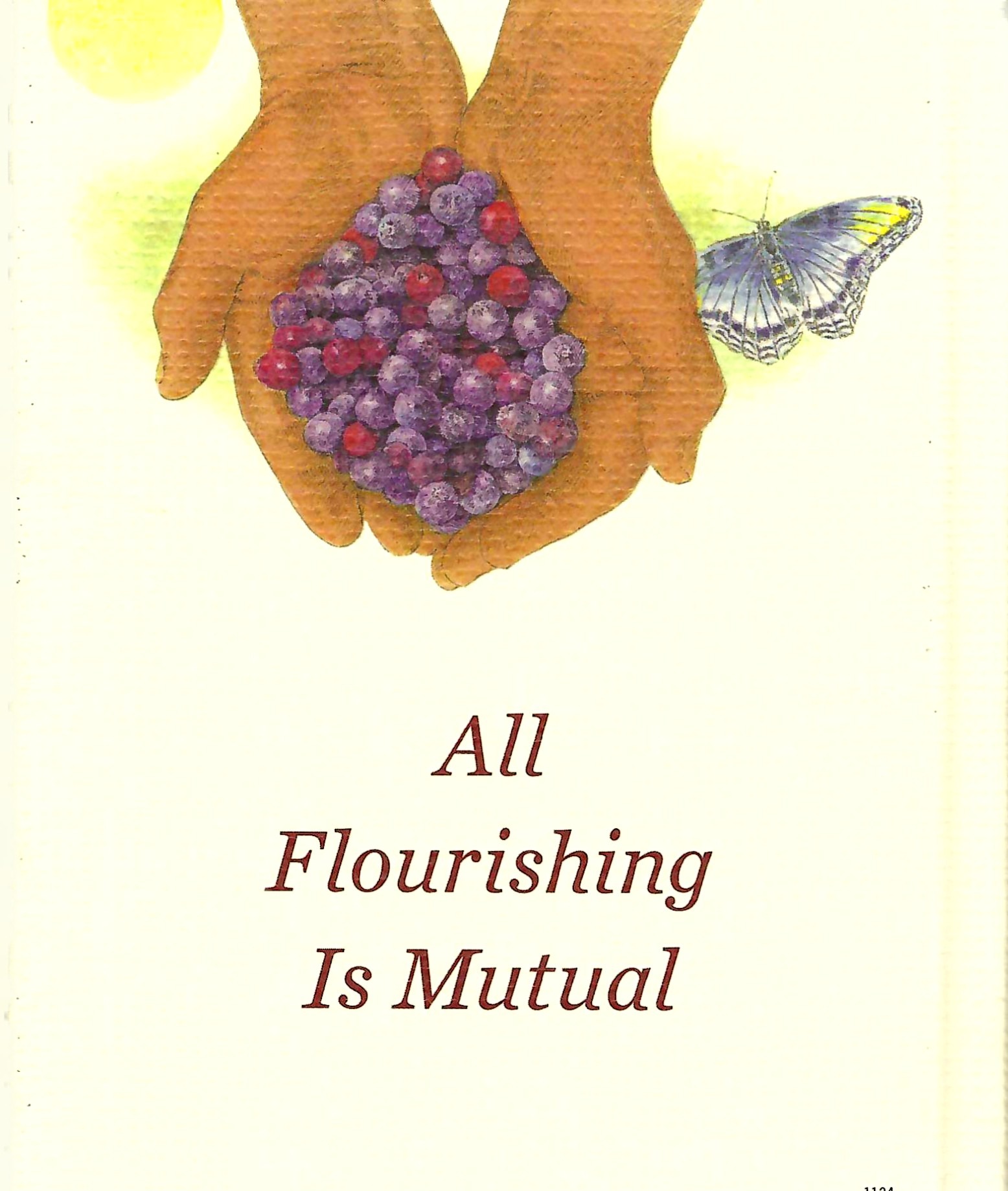
This morning, I invite us to imagine our congregation as an abundant berry patch. Dr. Robin Wall Kimmerer’s latest book The Serviceberry describes a natural world of abundance and reciprocity. She uses berry bushes to highlight the way a Gift Economy works. Our congregation runs on the model of a gift economy. We are flourishing and all flourishing is mutual. We are like a berry bush in full season.
Do you like berries? Do you have a favorite berry? Maybe strawberries or raspberries? I’m partial to blueberries myself. Do we have any cranberry fans? How about lingonberries or huckleberries?
Renown storyteller Joesph Bruchac (brew-shack) tells the story of the First Strawberries. And, I love this story. In this Cherokee tale, the Creator made the first man and the first woman at the same time so neither would be lonely. They marry and are very happy together. The story, however is about their first argument and the berry that helps them reconcile. The story says the man returns home after hunting and finds the woman has not prepared a meal, instead she is out picking flowers. He gets angry. “I am hungry” he says, “Do you expect me to eat flowers?” She also gets angry, “Your words hurt me. I will live with you no longer.” And she walks away.
A chase ensues, but she is a faster walker than he is. He tells the Sun that he is sorry but can’t catch up to her to tell her that. So the Sun takes pity on him and puts berries in her path to try to tempt her to slow down.
The Sun makes raspberries to grow. She pays the no attention. Blueberries, she walks on by. Blackberries, still nothing. Finally: strawberries. She sees them, stops, tastes them – and oh they are good. She starts collecting them to share with her husband. He catches up to her and apologies, they share the strawberries and all is well. And that’s why we have strawberries.
“To this day,” Bruchac concludes, “when the Cherokee people eat strawberries, they are reminded to always be kind to each other; to remember… friendship and respect are as sweet as the taste of the ripe, red berries.”
Other stories from myth and folklore relate the origins of berries, yes. There’s often magic involved, or some divine power. But I love this one about the strawberries because it also teaches us about kindness and a path toward reconciliation. Strawberries are a gift.
Robin Wall Kimmerer, in her book The Serviceberry, writes about berries as part of the Gift Economy of nature.
This abundance of berries (she writes) feels like a pure gift from the land. I have not earned, paid for, nor labored for them. There is no mathematics of worthiness that reckons I deserve them in any way. And yet here they are – along with the sun and the air and the birds and the rain.
Our congregation is like a berry bush in full season. All that we do is offered up as a gift. You don’t incur any debt by attendance on a Sunday morning. The berries are ripe and ready for you, all you need do is show up and they are yours. The berries benefit from being eaten, that’s how nature works. The energy needs to keep flowing, the gift needs to keep moving.
In the book, Dr. Kimmerer talks about her farmer neighbors, Paulie and Ed, who plant some Saskatoons – a western variety of this berry that goes by many names: Juneberry, Shadblow, Sugarplum, Sarvis, Chuckley Pear, Saskatoon, and Serviceberry. “Ethnobotanists know,” Kimmer writes, “that the more names a plant has, the greater its cultural importance.”
This pail of Juneberries represents hundreds of gift exchanges that led up to my blue-stained fingers: the Maples who gave their leaves to the soil, the countless invertebrates and microbes who exchanged nutrients and energy to build the humus in which the Serviceberry seed could take root, the Cedar Waxwing who dropped the seed, the sun, the rain, the early spring flies who pollinated the flowers, the farmer who wielded the shovel to tenderly settle the seedling. They are all parts of the gift exchange by which everyone gets what they need.
She writes about how Paulie and Ed, her farmer neighbors, planted those Saskatoon bushes – and the first season the berries were harvestable, they put out a call for a free ‘pick-your-own’ day for anyone.
Paulie and Ed had put in real labor, had invested money to buy, plant, and care for the trees. But when the berries were ready the first event was free. They broke the rules of capitalism and shifted those berries into the gift economy. Ed and Paulie’s goal was to build relationship in the community around them.
Kimmerer goes on to say that gratitude is the appropriate response to the abundance. “Well,” [Paulie] said, “They are so abundant. There’s more than enough to share and people could use a little goodness in their lives right now.” (p87-8)
Have you experienced something like this? Maybe you can recall time spent with friends when you were nourished body and soul yet needed no debit card at the end of the evening to pay for all you received. You simply received the gifts of love and nourishment. How wondrous. Gratitude is our natural response to abundance.
Reciprocity follows. Kimmerer’s book is subtitled, “Abundance and Reciprocity in the Natural World.” Reciprocity comes in many forms, offered in return through gratitude for the gifts we have received.
Reciprocity is not to be confused with a quantified exchange of some sort. There is no obligation taken on by receiving the gift. There is an exchange, but there is no payment required. There are no receipts. Instead, it is something dynamic in which the gift keeps moving. As Kimmerer writes: All flourishing is mutual. We all get what we need in the exchange.
There is an anecdote in Lewis Hyde’s seminal book The Gift, about an anthropologist studying a hunter-gatherer community in the South American rainforest. The researcher saw a hunter bring home a large kill, more than he and his family would be able to eat. The researcher asked the hunter about how he would store the excess. The hunter was confused by the question. He threw a feast and invited the neighboring families, and every morsel was eaten. The anthropologist assumed the smarter tactic would have been for the hunter to store the meat for himself. The hunter responded, “Store my meat? I store my meat in the belly of my brother.” (See pp 31-2 of Serviceberry)
Our congregation runs on the model of a gift economy. We are like a berry bush in full season. I’m not going to stop. We are here to be a berry bush so you all better be ready for a feast because there is no better place to store the excess of our care than in you. Where is there flourishing in your life now?
When you hear an invitation into our stewardship campaign, you are being invited to take part in caring for the berry bush, that it will continue to flourish for all of us.
Yes, we’re talking about money, but also talking about so many other things – the safety we are creating together, the awareness and education, the warmth of community, the joy and laughter, the rituals and blessings, the rest and the resistance. All of it is the berry bush and your reciprocity is yours to discern. What gift do you offer? What is your favorite berry? Where is there flourishing in your life now?
We have an insert in the order of service with that exact question. You are invited to write a response and turn it in so we can post our answers. Where is there flourishing in your life now?
Perhaps we will bless each other in the natural abundance of our care.
In a world without end,
May it be so.
 Rev. Douglas Taylor