
The Chrysalis Space
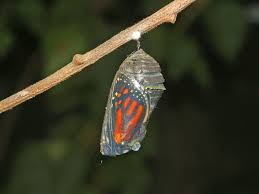
The Chrysalis Space
March 9, 2025
Rev. Douglas Taylor
Sermon video: https://youtu.be/RAHteJRrRy0
It can be hard to trust the change as it is happening. It is that in between time of no-longer and not-yet. For many years I have heard encouraging descriptions of the caterpillar-to-butterfly metamorphosis. Change and transformation are not only possible, the experience is magical and beautiful. Just look at that butterfly! Let go of what was and embrace who you are meant to be; who you are becoming!
But as anyone who has experienced being a teenager can tell you, becoming yourself is not easy. As anyone who has transitioned their gender can share – if you are respectful enough to stop and listen – transformation is not a simple process like flipping a switch.
More recently I’ve been reading about how in the chrysalis, the caterpillar does not just sprout pretty wings – it must completely dissolve itself down into goo before reforming into a butterfly. This goo-phase, this chrysalis space, is what I’m talking about this morning. The goo-phase: in which we are no longer a caterpillar but we are certainly not yet a butterfly. It can be hard to trust change as it is happening.
Paul Tillich was a 20th century Existentialist Theologian I studied significantly while in seminary and beyond. His theology takes psychology seriously, for example. So, I find his work helpful when taking about topics like growth and transformation. Tillich writes about the relationship between growth and chaos, saying this:
“Nothing that grows is without form. The form makes a thing what it is … Every new form is made possible only by breaking through the limits of the old form. In other words, there is a moment of ‘chaos’ between the old and the new form, a moment of no-longer-form and not-yet-form.” (Tillich, Systematic Theology Vol. III; p 50)
Here’s a fascinating thing: for the caterpillar, it is obvious when they are in this time of transformation. For people, it can be hard to spot. When you or I or someone you know is in goo- phase, there is no cocoon or chrysalis. We don’t have the silky pouch or hard shell around us as we go into the goo-phase. Instead, it looks like this: we are waking up in the morning, brushing our teeth, checking our email, going to work or to school. Or whatever it is different people do during an otherwise normal day.
The chrysalis space for us looks a lot like a normal day to someone else. There may be some outward signs in some cases, some clues might appear – but not necessarily. One clue is this: when I was in the goo-phase of my identity as a young adult, there was a lot of chaos around me. Chaos is a clue for when a person is in a chrysalis space.
Often the message I hear – and in my experience this holds true – is that the struggle is worth it. The goo-phase is a time of uncertainty, chaos, and disorientation. But it is worth it. The chaos is present during small changes, and when we undergo large changes – transformations – the chaos scales larger as well. And the transformation available in the chrysalis space is worth it.
In her book Trusting Change, my UU colleague Karen Hering talks about how we can find our way through personal and global transformation. The first step, she says, is finding the courage to start. To illustrate, she tells the story of going down into the unfinished basement when she was a child.
“A single lightbulb hung from the ceiling in the middle of the room, but the only way to turn it on was by pulling the string dangling from it at least eight feet from the doorway. I had to move fully into the darkness to reach it, reluctantly letting go of the door jamb as I did, feet stepping cautiously, arms flailing in from of me, sweeping the shadows to find the light’s string.
“This is the feeling I often get when embarking on any creative project.” (p21)
Usually, these conversations are about personal transformation. We talk about personal growth and the creative process. And I don’t want to make every sermon about the current political situation, but let me offer just a short bit about how the same dynamic we recognize on a personal level can also happen on the macro scale.
In recent years I’ve heard some of my radial progressive friends proclaim that the whole political show is corrupt, not just the left or the right, the red or the blue – everything. These friends advocate tearing the whole system down and starting fresh. While I understand this concept and – to an extent – agree with the theory. I don’t trust it in practice.
Because, it feels a bit like the current administration is attempting to do exactly that. They are not just moving the deck chairs; they are making dramatic changes with far-reaching and long-lasting consequences to fundamental aspects of our political system. Politically, we are in or at least approaching the goo-phase.
It can be hard to trust change as it is happening. But I’m not sure it is a good idea to trust these changes. What is the basis for my assessment? Am I just playing politics and supporting ‘my team?’ Or is there something about these changes that prompts me to be untrusting?
Progressive politician, Pete Buttigieg was talking with a late show host this past week and said this about the changes happening in the government workforce and their structures.
“The randomness is the real problem. I would be the first to say […] that there are some things in the government that need to be shaken up, that need to be changed. We worked a lot on that when I was there. […] We took whole departments and took them apart and put them back together, and actually some people had to be let go as part of that process. But it was a careful process to make sure we could serve people better. This is not that.” (March 5th, 2025 – Late Show with Stephen Colbert) https://www.youtube.com/watch?v=fVNKasTrY_4&ab_channel=TheLateShowwithStephenColbert
Buttigieg describes a careful process of change. What he describes is the regular, slower work of government. He is arguing against the radical, transformative chrysalis space of change for our national government. And I am mostly persuaded by that argument.
Part of the trouble, I think, is that not everyone consented to get into the goo our current national administration is trying to create. For a communal version of such transformation, it needs to be rooted in mutuality and it doesn’t necessarily need to be slow, we do need to move at the speed of trust – so that we’re together in the work and less harm is inflicted on the vulnerable among us. Communal transformation is as much a risk as personal transformation, and it takes a shared goal and mutual flourishing and trust.
Not all goo is the goo of transformation. Sometimes it is the goo of destruction, with no magical metamorphosis following after. There are countless examples in nature of a hungry organism digesting another organism into a goo.
Here’s a fascinating thing: Biologists know a little bit about what is going on during that metamorphosis inside the chrysalis. We’ve known for centuries that there are a few things that do not dissolve into goo during the transformation. Biologist talk about Imaginal Discs that have all the information about the butterfly anatomy ready and waiting inside the caterpillar. During the transformation, when most the caterpillar’s body is digested down to goo, the latent Imaginal Discs awaken and begin to form the adult butterfly.
In other words – there is a blueprint, a map for where the organism is headed. This is a critical element to being able to trust change as it is happening. It makes a big difference to step into uncertainly and chaos if you know the transformation is taking toward a place you plan to go.
As Erik Martinez Resly tells us in our reading this morning. “The question is not whether we will get lost in life, but rather how we will move through it in faith.” https://www.uua.org/worship/words/reflection/found-while-lost And as we may recall from a sermon I gave a few weeks back – faith is not about trusting when there is zero evidence. Faith is about believing in love even when love hidden or masked, and we decide to believe in love anyway.
Resley reminds us that we will always have times in our lives when things fall apart, when relationships sour or at least fade, when work grows dissatisfying, when we are disappointed. When whatever we are doing is no longer working. We become “disheartened, dispirited, we feel disoriented. We get lost.” And then he writes this sentence: “The question is not whether we will get lost in life, but rather how we will move through it in faith.”
Resly frames this whole reading as the entrance to the labyrinth. I think that is an important framework when we talk about trusting change. We may need an ending, but we can’t simply end. We must also enter the labyrinth – we must begin.
In Alice and Wonderland, Alice has this conversation with the Chesire Cat:
“Would you tell me, please, which way I ought to go from here?”
“That depends a good deal on where you want to get to,” said the Cat.
“I don’t much care where–” said Alice.
“Then it doesn’t matter which way you go,” said the Cat.
“–so long as I get SOMEWHERE,” Alice added as an explanation.
“Oh, you’re sure to do that,” said the Cat, “if you only walk long enough.”
This is often paraphrased (and then attributed to Lewis Carrol) as: “If you don’t know where you are going, any road will get you there.”
Most often we are prompted to embark on a change when we recognize a need to end, to leave, to stop something that is no longer working or is harmful or simply does not bring joy the way it used to. But to really step into change and trust that process, you need to be headed somewhere. You need to know where you are going.
When we are in the chrysalis space, whether we are in it personally or sharing it communally or witnessing it in someone we love, the greatest question is not if we will get through the transformation, but how. To make it through and emerge as a butterfly, it is not enough to simply dissolve everything to goo, we must also have our metaphorical Imaginal Discs. We must not only leave behind the no-longer; we must also reach toward the not-yet. Pay attention to what is growing, not what is dying.
It can be hard to trust the change as it is happening. But trusting the change is key to the path through the change. The chrysalis space is certainly chaotic and disorienting. We can feel lost. But the way through is like reaching out in the darkness for that pull string to turn on the light. It takes courage and discernment. Trusting the process we are in, trusting that we have the tools and powers we need to see our way through to reach the goal we are after.
In a world without end
May it be so
 Rev. Douglas Taylor