
The Modern Abolition Movement

The Modern Abolition Movement
Emily Richards and Douglas Taylor
3-29-26
Sermon Video: https://youtu.be/phpQUnoJUh0
Emily: Part 1
When we hear the word abolition we immediately think about tearing something down. Abolition in this country in the 18th and 19th centuries was the movement that sought to end slavery and continues to be what first comes to mind for many people when we talk about abolition.
Today the conversations about abolition have shifted and it is common to see and hear messages such as abolish the police. Abolish ICE. Demands that we get rid of the systems that are in place.
Dr. Crystal T Laura shared “I think of abolition as the deliberate and intentional removal of imprisonment, isolation, punitive institutionalization as the foremost way that we address issues of harm and healing.”
Abolition is the deliberate and intentional removal of systems that cause harm yes, but abolition justice inherently also has to include the building of something new.
Not REbuilding, which in many ways was what happened during reconstruction after the abolition of slavery in the United States, the old systems were simply shifted to continue to allow for the oppression and profit off of the people who were freed from chattel slavery.
True abolition means creating something totally different. And ideally better. In order to do that you have to tear down these systems and start from scratch.
The challenge there is that these systems, these ideologies, are so ingrained into the society in which we live that we cannot imagine what we would create to replace them.
Eric Stanley wrote:
“Abolition is not some distant future but something we create in every moment when we say no to the traps of empire and yes to the nourishing possibilities dreamed of and practiced by our ancestors and friends.
Every time we insist on accessible and affirming health care, safe and quality education, meaningful and secure employment, loving and healing relationships, and being our full and whole selves, we are doing abolition.
Abolition is about breaking down things that oppress and building up things that nourish. Abolition is the practice of transformation in the here and now and the ever after.”
Abolition is building things up. What do we want to build? What are we called to build as UUs? As a people who value justice and equity and generosity? As a people who believe in transformation, of our selves, our communities and our society?
Douglas: Part 2
This conversation about Abolition grew out of a “Congregational Study Action Issue” at our UUA General Assembly this past summer (2025). In general, a Congregational Study Action Issue (or CSAI for short) is a multi-year process intended to have people in our congregations talk about and consider a justice issue most of us do not already know a lot about. The point is to encourage sermons and workshops to get us talking and thinking before we draft any statements or work toward any changes.
When I heard the Abolition proposal, my initial thought was ‘prison reform is a worthy goal, I agree we should talk about that.’ But this is not simply a conversation about making changes to how prisons work in our society.
At root, it is about crime and punishment – yes. But theologically it asks us to look at what we mean by the idea of ‘crime,’ to recognize that not all behaviors we categorize as ‘crimes’ are about harm and not all harm is categorized as a crime. Digging deep we can ask: what do we do with people who cause harm? Are some people disposable? What would redemption look like, or rehabilitation, or repair?
One aspect of this conversation I eventually realized is that we’re also talking about the issues in our society that lead people to ‘break the law’ and end up in prison. Can we recognize that issues of poverty, racism, addiction, and homelessness are connected to this issue of abolition?
If we abolish prisons, we will also need to abolish the conditions that too often lead people to ‘break the law.’ If we had universal health care and affordable housing and minimum basic income – a lot fewer people would be at risk of incarceration.
This conversation leads us to consider all the harm that happens that never gets labeled as criminal. Can we recognize that climate degradation, wage theft, and income inequality are not ‘criminal’ but are issues we’ll want to tackle if we are going to seriously build a just world without relying on our current prison industrial complex.
Abolition has a holistic vision bringing in a broad swath of justice issues we Unitarian Universalists tend to be actively working on already. We talk about intersectionality and how often our struggles in one area overlaps with other areas in our lives.
This conversation about abolition touches on LGBTQ issues and immigration and reproductive rights and human trafficking and political corruption and addiction and so much more because it starts with the question of ‘what counts as a crime?’ and how will we respond as a community?
What might society look like if we began with responses to those questions that take our Unitarian Universalist values seriously? This isn’t merely about abolishing the systems that do not work – that are in fact causing us harm. It is also about imagining what we might do when we start to build something new.
Emily: Part 3
Frederic Jameson said “It’s easier for us to imagine the end of the world than the end of capitalism.” Really sit with that. “It’s easier for us to imagine the end of the world than the end of capitalism.”
We can include capitalism when talking about abolition. We can include it along with the abolishment of modern day slavery, of the prison industrial complex, of human trafficking, of forced labor, of family policing. Of all of these systems.
It was my youngest’s birthday this past week and they wanted McDonald’s for dinner. Wednesdays are a busy day for us so we went through the drive through on our way home from rehearsal and they noticed that there was a sign on the window that said that they didn’t accept bills larger than a $50.
And they asked why. I replied that it was probably because they don’t keep much cash in the register so they wouldn’t have change for a larger bill. And then I kind of flippantly added, they probably empty the registers regularly so there isn’t much in there if they get robbed.
And my kids were so offended that someone might rob McDonald’s. To which I responded, wouldn’t it be great if we lived in a society where people didn’t need to resort to robbing McDonald’s.
When we talk about abolition that is what we mean. Can we imagine a society where no one is living in poverty? Where no one feels like they need to steal to survive?
Alan Detlaff, a professor, author, and abolitionist, shares that statistics show that nearly three-quarters of children in foster care are there because of neglect, which is largely associated with poverty and disproportionately affects brown and black children.
Can we imagine a society where there is no need for children to be removed from their families for the crime of being poor?
Douglas: Part 4
In two weeks, on Sunday April 12, we will have a workshop based on Mariam Kaba’s book We Do This ‘Til We Free Us. We used an excerpt from the book as our reading this morning. Alex Compton and Catherine Magdala will lead the class with the support of our Social Action Huub.
We’ll crack open this conversation around abolition together. If you already have this figured out, maybe this class isn’t for you. But if you are curious or are beginning to see some connections and want more – then we can start a serious conversation about abolition and what might be possible together.
Last week in my sermon on “The Rejected Stone” I said:
“We are called to take care of each other, to build a society in which we all can thrive – not just some, but all. We are called to denounce the idea that some people are disposable or unworthy. The rejected and the outcast are more than welcome here – we are celebrated, central.” (3-2-6)
If that’s true, then we will want to start talking seriously about abolition together.
Last month in my sermon “Do We Have Enough Love” I shared this:
“Friends, our theology does not call us to be among the respected classes. We are not called to whisper sweet platitudes of God’s love to the oppressors. Instead, we are called to remember that our love is radical. … Our faith calls us to build just and loving communities. Our faith calls us to get out among people in need and get our hands dirty, to let our days be the evidence of our hearts on fire.” (2-15-26)
If that rings true, then we will want to start talking seriously about abolition together.
Last fall in my sermon “Sometimes Things Break” I reminded us:
“Sometimes things break. That doesn’t mean we are bad people. We can thrive and grow when broken, (perhaps only when we are broken.) How we respond to the brokenness builds the world around us. It’s not the brokenness that matters. What matters is our response. What matters is the love.” (9-28-25)
And if that sounds right to you, then we will want to start talking seriously about abolition together.
Friends, this is something we’ve been building up toward for a while. It only seems impossible because it is a big idea. But all the pieces are in front of us and we’ve been talking about them together for a few years. Abolition only seems radical because it is. But that’s what we’re here for – radical love, the kind of love that can get all of us free.
Emily: Part 5
W.E.B. du Bois wrote, at the beginning of Looking Forward, “How two theories of the future of America clashed and blended just after the Civil War: the one was abolition democracy based on freedom, intelligence and power for all men, the other was an industry for private profit directed by an autocracy determined at any price to amass wealth and power.”
The rise of autocracy and an industry determined to amass wealth and power, at any cost, has created a society where only the few can truly thrive and the rest of us are confined within systems that judge our worth based solely on our monetary assets, and find us lacking.
Abolition goes beyond making a few changes to the systems that already exist. Abolition requires a fundamentally different way of living. It requires building up things that nourish everyone. It requires transformation in the here and now and the ever after.
And to get there we need to start the demolition.
In a world without end,
may it be so.
Songs of the Civil Rights
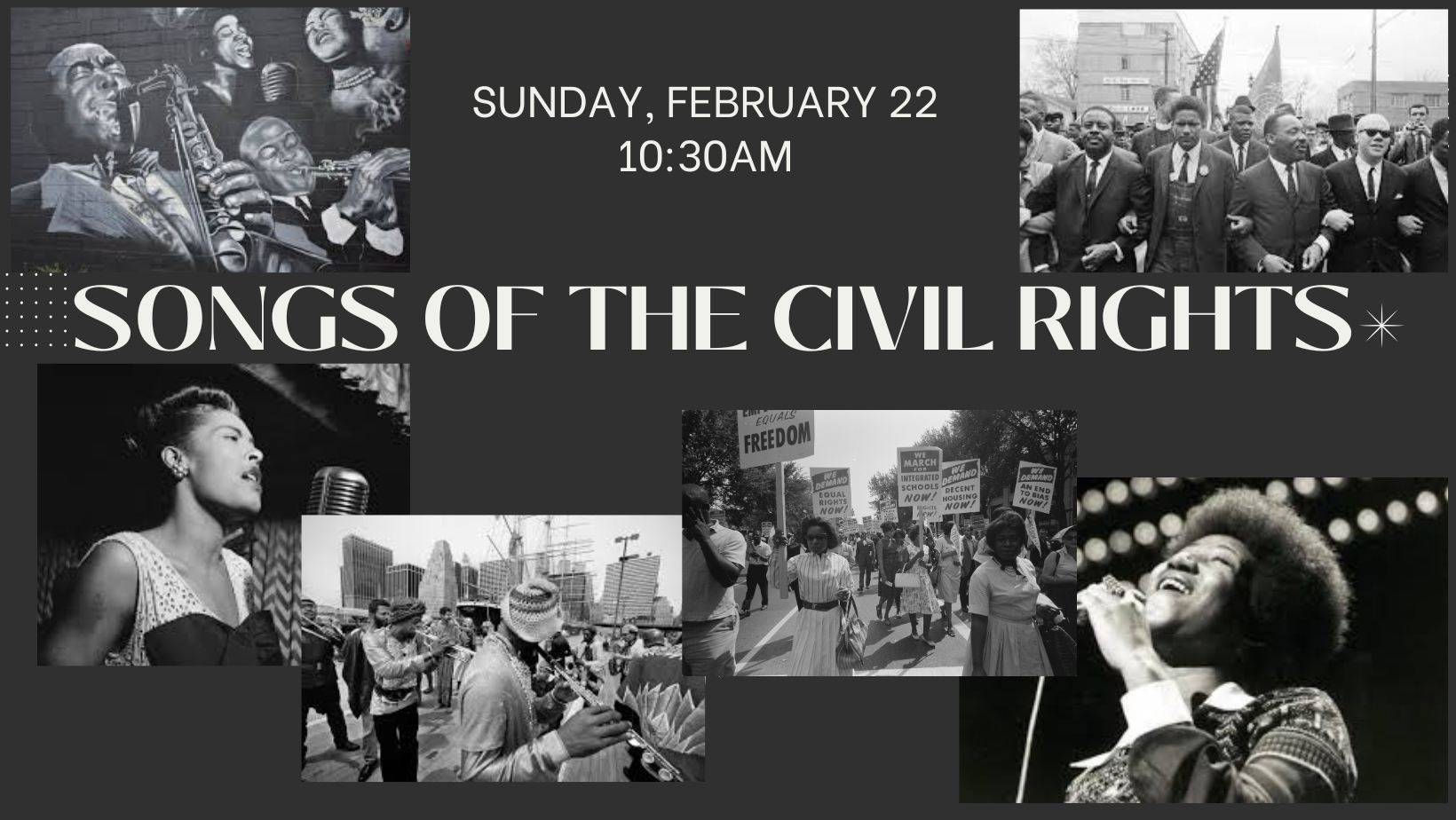
Songs of the Civil Rights
2-22-26
Rev Douglas Taylor and Dr. Sarah Gerk
Sermon video: https://youtu.be/tkNKonpW4yk
Sermon part I
Sarah
We are here today to consider how musical practices supported the Civil Rights movement. I am a musicology professor at BU. I study how music works within communities, primarily considering immigration, diaspora, and race in the United States during the 1800s.
When many of us hear “music of the Civil Rights movement,” we think about the music of protest actions. But it is a small part of the wide body of music that we professionals consider significant to the work of the Civil Rights movement. Music helps us in so many ways to regulate or foment emotional experiences, to form communities, and to broadcast information across a large community. In the 1960s, the popular music industry and recorded sound were relatively new, incredibly powerful tools for disseminating historical, emotional, and social information across the world, and we call your attention to this.
Today, Doug and I wish to explore how Black communities used jazz and popular music styles to create and assert their narratives. One of the most celebrated examples from the 1960s is John Coltrane’s Love Supreme, a jazz album that takes no received forms (so, it doesn’t adhere to the verses and choruses or blues chord progressions that are more familiar) to communicate Coltrane’s spiritual awakening to Islam in the early 1960s, finding his peace and sobriety in a violent and loss-filled moment.
My piece in this is to help you to understand the sound world of Black American music—how music that is not organized like our hymns and choir songs, which are typically conceived through music notation by thinking about melody, harmony, steady tempos, and song form, but instead on practices that stem from Africa and have developed in the New World, that come to us through Black churches and that place a lot of value on individual testimonies of spiritual experiences and personal narratives that would not survive or be understood in any other way. As we go along, I will help you to hear the ways that the music itself—the sound and not just the words—is working on us as it did in the 1960s to advance empathy, to help us process difficult information, and to find resilience.
Douglas
Dr. King once said,
It may be true that the law cannot change the heart, but it can restrain the heartless. The law cannot make a man love me, but it can restrain him from lynching me, and I think that’s pretty important also (Ware Lecture, 1966)
There were clear goals during the Civil Rights movement. People wanted desegregation, equality, real access to voting, access to education and jobs – they also wanted to put a stop to lynching. One goal we don’t talk about a lot was to have white people stop murdering black people with impunity. Which is still a conversation through the Black Lives Matter movement in our current time.
The song Strange Fruit is from 1939. It is based on a poem by Abel Meeropol, child of Russian Jewish immigrants, and it is a shocking song about the racial terrorism of lynching. Some say Holiday’s version marks the beginning of the civil rights movement. It is an unsettling and profound witness that can move you if you’ll let it. Consider that the trigger warning.
Sarah
Billie Holiday, one of jazz’s most celebrated vocalists, had an incredibly powerful voice. The grit of her voice itself, shaped by her strength to perform across Jim Crow’s America as well as adverse childhood experiences and substance abuse, contains a powerful message about who she is and how she feels. Billie’s expressivity comes in the ways in which she treats what would be a musical score—the map of the song—quite freely. Billie hardly ever stays on pitch, or in tempo. She scoops and slides her way around what would be a notated pitch. With the difficult material of “Strange Fruit,” she is often sagging below the scalar pitch, and lagging behind the tempo.
The first words of this song are “southern trees bear strange fruit.” The fruit are the corpses of lynched people. Listen to the words “bear strange fruit” and how they sag below the Western pitch. You may not be able to hear with your ear the gradations of microtone, and that’s ok. You can also feel it. It sounds off. Distressing. Clashing. Also hear or feel how she takes her time with those words, emphasizing them and slowing down a little, while the orchestra maintains a steady tempo. That is Holiday’s musical testimony to her own grief.
Video Strange Fruit by Billie Holiday
Douglas
One list I found, ranking the important songs of the Civil Rights Movement puts Sam Cooke’s A Change Is Gonna Come as the number one, most enduring song of the movement. https://www.azcentral.com/story/entertainment/music/2025/01/28/best-civil-rights-protest-songs/77978742007/
Sam Cooke was certainly among the most influential soul singers of all time. His murder in 1964 was tragic, and the conclusions of the investigation are questionable. His death is sadly one of many Black murders during the movement.
A Change Is Gonna Come talks about Cooke’s experiences with segregation and racism. He performed the song on the Tonight Show with Johnny Carson in February is 1964, but the network did not keep a copy of the tape from that night. And when the Beatles played at the Ed Sullivan theater two days later – Sam Cooke’s performance was overshadowed.
The song was in the album he released that spring, but it was not released as a single until after his death in December of ’64. And yet, despite the many ways the release missed the audiences – this song ranks among the most influential songs of all time. The song is both anguished and hopeful, a remarkable blend of despair and defiant resilience.
Choir A Change Is Gonna Come by Sam Cooke
Sermon part II
Sarah
Part of the work of Black musicians in the 1960s was to assert Black identities and Black power in a musical world that had been heavily shaped by white commercial interests. Rock ‘n’ roll of the 1950s was an incredible moment in which Black music got lots of attention and some people made a lot of money. But we can also name it as a historical moment of white appropriation of a powerful tool for Black communities.
Funk represents a backlash to this. Structured around an interlocking rhythmic pattern in the electric bass [MAYBE DO A LITTLE BOOTSY COLLINS IMITATION] and the drum set, the remaining instruments and vocalists layer their own patterns on top. Repetition is the structure, and that allows for individual and group emotional expressions or testimonies on top of that structure. Again, pitches and melodies are significantly less important than much of the music we practice here on Sundays.
Significantly for this particular song, James Brown invites Black communities to say repeatedly together “I’m Black and I’m Proud.” Musicologists have a term “unisonance” that describes the ways in which creating sound together can be a powerful tool for fostering a feeling of connectedness. Here, James Brown uses the tools of the American music industry—recording technology and widespread touring–to disseminate that feeling of “unisonance” ubiquitously across Black America.
Douglas
The songs of the civil rights range from hopeful to grief-soaked, triumphant to profound. And all of them helped lift the message and galvanize the people, and keep the movement moving forward! Music carries a message and brings it into a part of the brain that responds differently to speeches and text. Music can get in, where other forms of communication cannot.
James Brown’s style of funk was powerful, there was so much joy and pride flowing from his music. Black pride was an essential component of the Civil Rights movement. It helped people remember that the movement was not just about injustices and harm and what’s wrong with society. James Brown was celebrating what’s good, about Black beauty and Black joy, Black pride.
There is a lot of great music from the Civil Rights movement that will sting the conscience, that will being hope and unity, that will reveal the harm and lament the injustice. But if you are looking for unapologetic Black joy, you’re going to love James Brown.
Video Say It Loud – I’m Black and I’m Proud by James Brown
Douglas
We had a hard time limiting ourselves to the songs we are featuring this morning. Many songs were given a featured place by many people in the movement. There are numerous ‘unofficial anthems’ of the movement. It’s heartening, I think, to have so many songs lifted up as important. It is a testament to the importance of music to the Civil Rights movement.
The Staple Singers’ Freedom Highway, Gil Scott-Heron’s The Revolution Will Not Be Televised, Nina Simone’s Mississippi Goddam, and Marvin Gaye’s Inner City Blues are songs for the playlist I’m going to put out tomorrow – but regrettably did not make the cut for our brief hour together this morning. And white artists like Bob Dylan and Pete Seeger are important. But I want to be sure we keep our attention on the black artists this morning.
What music do you think is the music of today’s movements? Even if it is not music you regularly listen to – do you know about the artists? Have you heard, for example, Childish Gambino’s This is America? Or Shea Diamond’s Don’t Shoot? Are you aware of Kendrick Lamar’s Alright? Aware of the story behind it, the context of it, the message offered?
Pay attention to the music around you, notice how it serves beyond mere entertainment. Music has a way of getting into our brains in a way regular speech or text cannot. Music connects us, uplifts us, unifies us, and moves us forward. What are you listen to these days?
May the music be strong and may the movement be strong. May we be strong together.
In a world without end, may it be so.
—
Postlude All You Fascists Bound to Lose sung by Resistance Revival
The People’s Peace
The People’s Peace
Rev. Douglas Taylor
May 18, 2025
Sermon Video:https://youtu.be/254crtZ9Bio
I know my title suggests I will be talking about peace – and I will be. And I know my sermon description suggests this will be a history sermon – and it will be. But really, this morning is all about integrity and the freedom of conscience.
Rev. John Haynes Holmes is likely not a well-known figure from our religious history, but his impact has been significant. He was born almost 150 years ago and was an influential pacifist minister during the first and second World Wars. He served the Community Church of NYC for nearly four decades.
As I mentioned in my description of the service, Holmes was a staunch pacifist, and notably a co-founder of both the NAACP and the ACLU. Yet he was a controversial figure, his relationship with Unitarianism and with his colleagues was tumultuous. We effectively pushed him out of Unitarianism for being a non-conformist in his pacifism. Which is wild. I want to share with you the story of how our Unitarianism got caught up in the fervor of supporting the war and nearly lost our moral center as a tradition.
On both the Unitarian and Universalist sides of our heritage, we have prided ourselves on our commitment to freedom of belief and freedom of conscience. I have several times preached about the foundational value of honoring our theological diversity, of allowing for variety among our beliefs together, of insisting that we do not exclude based on such differences. Freedom of belief and freedom of conscience are central to our way of faith. Yet we have not always practice these freedoms well. My sermon today begins in one of our failures on this count.
I need to set the scene. This is 1917 – right at the time the United Staes had joined the war in Europe, the Great War, the War to End All Wars, or what we later came to call the First World War. The Unitarians met for their general conference meeting and the topic of supporting the war is put forth for discussion and resolution. The moderator of the conference 1917 is former president of the United States, William Howard Taft. Taft is the most recent of our four Unitarian US presidents, serving from 1909-1913. Taft strongly encouraged the Unitarian conference to support the war effort. Taft gave an opening address at the conferences, calling on the clergy to preach the righteousness of the war, to say it is necessary to preserve a peaceful world, and that we should all get behind President Wilson.
John Haynes Holmes is the young minister of what was then known as Church of the Messiah, NYC – a prominent Unitarian pulpit. Holmes was a strong advocate for justice and the modern social message of religion. He was in the position to bring a report about the perspectives and attitudes of Unitarians toward the war. As a staunch pacifist he called for the clergy to mourn the dead, cry out at the destruction, and seek the path of reconciliation.
Taft did not like Holmes’ report and setting the moderator gavel aside, took the floor to argue against Holmes’ pacifism and propose a motion saying “That it is the sense of this Unitarian Conference that this war must be carried to a successful issue, … that we … approve the measures of President Wilson and Congress to carry on this war.”
In the debate, Holmes rose and said, “I am a pacifist, I am non-resistant, I hate war, and I hate this war; so long as I live and breathe I will have nothing to do with this war or any war, so help me God.” Taft said “Our house is afire and we must put it out, and it is no time for considering whether the firemen are using the best kind of water.” The motion was adopted by a vote of 236 to 9. (Stream of Light, Conrad Wright, ed; p103)
There are times in history when we feel a fervent need to take some communal action, to stand against some evil. It is not a stretch to say many people, myself included, feel we are in just such a moment for our country today. Yet to refuse a space for conscientious dissent feels unimaginable. Everything in me would rebel if there were a resolution from the UUA proclaiming that all of us must agree with this or that policy or proposal or action.
In 1918, the year following the debate between Taft and Holmes, the leadership of the American Unitarian Association issued sanctions against any congregation employing a minister who was not “a willing, earnest, and outspoken supporter of the United States in the vigorous and resolute prosecution of the war.” They withheld all aid to such congregations. Holmes withdrew his fellowship with the Unitarians and the church likewise left the Association, changing its name to Community Church, NYC.
A decade or so after that war, the Unitarians struck down those sanctions. And as he neared retirement, Holmes was courted by Unitarian leadership to reinstate his fellowship among the Unitarians, which he did. The broader story includes this reconciliation.
In recent years, pro-war UUs are far from the majority. The counter-cultural movements of the ‘60’s became our bread and butter in the following decades – peace, civil rights, equality, diversity – these values and their accompanying justice issues became bedrock cultural aspects of our Unitarian Universalist identity. Holmes’ ministry predated all of that by a few decades.
Over the years I have bumped into people who assumed Unitarian Universalists were always anti-war. One person was aghast to hear a colleague suggest we are not considered one of the Peace Churches.
The Peace Churches are denominations such as the Brethren, the Quackers, the Amish and the Mennonites who have historically held a biblical commitment to non-resistance and pacifism as a core tenet of their faith. I am reminded of James Baldwin’s quip, “If one believes in the Prince of Peace one must stop committing crimes in the name of the Prince of Peace.”
Unitarians have, in more recent times, shifted to a more anti-war stance, a more reconciling perspective. In recent conflicts, for example, the UUA has been very supportive of Ukraine’s resistance to Russian aggression but was noncommittal for several month when talking about the war in Gaza. The UUA has been nuanced and cautious about asserting a stance – perhaps as a reflection of the experience of Holmes, but I doubt it. I don’t think the story of John Haynes Holmes’ pacifism and refusal to toe the line with conformity take up much space in how we remember our history. It is not a story we tell very loudly among ourselves.
I will note that throughout our early history, Unitarians in particular have been in the thick of the establishment of our government. Many of the ‘founding fathers’ of the United States have some Unitarian connections. We were owners of business and leading academics in the early formation of our nation. We were influencers. We were the establishment.
The past hundred years, however, has seen a pivot away from Unitarians holding significant political influence. We have – most notably during the 60’s and onward – shifted toward being a voice of resistance. And circling back to Holmes I would credit his ministry as having an indirect impact on our progress as a religious tradition.
I would not say we have become anti-establishment, however. I think we’ve grown into a faith community that is not simply against something, we are working to establish a kind of community that serves the needs of all people through our values. I would not say Holmes’ greatest attribute was his pacifism. Yes, his stance against the war precipitated his withdrawal from the Unitarian Association. But that particular stance was grounded in a broader vision for what could be when we set militarism aside.
In one of his 1917 sermons he said “War and democracy are incompatible.” He spoke about how the mindset of war tramples the values we are wanting to protect by going the war. While we may not be actively at war in the way we were in 1917, it is not hard to see how great an impact militarism has had on the erosion of our democracy. Can you see how the state’s use of force has eroded our freedom? It is this broader vision of what could be that lead me to want to learn more about Holmes.
It was not just his radical pacifism; his vision of ministry and of the nature of religion was also radical for the time. He was far from the only Unitarian minister calling for a modernization of our theology – indeed the Humanist movement of the 1930’s may have been influenced by Holmes’ writings. The part I found more prescient for our current situation is his call for “a religion that moved from concentration on the individual and focused instead on the social nature of every individual.” (Unitarian Universalism, a narrative history, by David Bumbaugh; p137)
Our current Unitarian Universalist conversations about collective liberation and Beloved Community are fed by indigenous perspectives as well as from people like Holmes who swim counterwise from within the dominant stream of our history. His non-conformity was not a simple one-sided complaint against one specific aspect of evil. Holmes offered a wholistic vision of a better world.
Witness his fuller story. He was approached by W.E.B. Debois to join in the creation of the NAACP – one of about 60 people who are never listed among the founders. Holmes was committed to integration and the rights of people of color. Later he was part of forming the American Civil Liberties Union. In both cases, his name is not at the center. If you look up the history of the founding of the NAACP, you will not find his name among the founders – because he was not front and center, he was in a supportive role as a partner and ally.
I highlight his non-conformity, his refusal to set aside his conscience. But his ministry cannot be reduced to one issue or one fight against the establishment. He was a builder of new possibilities. In this way, he is a role model to me. He heeded the promptings of the spirit, lived within his integrity, insisting not that everyone agree with him but that everyone be free to agree with their own conscience.
I’ve never been what you might call an activist preacher. I can preach a good justice sermon, but my calling has always been to build that certain sort of community where all souls shall grown strong and together we move toward a more Beloved world. Holmes did that too.
And I see it in many of you. And together we can bring more peace, more grace, move love each day. And God help us – together we can make this place beautiful.
In a world without end,
may it be so
MLK Keynote Speech 2025
MLK Keynote Speech 2025
Rev. Douglas Taylor
host by the MLK Commission of Broome County
Monday, January 20, 2025 at 6:00pm
at the Salvation Temple Church, 80 Main Street
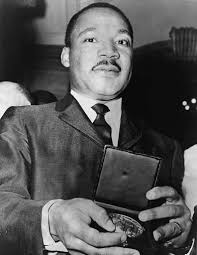
When I was here last year, participating in the service, I shared a small anecdote about my personal connection to one of Dr. King’s early speeches. My mother’s father, Ashley Walter Strong served the as a leader in Old Stone Universalist Church in Schuyler Lake, NY. Grandpa Strong served as Moderator and then President of the New York State Convention of Universalists in the mid 1950’s. It was in that role that he met the Rev. Dr. Martin Luther King Jr. In 1956 the meeting in Cortland and Dr. King was the featured speaker; as moderator it was my grandfather’s responsibility to introduce him.
By this time, young Dr. King had successfully navigated the Montgomery bus boycott resulting in a U.S. district court decision that segregation of municipal buses is unconstitutional.
(Although the official Supreme Court decision upholding the lower court decision was still a few months away.) Dr. King had been arrested once by this time; (although the first bomb would not appear on his front porch for another six months.) The summer of 1956 was before Dr. King and his wife traveled to India to study Mahatma Gandhi’s policies of nonviolence. It was before James Meredith tried to enroll at the University of Mississippi, before King was jailed in Birmingham where he wrote his stirring Letter from the Birmingham Jail, before the 1963 “I Have a Dream” speech during the march on Washington. This was before King visited West Berlin, before he met with the Pope in Rome, before he was awarded the Nobel Peace Prize. This was before Malcolm X was murdered, before the march from Selma to Montgomery. It was before President Johnson signed the voting rights bill, before the 1967 riots in Detroit and in Newark and in Jackson Mississippi. It was almost twelve years before Martin Luther King was shot by James Earl Ray in Memphis.
My grandfather stood at the lectern to introduce Dr. King to the 1956 State Convention delegates and attendees and had no way of knowing what would unfold over the next dozen years for that man or for the nation. He knew about King’s education and vocation; he knew about the bus boycott and the scope of the issues King and others were trying to address. My grandfather knew these were issues that he and the other Universalists there were deeply concerned about. He could sense the fire and the passion in this man.
I have tried to imagine myself in my grandfather’s position. The Universalist, if you are unfamiliar, are a people of God’s love. Love has long been our central value, guiding our faith. Standing before a gathering of northern white religious people concerned for issues of racial injustice, introducing Dr. King.
When I asked my mother about it, she was 16 years old at the time, she wrote this to me:
I know he was so proud of being able to introduce Dr. King. Knowing Dad, I would say that he stood in the same spiritual awe as I did. Dad had a deep respect for the integrity and convictions [of] Dr. King. We were all so proud of being Universalists that day.
I’ve been thinking about the experience of white allies in the Civil Rights movement and anti-racism efforts beyond. I’ve been thinking about the message Dr. King preached to engage white people in the effort for desegregation and racial equality. Because the vision Dr. King put forth was of a multi-racial, multi-cultural Beloved Community, and that is not a message only for Black people. King was talking to white people as well.
Early in my own ministry, I began preaching an MLK sermon on the Sunday before the national holiday. I have preached such a sermon nearly every year in my congregation these past twenty years. I often preach specifically about King and his message, although some years I focus on racism through the work of Michelle Alexander or Ta-Nahisi Coates, and sometimes I just preach about democracy with a few references to King. But my congregation has come to understand that I will be sharing King’s message and vision with them each year; and more – they have come to understand that King’s message is for them.
I strive to bring King’s message and vision to my predominantly white congregation, to encourage them – not that most of them need this encouragement – to heed his vision as applicable to them. The vision King offered the nation was a powerful vision calling us to move forward by staying true to the fundamental statements of who we are and who we have been as a country since our inception. King cast a vision of the beloved community united to defeat racism, united to defeat economic inequality, united to defeat the great sin of war.
It is interesting to note that nowadays we try to tame King’s message by saying only it is a message about racism. We try to contain it into a narrow concept consumable only as a nice story of something that happened once upon a time for black people. But the message cannot be so contained and ignored because King’s vision was not simply a vision of voting rights and desegregation. The message cannot be contained because the vision cannot be contained. King’s vision was of the beloved community and it included all God’s children.
King’s vision was as much about peace as he spoke out against the Vietnam War. His vision was as much about economic opportunity as he spoke in support of striking workers. King’s vision was not for some people during some time now past. His vision was for the nation to rise up and live out the true meaning of its creed, that all people are created equal. King’s vision was less about desegregation for blacks and more about stirring the rest of the nation to wake up to the injustices that were being experienced by the least of these in our midst.
The 1956 sermon King delivered to the Universalists is not my only connection to King. Ten years later, in 1966, Dr. King spoke to a larger convention, the General Assembly of Unitarian Universalists delivering the distinguished Ware Lecture.
Over the years the Ware Lecture has been delivered by Jane Addams, Howard Thurman, Linus Pauling, Helen Caldicott, Krista Tippett, Van Jones, Eboo Patel, and Cornell West. It is an impressive list. In 1966, the speaker was the Reverend Dr. Martin Luther King, Jr. and his title of his talk was “Don’t Sleep Through the Revolution.” Dr. King was invited to speak to the gathered Unitarian Universalists, a predominantly white faith tradition, and the message he chose to bring us was to wake up!
Dr. King began his speech to us with the story of Rip van Winkle. In case the tale has fallen out of fashion; briefly, it is a short story by Washington Irving about a man who falls asleep up in the Catskill mountains for 20 years. Most cogently, he falls asleep while King George the third of England rules the land and wakes to find President George Washington in charge. Rip van Winkle slept through a revolution.
In drawing the parallel, King said to us,
“One of the great misfortunes of history is that all too many individuals and institutions find themselves in a great period of change and yet fail to achieve the new attitudes and outlooks that the new situation demands. There is nothing more tragic than to sleep through a revolution.” (MLK Don’t Sleep Through the Revolution)
He then goes on to describe the demands of “the new situation” as well as what he means by “the new attitudes and outlooks” needed to face it.
He talked about the shift underway in how racism is experienced in America after the Civil Rights and Voting Rights Acts were signed into law. He talked about the ongoing pervasive attitude of racial superiority (or ‘white supremacy’ as we might say today.) He told us about the ongoing threats of violence and annihilation. Dr. King warned us about the apathy of the church, the tragic sin of standing by while people were oppressed and degraded. He warned us against sleeping through the revolution.
And frankly, in all fairness, we Unitarian Universalists – like many good white liberals – we did fall asleep after we experienced an internal implosion over racial issues just a few years after King spoke with us. As a religious movement, we pretty much stopped talking about race through the 70’s and 80’s and much of the 90’s. Now, that’s a broad and un-nuanced way of putting it, but it is largely true.
But a new day has arrived. The current generation faces much the same adversity folks faced the 60’s. There are remarkable similarities. There is an upswell in calls for civil rights and justice for marginalized identities. Young people are riled up and the older generation doesn’t quite understand why. Back in the ‘60’s, Dr. King would often cite three evils for us to deal with as a nation: racism, economic exploitation, and militarism. Are we not still facing these three evils today?
So, in 1966, Dr. King said, “all too many individuals and institutions find themselves in a great period of change and yet fail to achieve the new attitudes and outlooks that the new situation demands.” And the great period of change he referred to then is strikingly similar to the great period of change we are now in today. We can add a few problems and difficulties that were not in play back then. Healthcare, for example, was not a ‘for-profit’ endeavor back then; we invented that problem in the 70’s. And the climate crisis has grown dramatically worse since King’s time. The need for human rights and civil rights for other marginalized groups has expanded, but echoes the work King and others had done in their time.
Many people who were deeply involved in the hard work of justice-making in the 60’s may be rightly disheartened that we find ourselves in so similar a situation today. But I tell you the fires have not died and there are workers in the field today building toward a better world, where justice will roll down like waters and peace like a mighty stream.
Dr. King told that gathering of white religious liberals in 1966 that we would need new attitudes and outlooks to address the situation. As you might suspect, the new attitudes and outlooks he called for over 50 years ago – I’m going to tell you are applicable today. Indeed the ‘new’ attitudes and outlooks he called for back then, while radical, were not really new in the 60’s.
There were two particular ideas, theological ideas, that he mentioned in his speech to the Unitarian Universalists as the attitudes and outlooks needed for those times.
The first in the mindset of interconnectedness as a perspective of renewal. In the 1966 Ware Lecture he said it like this: “All life is inter-related, and somehow we are all tied together. For some strange reason I can never be what I ought to be until you are what you ought to be, and you can never be what you ought to be until I am what I ought to be.” In other speeches he talked about it as a “network of mutuality, a single garment of destiny,” in which we are all caught up together; and how “injustice anywhere is a threat to justice everywhere.” It’s all inter-related. This theological premise that we are interconnected led King and it leads us today into the work of justice.
It becomes important to be in relationship with the poor and oppressed, that you understand the condition of the disenfranchised and dispossessed. Dr. King said “True compassion is more than flinging a coin to a beggar; it comes to see that an edifice which produces beggars needs restructuring.” I am suggesting our interconnectedness calls us to have relationships with people who are vulnerable and suffering today.
The second theological perspective he mentioned is that of the Beloved Community. Dr. King kept the vision of a Beloved Community fresh in the people’s minds, as a beacon toward which we were striving. The whole underpinning of the I Have a Dream speech is that the ‘dream’ was really a social vision of the Beloved Community.
The dream is the goal. And here is the trick. This is what King came to say to the Unitarian Universalist back in in 1966. To achieve the dream, good people like me and other progressive white liberals need to first wake up and stay awake through the revolution.
What are we going to do? What are you willing to do? It is all inter-related and our goal is nothing less than Beloved Community. What are we going to do?
In the speech he gave to the Unitarian Universalists Dr. King quoted Victor Hugo who had once said there is nothing more powerful in all the world than an idea whose time has come. I would cautiously suggest that time is cyclical and the time has come again for the grand ideas of freedom and justice in our country. And it is the church that needs to herald these ideas, it is the church that must wake up and shout such things in the highways and byways of our nation.
In his 1967 book, Where Do We Go From Here: Chaos or Community? King wrote:
“The church has an opportunity and a duty to lift up its voice like a trumpet and declare unto the people the immorality of segregation. It must affirm that every human life is a reflection of divinity, and that every act of injustice mars and defaces the image of God in man.”
This is the call for religion to recognize its role in ushering in a solution to national problems.
In his Letter from the Birmingham Jail he wrote that the church had been behaving like a thermometer of culture when it used to be like a thermostat! During Dr. King’s time, the church had an opportunity and a duty to lift up its voice like a trumpet and declare unto the people the immorality of racism. Churches did so then and need to do so now. Will we? He called on churches to be champions once more for the poor, to cry out against the sin of economic inequality. Will we? King called on churches to raise their voices against the oppressive machinery of war and destruction. Will we?
The message of Dr. King was not contained as only a message against racism. He spoke out against the triple threat of racism, militarism and economic disparity. A key demand in his I Have a Dream speech, for example, was for “a national minimum wage act that will give all Americans a decent standard of living.” (A line that often gets missed!)
Dr. King was killed while supporting striking sanitation workers in Memphis, TN who were struggling for a living wage and for their dignity. Dr. King said,
“There is nothing but a lack of social vision to prevent us from paying an adequate wage to every American worker whether a hospital worker, laundry worker, maid, or day laborer.”
Dr. King’s vision still serves for our current situation, as there are still parts of that vision we have not realized. We can yet work against racism. We still can take part in speaking out against endless war. There is still more to do, right here in downtown Binghamton to change systems and support individuals struggling with poverty and economic inequality. Dr. King shared with us the dream but to achieve the dream we must first wake up.
To achieve the dream of economic equality, we must wake up enough to recognize that nearly 40 million people in American living in poverty is unacceptable and that we can do something about it. To achieve the dream of a day when “little black boys and black girls will be able to join hands with little white boys and white girls as sisters and brothers,” we need to first wake up to the fact that we have more than 11 million children living in poverty in this country, which is unacceptable and something we can address if we wanted to address it.
To achieve the dream of a day when increasing our teachers’ take-home pay will triumph over tax-breaks for tycoons; when providing for the poor pulls rank over putting them in prison; when we adjust our attitude as a society about the possibility of putting people of color into positions of power … then we must first wake up to the myth of meritocracy and the insidious reality of white supremacy culture.
I share the dream of a day when we put our great wisdom and wealth to work feeding the hungry, housing the homeless, and caring for the sick. I share the dream of a day when our nation is once more recognized as the leader of the free world not by of the magnitude of our military but by the capacity of our compassion. I share the dream of a day when we wake up and realize that before we can be a great nation, we must first be a good nation. We all have a role in bringing that Dream to fruition. It is time for us to again wake up and join the work of building the Beloved Community for today.
In a world without end,
May it be so.
 Rev. Douglas Taylor