
Martin and Malcolm in America
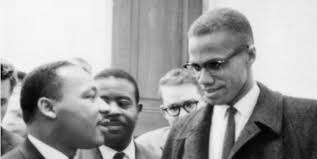
Martin and Malcolm in America
Rev. Douglas Taylor
1-19-25
Sermon Video: https://youtu.be/pjYecyTMKL4
James Baldwin wrote an incisive article for Esquire magazine in 1972 about his relationships with both Martin Luther King Jr. and Malcolm X. Baldwin had the unique position of being a contemporary colleague of both men. Four years after Martin’s assassination and seven years after Malcom’s, Balwin wrote,
“Malcolm and Martin, beginning at what seemed to be very different points … and espousing, or expressing, very different philosophies, found that their common situation so thoroughly devastated what had seemed to be mutually exclusive points of view that by the time each met his death there was practically no difference between them.”
It is commonly accepted in many circles even to this day, the romantic cliche that Martin was the peaceful, inspiring one working tirelessly for integration while Malcolm was the scary, dangerous one fighting for black empowerment. They are held up as dissonant icons of the ‘60’s; two paths, two opposing options people could choose between. Peniel Joseph’s book title The Sword and the Shield acknowledges this mythic perception of these two historic men. “Self-defense vs. nonviolence,” we can read on the jacket cover, “black power vs. civil rights, the sword vs. the shield”
The truth, I hope you are not surprised, is more nuanced and complimentary. Indeed, over the years I have found myself draw more to the radical work of King in his later years. And if Baldwin’s analysis is on target, we who love the radical aspects of King, have much to appreciate in the later years of Malcolm X as well.
The Soul Matters theme of the month for January is ‘story.’ I think it is fitting for us to grapple with the stories we have been fed about these two men, and the impact of these stories on how we respond to situations of racism and economic injustice today.
Part of the story is simply historical record.
Martin Luther King Jr. was born in Atlanta into a preacher’s family. He experienced southern segregation and racism growing up, but also the protective strength of the black church. He attended Morehouse college, Crozier Theological Seminary, and Boston University for his doctorate. At the age of 25 he was called to serve the Dexter Avenue Baptist Church in Montgomery Alabama. From there, he became more and more involved and central to the Civil Rights Movement.
Malcolm X, was born in Omaha Nebraska to the Little family, admirers of Marcus Garvey. His father died in a streetcar accident although many suspected it was not an accident. His mother was later committed to a state hospital after a nervous breakdown. Malcolm’s adolescent years were spent in foster homes or with other relations. Malcolm was a street hustler and thief. He was arrested for burglary when he was 20. While in prison, he converted to Nation of Islam, changed his last name from “Little” to “X” as was the custom in the Nation of Islam, and once paroled, began climbing the ranks in the religious institution. From there, he became more and more involved and a central spokesman for the Black Power movement.
Both Martin and Malcolm rose to such levels of power and persuasion among people that our government had agents and surveillance on each of them throughout their public careers. Both Martin and Malcolm’s assassinations spurred questions and conspiracies around the official stories offered about the shooters. All of that is about circumstance more than either of their character.
What brought them together is that both Martin and Malcolm had the goal of eradicating racial discrimination and advancing the conditions of Black people in our country and world-wide. They certainly disagreed on the role of violence in the movement – King advocating for Non-Violent Direct Action and Malcolm X strongly supporting armed self-defense. And they did not agree on the ultimate goal of what racial advancement looked like. King was an integrationist, envisioning a multi-racial Beloved Community. Malcolm X was a black nationalist, promoting the superiority of the Black race.
If you were alive back then and remember how things were, you may recall how vilified Malcolm X was. Martin Luther King Jr. was also vilified in certain circles, but the lion’s share of the fearmongering was heaped onto Malcolm X.
It was easier to demonize Malcolm X for two reasons – he was saying some fairly radical and scary things. For example, one talk King gave on Civil Rights was titled “Give Us the Ballot.” Later, when Malcolm X did something similar the title he used was “The Ballot or the Bullet.” Malcom X was provocative, and thus, easier to demonize. The second reason is that King’s impact was built across the racial lines, among white and black people. Malcolm’s impact was among black people who were poor and marginalized. And really, the demonizing I’m talking about is defined by the espeices of the white people at the time, not the black people. Both Martin and Malcolm were considered dangerous by those in power who benefited from the status quo.
There is a lesson here. When we are offered narratives about people that they are scary and dangerous – maybe look a little deeper to uncover the motives feeding those narratives. Fear and division are tools used by oppressive systems to maintain control. It was Malcolm X who said, “If you’re not careful, the newspapers will have you hating the people who are being oppressed, and loving the people who are doing the oppressing.”
Malcolm X’s primary goal was to advance Black dignity. He wanted Black people to be proud of themselves because they were Black. He wanted Black people to walk tall, proud to be Black. James Baldwin once wrote: “It took many years of vomiting up all the filth I’d been taught about myself, and half-believed, before I was able to walk on the earth as though I had a right to be here.” Malcolm wanted to give Black people a world in which they knew they had a right to belong, in which they did not need to shield themselves from the hatred and self-hatred fed to them every day. Malcolm’s fierce critique of white supremacy, his rhetorical sword, was a tool in the service of his passion for Black dignity.
King’s focus was on Black citizenship. He insisted that we must join together in solidarity and make our democracy work for all the people. King wanted Black people to demand their rights, to insist on being granted their due as citizens of the nation. And more, he wanted all people, white and Black, to participate in making our nation realize its promise. I think many of us are more familiar with Dr. King’s motives and his articulation of his goals.
We are certainly more familiar with Martin’s quotes, like, “We are inextricable caught in a network of mutuality;” and, “True peace is not merely the absence of tension; it is the presence of justice.” But Malcolm had the gift of eloquence as well. “We didn’t land on Plymouth Rock, Plymouth Rock landed on us,” he said; and, “You can’t separate peace from freedom because no one can be at peace unless he has his freedom.” Many people will quote Dr. King out of context and turn his words of power into pablum – we don’t get to have that poetry without also taking the pain.
The contemporary Black Lives Matter movement feels like the heir of both the Black Power movement and the Civil Rights Movement blended. The call to say their names, for example, to lift up the individuals who have been killed was a key part of the movement. It is a mark of Black dignity. And the call to assemble and insist on civic change was the main thrust. It is a mark of Black citizenship to declare – these are our streets. We keep us safe.
But it is Malcolm X who is quoted more often by young activists today. The call for Black citizenship is certainly still important to people, but the call for Black dignity is the starting point, without which there is no other work. In his new book Starting Somewhere, local activist and organizer, Roderick Douglass offers a Malcolm X quote in the forward of the book. “There is no better teacher than adversity. Every defeat, every heartbreak, every loss, contains its own seed, its own lesson on how to improve your performance the next time.” Appreciation of Malcolm’s contribution and impact is rising.
As our days unfold before us, it is worth noting that the anger and pain Malcolm spoke to is the same anger and pain many vulnerable people feel today. Martin Luther King Jr.’s vision of Beloved Community with a place for everyone is still our central guide. But there is much we can learn from Malcolm X’s perspective as well. When we make the commitment to live out of Unitarian Universalist values of Justice and Equity and love – then we do well to lean in to that discomfort of other people’s pain and anger. Learning more about Malcolm X, his life, his words and teachings, will help me be more present and a better ally.
Recognizing the blend of Martin and Malcolm in their later years, we can attend not just to the call for peace and justice, but for dignity as well. Recognizing and encouraging the dignity of the poor, the disenfranchised, and the vulnerable is what opens up the possibility of a Beloved Community where we can meet as equals. Martin once said, “A riot is the language of the unheard.” With all that is going on in the world, the suffering and the injustice, we who would be part of the solution must keep our ears and hearts open to what is going on. And we can treat all people with dignity, for that is the starting point for the Beloved Community to become realized in our midst.
In a world without end,
May it be so
 Rev. Douglas Taylor