
The Chrysalis Space
The Chrysalis Space
March 9, 2025
Rev. Douglas Taylor
Sermon video: https://youtu.be/RAHteJRrRy0
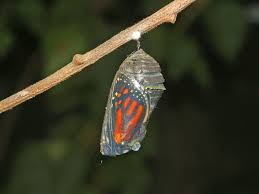
It can be hard to trust the change as it is happening. It is that in between time of no-longer and not-yet. For many years I have heard encouraging descriptions of the caterpillar-to-butterfly metamorphosis. Change and transformation are not only possible, the experience is magical and beautiful. Just look at that butterfly! Let go of what was and embrace who you are meant to be; who you are becoming!
But as anyone who has experienced being a teenager can tell you, becoming yourself is not easy. As anyone who has transitioned their gender can share – if you are respectful enough to stop and listen – transformation is not a simple process like flipping a switch.
More recently I’ve been reading about how in the chrysalis, the caterpillar does not just sprout pretty wings – it must completely dissolve itself down into goo before reforming into a butterfly. This goo-phase, this chrysalis space, is what I’m talking about this morning. The goo-phase: in which we are no longer a caterpillar but we are certainly not yet a butterfly. It can be hard to trust change as it is happening.
Paul Tillich was a 20th century Existentialist Theologian I studied significantly while in seminary and beyond. His theology takes psychology seriously, for example. So, I find his work helpful when taking about topics like growth and transformation. Tillich writes about the relationship between growth and chaos, saying this:
“Nothing that grows is without form. The form makes a thing what it is … Every new form is made possible only by breaking through the limits of the old form. In other words, there is a moment of ‘chaos’ between the old and the new form, a moment of no-longer-form and not-yet-form.” (Tillich, Systematic Theology Vol. III; p 50)
Here’s a fascinating thing: for the caterpillar, it is obvious when they are in this time of transformation. For people, it can be hard to spot. When you or I or someone you know is in goo- phase, there is no cocoon or chrysalis. We don’t have the silky pouch or hard shell around us as we go into the goo-phase. Instead, it looks like this: we are waking up in the morning, brushing our teeth, checking our email, going to work or to school. Or whatever it is different people do during an otherwise normal day.
The chrysalis space for us looks a lot like a normal day to someone else. There may be some outward signs in some cases, some clues might appear – but not necessarily. One clue is this: when I was in the goo-phase of my identity as a young adult, there was a lot of chaos around me. Chaos is a clue for when a person is in a chrysalis space.
Often the message I hear – and in my experience this holds true – is that the struggle is worth it. The goo-phase is a time of uncertainty, chaos, and disorientation. But it is worth it. The chaos is present during small changes, and when we undergo large changes – transformations – the chaos scales larger as well. And the transformation available in the chrysalis space is worth it.
In her book Trusting Change, my UU colleague Karen Hering talks about how we can find our way through personal and global transformation. The first step, she says, is finding the courage to start. To illustrate, she tells the story of going down into the unfinished basement when she was a child.
“A single lightbulb hung from the ceiling in the middle of the room, but the only way to turn it on was by pulling the string dangling from it at least eight feet from the doorway. I had to move fully into the darkness to reach it, reluctantly letting go of the door jamb as I did, feet stepping cautiously, arms flailing in from of me, sweeping the shadows to find the light’s string.
“This is the feeling I often get when embarking on any creative project.” (p21)
Usually, these conversations are about personal transformation. We talk about personal growth and the creative process. And I don’t want to make every sermon about the current political situation, but let me offer just a short bit about how the same dynamic we recognize on a personal level can also happen on the macro scale.
In recent years I’ve heard some of my radial progressive friends proclaim that the whole political show is corrupt, not just the left or the right, the red or the blue – everything. These friends advocate tearing the whole system down and starting fresh. While I understand this concept and – to an extent – agree with the theory. I don’t trust it in practice.
Because, it feels a bit like the current administration is attempting to do exactly that. They are not just moving the deck chairs; they are making dramatic changes with far-reaching and long-lasting consequences to fundamental aspects of our political system. Politically, we are in or at least approaching the goo-phase.
It can be hard to trust change as it is happening. But I’m not sure it is a good idea to trust these changes. What is the basis for my assessment? Am I just playing politics and supporting ‘my team?’ Or is there something about these changes that prompts me to be untrusting?
Progressive politician, Pete Buttigieg was talking with a late show host this past week and said this about the changes happening in the government workforce and their structures.
“The randomness is the real problem. I would be the first to say […] that there are some things in the government that need to be shaken up, that need to be changed. We worked a lot on that when I was there. […] We took whole departments and took them apart and put them back together, and actually some people had to be let go as part of that process. But it was a careful process to make sure we could serve people better. This is not that.” (March 5th, 2025 – Late Show with Stephen Colbert) https://www.youtube.com/watch?v=fVNKasTrY_4&ab_channel=TheLateShowwithStephenColbert
Buttigieg describes a careful process of change. What he describes is the regular, slower work of government. He is arguing against the radical, transformative chrysalis space of change for our national government. And I am mostly persuaded by that argument.
Part of the trouble, I think, is that not everyone consented to get into the goo our current national administration is trying to create. For a communal version of such transformation, it needs to be rooted in mutuality and it doesn’t necessarily need to be slow, we do need to move at the speed of trust – so that we’re together in the work and less harm is inflicted on the vulnerable among us. Communal transformation is as much a risk as personal transformation, and it takes a shared goal and mutual flourishing and trust.
Not all goo is the goo of transformation. Sometimes it is the goo of destruction, with no magical metamorphosis following after. There are countless examples in nature of a hungry organism digesting another organism into a goo.
Here’s a fascinating thing: Biologists know a little bit about what is going on during that metamorphosis inside the chrysalis. We’ve known for centuries that there are a few things that do not dissolve into goo during the transformation. Biologist talk about Imaginal Discs that have all the information about the butterfly anatomy ready and waiting inside the caterpillar. During the transformation, when most the caterpillar’s body is digested down to goo, the latent Imaginal Discs awaken and begin to form the adult butterfly.
In other words – there is a blueprint, a map for where the organism is headed. This is a critical element to being able to trust change as it is happening. It makes a big difference to step into uncertainly and chaos if you know the transformation is taking toward a place you plan to go.
As Erik Martinez Resly tells us in our reading this morning. “The question is not whether we will get lost in life, but rather how we will move through it in faith.” https://www.uua.org/worship/words/reflection/found-while-lost And as we may recall from a sermon I gave a few weeks back – faith is not about trusting when there is zero evidence. Faith is about believing in love even when love hidden or masked, and we decide to believe in love anyway.
Resley reminds us that we will always have times in our lives when things fall apart, when relationships sour or at least fade, when work grows dissatisfying, when we are disappointed. When whatever we are doing is no longer working. We become “disheartened, dispirited, we feel disoriented. We get lost.” And then he writes this sentence: “The question is not whether we will get lost in life, but rather how we will move through it in faith.”
Resly frames this whole reading as the entrance to the labyrinth. I think that is an important framework when we talk about trusting change. We may need an ending, but we can’t simply end. We must also enter the labyrinth – we must begin.
In Alice and Wonderland, Alice has this conversation with the Chesire Cat:
“Would you tell me, please, which way I ought to go from here?”
“That depends a good deal on where you want to get to,” said the Cat.
“I don’t much care where–” said Alice.
“Then it doesn’t matter which way you go,” said the Cat.
“–so long as I get SOMEWHERE,” Alice added as an explanation.
“Oh, you’re sure to do that,” said the Cat, “if you only walk long enough.”
This is often paraphrased (and then attributed to Lewis Carrol) as: “If you don’t know where you are going, any road will get you there.”
Most often we are prompted to embark on a change when we recognize a need to end, to leave, to stop something that is no longer working or is harmful or simply does not bring joy the way it used to. But to really step into change and trust that process, you need to be headed somewhere. You need to know where you are going.
When we are in the chrysalis space, whether we are in it personally or sharing it communally or witnessing it in someone we love, the greatest question is not if we will get through the transformation, but how. To make it through and emerge as a butterfly, it is not enough to simply dissolve everything to goo, we must also have our metaphorical Imaginal Discs. We must not only leave behind the no-longer; we must also reach toward the not-yet. Pay attention to what is growing, not what is dying.
It can be hard to trust the change as it is happening. But trusting the change is key to the path through the change. The chrysalis space is certainly chaotic and disorienting. We can feel lost. But the way through is like reaching out in the darkness for that pull string to turn on the light. It takes courage and discernment. Trusting the process we are in, trusting that we have the tools and powers we need to see our way through to reach the goal we are after.
In a world without end
May it be so
Berries of Abundance
Berries of Abundance
Douglas Taylor
3-2-25
Sermon Video: https://youtu.be/V-DreMzzl1A
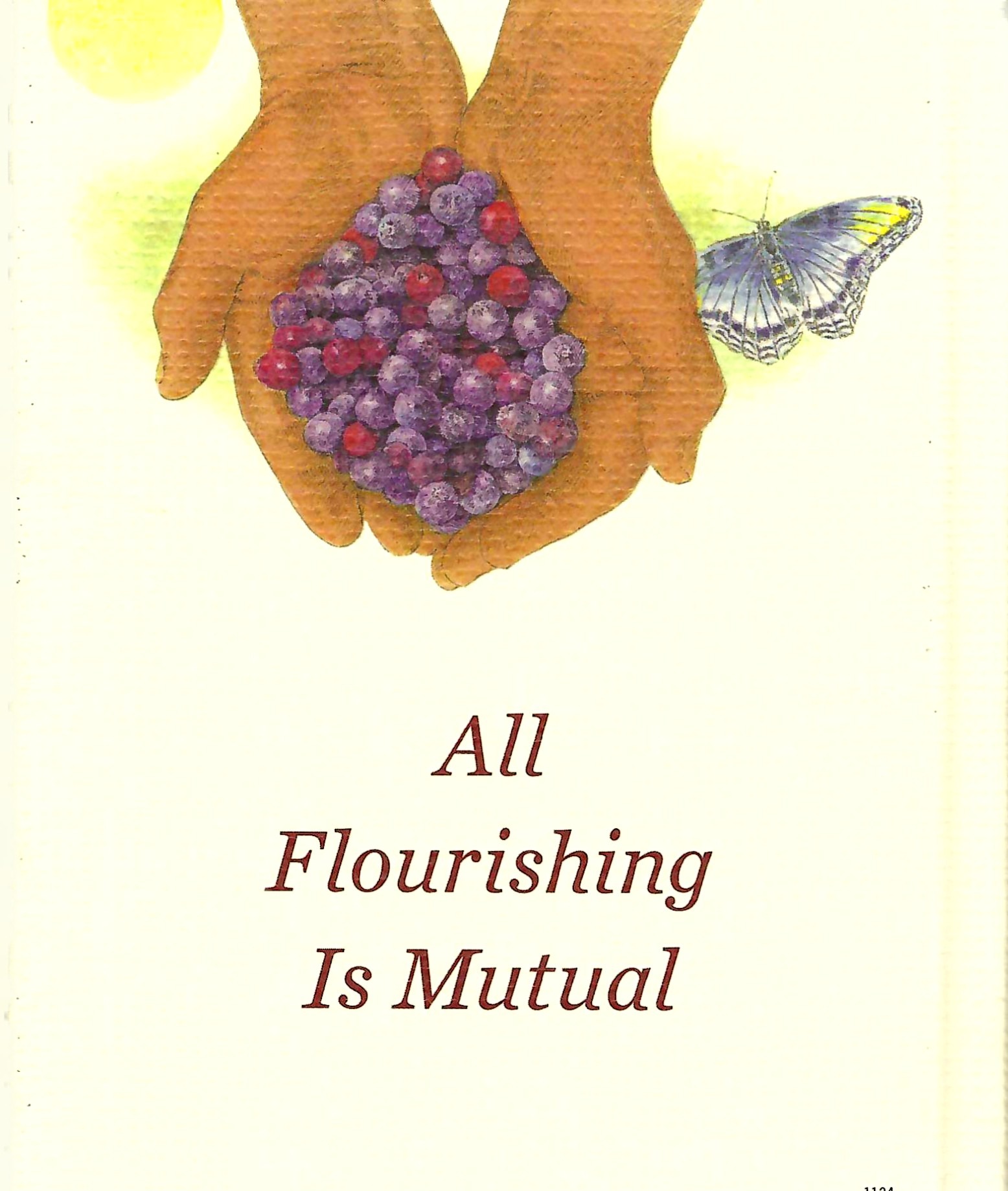
This morning, I invite us to imagine our congregation as an abundant berry patch. Dr. Robin Wall Kimmerer’s latest book The Serviceberry describes a natural world of abundance and reciprocity. She uses berry bushes to highlight the way a Gift Economy works. Our congregation runs on the model of a gift economy. We are flourishing and all flourishing is mutual. We are like a berry bush in full season.
Do you like berries? Do you have a favorite berry? Maybe strawberries or raspberries? I’m partial to blueberries myself. Do we have any cranberry fans? How about lingonberries or huckleberries?
Renown storyteller Joesph Bruchac (brew-shack) tells the story of the First Strawberries. And, I love this story. In this Cherokee tale, the Creator made the first man and the first woman at the same time so neither would be lonely. They marry and are very happy together. The story, however is about their first argument and the berry that helps them reconcile. The story says the man returns home after hunting and finds the woman has not prepared a meal, instead she is out picking flowers. He gets angry. “I am hungry” he says, “Do you expect me to eat flowers?” She also gets angry, “Your words hurt me. I will live with you no longer.” And she walks away.
A chase ensues, but she is a faster walker than he is. He tells the Sun that he is sorry but can’t catch up to her to tell her that. So the Sun takes pity on him and puts berries in her path to try to tempt her to slow down.
The Sun makes raspberries to grow. She pays the no attention. Blueberries, she walks on by. Blackberries, still nothing. Finally: strawberries. She sees them, stops, tastes them – and oh they are good. She starts collecting them to share with her husband. He catches up to her and apologies, they share the strawberries and all is well. And that’s why we have strawberries.
“To this day,” Bruchac concludes, “when the Cherokee people eat strawberries, they are reminded to always be kind to each other; to remember… friendship and respect are as sweet as the taste of the ripe, red berries.”
Other stories from myth and folklore relate the origins of berries, yes. There’s often magic involved, or some divine power. But I love this one about the strawberries because it also teaches us about kindness and a path toward reconciliation. Strawberries are a gift.
Robin Wall Kimmerer, in her book The Serviceberry, writes about berries as part of the Gift Economy of nature.
This abundance of berries (she writes) feels like a pure gift from the land. I have not earned, paid for, nor labored for them. There is no mathematics of worthiness that reckons I deserve them in any way. And yet here they are – along with the sun and the air and the birds and the rain.
Our congregation is like a berry bush in full season. All that we do is offered up as a gift. You don’t incur any debt by attendance on a Sunday morning. The berries are ripe and ready for you, all you need do is show up and they are yours. The berries benefit from being eaten, that’s how nature works. The energy needs to keep flowing, the gift needs to keep moving.
In the book, Dr. Kimmerer talks about her farmer neighbors, Paulie and Ed, who plant some Saskatoons – a western variety of this berry that goes by many names: Juneberry, Shadblow, Sugarplum, Sarvis, Chuckley Pear, Saskatoon, and Serviceberry. “Ethnobotanists know,” Kimmer writes, “that the more names a plant has, the greater its cultural importance.”
This pail of Juneberries represents hundreds of gift exchanges that led up to my blue-stained fingers: the Maples who gave their leaves to the soil, the countless invertebrates and microbes who exchanged nutrients and energy to build the humus in which the Serviceberry seed could take root, the Cedar Waxwing who dropped the seed, the sun, the rain, the early spring flies who pollinated the flowers, the farmer who wielded the shovel to tenderly settle the seedling. They are all parts of the gift exchange by which everyone gets what they need.
She writes about how Paulie and Ed, her farmer neighbors, planted those Saskatoon bushes – and the first season the berries were harvestable, they put out a call for a free ‘pick-your-own’ day for anyone.
Paulie and Ed had put in real labor, had invested money to buy, plant, and care for the trees. But when the berries were ready the first event was free. They broke the rules of capitalism and shifted those berries into the gift economy. Ed and Paulie’s goal was to build relationship in the community around them.
Kimmerer goes on to say that gratitude is the appropriate response to the abundance. “Well,” [Paulie] said, “They are so abundant. There’s more than enough to share and people could use a little goodness in their lives right now.” (p87-8)
Have you experienced something like this? Maybe you can recall time spent with friends when you were nourished body and soul yet needed no debit card at the end of the evening to pay for all you received. You simply received the gifts of love and nourishment. How wondrous. Gratitude is our natural response to abundance.
Reciprocity follows. Kimmerer’s book is subtitled, “Abundance and Reciprocity in the Natural World.” Reciprocity comes in many forms, offered in return through gratitude for the gifts we have received.
Reciprocity is not to be confused with a quantified exchange of some sort. There is no obligation taken on by receiving the gift. There is an exchange, but there is no payment required. There are no receipts. Instead, it is something dynamic in which the gift keeps moving. As Kimmerer writes: All flourishing is mutual. We all get what we need in the exchange.
There is an anecdote in Lewis Hyde’s seminal book The Gift, about an anthropologist studying a hunter-gatherer community in the South American rainforest. The researcher saw a hunter bring home a large kill, more than he and his family would be able to eat. The researcher asked the hunter about how he would store the excess. The hunter was confused by the question. He threw a feast and invited the neighboring families, and every morsel was eaten. The anthropologist assumed the smarter tactic would have been for the hunter to store the meat for himself. The hunter responded, “Store my meat? I store my meat in the belly of my brother.” (See pp 31-2 of Serviceberry)
Our congregation runs on the model of a gift economy. We are like a berry bush in full season. I’m not going to stop. We are here to be a berry bush so you all better be ready for a feast because there is no better place to store the excess of our care than in you. Where is there flourishing in your life now?
When you hear an invitation into our stewardship campaign, you are being invited to take part in caring for the berry bush, that it will continue to flourish for all of us.
Yes, we’re talking about money, but also talking about so many other things – the safety we are creating together, the awareness and education, the warmth of community, the joy and laughter, the rituals and blessings, the rest and the resistance. All of it is the berry bush and your reciprocity is yours to discern. What gift do you offer? What is your favorite berry? Where is there flourishing in your life now?
We have an insert in the order of service with that exact question. You are invited to write a response and turn it in so we can post our answers. Where is there flourishing in your life now?
Perhaps we will bless each other in the natural abundance of our care.
In a world without end,
May it be so.
The Honorable Harvest
The Honorable Harvest
A service at Thanksgiving time about our relationships with the food we harvest – based on the teachings and stories in Robin Wall Kimmerer’s book “Braiding Sweetgrass.”
Greeting and Announcements
Good morning. Welcome to the _______ Unitarian Universalist Congregation where we join together in the search for deeper meaning and richer connections. Our stories all come from Robin Wall Kimmerer’s book “Braiding Sweetgrass,” and are adapted into this worship service by Rev. Douglas Taylor
Passing the Peace
Prelude
Opening Words by Shari Woodbury
This opening was written for two voices, as indicated below.
1: Welcome, who come in friendship
who long for genuine community…
2: May you be graciously received here
as your authentic self.
1: Welcome, who come in curiosity,
full of questions or simply open…
2: May you embrace wonder
and encounter new delights.
1: Welcome, who come heavy with fatigue,
weary from the troubles of the world
or the troubles of your particular life…
2: May you rest and be filled in this sacred space.
1: Welcome, who come with joy
for flowing rivers and gentle breeze,
for changing skies and great trees…
2: May the grace of the world
leave a lasting imprint in you.
1: Welcome, who come with thanks
for the altruism of the earth
and the gift of human care…
2: May your grateful heart overflow
and bless those around you.
BOTH: Come, let us celebrate together
this wondrous life.
*Doxology (#381 SLT) Composite based on Isaac Watts
From all that dwell below the skies
Let songs of hope and faith arise
Let peace, goodwill on earth be sung
Through every land, by every tongue
Covenant (#381 SLT) by James Vila Blake (adapted)
Love is the spirit of this congregation
And service is its life
This is our great covenant;
To dwell together in peace,
To seek the truth in love,
And to help one another.
Chalice Lighting by Katie Gelfand
We light our chalice as a symbol of gratitude
as we celebrate the abundance of our lives together.
In this sanctuary we harvest bushels of strength for one another,
and offer our crop with the hands of compassion and generosity.
In the authentic and gentle manner of our connections,
we cultivate a simple sweetness to brighten our spirits.
May we be grateful for the ways we nourish and uplift each other,
For it is the sharing of this hallowed time together that sustains us.
Opening Hymn (#21, SLT) For the Beauty of the Earth
Story Part One “The Honorable Harvest” by Robin Wall Kimmerer
(Three roles – Narrator, William, and Robin. William and Robin act out greeting, Robin acts out poling and knocking rice, William acts out sketching and showing, Robin acts out listening.)
Narrator: William was a young student from Europe who was studying to be an engineer. One day, near the end of Summer, he traveled to visit a friend Robin in Minnesota. Robin was part of an Anishinaabe family and they practiced the traditional rice gathering practice from many generations back. William was eager to experience a bit of Native American culture.
William: “The family rose early before the sun, and we went out for the day’s work. Dawn found us all out on the lake in canoes. They taught me to pole our way carefully through the rice beds, knocking the ripe seed into the canoe. It was hard work. But it did not take long for us to collect quite a bit of rice.”
Narrator: At the end of the day, William wanted to thank the family for including him in the day’s work, to show his appreciation. The next morning, he showed them a sketch of a grain capturing system he had designed. As an engineer, he felt he could easily build this device and attach it to the gunwales of their canoes.
William: “You can continue to gather the rice as you have been doing for generations. I know that is important. But your way is not efficient. Yesterday, I saw that at least half the rice just fell into the water. It is such a waste. With my technique, you could get 85 percent more rice for your efforts.”
Narrator: His hosts listened respectfully, then Robin’s grandfather spoke up. “Let me tell you a story.”
Prayer by Douglas Taylor
Eternal Spirit, from whom all things come
and to whom all things return.
We gather in gratitude this day
We gather as children of the earth,
joined together in a bond of respect and connection.
We lift our hearts and our voices in both grief and gratitude
We share our grief for the ways our mother earth has been dishonored and destroyed,
for the ways the connection has been severed,
for the ways we are alienated from our home.
We pray for healing and for a turning
and for strength to again flow between the land and the people.
We share of gratitude for the ways we discover and rediscover
our connection and wholeness each day.
We share our gratitude for our place in the circle,
for the sharing and for the light.
We share our gratitude for all the earth offers us,
for the gifts of sun and soil,
of life and the nourishing spirit.
As we wind our way into our culture’s celebration of Thanksgiving, O spirit,
may we learn to lean in to our gratitude for the land
and the plentiful nourishment it can provide.
May be uncover and honorable harvest this season.
May we help keep the balance of living
and give thanks for all we have been given.
In the name of all that is holy,
May it be so.
Silence
Meditative Hymn (#123, STL) Spirit of Life
Story Part Two “The Honorable Harvest” by Robin Wall Kimmerer
(Narrated by one and acted out by two others, Nanbosho has a stick ‘fishing pole’ and Heron uses hands like a beak to spear fish. Later, Fox uses hands to show ears)
Our hosts listened respectfully to their guest, then Robin’s grandfather spoke up. “Let me tell you a story.” Here is the story she told:
Anishinaabe elder Basil Johnston tells of the time our teacher Nanabozho was fishing in the lake for supper, as he often did, with hook and line. Heron came striding along through the reeds on his long, bent legs, his beak like a spear. Heron is a good fisherman and a sharing friend, so he told Nanabozho about a new way to fish that would make his life much easier. Heron cautioned him to be careful not to take too many fish, but Nanabozho was already thinking of a feast. He went out early the next day and soon had a whole basketful of fish, so heavy he could barely carry it and far more than he could eat. So he cleaned all those fish and set them out to dry on the racks outside his lodge. The next day, with his belly still full, he went back to the lake and again did what Heron had showed him. “Aah,” he thought as he carried home the fish, “I will have plenty to eat this winter.”
Day after day he stuffed himself and, as the lake grew empty, his drying racks grew full, sending out a delicious smell into the forest where Fox was licking his lips. Again, he went to the lake, so proud of himself. But that day his nets came up empty and Heron looked down on him as he flew over the lake with a critical eye. When Nanabozho got home to his lodge, he learned a key rule—never take more than you need. The racks of fish were toppled in the dirt and every bite was gone.
Reflection How we Honor the Harvest
by Douglas Taylor, Andrea Lerner, and Dylan Cooke
Taylor
Our stories this morning are all adapted from the book “Braiding Sweetgrass” by Robin Wall Kimmerer from 2013. The subtitle is “Indigenous Wisdom, Scientific Knowledge, and the Teachings of Plants.” Kimmerer is a member of the Citizen Potawatomi Nation and the SUNY Distinguished Teaching Professor of Environmental Biology. At the intersection of those to aspects of her life, she reveals the wisdom of sustainability as something both modern and ancient.
As the season turns once more to the time of harvest and our country’s holiday of thanksgiving. I invite us into the wisdom and wondering that Kimmerer’s book offers. She writes about our needing to see ourselves as a part of our ecosystem. That we should not merely take, but instead both give and take. As heterotrophs, we do not photosynthesize our own energy. Our role is to consume, to exchange a life for a life.
Kimmerer asks
“How, in our modern world, can we find our way to understand the earth as a gift again, to make our relations with the world sacred again? I know we cannot all become hunter-gatherers- the living world could not bear our weight- but even in a market economy, can we behave ‘as if’ the living world were a gift?” [p. 31]
Do you have a story of how you’ve grown or foraged or hunted your own food? Are you a part of your ecosystem and the give and take that is needed as you consume? As you sit down for a Thanksgiving meal, can you note where the various foods came from and how they came to your table?
—
Cooke
“For much of my life, I have had access to fresh grown foods. For instance every year my family has a garden that always at least has something growing in it or my first job was working on a vegetable farm. For this I am thankful as it has given me a very open perspective to the benefits of eating food produced in this manner and as a kid it gave me the opportunity to enjoy vegetables that many others my age never got the opportunity to experience or learn to enjoy.
Another place I ended up being involved with food was my grandfather’s old garden. It was a project of his to grow some food for himself, an endeavor which lasted a handful years. Over time he began to downsize it as the work began to outweigh the benefit to himself. Year after year it began to shrink until there was only one bed left that happened to be full of asparagus. For him the time had come to let this final part of the garden go. As he requested, I mowed over the area as I had with the previous garden beds leaving his yard garden-less or so we thought. The thing some of you might not know about asparagus is that once it is left untouched for its first two years it begins to be self-sufficient making it become super resilient. This meaning to this day year after year that asparagus pokes its way out of the ground showing exactly where the bed was and during its most active time of the season, even while mowing over it weekly there are enough stems to make a dinner side out of each week.
The resilience of asparagus is definitely something to admire and just one of many examples that if nature is not pushed past its breaking point it will continue to provide.”
—
Taylor
Dylan reminded me as we were preparing for this service of that favorite Dr. Suess quote from the Lorax. “Unless! Unless someone like you cares a whole awful lot, nothing is going to get better. It’s not.” The path to a better world is for people to care. The path to caring is being connected, being interconnected and familiar with the world.
—
Lerner
I grew up the youngest of eight children to parents in NW Pennsylvania who grew up during the depression and experienced food rationing in World War II. We had a stove with 8 burners, two ovens, a griddle and a broiler. It’s not surprising that, having to feed all of us, they were experienced in gardening, foraging, fishing, hunting, bee keeping, and raising chickens and other fowl.
Some of my favorite memories are walking along the trails in the woods near our home picking raspberries, blackberries and blueberries with my Dad. Along the way we’d sometimes find mushrooms to bring home for dinner. He knew which ones were safe and which were not.
My mother loved to grow vegetables that seemed unusual to me. I’m still not sure what salsify is, but it sounded exotic. She grew brussel sprouts long before I ever saw one at the grocery. I wasn’t much for weeding, but I loved the harvest, and learned to freeze and can produce for the winters. We were always taught not to waste food, or anything for that matter – we’d hear, “use it up, wear it out, make it do, or do without.”
I remember holidays that were packed with people cooking and baking and sharing stories, and I’ve tried to pass down the wisdom and love to our children. They are all excellent cooks, and one is a professional chef. Our holidays continue the loving traditions of our ancestors.
Many of you know about John Murray, an early Universalist in this country, who landed in Good Luck NJ near the home of Thomas Potter. The Murray Grove Retreat and Conference Center is still on this property, and is a favorite place for many UUs to retreat and relax. One fall, I noticed that the wild concord grapes that grow around the pool had a bumper crop of grapes. My foraging genes kicked in, and a few grocery bags later, I was on my way home to make jelly. No Hell Jell, we called it, and I donated most back to Murray Grove as a fundraiser.
I’ve been following along with the lives of some youth leaders from my time with the UUA Metro NY District, now adults. Of course, many of them are in the helping professions, and I’m delighted that more than the average number of them turned to occupations in sustainable agriculture – like
Katie who was farm manager at John Hart Farms, a family-run working farm that offers resources and information to growers at any agricultural scale—from families looking to raise a few chickens, to industrial-sized operations.
Kassandra in Colorado at FrontLine Farming, a food and farmers advocacy group focusing on food growing, education, sovereignty, and justice.
And Tobin in Mass, working with Book and Plow Farm, associated with Amherst College. They provide high quality vegetables and nourishing education that feed the local community in sustainable ways.
Watching these youth and my own children grow into caring and nurturing adults really gives me hope for the future.
—
Taylor
For my part, I can only witness to the blessing and abundance of the earth. I am not an attentive gardener. I have many examples I could share of herbs and vegetables under my care that did not make it. The farmers’ fields from my youth were a fertile land for my imagination, but I never actually paid attention to the food that was growing there as well. I am a child of the supermarkets and restaurants. Kimmerer’s question drives right to heart of my own living. Perhaps it is different for you. I welcome you to call your own story to mind.
Kimmerer asks
“How, in our modern world, can we find our way to understand the earth as a gift again, to make our relations with the world sacred again? I know we cannot all become hunter-gatherers- the living world could not bear our weight- but even in a market economy, can we behave ‘as if’ the living world were a gift?” [p. 31]
In a world without end,
May it be so.
—
Joys and Sorrows
Offering / Offertory
Reading “Guidelines for an Honorable Harvest” by Robin Wall Kimmerer
Introduction: The guidelines for the Honorable Harvest are not written down, or even consistently spoken of as a whole—they are reinforced in small acts of daily life. But if you were to list them, they might look something like this:
Voice 1: Know the ways of the ones who take care of you, so that you may take care of them.
Voice 2: Introduce yourself. Be accountable as the one who comes asking for life.
Congregational response: Sustain the ones who sustain you and the earth will last forever.
1: Ask permission before taking. Abide by the answer.
2: Never take the first. Never take the last.
Cong: Sustain the ones who sustain you and the earth will last forever.
1: Take only what you need.
2: Take only that which is given.
Cong: Sustain the ones who sustain you and the earth will last forever.
1: Never take more than half. Leave some for others.
2: Harvest in a way that minimizes harm.
Cong: Sustain the ones who sustain you and the earth will last forever.
1: Use it respectfully. Never waste what you have taken.
2: Share.
Cong: Sustain the ones who sustain you and the earth will last forever.
1: Give thanks for what you have been given.
2: Give a gift, in reciprocity for what you have taken.
Cong: Sustain the ones who sustain you and the earth will last forever.
From Braiding Sweetgrass, Robin Wall Kimmerer; p 183
—
Story Part Three “The Honorable Harvest” by Robin Wall Kimmerer
Two roles: narrator, Aunt
Narrator: Finishing her story of Nanbozho and the heron, the elder smiled at their guest for a moment and returned to braiding the sweetgrass basket she had been working on. Another member of the family, Robin’s aunt, spoke up.
Aunt: “We know that to over-harvest would destroy the ecosystem. Our traditional ecological knowledge has many prescriptions for sustainability. Our science and our philosophy teach us this. We have many stories that teach us this. You do not have such stories where you come from.”
Narrator: And it was true. William could not think of any stories from his people that cautioned against overconsumption, that taught people about sustainability. Robin’s Aunt continued.
Aunt: “We do not harvest the rice in the traditional way because we don’t know any better. We keep to the old practices because they help restore balance, they keep us in the circle. We could get more rice using your technique. It is thoughtful of you to offer us your knowledge. But the rest of the rice is not for us. It’s got to seed itself for next year. And what we leave behind is not wasted. We’re not the only ones who like rice. Did you notice the abundance of wildlife around the lake? It will be duck season soon. Do you think the ducks would stop here if we took all the rice every year? Our teachings tell us to never take more than half.”
Apple Sharing
On the front table there are dozens of apples in baskets – enough for everyone and more.
I welcome you into our Apple harvest sharing. These apples have come from the land less than ten miles north of where we now gather. Up at Apple Hill Farms, where the orchards grow, six generations have tended the farm. These apples are Crispin, Ida Red, and Macoun. They are local and if you choose, after eating your apple you may try growing your own tree from the seeds for such things are possible with the right knowledge and care and attention.
In a moment, I will invite those of you here in person to come forward and select an apple to take with you. If you are online, we will likely have several apple remaining that we will keep in the lobby. If you come by Monday or Tuesday this week, morning or early afternoon, you may come by and have an apple for yourself as well. This offering is meant for everyone. The earth and the trees have brought this good fruit forth. We are recipients of the bounty. And it signals our connection and our place in the balance of things.
Consider it a communion, a sign of our connection with the land and with the Spirit and with each other. As you eat your apple, know that others are also eating their apples – apples which all came from the same trees in the orchard there up the hill less than ten miles to the north. The sun and soil and rain and breezes that nourished your apple did so for all these apples. And now these apples nourish us and the circle continues.
Come, let us partake of the blessed bounty of the land.
Interlude
Affirmation by Amy Kindred
Of all the gifts in all the world,
for love we are grateful.
Of all the gifts in all the world,
for helping hands we are grateful.
Of all the gifts in all the world,
for food [from the good earth] we are grateful.
May we remember that the best gifts don’t arrive wrapped in paper or bows.
For love, helping hands, food [from the good earth] and so much more
We are grateful.
Amen and May it be so.
Closing Hymn (#1010, STJ) We Give Thanks
Chalice Extinguishing (#456 SLT) (unison) by Elizabeth S. Jones
We extinguish this flame, but not the light of truth,
The warmth of community, or the fire of commitment.
These we carry in our hearts until we are together again.
Benediction by Susan Karlson
We leave blessed by our connections to one another, to the spirit of life.
Walk lightly that you see the life that is below your feet.
Spread your arms as if you had wings and could dance through the air.
Feel the joy of the breath in your lungs and the fire in your heart.
Live to love and be a blessing on this earth
Postlude
 Rev. Douglas Taylor