
The People’s Peace
The People’s Peace
Rev. Douglas Taylor
May 18, 2025
Sermon Video:https://youtu.be/254crtZ9Bio
I know my title suggests I will be talking about peace – and I will be. And I know my sermon description suggests this will be a history sermon – and it will be. But really, this morning is all about integrity and the freedom of conscience.
Rev. John Haynes Holmes is likely not a well-known figure from our religious history, but his impact has been significant. He was born almost 150 years ago and was an influential pacifist minister during the first and second World Wars. He served the Community Church of NYC for nearly four decades.
As I mentioned in my description of the service, Holmes was a staunch pacifist, and notably a co-founder of both the NAACP and the ACLU. Yet he was a controversial figure, his relationship with Unitarianism and with his colleagues was tumultuous. We effectively pushed him out of Unitarianism for being a non-conformist in his pacifism. Which is wild. I want to share with you the story of how our Unitarianism got caught up in the fervor of supporting the war and nearly lost our moral center as a tradition.
On both the Unitarian and Universalist sides of our heritage, we have prided ourselves on our commitment to freedom of belief and freedom of conscience. I have several times preached about the foundational value of honoring our theological diversity, of allowing for variety among our beliefs together, of insisting that we do not exclude based on such differences. Freedom of belief and freedom of conscience are central to our way of faith. Yet we have not always practice these freedoms well. My sermon today begins in one of our failures on this count.
I need to set the scene. This is 1917 – right at the time the United Staes had joined the war in Europe, the Great War, the War to End All Wars, or what we later came to call the First World War. The Unitarians met for their general conference meeting and the topic of supporting the war is put forth for discussion and resolution. The moderator of the conference 1917 is former president of the United States, William Howard Taft. Taft is the most recent of our four Unitarian US presidents, serving from 1909-1913. Taft strongly encouraged the Unitarian conference to support the war effort. Taft gave an opening address at the conferences, calling on the clergy to preach the righteousness of the war, to say it is necessary to preserve a peaceful world, and that we should all get behind President Wilson.
John Haynes Holmes is the young minister of what was then known as Church of the Messiah, NYC – a prominent Unitarian pulpit. Holmes was a strong advocate for justice and the modern social message of religion. He was in the position to bring a report about the perspectives and attitudes of Unitarians toward the war. As a staunch pacifist he called for the clergy to mourn the dead, cry out at the destruction, and seek the path of reconciliation.
Taft did not like Holmes’ report and setting the moderator gavel aside, took the floor to argue against Holmes’ pacifism and propose a motion saying “That it is the sense of this Unitarian Conference that this war must be carried to a successful issue, … that we … approve the measures of President Wilson and Congress to carry on this war.”
In the debate, Holmes rose and said, “I am a pacifist, I am non-resistant, I hate war, and I hate this war; so long as I live and breathe I will have nothing to do with this war or any war, so help me God.” Taft said “Our house is afire and we must put it out, and it is no time for considering whether the firemen are using the best kind of water.” The motion was adopted by a vote of 236 to 9. (Stream of Light, Conrad Wright, ed; p103)
There are times in history when we feel a fervent need to take some communal action, to stand against some evil. It is not a stretch to say many people, myself included, feel we are in just such a moment for our country today. Yet to refuse a space for conscientious dissent feels unimaginable. Everything in me would rebel if there were a resolution from the UUA proclaiming that all of us must agree with this or that policy or proposal or action.
In 1918, the year following the debate between Taft and Holmes, the leadership of the American Unitarian Association issued sanctions against any congregation employing a minister who was not “a willing, earnest, and outspoken supporter of the United States in the vigorous and resolute prosecution of the war.” They withheld all aid to such congregations. Holmes withdrew his fellowship with the Unitarians and the church likewise left the Association, changing its name to Community Church, NYC.
A decade or so after that war, the Unitarians struck down those sanctions. And as he neared retirement, Holmes was courted by Unitarian leadership to reinstate his fellowship among the Unitarians, which he did. The broader story includes this reconciliation.
In recent years, pro-war UUs are far from the majority. The counter-cultural movements of the ‘60’s became our bread and butter in the following decades – peace, civil rights, equality, diversity – these values and their accompanying justice issues became bedrock cultural aspects of our Unitarian Universalist identity. Holmes’ ministry predated all of that by a few decades.
Over the years I have bumped into people who assumed Unitarian Universalists were always anti-war. One person was aghast to hear a colleague suggest we are not considered one of the Peace Churches.
The Peace Churches are denominations such as the Brethren, the Quackers, the Amish and the Mennonites who have historically held a biblical commitment to non-resistance and pacifism as a core tenet of their faith. I am reminded of James Baldwin’s quip, “If one believes in the Prince of Peace one must stop committing crimes in the name of the Prince of Peace.”
Unitarians have, in more recent times, shifted to a more anti-war stance, a more reconciling perspective. In recent conflicts, for example, the UUA has been very supportive of Ukraine’s resistance to Russian aggression but was noncommittal for several month when talking about the war in Gaza. The UUA has been nuanced and cautious about asserting a stance – perhaps as a reflection of the experience of Holmes, but I doubt it. I don’t think the story of John Haynes Holmes’ pacifism and refusal to toe the line with conformity take up much space in how we remember our history. It is not a story we tell very loudly among ourselves.
I will note that throughout our early history, Unitarians in particular have been in the thick of the establishment of our government. Many of the ‘founding fathers’ of the United States have some Unitarian connections. We were owners of business and leading academics in the early formation of our nation. We were influencers. We were the establishment.
The past hundred years, however, has seen a pivot away from Unitarians holding significant political influence. We have – most notably during the 60’s and onward – shifted toward being a voice of resistance. And circling back to Holmes I would credit his ministry as having an indirect impact on our progress as a religious tradition.
I would not say we have become anti-establishment, however. I think we’ve grown into a faith community that is not simply against something, we are working to establish a kind of community that serves the needs of all people through our values. I would not say Holmes’ greatest attribute was his pacifism. Yes, his stance against the war precipitated his withdrawal from the Unitarian Association. But that particular stance was grounded in a broader vision for what could be when we set militarism aside.
In one of his 1917 sermons he said “War and democracy are incompatible.” He spoke about how the mindset of war tramples the values we are wanting to protect by going the war. While we may not be actively at war in the way we were in 1917, it is not hard to see how great an impact militarism has had on the erosion of our democracy. Can you see how the state’s use of force has eroded our freedom? It is this broader vision of what could be that lead me to want to learn more about Holmes.
It was not just his radical pacifism; his vision of ministry and of the nature of religion was also radical for the time. He was far from the only Unitarian minister calling for a modernization of our theology – indeed the Humanist movement of the 1930’s may have been influenced by Holmes’ writings. The part I found more prescient for our current situation is his call for “a religion that moved from concentration on the individual and focused instead on the social nature of every individual.” (Unitarian Universalism, a narrative history, by David Bumbaugh; p137)
Our current Unitarian Universalist conversations about collective liberation and Beloved Community are fed by indigenous perspectives as well as from people like Holmes who swim counterwise from within the dominant stream of our history. His non-conformity was not a simple one-sided complaint against one specific aspect of evil. Holmes offered a wholistic vision of a better world.
Witness his fuller story. He was approached by W.E.B. Debois to join in the creation of the NAACP – one of about 60 people who are never listed among the founders. Holmes was committed to integration and the rights of people of color. Later he was part of forming the American Civil Liberties Union. In both cases, his name is not at the center. If you look up the history of the founding of the NAACP, you will not find his name among the founders – because he was not front and center, he was in a supportive role as a partner and ally.
I highlight his non-conformity, his refusal to set aside his conscience. But his ministry cannot be reduced to one issue or one fight against the establishment. He was a builder of new possibilities. In this way, he is a role model to me. He heeded the promptings of the spirit, lived within his integrity, insisting not that everyone agree with him but that everyone be free to agree with their own conscience.
I’ve never been what you might call an activist preacher. I can preach a good justice sermon, but my calling has always been to build that certain sort of community where all souls shall grown strong and together we move toward a more Beloved world. Holmes did that too.
And I see it in many of you. And together we can bring more peace, more grace, move love each day. And God help us – together we can make this place beautiful.
In a world without end,
may it be so
Martin and Malcolm in America
Martin and Malcolm in America
Rev. Douglas Taylor
1-19-25
Sermon Video: https://youtu.be/pjYecyTMKL4
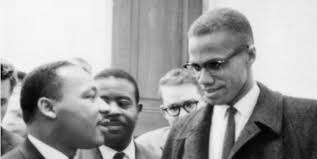
James Baldwin wrote an incisive article for Esquire magazine in 1972 about his relationships with both Martin Luther King Jr. and Malcolm X. Baldwin had the unique position of being a contemporary colleague of both men. Four years after Martin’s assassination and seven years after Malcom’s, Balwin wrote,
“Malcolm and Martin, beginning at what seemed to be very different points … and espousing, or expressing, very different philosophies, found that their common situation so thoroughly devastated what had seemed to be mutually exclusive points of view that by the time each met his death there was practically no difference between them.”
It is commonly accepted in many circles even to this day, the romantic cliche that Martin was the peaceful, inspiring one working tirelessly for integration while Malcolm was the scary, dangerous one fighting for black empowerment. They are held up as dissonant icons of the ‘60’s; two paths, two opposing options people could choose between. Peniel Joseph’s book title The Sword and the Shield acknowledges this mythic perception of these two historic men. “Self-defense vs. nonviolence,” we can read on the jacket cover, “black power vs. civil rights, the sword vs. the shield”
The truth, I hope you are not surprised, is more nuanced and complimentary. Indeed, over the years I have found myself draw more to the radical work of King in his later years. And if Baldwin’s analysis is on target, we who love the radical aspects of King, have much to appreciate in the later years of Malcolm X as well.
The Soul Matters theme of the month for January is ‘story.’ I think it is fitting for us to grapple with the stories we have been fed about these two men, and the impact of these stories on how we respond to situations of racism and economic injustice today.
Part of the story is simply historical record.
Martin Luther King Jr. was born in Atlanta into a preacher’s family. He experienced southern segregation and racism growing up, but also the protective strength of the black church. He attended Morehouse college, Crozier Theological Seminary, and Boston University for his doctorate. At the age of 25 he was called to serve the Dexter Avenue Baptist Church in Montgomery Alabama. From there, he became more and more involved and central to the Civil Rights Movement.
Malcolm X, was born in Omaha Nebraska to the Little family, admirers of Marcus Garvey. His father died in a streetcar accident although many suspected it was not an accident. His mother was later committed to a state hospital after a nervous breakdown. Malcolm’s adolescent years were spent in foster homes or with other relations. Malcolm was a street hustler and thief. He was arrested for burglary when he was 20. While in prison, he converted to Nation of Islam, changed his last name from “Little” to “X” as was the custom in the Nation of Islam, and once paroled, began climbing the ranks in the religious institution. From there, he became more and more involved and a central spokesman for the Black Power movement.
Both Martin and Malcolm rose to such levels of power and persuasion among people that our government had agents and surveillance on each of them throughout their public careers. Both Martin and Malcolm’s assassinations spurred questions and conspiracies around the official stories offered about the shooters. All of that is about circumstance more than either of their character.
What brought them together is that both Martin and Malcolm had the goal of eradicating racial discrimination and advancing the conditions of Black people in our country and world-wide. They certainly disagreed on the role of violence in the movement – King advocating for Non-Violent Direct Action and Malcolm X strongly supporting armed self-defense. And they did not agree on the ultimate goal of what racial advancement looked like. King was an integrationist, envisioning a multi-racial Beloved Community. Malcolm X was a black nationalist, promoting the superiority of the Black race.
If you were alive back then and remember how things were, you may recall how vilified Malcolm X was. Martin Luther King Jr. was also vilified in certain circles, but the lion’s share of the fearmongering was heaped onto Malcolm X.
It was easier to demonize Malcolm X for two reasons – he was saying some fairly radical and scary things. For example, one talk King gave on Civil Rights was titled “Give Us the Ballot.” Later, when Malcolm X did something similar the title he used was “The Ballot or the Bullet.” Malcom X was provocative, and thus, easier to demonize. The second reason is that King’s impact was built across the racial lines, among white and black people. Malcolm’s impact was among black people who were poor and marginalized. And really, the demonizing I’m talking about is defined by the espeices of the white people at the time, not the black people. Both Martin and Malcolm were considered dangerous by those in power who benefited from the status quo.
There is a lesson here. When we are offered narratives about people that they are scary and dangerous – maybe look a little deeper to uncover the motives feeding those narratives. Fear and division are tools used by oppressive systems to maintain control. It was Malcolm X who said, “If you’re not careful, the newspapers will have you hating the people who are being oppressed, and loving the people who are doing the oppressing.”
Malcolm X’s primary goal was to advance Black dignity. He wanted Black people to be proud of themselves because they were Black. He wanted Black people to walk tall, proud to be Black. James Baldwin once wrote: “It took many years of vomiting up all the filth I’d been taught about myself, and half-believed, before I was able to walk on the earth as though I had a right to be here.” Malcolm wanted to give Black people a world in which they knew they had a right to belong, in which they did not need to shield themselves from the hatred and self-hatred fed to them every day. Malcolm’s fierce critique of white supremacy, his rhetorical sword, was a tool in the service of his passion for Black dignity.
King’s focus was on Black citizenship. He insisted that we must join together in solidarity and make our democracy work for all the people. King wanted Black people to demand their rights, to insist on being granted their due as citizens of the nation. And more, he wanted all people, white and Black, to participate in making our nation realize its promise. I think many of us are more familiar with Dr. King’s motives and his articulation of his goals.
We are certainly more familiar with Martin’s quotes, like, “We are inextricable caught in a network of mutuality;” and, “True peace is not merely the absence of tension; it is the presence of justice.” But Malcolm had the gift of eloquence as well. “We didn’t land on Plymouth Rock, Plymouth Rock landed on us,” he said; and, “You can’t separate peace from freedom because no one can be at peace unless he has his freedom.” Many people will quote Dr. King out of context and turn his words of power into pablum – we don’t get to have that poetry without also taking the pain.
The contemporary Black Lives Matter movement feels like the heir of both the Black Power movement and the Civil Rights Movement blended. The call to say their names, for example, to lift up the individuals who have been killed was a key part of the movement. It is a mark of Black dignity. And the call to assemble and insist on civic change was the main thrust. It is a mark of Black citizenship to declare – these are our streets. We keep us safe.
But it is Malcolm X who is quoted more often by young activists today. The call for Black citizenship is certainly still important to people, but the call for Black dignity is the starting point, without which there is no other work. In his new book Starting Somewhere, local activist and organizer, Roderick Douglass offers a Malcolm X quote in the forward of the book. “There is no better teacher than adversity. Every defeat, every heartbreak, every loss, contains its own seed, its own lesson on how to improve your performance the next time.” Appreciation of Malcolm’s contribution and impact is rising.
As our days unfold before us, it is worth noting that the anger and pain Malcolm spoke to is the same anger and pain many vulnerable people feel today. Martin Luther King Jr.’s vision of Beloved Community with a place for everyone is still our central guide. But there is much we can learn from Malcolm X’s perspective as well. When we make the commitment to live out of Unitarian Universalist values of Justice and Equity and love – then we do well to lean in to that discomfort of other people’s pain and anger. Learning more about Malcolm X, his life, his words and teachings, will help me be more present and a better ally.
Recognizing the blend of Martin and Malcolm in their later years, we can attend not just to the call for peace and justice, but for dignity as well. Recognizing and encouraging the dignity of the poor, the disenfranchised, and the vulnerable is what opens up the possibility of a Beloved Community where we can meet as equals. Martin once said, “A riot is the language of the unheard.” With all that is going on in the world, the suffering and the injustice, we who would be part of the solution must keep our ears and hearts open to what is going on. And we can treat all people with dignity, for that is the starting point for the Beloved Community to become realized in our midst.
In a world without end,
May it be so
To Show an Affirming Flame

To Show and Affirming Flame
Rev. Douglas Taylor
11-10-24
sermon video: https://youtu.be/TotbAzq7Nh8
This week has been fraught with emotions and reactions and dawning realizations from this past Tuesday’s election. Many among us are lamenting. Many people are angry and frightened by what is presenting as a march toward fascism in our country.
In my description for today’s service I stated that W.H. Auden wrote a poem entitled “September 1, 1939.” I mention it because the last line of that poem is the title for this sermon: “To show an affirming flame.” The title of the poem, “September 1, 1939,” refers to the beginning of World War II. The poem itself is a denouncement of fascism and a call toward solidarity.
I sit in one of the dives
On Fifty-second Street
Uncertain and afraid
As the clever hopes expire
Of a low dishonest decade:
Waves of anger and fear
Circulate over the bright
And darkened lands of the earth,
Obsessing our private lives;
The unmentionable odour of death
Offends the September night.
Auden goes on to decry the madness and cruelty of the era leading to Adolf Hitler’s ascendency to power, the lies and apathy that allowed evil to gain control. Some literary critics have suggested this is Auden’s best poem, indeed called it the best poem of the 20th century. It is laced with references to the history of Democracy as a concept and the steady erosion we suffer again and again. It calls us to both rise with our individual responsibility and stay firm in our communal solidarity. The second-to-final stanza reads:
All I have is a voice
To undo the folded lie,
The romantic lie in the brain
Of the sensual man-in-the-street
And the lie of Authority
Whose buildings grope the sky:
There is no such thing as the State
And no one exists alone;
Hunger allows no choice
To the citizen or the police;
We must love one another or die.
“We must love one another or die,” he wrote. True then, and true still today. “All I have is a voice to undo the folded lie.” This past election season will perhaps be best remembered for all the incredible lies.
Democracy is embedded with certain values. And there is a certain amount of overlap between those values and our Unitarian Universalist religious values. Chief among them liberty, freedom, and justice. A democracy assumes an informed citizenry, so there is an implied value of education and critical thinking. Equality and forbearance – or at least tolerance – round out the necessary values for democracy to thrive. I am hard pressed to find examples of these values in our incoming president-elect Donald Trump or in the policies and promises he has made. Instead I see crass vulgarity, posturing and bullying, deceit and lies, and divisiveness. Divisiveness is a common tool for authoritarian politics, not for democracies.
I saw a list of the early warning signs of fascism as displayed at a Holocaust Museum. I posted it on social media if you are looking for it. The list of warning signs induced: “Powerful and continuing nationalism; Disdain for human rights; Identification of enemies as a unifying cause; Supremacy of the military; Rampant sexism; Controlled mass media; Obsession with national security; Religion and government intertwined; Corporate power protected; Labor power suppressed; Disdain for intellectuals and the arts; Obsession with crime and punishment; Rampant cronyism and corruption.”
And to be clear, some of what is likely to happen over the next four years is basic policy changes that happen every time there is a change in the political party. It is stuff that I will argue against, plans that will go against my values, actions that I find objectionable but ultimately match what previous administrations have done. But then there will be things that tear apart the structures of our democracy in favor of constructing a fascist oligarchy.
There is still harm committed in the first set of policies and actions. A tragic example is Ronald Reagan’s refusal to recognize AIDS which led to a great deal of death and suffering. In making the distinction between basic party changes and fascist plans, I don’t want to minimize the harm that results from the former. I am merely lifting up the truth that as long as our democracy remains intact, there is recourse.
In her 2018 book Fascism, A Warning, Madeleine Albright had written, a Fascist “is someone who claims to speak for a whole nation or group, is utterly unconcerned with the rights of others, and is willing to use violence and whatever other means are necessary to achieve the goals he or she might have.”
We’ve already seen four years of a Donald Trump presidency; we don’t need to guess at what a second term might contain. The rights of queer and trans people are under threat. Immigrants and people of color are at risk. Women’s access to reproductive health care is under attack. Trump will quite likely pull all support from Ukraine and NATO, allowing Putin free reign for Russian military expansion. I can’t imagine he will do much to support the Palestinians either. He will certainly pull us out of the Paris Accords again, so our efforts to respond to the climate crisis will be stalled. And he has promised again to destroy the Affordable Care Act – an unattained goal he had last time he was in office. And his whole campaign was centered around an untenable promise of mass deportations of undocumented immigrants.
Honestly, I don’t think fascism in the United States will show up as Concentration Camps in the near future. We already have a robust prison system that will serve the same purpose. Where else would we get the labor to cover the work of undocumented immigrants once we’ve deported them. If we bother deporting them when we could just pump them into the prison system. Stock prices for private prisons jumped this past week.
But in all of that, I am well convinced that the signature play of the Trump re-election campaign has been the rampant use of misinformation, disinformation, and lies. People talk about how fascists go after the journalists, but I believe the current MAGA political right-wing has circumvented the need to silence journalists by blasting media with lies and sensational nonsense so no signal can make it through the noise.
Everyone is so numb to the lies, countless stories are emerging of people saying they voted for him but they don’t believe he will really dismantle the Affordable Care Act because they need it, or deport all the immigrants because they’re married to one, or make abortions illegal at the federal level because their mistress’s still need that access. There is a subset of the people who voted for him who know he is a liar and don’t believe him.
And I hear progressives saying “Believe him, he’s telling you the harm he is planning to cause. Believe him.” But there are so many lies. Which ones matter? Which ones should I trust. All I have is a voice to undo the folded lie. In Auden’s poem, the lie was about believing a dictator was better equipped to make decisions for you. In Auden’s poem, the lie was that an individual exists alone and would not experience the consequences of a semi-distant evil about to land on someone else. In Auden’s poem, the lie was all those people who went along with the Nazis because they thought the economic policy sounded better.
There are guardrails still in place protecting our democracy today. If we are tempting fascism, it will not drop upon us overnight. We can still pay attention; we can still resist. Part of the work is to continue to do what we’ve been doing – building relationships with people and communities doing good work in the world around us. We can keep working to support change for unhoused people in Broome County. We can keep working to feed people with Beloved Community. We can keep educating ourselves on racism and White Supremacy. We can keep supporting Planned Parenthood and other local abortion providers. We can keep advocating for queer youth and creating spaces for trans and queer people to be welcome and to be safe. And my list goes on. We are already doing a lot of what we need to be doing together, locally where it matters most, and beyond.
The final stanza of Auden’s September 1, 1939 poem says this:
Defenceless under the night
Our world in stupor lies;
Yet, dotted everywhere,
Ironic points of light
Flash out wherever the Just
Exchange their messages:
May I, composed like them
Of Eros and of dust,
Beleaguered by the same
Negation and despair,
Show an affirming flame.
We are not yet defenseless as he saw Europe and America to be at that moment in time. We may not be far off, but we are not defenseless yet. The harm people are worried about is real and so our response must be equally real.
I am called to take the side of the poor, the marginalized, the vulnerable and disempowered, and all those treated with injustice and cruelty. We are called to get in the way of systemic injustice, to stand up against tyranny, to agitate the establishment for change so that all people can heal from the wounds of our days and we can all experience more peace.
Our work remains: to build solidarity, to uphold justice, to shine our light, and love bravely in a world too full of desperate loneliness and alienation.
I’ll close with a James Baldwin quote I was reminded of earlier this week. In his novel If Beale Street Could Talk, Baldwin wrote: “…love brought you here. If you trusted love this far, don’t panic now.”
In a world without end
May it be so
 Rev. Douglas Taylor