
Songs of the Civil Rights
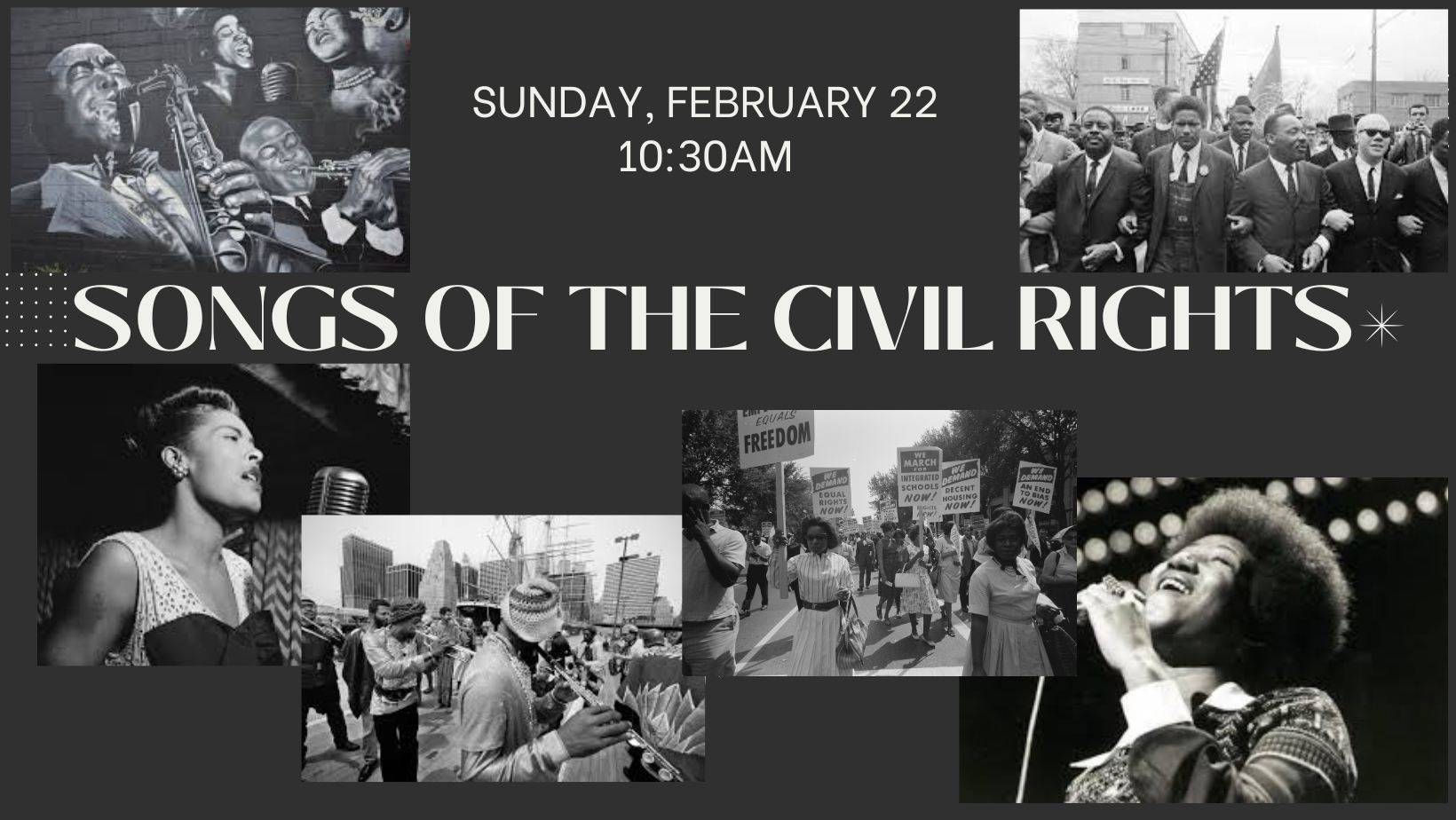
Songs of the Civil Rights
2-22-26
Rev Douglas Taylor and Dr. Sarah Gerk
Sermon video: https://youtu.be/tkNKonpW4yk
Sermon part I
Sarah
We are here today to consider how musical practices supported the Civil Rights movement. I am a musicology professor at BU. I study how music works within communities, primarily considering immigration, diaspora, and race in the United States during the 1800s.
When many of us hear “music of the Civil Rights movement,” we think about the music of protest actions. But it is a small part of the wide body of music that we professionals consider significant to the work of the Civil Rights movement. Music helps us in so many ways to regulate or foment emotional experiences, to form communities, and to broadcast information across a large community. In the 1960s, the popular music industry and recorded sound were relatively new, incredibly powerful tools for disseminating historical, emotional, and social information across the world, and we call your attention to this.
Today, Doug and I wish to explore how Black communities used jazz and popular music styles to create and assert their narratives. One of the most celebrated examples from the 1960s is John Coltrane’s Love Supreme, a jazz album that takes no received forms (so, it doesn’t adhere to the verses and choruses or blues chord progressions that are more familiar) to communicate Coltrane’s spiritual awakening to Islam in the early 1960s, finding his peace and sobriety in a violent and loss-filled moment.
My piece in this is to help you to understand the sound world of Black American music—how music that is not organized like our hymns and choir songs, which are typically conceived through music notation by thinking about melody, harmony, steady tempos, and song form, but instead on practices that stem from Africa and have developed in the New World, that come to us through Black churches and that place a lot of value on individual testimonies of spiritual experiences and personal narratives that would not survive or be understood in any other way. As we go along, I will help you to hear the ways that the music itself—the sound and not just the words—is working on us as it did in the 1960s to advance empathy, to help us process difficult information, and to find resilience.
Douglas
Dr. King once said,
It may be true that the law cannot change the heart, but it can restrain the heartless. The law cannot make a man love me, but it can restrain him from lynching me, and I think that’s pretty important also (Ware Lecture, 1966)
There were clear goals during the Civil Rights movement. People wanted desegregation, equality, real access to voting, access to education and jobs – they also wanted to put a stop to lynching. One goal we don’t talk about a lot was to have white people stop murdering black people with impunity. Which is still a conversation through the Black Lives Matter movement in our current time.
The song Strange Fruit is from 1939. It is based on a poem by Abel Meeropol, child of Russian Jewish immigrants, and it is a shocking song about the racial terrorism of lynching. Some say Holiday’s version marks the beginning of the civil rights movement. It is an unsettling and profound witness that can move you if you’ll let it. Consider that the trigger warning.
Sarah
Billie Holiday, one of jazz’s most celebrated vocalists, had an incredibly powerful voice. The grit of her voice itself, shaped by her strength to perform across Jim Crow’s America as well as adverse childhood experiences and substance abuse, contains a powerful message about who she is and how she feels. Billie’s expressivity comes in the ways in which she treats what would be a musical score—the map of the song—quite freely. Billie hardly ever stays on pitch, or in tempo. She scoops and slides her way around what would be a notated pitch. With the difficult material of “Strange Fruit,” she is often sagging below the scalar pitch, and lagging behind the tempo.
The first words of this song are “southern trees bear strange fruit.” The fruit are the corpses of lynched people. Listen to the words “bear strange fruit” and how they sag below the Western pitch. You may not be able to hear with your ear the gradations of microtone, and that’s ok. You can also feel it. It sounds off. Distressing. Clashing. Also hear or feel how she takes her time with those words, emphasizing them and slowing down a little, while the orchestra maintains a steady tempo. That is Holiday’s musical testimony to her own grief.
Video Strange Fruit by Billie Holiday
Douglas
One list I found, ranking the important songs of the Civil Rights Movement puts Sam Cooke’s A Change Is Gonna Come as the number one, most enduring song of the movement. https://www.azcentral.com/story/entertainment/music/2025/01/28/best-civil-rights-protest-songs/77978742007/
Sam Cooke was certainly among the most influential soul singers of all time. His murder in 1964 was tragic, and the conclusions of the investigation are questionable. His death is sadly one of many Black murders during the movement.
A Change Is Gonna Come talks about Cooke’s experiences with segregation and racism. He performed the song on the Tonight Show with Johnny Carson in February is 1964, but the network did not keep a copy of the tape from that night. And when the Beatles played at the Ed Sullivan theater two days later – Sam Cooke’s performance was overshadowed.
The song was in the album he released that spring, but it was not released as a single until after his death in December of ’64. And yet, despite the many ways the release missed the audiences – this song ranks among the most influential songs of all time. The song is both anguished and hopeful, a remarkable blend of despair and defiant resilience.
Choir A Change Is Gonna Come by Sam Cooke
Sermon part II
Sarah
Part of the work of Black musicians in the 1960s was to assert Black identities and Black power in a musical world that had been heavily shaped by white commercial interests. Rock ‘n’ roll of the 1950s was an incredible moment in which Black music got lots of attention and some people made a lot of money. But we can also name it as a historical moment of white appropriation of a powerful tool for Black communities.
Funk represents a backlash to this. Structured around an interlocking rhythmic pattern in the electric bass [MAYBE DO A LITTLE BOOTSY COLLINS IMITATION] and the drum set, the remaining instruments and vocalists layer their own patterns on top. Repetition is the structure, and that allows for individual and group emotional expressions or testimonies on top of that structure. Again, pitches and melodies are significantly less important than much of the music we practice here on Sundays.
Significantly for this particular song, James Brown invites Black communities to say repeatedly together “I’m Black and I’m Proud.” Musicologists have a term “unisonance” that describes the ways in which creating sound together can be a powerful tool for fostering a feeling of connectedness. Here, James Brown uses the tools of the American music industry—recording technology and widespread touring–to disseminate that feeling of “unisonance” ubiquitously across Black America.
Douglas
The songs of the civil rights range from hopeful to grief-soaked, triumphant to profound. And all of them helped lift the message and galvanize the people, and keep the movement moving forward! Music carries a message and brings it into a part of the brain that responds differently to speeches and text. Music can get in, where other forms of communication cannot.
James Brown’s style of funk was powerful, there was so much joy and pride flowing from his music. Black pride was an essential component of the Civil Rights movement. It helped people remember that the movement was not just about injustices and harm and what’s wrong with society. James Brown was celebrating what’s good, about Black beauty and Black joy, Black pride.
There is a lot of great music from the Civil Rights movement that will sting the conscience, that will being hope and unity, that will reveal the harm and lament the injustice. But if you are looking for unapologetic Black joy, you’re going to love James Brown.
Video Say It Loud – I’m Black and I’m Proud by James Brown
Douglas
We had a hard time limiting ourselves to the songs we are featuring this morning. Many songs were given a featured place by many people in the movement. There are numerous ‘unofficial anthems’ of the movement. It’s heartening, I think, to have so many songs lifted up as important. It is a testament to the importance of music to the Civil Rights movement.
The Staple Singers’ Freedom Highway, Gil Scott-Heron’s The Revolution Will Not Be Televised, Nina Simone’s Mississippi Goddam, and Marvin Gaye’s Inner City Blues are songs for the playlist I’m going to put out tomorrow – but regrettably did not make the cut for our brief hour together this morning. And white artists like Bob Dylan and Pete Seeger are important. But I want to be sure we keep our attention on the black artists this morning.
What music do you think is the music of today’s movements? Even if it is not music you regularly listen to – do you know about the artists? Have you heard, for example, Childish Gambino’s This is America? Or Shea Diamond’s Don’t Shoot? Are you aware of Kendrick Lamar’s Alright? Aware of the story behind it, the context of it, the message offered?
Pay attention to the music around you, notice how it serves beyond mere entertainment. Music has a way of getting into our brains in a way regular speech or text cannot. Music connects us, uplifts us, unifies us, and moves us forward. What are you listen to these days?
May the music be strong and may the movement be strong. May we be strong together.
In a world without end, may it be so.
—
Postlude All You Fascists Bound to Lose sung by Resistance Revival
A Protestor’s Prayer
A Protester’s Prayer
Rev. Douglas Taylor
June 14, 2025 (for the No Kings protest)
Eternal Spirit from Whom all things come and to Whom all things return, strengthen our resolve as we engage in peaceful protest.
We gather as individuals united under a banner of concern for something we hold precious – for truth, for peace, for our children, for the vulnerable. We gather as individuals blending our voices and our presence into the throngs at the courthouse, in the streets, at the detention centers, outside the places of power. We gather in protest of the wrongs committed. Our voices will be heard.
Gracious Spirit, our communities have too long listened to the discordant voices of those who would divide us. We have listened too long to the loud posturing and bluster of would-be-tyrants and liars.
Grant us the courage to be not quiet in our demands for justice, to be loud in amplifying the voices of the marginalized, the abused, particularly the immigrants and queer people currently targeted by those in power today. May we listen to the voices of those most impacted by harm.
Help us remember, O Spirit, that there is no form of protest seen as acceptable in the eyes of the oppressors. May we be bold in asserting – for our communities and for the vulnerable – the demands we have for a better community.
We know fascism is fragile, relying on fear and obedience. Guide our hearts, O Spirit, to not give in to fear and hatred of those we seek to oppose, of those we would challenge, of those we view as adversaries. Help us stay true to our own values of compassion and dignity – lest we become strangers to ourselves and to our goals.
Remind us to support one another – across our causes and rallying cries – to share in the work of building the better world. Grant us the strength that comes in collective voices calling for meaningful change.
Grant that we may have the endurance to persist in our efforts, help us to remain steadfast in our pursuit of justice. Be with us, O Spirit, in our effort. May Your love, and love for all our neighbors, guide our actions. And may we always remember that the prayer for courage is the prayer that never goes unanswered.
This we ask in the name of all that is holy. May it be so.
 Rev. Douglas Taylor