
Wild Wonder
Wild Wonder
Rev. Douglas Taylor
8-23-26
Sermon Video: https://youtu.be/KhREu2uqyb8
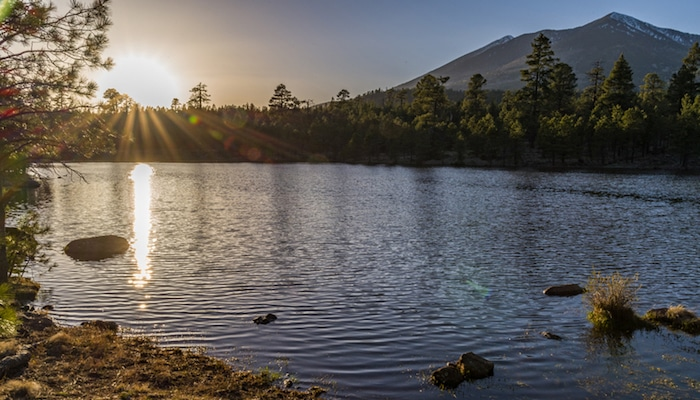
Researchers call it “soft fascination.” Which makes it sound like a new-age meditation technique. Soft fascination is a state of effortless, gentle attention. Which is almost, maybe a meditation technique. But really, Soft Fascination is when your mind focuses on gentle environmental stimuli: think dappled sunlight on trees or creek water trickling around stones or branches swaying in the breeze. We are drawn to such sounds and movement in nature – not as a meditation technique, simply as a reality. We all do it. And it’s not because they are loud and amazing or demanding of our attention; but precisely because they are not.
Evolutionarily, these sounds and motions are a sign that all’s well – no danger or threat looming. Watching a thunder storm from a dry porch is certainly an amazing experience. Standing at the Grand Canyon is a phenomenal way to gain perspective. But that’s not the experience researchers are talking about. It is instead the soft, gentle, effortless stimuli we are naturally drawn to which allow our otherwise overtaxed minds to rest and heal.
And, I will add – this is not just cool background sounds like from a white noise machine – although such devices are not unhelpful. It’s not background. This experience of “soft fascination” is when your attention is on the experience. Studies have shown for decades that experiences of Soft Fascination are calming and restorative.
Other studies highlight benefits with stress reduction and anxiety reduction. There are studies about blood pressure, and pain perception, and general immune support. One hitch is that folks struggle to determine exactly why being in nature this way helps. We just know that it does.
I have always loved the woods and wilderness. I love the wilderness from my experiences growing up with many opportunities to explore and play and (every now and then) to simply be in the woods near my home. I grew up in the Bushnell Basin near to where the Erie Canal runs through the southern suburbs of Rochester, NY. Glaciers created the basin long ago, which accounts for the many sudden hills and lowlands. Across the street from my house was one such lowland. The ground dropped down several dozen feet to a broad swath of trees and clearings that we called The Flats. (not really enough to count as ‘wilderness’ but as a child it was enough.)
Every spring and fall the Flats would become a maze of flooded creeks and overgrown puddles, and all winter there would thick patches of ice everywhere. The land was not useful for farming or development and so was left to go wild with trees and shrubs, left to grow wild for the imagination and exploration of children.
Once I was old enough to be outside on my own, I spent nearly every nice afternoon down in the flats. I wandered a stretch of several miles, sometimes with a friend or sibling, more often alone. I explored, learning the boundary of the creek, memorizing where flats turned to cornfield, finding the biggest trees, making up games, having adventures.
I developed a strong sense of ownership to the Flats. ‘Ownership’ is too possessive a word – I developed a strong sense of identifying with the Flats. Like the wilderness was a gift for me to open anew each day. I spent years down there, like it was an extension of my own home.
When I read about environmental psychologists studying the benefits of being in nature, I am reminded of the woods of my youth. When I hear people talk about hiking or camping, I am reminded of the woods of my youth. When I venture out into the woods as an adult, I am reminded of the woods of my youth.
There is a potion of Walt Witman’s poem, Leaves of Grass that I’ve always identified with. “There was a child went forth every day,” Whitman wrote. And I was that child.
And the first object he looked upon and received with wonder or pity or love or dread, that object he became, And that object became part of him for the day or a certain part of the day … or for many years or stretching cycles of years. The early lilacs became part of this child, And grass, and white and red morning glories, and white and red clover, and the song of the phœbe-bird
Whitman continues, listing many things in nature and people that became part of this child. The point he makes is that such encounters form our identities. Time in nature, or in any setting really, shapes who we become. I think we tend to down play the impact such experiences can have on children in particular. As adults we can still have formative experiences, but our brains are most ready for such things when we are younger.
When people think about ‘spiritual experiences’ we usually imagine big events, like a grand epiphany or dramatic turning point. What if a regular childhood practice like rambling through the woods could count as a spiritual experience. What if we’re talking about simple quiet experiences? Not just the grand dramatic ones?
In her most recent book The Wonder Paradox, philosopher, poet, professor Jennifer Michael Hecht writes about the value of poetry for non-religious people to engage in the thing religious people call ‘spiritual experiences.’ Her book explores how poetry can open us to wonder and awe. She offers a biographical context for herself early in the book:
My physicist father didn’t believe in God by kept quiet about it when we kids were young. I believed from the time my mother told me God was there until one day when I was twelve, standing in my parents’ living room, when I had an uncanny mental shift. I suddenly knew I might be anybody, anywhere, but instead I happened to be here, being me.
The proximate cause was ordinary loveliness: a steep slant of late-afternoon light serrated in the folds of a diaphanous blue curtain; nylon maybe. Yellow sunlight in a glowing fabric curlicue. I saw that we are just one species among great nature, and as the trees very slowly rot, so do our pampered haunches. That’s it. There is no reason to imagine a guy in the sky bowling to make thunder and brooding over how we fail him. Then the sounds of the world returned to my hearing. I never lost interest in such perspective shifts and I never again believed. (pp5-6)
I was fascinated by her description. One person can see a shaft of sunlight through the curtains and interprets a loving God, another the utter lack of a God, and still another can take no meaning whatsoever beyond that it is lovely. My point is less about the conclusions we may reach and more about honoring that such moments can and do shape us profoundly.
Hecht called what she experienced a ‘perspective shift.’ Perhaps it is this perspective shift that makes an ordinary experience of “soft fascination” into a spiritual experience. I’m beginning to devolve into analysis of semantics, for which I apologize. I’m very interested in our experiences of the natural world that lead us into wonder and healing.
I recently pawed through an old copy of the book The Geography of Childhood (1994). The book is a series of essays by naturalists Gary Nabhan and Stephen Trimble in which they present their hypothesis that children need wild places in their lives. Using mostly stories from their own lives and the lives of their children along with a sound base of theory, the authors make a compelling case. The hypothesis is not that everyone needs wild places, but that children need wild places.
Children in particular need wild places for developmental reasons. Surveys claim that less that ten percent of adults see the quality of the environment as an important issue, “over ninety percent of our children feel it is the major issue in their lives.” (p 40) They are drawn to wild places like moths to a flame. My experiences and feelings about nature fit well with what these authors suggest.
I remember how they talked about studies done around how young children use school playgrounds. In one situation, they replaced “an acre and a half of asphalt with a diverse group of traditional playground swings and bars; structures and sitting area; and a half-acre of fishing ponds, streams, woods, and meadows.” (p 66) Then they watched the children to see where and how they played. One aspect they found was how “the natural area of the playground saw wider ranges of activities and more mixing of the genders.” (Ibid) The bit of asphalt they left was used primarily by boys for competitive ball games. This is how some of the children described the natural area: “It’s a very good place. Really quiet. Lots of kids just sit around there and talk.” “It’s just perfect.” (Ibid) Children make themselves at home in the wilderness.
Slides and swings and playground climbing equipment are all really great. Kids love those things. They are exciting. And there is something altogether different and important found in wild spaces. All experiences of wonder are important and valuable. That experience of pumping on the swing and getting up so high! Holding on to a powerful ATV or snowmobile as the landscape flies past! Visiting the elephants at the zoo! All of these experiences can be experiences of wonder. They are curated, contained, commercialized. And they’re good.
But wild wonder is something else. Wild wonder is nourished by chirping crickets and shifting patches of sunlight, burbling creek water and fields of undulating wheat moving like waves on the ocean. Wild wonder hums and shines in a way that eases our minds and brings spiritual restoration. Wild wonder allows your nervous system to settle and heal. We are drawn to these natural experiences. We don’t need to force our minds to be empty or to recite the supplication in the correct way. We simply need to show up and allow our brains to do would they might naturally do when offered the context of the gentle natural world – to experience wonder.
May we each fall in love anew with the quiet murmurings of the natural world. May we ‘rest in the grace of the world.” May we be led into the presence of “green pastures” and “still water.” May we re-acquaint ourselves with the companionable ease found in being present where we belong – in nature, among the dappled leaves and gentle buzz of life. May you slip into moments of Soft Fascination. May it bring you rest. May it restore your soul.
In a world without end
May it be so
—

