
Spending Your Privilege
Rev. Douglas Taylor
March 23, 2025
Sermon Video: https://youtu.be/2tZED6qed5A
There was a reddit post that’s been around for a few years about how dads are native to Home Depot while lesbians are native to Lowe’s. The premise being that these two common types of home improvement shoppers can’t mix. But then a follow up post claimed it was perhaps true at one point but they’ve mixed around so much that trying to separate them back out into their respective original ranges would do more harm than good to the delicate ecosystem of chain hardware stores. https://www.reddit.com/r/tumblr/comments/a0yj5o/dads_are_an_invasive_species/?rdt=59894 Personally, I’m glad for the mix because I am a dad but like hanging out with the lesbians.
I was recently at one of these big chain hardware stores buying a few things. The cashier was a big man who smiled as he was ringing me up, complimented my t-shirt, and commended my brave choice to wear it in the store. I looked down because I had forgotten what t-shirt I was wearing. “Have a Gay Day” it says in big letters on a rainbow background. The cashier went on to say he didn’t have a problem with my shirt, liked it in fact. But he knew other guys in the store would take issue with my attire.
Honestly I had not spent much time that morning thinking about the message on my shirt before he brought it up. It did not feel like a risk to me. That’s part of my privilege. I felt safe wearing a shirt that could conceivably trigger a unpleasant response – possibly a verbally threatening response, or more. But I didn’t even think twice about it when I walked out the door on my way to the hardware store.
Now, that’s not entirely true. I did think about it way back when I bought the shirt at Hot Topic. I thought about it when I was walking around in a park and a pair of younger people said ‘cool shirt’ as they walked past me. I thought about it when my gay niece said “Uncle Douglas has more gay shirts than I do.” I thought about it when a Methodist colleague nodded in appreciation a month or so before their General Conference voted to lift the ban on LGBTQ clergy and same-sex marriages.
I was aware of the impact my t-shirt might have when I bought it, and was reminded a few times along the way of the impact my t-shirt did have. But up until the comments of the cashier saying I was brave to wear my ‘Have a Gay Day’ t-shirt at the hardware store, all my thoughts had been about the positive impact my shirt could have.
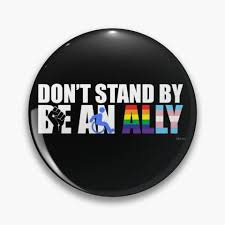
Sometimes being an ally means showing up in ways that can make me uncomfortable, or to take a risk that a more vulnerable person, a less privileged person, might not be safe taking. In the reading this morning [“What’s the Difference Between an Ally and Accomplice?” by Annalee Schafranek
https://www.ywcaworks.org/blogs/ywca/tue-12212021-1103/whats-difference-between-ally-and-accomplice], one of the definitions of an ally was this: “Being an ally is about recognizing your privilege, then using it in solidarity with marginalized groups to challenge the status quo.”
That word ‘privilege’ is important in this conversation. I have noticed that sometimes conversations about privilege can be misinterpreted as conversations about guilt or about making people ashamed. If your conversations about oppression – about land acknowledgments or bathrooms or reparations – if your conversations as a person of privilege get stuck in guilt and shame, something is off about those conversations.
It doesn’t serve you or any vulnerable communities for you as an ally or potential ally to get stuck in feelings of guilt or shame. It serves the status quo. It serves the oppressor. It serves the dominant culture that does not want change when good liberals to get stuck and stop trying to change. James Baldwin once said “People can cry much easier than they can change.”
Remember, the point is about changing the situation so the people who are getting hurt stop getting hurt. The point is not to flip who gets hurt. The point is not to start oppressing the oppressors. White people feeling bad about slavery is not the point. Straight people feeling unsafe in the bathrooms is not the point. The point is not to flip who gets hurt. The point is for the people who are getting hurt to stop getting hurt.
In a 1966 speech, delivered at Illinois Wesleyan University, Dr. King said,
It may be true that the law cannot change the heart but it can restrain the heartless. It may be true that the law cannot make a man love me, religion and education will have to do that, but it can restrain him from lynching me. And I think that’s pretty important also.
-Dr. Martin Luther King, Jr.
What Dr. King is highlighting is how changing attitudes is important, but changing behaviors is often enough. Usually when we think about Inclusion and Diversity, we are talking about perspectives and attitudes, frameworks, ways of looking at the world. I would like to shift that conversation into behaviors, practices that promote these attitudes and perspectives.
I’ve been thinking about this for a bit and here are a few practices I’ve found. To be an ally and eventually perhaps an accomplice, an important practice of inclusion we can do regularly is about listening.
I need to listen, but I am listening with a specific goal: to learn more, to educate myself about what’s going on and about the experiences of people different from me – experiences of people with marginalized identities in our society. This is a great tip for life in general. Listen to children, listen to your neighbor, listen to the cashier, listen to elders, listen to anyone out there … with the goal of learning more about the experiences of people who are different.
And then, here is a justice twist: give a little extra credence to people who are marginalized and vulnerable in our society. Any listening is good and worthy. And, listen with a little preference for people who historically marginalized and vulnerable. I’m not saying people who share my identity are always wrong and people different from me are always right. There are liars and con artists among all types of people. But when people say things like: ‘amplify the voices of people of color’ and ‘believe women’ and ‘walk a mile in another person’s moccasins;’ the suggestion is to counter the near-universal bias people have to dismiss the experiences of those who are suffering.
One regular practice of inclusion is to listen in this way. A companion practice is to get into relationships with people who have identities that are different from your own. It will help with the listening. You can’t get everything second hand – meet people and learn from them.
Another practice is to spend your privilege. Once you have a good understanding of your privilege, the thing to do is use your privilege for something good. I remember a scene from a movie I’d watched years back but can’t remember the title or much else about it. Two friends had grown up in the same neighborhood and are teenagers now – one black, one white. They are getting into trouble together and police show up. The cops have caught the black teen and his white friend jumps on the cop. The black friend gets free and runs off while the white friend is arrested. In an unjust incarceration system, the white friend will have an easier time in prison than the black friend.
That’s certainly accomplice-level behavior. I’m still working on the ally-level work walking around in my gay t-shirt. But my point is we can all find ways to leverage our privilege for the good of vulnerable people and communities. “Being an ally is about recognizing your privilege, then using it in solidarity with marginalized groups to challenge the status quo.” (Annalee Schafranek)
When we talk about Diversity, Equity, and Inclusion, we are refuting the values of Uniformity, Inequity, and Exclusion. The goal is to build something that is more fair, allows more people at the table, that expands the circle.
And do you know what else a person needs to do to be a good ally? Do you want more practices you can do? Heal, rest, the world does not need your exhaustion. The better world we are building includes being better for you. Give love, receive love. It’s not all shouting in the streets. It’s mutual aid and highlighting resources. It’s laughter and holding space for others to just breathe.
Aboriginal elder, activist, and educator Dr. Lilla Watson has a fabulous quote that sums it up well: “If you have come here to help me, you’re wasting your time. If you have come because your liberation is bound up in mine, then let us work together.”
Step up and engage with the injustice you see. Because it is an injustice that includes you. Spend your privilege to make things better. Through practices of inclusion, through actions of equity, through behaviors that build the beloved community.
As a congregation, we’ve been trying to serve the needs of the broader community without reinventing the wheel. Instead of creating our own community dinner, we are partnering with another organization that already knows what they are doing. Instead of becoming the folks who visit the encampments of unhoused and homeless people, we are hosting the folks who are already doing that work. Instead of trying to be the center for Trans people to gather, we are becoming one of the places Trans leaders know they can call on for space. We are using our building to support good work. We are spending our privilege.
When I eventually level up to being an accomplice as described in the reading from this morning, I’ll probably offer another sermon about how to be an accomplice. I know several of you are already functioning as accomplices. But the goal here is not for me or any of us to climb the liberal achievement ladder. Our goal is to build the Beloved Community. For that we need to each keep doing the piece we have for us to do. For that we need each other as we are, listening, learning, healing, acting for justice.
Ina world without end,
May it be so
 Rev. Douglas Taylor