
The World We Long For
The World We Long For
Rev. Douglas Taylor
8-30-26
Sertmon Video: https://youtu.be/iDr2ybW7LlA
Last Sunday, after leading worship here in morning, I met up with other people of faith for a Peace Walk in Otsiningo Park. This was our second annual interfaith Peace Walk. It feels good to have this positive activity together. The local interfaith group has been struggling in recent years. After covid and the shut downs, many faith communities felt the need to focus internally. We did. As folks were beginning to reach out again, the war between Israel and Gaza erupted, and locally we did not have the strength of relationship in place to navigate that together. It has been slow work to rebuild trust and come back together across our various communities of faith.
As one of the leaders in the interfaith community, I was pushing for us to keep it simple; to have discussions about the simple value of interfaith connections. In essence I suggested we not talk about the big divisive topic of the day, at least initially. Delightfully, last year we invited people to come together to offer prayers and walk together for peace. With wars and violence happening in the name of faith, we decided to meet each other in an activity for peace in the name of faith.
This is indirect – we’re not talking about genocide or about who is harming whom. We are not addressing the problem we all recognize, though we recognize it from different directions to be sure. But we are talking about what we’d like to see happening instead of the war and violence. We are talking together about the world we long for. It is a step. We are rebuilding local connections and relationships.
About three dozen of us gathered, Muslim, Christian, Pagan, Jewish, and Unitarian Universalist. A few of the clergy and lay leaders offered prayers. Then we split up into pairs or small clusters to walk around the park together with the conversation prompt: “What does your faith say about Peace?”
I walked with a retired doctor of the Muslim faith. He talked about what Islam teaches him about peace, about how his healing work as a doctor is a form of being true to the teachings of his faith about peace. I spoke about how my Unitarian Universalist faith calls me to practice justice and compassion on the road toward peace. I talked about how my faith says peace will come if we can build a true Beloved Community where all are cared for and injustices are addressed.
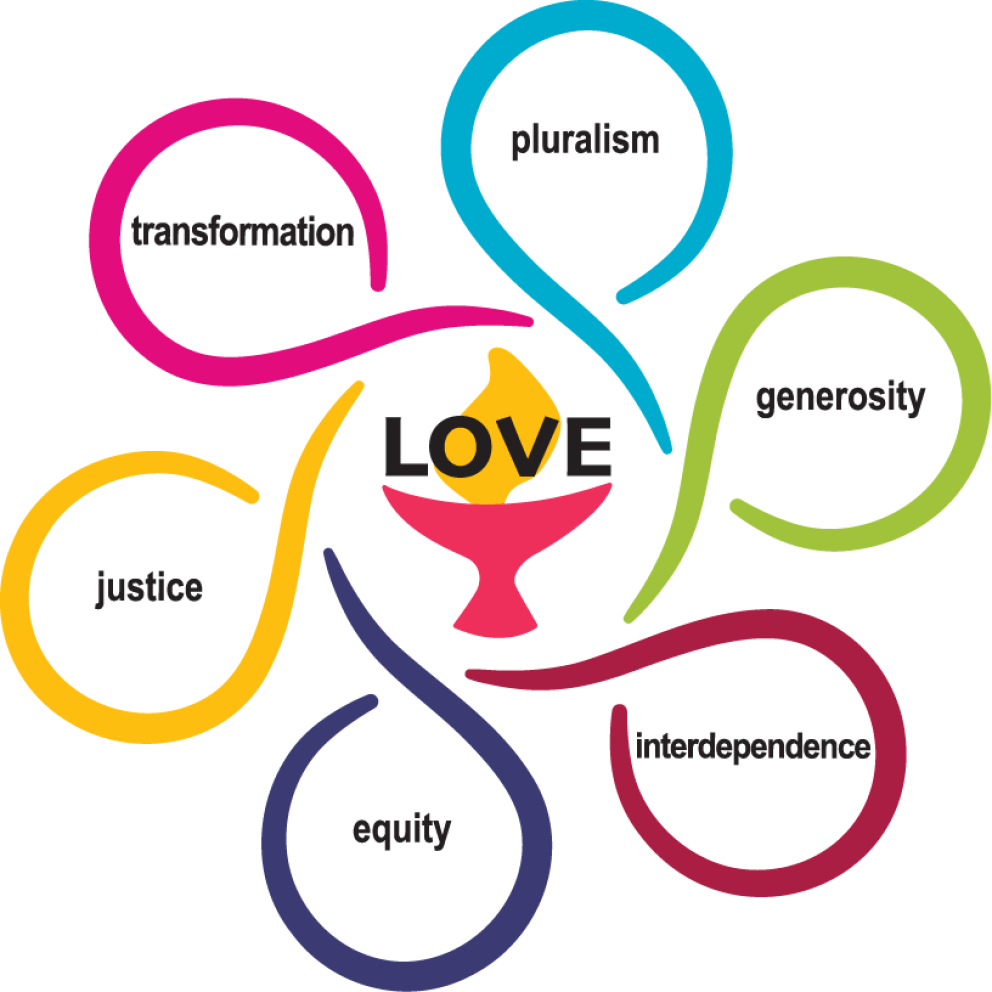
One of the deep values of Unitarian Universalism is Pluralism – the celebration of our diverse cultures, experiences, and theologies. We strive to live that value among ourselves as well as out in the community. We have an insert in the order of service today which shows the official Unitarian Universalist statement of values. https://www.uua.org/beliefs/shared-values You’ll see that Pluralism is one of the values we share.
If anyone asks you, “What is Unitarian Universalism? What do you all believe?” You can say – we are not a belief-centered religion, we are a values-centered religion. We have many different beliefs, but we gather around a set of values centered by Love.” And Pluralism is one of the values on our list.
And thinking back to the conversation I was having at the peace walk, Justice is one of the values on our list. When injustices are addressed, peace can occur. As Unitarian Universalist we pay attention of systemic oppressions and work to build something better in response. Over this past week, for example, we’ve had roof work done on our building. This meant we also had to be careful about Immigration and Customs Enforcement. The way ICE shows up is different depending on the community – around here lately, they have been targeting roofers who are brown and black.
So our leadership made a commitment to make our property a little bit safer for our roofers by blocking our driveways and stationing volunteers to sit out front whenever the roofers were here working. This was a good deal of added labor on our part and very inconvenient for everyone – not just ICE. It impacted our ability to prepare for our annual Veggiefest. The prep work for Veggiefest is fairly extensive and involved. With the added difficulties around accessing the building and concerns about an ICE raid – preparing for Veggiefest was untenable. So, we canceled.
We do still have musicians playing Porchfest today; and the Flea Market sale is still on along with some root beer float sales. And we are giving away ice pops along with conversations about the negative impact of ICE on our communities. But we’re not having Veggiefest this year. Which helps highlight how living our values will sometimes mean things don’t work out the way we want. Living our values doesn’t mean there are no conflicts. But our values help us navigate these conflicts and difficulties among us. Our values also help us respond to what’s going wrong in the world.
I have several complaints about what’s going wrong in the world around me. The way ICE is roaming our cities like masked and armed gangs is deeply troubling. The way unhoused people are treated by our local government and police is inhumane and cruel. The constant and casual lying and corruption is infuriating. The erosions of our democracy, the predatory capitalism, the plundering of our environment, the deregulation of food and drug safety, and the rampant bigotry and hypocrisy of this current administration is staggering.
And! … and I believe it is vital to have a clear vision of what I DO want. I have a long list of what is happening that I don’t want. But I cannot allow anger and indignation be my only response to it all. A set of values such as the official list of Unitarian Universalists values, gives me the framework for that affirming vision of the world we long for.
Here’s another example: This summer I had some back trouble which landed me in several doctors’ offices. Things are better now, but the suffering has shifted from physical pain to economic pain. We do not need to burden people with unreasonable medical debt – many other countries have figured this one out, yet we still do it. Economically, the country is in trouble. Many basic expenses like food and gas continue to rise, while medical debt, student loan debt, and housing costs sky rocket. It’s not sustainable – unless you happen to be one of the billions syphoning wealth off the rest of us. It’s sick.
But notice we have listed Generosity among our central Unitarian Universalist values. We, as a whole community, do what we can to share what we have to make the world a better place. We work to counter the avarice around us with compassion and attention. We are using our resources and several individuals are giving their time and energy to support vulnerable people in the community, to feeding people, bringing clothes and necessities to folks, treating people with dignity and respect. Generosity is not just about money; it’s about all our resources and how we share them.
The world we long for is a world rooted in the values that lift us up. Our Unitarian Universalist faith has constructed a list of values we hold as central, as defining for our identity as a religion. These values guide how we want to be as a religious community; and I argue they guide how us into the world we long to live in. I talked about and gave examples of Pluralism, Justice, and Generosity.
(And briefly, to say a word about each of the other values in our list…) We celebrate our Interdependence with our connectedness with nature and with each other. We honor the value of Equity with the way we treat all people with respect and dignity – each other and all those we partner with and who experience our activities in the community around us. And I am excited for the coming year and the offerings I will co-create for transformation and learning. All of this threaded though the central value of love!
And I want to be clear – this list of values we have is not exclusive or limiting. It’s just the list we came up with together through discussion and debate among thousands of UUs from hundreds of congregations over a span of more than 5 years just recently. But it is not to say there aren’t other values you find compelling or central to your understanding of love and faith.
We have some posters around the building that we made internally, they say
“Do you believe in kindness, peace, equality, love, inclusion, hope, and diversity? So do we.” Unitarian Universalist Congregation of Binghamton.
I want to be sure my list of values includes joy and grace and a sense of agency. I happen to like the term interconnected better than interdependent – but I still support the values listed in the official version of our UU values. I don’t need everything to fit me specifically or for every part of me to fit here – that’s just not realistic or necessary. This list is good, and good is good enough for us to heal each other and heal the world together.
In closing, I want to recast the reading we heard before the sermon. Rev. Scott Alexander’s “We Need a Religion” https://www.uua.org/worship/words/reading/we-need-religion paired various troubles in the world with the Seven UU Principles – that’s what we used to talk about our religion for about forty years before writing the new articulation about our values. I needed a new version, following Rev. Alexander’s structure, but following the values instead of the principles.
We Need a Religion inspired by Scott W. Alexander (by Douglas Taylor)
In a world with so much tyranny and oppression,
We need a religion that values justice, and works to be diverse multicultural Beloved Communities where all thrive.
In a world with so much fear and violence,
We need a religion that values transformation, and calls us to grow spiritually and ethically, adapting to a changing world.
In a world with so many persons abused and neglected,
We need a religion that values equity, and declares that every person is inherently worthy and has the right to flourish with dignity, love and compassion.
In a world with so much dogmatism and falsehood,
We need a religion that values pluralism, and embraces our differences while celebrating our free and responsible search for truth and meaning.
In a world with so much greed and corruption,
We need a religion that values generosity, and cultivates in us a spirit of gratitude and hope, where we are connected to one another in mutuality.
In a world with so much personal isolation and environmental degradation,
We need a religion that values interdependence, and leads us to acknowledge our place in the great web of life with reverence and humility.
In a world with so much uncertainty and despair,
We need a religion that is centered on the value of love, and teaches our hearts to hope, and our hands to care.
—
In a world without end,
May it be so
The Modern Abolition Movement

The Modern Abolition Movement
Emily Richards and Douglas Taylor
3-29-26
Sermon Video: https://youtu.be/phpQUnoJUh0
Emily: Part 1
When we hear the word abolition we immediately think about tearing something down. Abolition in this country in the 18th and 19th centuries was the movement that sought to end slavery and continues to be what first comes to mind for many people when we talk about abolition.
Today the conversations about abolition have shifted and it is common to see and hear messages such as abolish the police. Abolish ICE. Demands that we get rid of the systems that are in place.
Dr. Crystal T Laura shared “I think of abolition as the deliberate and intentional removal of imprisonment, isolation, punitive institutionalization as the foremost way that we address issues of harm and healing.”
Abolition is the deliberate and intentional removal of systems that cause harm yes, but abolition justice inherently also has to include the building of something new.
Not REbuilding, which in many ways was what happened during reconstruction after the abolition of slavery in the United States, the old systems were simply shifted to continue to allow for the oppression and profit off of the people who were freed from chattel slavery.
True abolition means creating something totally different. And ideally better. In order to do that you have to tear down these systems and start from scratch.
The challenge there is that these systems, these ideologies, are so ingrained into the society in which we live that we cannot imagine what we would create to replace them.
Eric Stanley wrote:
“Abolition is not some distant future but something we create in every moment when we say no to the traps of empire and yes to the nourishing possibilities dreamed of and practiced by our ancestors and friends.
Every time we insist on accessible and affirming health care, safe and quality education, meaningful and secure employment, loving and healing relationships, and being our full and whole selves, we are doing abolition.
Abolition is about breaking down things that oppress and building up things that nourish. Abolition is the practice of transformation in the here and now and the ever after.”
Abolition is building things up. What do we want to build? What are we called to build as UUs? As a people who value justice and equity and generosity? As a people who believe in transformation, of our selves, our communities and our society?
Douglas: Part 2
This conversation about Abolition grew out of a “Congregational Study Action Issue” at our UUA General Assembly this past summer (2025). In general, a Congregational Study Action Issue (or CSAI for short) is a multi-year process intended to have people in our congregations talk about and consider a justice issue most of us do not already know a lot about. The point is to encourage sermons and workshops to get us talking and thinking before we draft any statements or work toward any changes.
When I heard the Abolition proposal, my initial thought was ‘prison reform is a worthy goal, I agree we should talk about that.’ But this is not simply a conversation about making changes to how prisons work in our society.
At root, it is about crime and punishment – yes. But theologically it asks us to look at what we mean by the idea of ‘crime,’ to recognize that not all behaviors we categorize as ‘crimes’ are about harm and not all harm is categorized as a crime. Digging deep we can ask: what do we do with people who cause harm? Are some people disposable? What would redemption look like, or rehabilitation, or repair?
One aspect of this conversation I eventually realized is that we’re also talking about the issues in our society that lead people to ‘break the law’ and end up in prison. Can we recognize that issues of poverty, racism, addiction, and homelessness are connected to this issue of abolition?
If we abolish prisons, we will also need to abolish the conditions that too often lead people to ‘break the law.’ If we had universal health care and affordable housing and minimum basic income – a lot fewer people would be at risk of incarceration.
This conversation leads us to consider all the harm that happens that never gets labeled as criminal. Can we recognize that climate degradation, wage theft, and income inequality are not ‘criminal’ but are issues we’ll want to tackle if we are going to seriously build a just world without relying on our current prison industrial complex.
Abolition has a holistic vision bringing in a broad swath of justice issues we Unitarian Universalists tend to be actively working on already. We talk about intersectionality and how often our struggles in one area overlaps with other areas in our lives.
This conversation about abolition touches on LGBTQ issues and immigration and reproductive rights and human trafficking and political corruption and addiction and so much more because it starts with the question of ‘what counts as a crime?’ and how will we respond as a community?
What might society look like if we began with responses to those questions that take our Unitarian Universalist values seriously? This isn’t merely about abolishing the systems that do not work – that are in fact causing us harm. It is also about imagining what we might do when we start to build something new.
Emily: Part 3
Frederic Jameson said “It’s easier for us to imagine the end of the world than the end of capitalism.” Really sit with that. “It’s easier for us to imagine the end of the world than the end of capitalism.”
We can include capitalism when talking about abolition. We can include it along with the abolishment of modern day slavery, of the prison industrial complex, of human trafficking, of forced labor, of family policing. Of all of these systems.
It was my youngest’s birthday this past week and they wanted McDonald’s for dinner. Wednesdays are a busy day for us so we went through the drive through on our way home from rehearsal and they noticed that there was a sign on the window that said that they didn’t accept bills larger than a $50.
And they asked why. I replied that it was probably because they don’t keep much cash in the register so they wouldn’t have change for a larger bill. And then I kind of flippantly added, they probably empty the registers regularly so there isn’t much in there if they get robbed.
And my kids were so offended that someone might rob McDonald’s. To which I responded, wouldn’t it be great if we lived in a society where people didn’t need to resort to robbing McDonald’s.
When we talk about abolition that is what we mean. Can we imagine a society where no one is living in poverty? Where no one feels like they need to steal to survive?
Alan Detlaff, a professor, author, and abolitionist, shares that statistics show that nearly three-quarters of children in foster care are there because of neglect, which is largely associated with poverty and disproportionately affects brown and black children.
Can we imagine a society where there is no need for children to be removed from their families for the crime of being poor?
Douglas: Part 4
In two weeks, on Sunday April 12, we will have a workshop based on Mariam Kaba’s book We Do This ‘Til We Free Us. We used an excerpt from the book as our reading this morning. Alex Compton and Catherine Magdala will lead the class with the support of our Social Action Huub.
We’ll crack open this conversation around abolition together. If you already have this figured out, maybe this class isn’t for you. But if you are curious or are beginning to see some connections and want more – then we can start a serious conversation about abolition and what might be possible together.
Last week in my sermon on “The Rejected Stone” I said:
“We are called to take care of each other, to build a society in which we all can thrive – not just some, but all. We are called to denounce the idea that some people are disposable or unworthy. The rejected and the outcast are more than welcome here – we are celebrated, central.” (3-2-6)
If that’s true, then we will want to start talking seriously about abolition together.
Last month in my sermon “Do We Have Enough Love” I shared this:
“Friends, our theology does not call us to be among the respected classes. We are not called to whisper sweet platitudes of God’s love to the oppressors. Instead, we are called to remember that our love is radical. … Our faith calls us to build just and loving communities. Our faith calls us to get out among people in need and get our hands dirty, to let our days be the evidence of our hearts on fire.” (2-15-26)
If that rings true, then we will want to start talking seriously about abolition together.
Last fall in my sermon “Sometimes Things Break” I reminded us:
“Sometimes things break. That doesn’t mean we are bad people. We can thrive and grow when broken, (perhaps only when we are broken.) How we respond to the brokenness builds the world around us. It’s not the brokenness that matters. What matters is our response. What matters is the love.” (9-28-25)
And if that sounds right to you, then we will want to start talking seriously about abolition together.
Friends, this is something we’ve been building up toward for a while. It only seems impossible because it is a big idea. But all the pieces are in front of us and we’ve been talking about them together for a few years. Abolition only seems radical because it is. But that’s what we’re here for – radical love, the kind of love that can get all of us free.
Emily: Part 5
W.E.B. du Bois wrote, at the beginning of Looking Forward, “How two theories of the future of America clashed and blended just after the Civil War: the one was abolition democracy based on freedom, intelligence and power for all men, the other was an industry for private profit directed by an autocracy determined at any price to amass wealth and power.”
The rise of autocracy and an industry determined to amass wealth and power, at any cost, has created a society where only the few can truly thrive and the rest of us are confined within systems that judge our worth based solely on our monetary assets, and find us lacking.
Abolition goes beyond making a few changes to the systems that already exist. Abolition requires a fundamentally different way of living. It requires building up things that nourish everyone. It requires transformation in the here and now and the ever after.
And to get there we need to start the demolition.
In a world without end,
may it be so.
Tea and Purpose

Tea and Purpose
Rev. Douglas Taylor
12-14-25
Sermon video: https://youtu.be/wS0h-ziD9V4
The amazing Terry Pratchett once wrote: “There’s always a story. It’s all stories, really. The sun coming up every day is a story. Everything’s got a story in it. Change the story, change the world.” (Terry Pratchett, A Hat Full of Sky)
As Pratchett suggests, we do well to pay attention to the stories we are telling ourselves about the world we live in and the world we long to live into.
Last week we talked about Star Wars and the power of hope. One of the things we saw in those stories was how resistance shows up against the forces of Empire. Star Wars is a form of dystopian fiction. Dystopian literature offers a bleak perspective on the future – things have gone wrong and now we need to work to make it better. Good dystopian fiction will go one better to reveal what is going wrong now, not just in an imagined future. It will be about our present condition more than anything else.
Today I want to talk about some utopian fiction. And in a similar vein, good utopian fiction reveals not just some imagined happy future, but how we are living with the seeds of that future even today. “Change the story, change the world.”
The story I am excited about this morning is about robots. I will confess, I’ve never been a huge fan of robot-based science fiction. And upon reflection I think that has to do with the way robots have been portrayed in science fiction over the years.
One of the things about stories is how they have a surface level entertainment and a deeper level of impact. On the surface, a story about robots may be a fun exploration of technology and imagination. On a deeper level, robots offer a mirror to explore what it means to be human. When Science Fiction leans into a character who is non-human, the author is able to help the reader better understand what it means to be human.
Isaac Asimov offered the classic version of robot stories. For Asimov, robots were an exploration into ethics and logic and the hope for a better future for humanity based on ethics and logic. Asimov wrote his robots as tools or servants to humanity. And while he did critique the premise in some ways – that was the premise. Robots were the perfect servants.
Later versions of the genre had the robots take on different roles. Think about The Robot from the Lost in Space series: “Danger! Danger!” The Robot was a powerful and loyal piece of equipment. Think about The Terminator, who was really just a weapon – and then remember how most advances in drone technology are rooted in military research these days. Think about the Droids in Star Wars who were really just a plot device and sometimes comic relief. And then think about the way Gene Rodenberry’s Star Trek portrays the character of Data as a sentient being with relationships and a unique place in the crew. Data was the first (and until recently, the only) robot I enjoyed.
The Monk and Robot series by Becky Chambers offers a radically different robot from the loyal equipment or perfect servant of earlier versions of this literary mirror. Where Asimov’s robots are essentially tools of humanity and society, Chambers’ robots are peers with humanity seeking purpose and community. Where Asimov’s robots are stand-ins for a conversation about racism and law, Chambers’ robots are conversation partners on the topic of freedom and liberation.
And most alluring for me is that freedom is not an either/or scenario – it is not an apocalyptic uprising of the machines. They do ‘rise up’ but their freedom frees the humans too. And that is how this story changes the mirror of what robots reveal about what it means to be human.
The description on the inside jacket of this book categorized as ‘cozy sci-fi’ tells us this:
It’s been centuries since the robots of Penga gained self-awareness and laid down their tools. Centuries since they wandered, en masse, into the wilderness, never to be seen again. Centuries since they faded into myth and urban legend.
One day, the life of a tea monk is upended by the arrival of a robot, there to honor the old promise of checking in. The robot has one question: “What do people need?” But the answer to that question depends on who you ask, and how. They’re going to need to ask it a lot.
How would you answer? What do you see that we need?
I mentioned near the beginning that this is a utopian story. Part of the premise as the book begins is that the people have resolved their basic needs. There is no poverty, no inequity on injustice leading to homelessness or hunger. It is a society in which everyone basic needs are met. In a world where people have what they want, what more do we need?
In the second book, there is a scene when the robot, Mosscap, first comes to a community and asks it’s question: “What do you need?” The small town of people who turned up to see the oddity of a robot were confused by the question at first. Nobody quite knew how to respond.
After a long pause, a bearded man piped up from the back of the crowd. “Well, um … I need the door to my house fixed. It’s a bit drafty.” (PCS p23)
Sometimes it can be hard to think beyond the immediate needs of our daily rounds. What do you need? Maybe not ‘what do you need help with?’ Maybe not ‘What do you need a robot to do for you?’ Because I don’t have a real robot tucked up here in the pulpit with me. And I’m not so good at fixing your drafty doorway. So what do you need? Really?
I imagine many answers in our current situation might land in the category of righting a wrong, answering an injustice, fixing a gross inequity. I need ambulance rides to be fully covered by insurance and for teachers to be valued more than celebrities. I need oligarchs and abusers to be held accountable and removed from power. I need my society to really care for the wellbeing of all the people in our society.
So, if that were accomplished, as is suggested in our little novel about a tea monk and their robot friend, then what would you need? Pretend we’ve solved our injustices and we live in a Star Fleet type of universe. What do you need?
This begins to drift into theological territory. What is the Human Condition? Many theologies are built around an assumption of sin or fallenness and how awful we are compared with God and what God expects of us. I don’t have time for that sort of sour thinking. Yes, we are imperfect and broken, but not is a sinful or bad way worthy of judgment. We are imperfect and broken in the way all the world is.
I believe our Human Condition is one in which we need to be loved – and we are loved. We may forget this truth or trauma can chased this truth from our knowing, but we are. I believe our Human Condition is one in which we are intrinsically part of the holiness that pervades the whole universe. We are interconnected – thus what I need is not only what I need, but what we need. And we need each other. I think any answer to the question ‘what do people need?’ must include the answer: each other. We need mutual thriving.
In this story I’m inviting you to read, the author makes multiple references to our need for each other. It shows up when the story talks about various things from interdependent ecosystems to friendships. What do people need? Each other.
One of the characters is the robot, the mirror of humanity revealing a deep truth about ourselves. The robot brings the question and raises thoughtful and emotionally mature reflection on the responses it hears from the humans. The other character is Dex, the tea monk.
Let me tell you a little about the work of a tea monk. Dex the tea monk travels from town to town helping people. They set up a small booth in the town market when they arrive. The booth has comfortable places to sit and relax, and it has tea. People visit a tea monk to talk through things they are struggling with. Maybe it is a grief or a confusion, perhaps they just need to talk through a decision they have to make. Usually people simply need a bit of companionship and a space to relax. Dex offers people empathy and they offer a cup of tea. Dex gives people what they need.
“What do people need?” the robot asks. Both the tea monk and the robot are in the business of figuring out what people need. Perhaps it is your business as well. What do people need? Each other, certainly.
In a cozy science fiction story where people’s basic needs are met, where folks don’t need to fight against Empire or join the resistance – they still need things. Surprisingly, what people need to fight Empire is also what people need in this Monk and Robot story – mutual thriving.
Later, during the book discussion I’m planning in January, we will talk more about mutual thriving as well as topics of economy, ecology, freedom, pleasure, our relationship with nature and with technology, as well as the meaning of life. And I’ll serve tea. I promise.
For now, I leave you that question to ponder. What do you need. May you uncover surprising answers as you wind your way through this holiday season.
In a world without end, may it be so.
Do Not Oppress the Foreigner
Do Not Oppress the Foreigner
Rev. Douglas Taylor
9-14-25
Sermon Video: https://youtu.be/7KmnS8jJB9E
Each Sunday morning we light the flame in our sanctuary chalice. The Flaming Chalice is the recognized symbol of our faith tradition. Fascinatingly, the origin of this religious symbol is pertinent to our topic of immigration this today.
Hans Deutsch, an Austrian artist, first brought together the chalice and the flame as a Unitarian symbol during his work with the Unitarian Service Committee during World War II. The Service Committee commissioned Deutsch to create a logo that they could use on legal paperwork for Jews and political dissidents fleeing the rise of Nazi Germany. It also developed as an underground symbol that transcended the language barrier for those assisting the refuges.
Our central religious symbol as Unitarian Universalists, the image that represents our identity, was first used as a symbol of hope and support for refugees escaping fascism.
The Chalice Lighting words I used this morning were written by Erika Hewitt. Rev. Hewitt wrote:
The chalice, as a symbol of Unitarian Universalism, arose as a beacon of hope in an atmosphere of tyranny. The chalice arose as a sign of promise that the marginalized would neither be forgotten nor ignored, because they are beloved and precious from the perspective of the Holy.
Our faith has a proud history of resisting tyranny and fascism. Of revealing hope, of holding out a promise to treat all people – particularly the marginalized and the vulnerable – as beloved and precious. That’s what it means to be Unitarian Universalist in face of rising tyranny.
You may have noticed the new signs posted on some of the doors in our building in recent months. The signs essentially declare some spaces as ‘private’ such as our main office, the library, the RE classrooms and so on. These signs are not meant to stop members of the congregation from entering those spaces. They are meant to stop Immigration and Customs Enforcement agents from entering. Our current federal administration reversed a long-standing position that said ICE agents would not enter sensitive areas such as hospitals, schools, and houses of worship. Ice agents are now being sent into these spaces to find people to arrest and deport. A house of worship is a public space, technically. This is an example of the administration pushing against the fourth amendment rights.
Broome County is not experiencing a surge of ICE activity in our streets. Instead we are seeing it in our jail where more that 25% of the roughly 400 people imprisoned there are part of the ICE arrests and detainments from around the state.
In our country today, we are experiencing the rise of fascism in the form of White Christian Nationalism. This evil among us is targeting immigrants along with a handful of other vulnerable identities. Christian Nationalism is, at heart, a betrayal of Christianity. The practices and policies of the current administration are deeply anti-democratic, anti-Christian and immoral. I mean this in particular today as it relates to immigration, but my statement applies more broadly to be sure. But today, let us consider how immoral and anti-Christian this current administration is with regards to immigration.
In the Bible, we can find a multitude of times when the people receive commandments from God to treat vulnerable people in a fair and just way – particularly widows and orphans, the poor, and foreigners. We heard, for example, the passage from Exodus this morning, Exodus 23:9: “Do not oppress a foreigner; you yourselves know how it feels to be foreigners, because you were foreigners in Egypt.” This passage, and the sentiment it offers, is not a minor point. It is a seminal passage for the Jewish faith. But it has also served Christian ethical thinking as well.
And the passage from Exodus is not an outlier. It is a companion to multiple other times in scripture when we hear the same commandment. Deuteronomy 26:5 and 27:19, Ezekiel 22:7, Leviticus 23:22 and 24:22, Zechariah 7:10, Malichi 3:5, and Jeramiah 7:6 – along with another dozen or so more from Deuteronomy and Leviticus and Exodus. There are a few narratives from Gensis that frame the conversation as well. Add to these the passages from the Gospel of Matthew’s Sermon on the Mount and Paul’s letter to the church in Rome along with that amazing passage from Hebrews 13:2, “Do not forget to show hospitality to strangers, for by so doing some people have shown hospitality to angels without knowing it.” Taken together, they frame a very clear call for Jews and Christians to treat immigrants with compassion. It is appropriate to surmise that the overall message from the Bible on this topic is that compassion for immigrants is required of us. We should not abuse or oppress immigrants, and instead we should treat them like citizens.
In fairness, I will say the Bible does contradict itself often; and on this topic we find that to be the case as well. The book of Nehemiah is deeply anti-immigrant; and some Christians – particularly conservative evangelical Christians – do love to quote from that text. Nehemiah’s context is important to notice, however. The first Babylonian exile had happened recently and the temple had been destroyed. Nehemiah took on the project of rebuilding the city walls. Part of his project was to ‘cleanse’ the population of what he deemed to be cultural pollution – meaning there had been a lot of intermarriage between Jews and other groups. Nehemiah’s purity goals and anti-immigration policies served a purpose in his mind, despite being out of step with the rest of scripture.
But again, taken as a whole, the perspective found in the book of Nehemiah is an outlier compared to what the rest of scripture says about how to treat immigrants.
Religious advisors to the current Trump administration encouraged the president to use a hardline Nehemiah interpretation of scripture’s perspective on immigration. “Nehemiah went there to build a wall to keep the wrong people out.” What they don’t say out loud is the way Nehemiah’s rigid cultural purity was at play very strongly. They like that part, but know it would not be popular among the general US population. The general US population is far more welcoming of immigrants than the relatively small subset of white evangelical Christians in the United States. Far more US Christians are familiar with and in agreement with the passages that advocate for compassion toward the foreigner and the immigrant.
And here’s the rub. These religious arguments in our contemporary political debate are disingenuous. The Christian Nationalists using these biblical arguments for anti-immigrant agenda are Nationalists first. The part about being Christian is an adjective – it is a means toward their nationalism. Their goal is not strong borders and crime prevention.
If they wanted to prevent crime, they would not be kidnapping parents as they drop their kids at school or disappearing people who show up for their immigration hearings, or raid work locations. If they really wanted to prevent crime they would be arresting the business owners who exploit the workers, not the workers. But that is not their goal. It never was. Those are merely the arguments they present as they strive to shape our country into their Christian Nationalist dream.
You may have noticed a small nuance in my language about Nehemiah being used to advocate for anti-immigration policies and the scores of other passages such as Exodus and Hebrews being used to advocate for compassion for immigrants. Immigration the way we experience it today is very different from what is being talked about in the Bible. There was no Border enforcement police or deportation processes, no naturalized citizens exactly or work visas. We are extrapolating and interpreting when we use these old texts to guide current opinion and policy.
And if we are being honest, it is worth pointing out that it is a very small number of people who would say their true goal is to be biblically accurate. Most people, if they were being honest, would admit to a different motive.
For me, my motive behind how I think about immigration is this: I believe in the power of our differences, that we are a better community when we have a variety of perspectives and experiences among us. E Pluribus Unum! Our strength is in our compassion for those who are different, in particular for those who are vulnerable.
For others, the motive seems to be a desire gain control through fear, to dehumanize certain people, and create a monoculture – a white supremacist or Christian Nationalist dream of exclusion and power. They are using the immigration issue because immigrants are one of the easy groups to target in their culture war.
We, as Unitarian Universalists have a role to play in the face of this hate. We have a calling to light our chalice and resist tyranny, again. We must resist the fear and hatred and lies that seek to divide us. Our faith calls us to be generous and gracious with the vulnerable among us who are being attacked and abused.
I encourage you to seek truth, to protect the homeless, our trans siblings, and the undocumented among us. Refuse hatred, but call out that hate when wherever you find it. Go out and meet people, experiences the differences of the broader community. Help the marginalized and vulnerable people under attack to know they are not alone, they do belong, they are beloved. Know that you are not alone, you do belong, you are beloved.
In a world without end,
May it be so.
To Save or Savor

To Save or Savor
8-31-25
Rev. Douglas Taylor
Sermon Video: https://youtu.be/OEj-ifcUj5I
I know E.B. White as the author of beloved children’s books like Stuart Little and Charlotte’s Web. Perhaps you know him for that definitive book about English writing – Strunk and White’s Element’s of Style. Then there is a vast collection of pieces he wrote of the course of years he spent as a regular essayist for The New Yorker. One of his pithy pieces is the starting point for my reflection today. E. B. White once wrote, “I arise in the morning torn between a desire to improve the world and a desire to enjoy the world. This makes it hard to plan the day.”
In my description of today’s worship service, I suggested that in the full quote White decides that savoring is more important. This is not true. The full quote only heightens the tension revealed in the shortened version.
The full quote was from a piece he did for the New Yorker in 1969 – after he’d won awards like the Newbury, so he had people’s attention.
“If the world were merely seductive, that would be easy. If it were merely challenging, that would be no problem. But I arise in the morning torn between a desire to improve the world and a desire to enjoy the world. This makes it hard to plan the day.” The New York Times (11 July 1969)
Do you improve or enjoy the world? Do we save or savor the world? E. B. White is not remembered as an activist, exactly. His name is on the list of amazing writers, but not really on the list of social reformers or change agents who tried save the world. He certainly spoke about the issues of the day, advocating for justice and civil rights, for democracy and virtuous principles. But he said his desire was to improve the world and one can easily argue that he did.
He lived and wrote during challenging times. But they were not only challenging, they were also, as he says, seductive. His books and his pieces in The New Yorker had an impact on our lives – but the character of his writing leads me to believe he was able to enjoy the world splendidly. E. B. White seems to have been able to both improve and enjoy the world.
How do you plan to spend your day?
White said the times in which he lived were challenging. We also live in challenging times. It has become numbingly normal to get news about the erosion of our democracy or attacks on the rule of law perpetrated by the executive branch of our federal government. Meanwhile thugs in masks are kidnapping people on the streets under the protection of our government. Meanwhile our trans siblings are losing protections and seeing society encouraged to fear them. Meanwhile our health care system is being run by conspiracy theorists instead of scientists, our Homeland Security is run by white nationalists, and our federal intelligence agencies are actively colluding to cover up the Epstein Files in plain sight. Plus we have a war in the Ukraine and a genocide unfolding in Gaza, and ridiculous international trade wars we are paying for here from our own pocketbooks. Billionaires keep getting richer and AI companies are stealing our data and identities for their own profit.
So, yes. I do arise each morning with the desire to improve the world. Do you want to save the world too? I want to protect the immigrants and refugees, I want to fight for better healthcare and vaccines, I want to defend the rights and protections of LGBTQ people. I see our unhoused and hungry people right here in Broome County and want to do something about it.
I have this desire to improve the world, and thankfully I’m part of groups that are doing exactly that. Our congregation just co-hosted a huge community barbeque that served over 400 meals. The UUA launched a campaign around Abolition with a focus on prison – and our congregation is going to tap into that this year. Our Systemic Housing Crisis social action team is working to raise funds and awareness of local legislative changes we can make and have partnered with a community land trust to create more sustainable housing to people. The Interfaith group that I am a part of is rebuilding itself after the pandemic – we are reestablishing local interfaith relationships. And our first official action was a Peace Walk at which we talked with and listened to each other – especially about Gaza. And so much more – we’re in the middle of this, in the thick of it together. We are acting on that desire to improve the world, responding to the challenging times in which we live.
And it can be a lot. And is anyone here feeling overwhelmed by it all? Are you feeling scattered, frustrated, and numb? Sometimes I need to check out, escape, just drop everything and stare at some patch of earth or a quiet stream for a bit – or play keepy-uppy with my granddaughter for a while.
How about you? I am reminded that the better world we are building does not need me exhausted and burned out. This is more than just a conversation about self-care or justice-fatigue. You’ve heard the argument that we need to do our justice work like a choir singing a prolonged note together – different choir members take their breath at different times so the experience of the note is sustained while the individual singers each get to breath and no one person is carrying the whole prolonged note alone. You’ve heard that metaphor perhaps? That’s not what I’m talking about.
E. B. White said the world is seductive. And he arises with a desire to enjoy the world. To savor it. This part is not just about taking a break. It’s about pouring some of your good energy into loving the world powerfully – savoring the beauty of it, enjoying life. Do you enjoy life?
This is not simply a matter of scheduling your day to do some improving in the morning and wrap that up to have time for savoring by 3:15. There is a way in which the desire to improve the world is borne from a critical dissatisfaction with the way things are. Things could be better, let’s get to work on that. But the desire to enjoy the world is borne from a recognition that the world is beautiful right now, just as it is.
Look at that amazing sunset! Listen to this elegant piece of music. Can I describe to you this cool game I found that I’m loving? Check out my new shoes – they look great and are soooo comfortable. If all my energy is on improving what’s wrong, how much energy do I have for enjoying what’s right?
Ah! But if I am so invested in savoring what’s right – am I blocking out or in denial about what’s wrong in the world around me? How might we both save and savor? Enjoy and improve?
Here’s a trick that works against us: we live in a late-stage capitalist society that pushes us to be dissatisfied with trivialities – Does your body smell wrong? Are you performing masculinity wrong? Is your dry skin keeping you from dating the right people? What if you are embarrassing your children because you drive the wrong car or buy the wrong food!
We certainly need to step back from this manufactured dissatisfaction and instead simply love the world as it is. The world is already amazing and so are you! You don’t need to be perfect to be loved.
And if you still feel compelled to be dissatisfied, let me gently tell you: no one cares about your ear hair – but brown-skinned people are being profiled by ICE, the CDC has stopped promoting vaccines, and the Epstein Files are still being covered up.
E. B. White did not resolve the dilemma. White intentionally kept the tension of this dual yearning to both enjoy and improve the world. He did not want us to have the solution; he wanted us to experience the tension. I was wrong when I suggested that E. B. White’s full quote revealed his conclusion that savoring is more important than saving. He didn’t say that. It was a farm and garden blog I read that said that.
Katie Spring is a health-conscious, modern young blogger who writes about tomatoes and cabbages, about women-owned seed catalogues and ‘5 ways to stay grounded and avoid burnout when while starting a farm.’ In one of her posts, she raises E. B. White’s dilemma about saving and savoring the world https://katiespring.com/save-savor-world/ and says:
“It resonated so fully within me: the pull between wanting to protect, defend, and fight for the world and wanting to laugh, explore, and sink into the world’s beauty. The two acts appeared so separate.”
She eventually realized that the two are not separate, but intwined – and indeed they begin with savoring. “Savoring leads to saving,” she writes, “because savoring leads to love.” It’s that simple.
I found her reasoning quite sound. “Savoring leads to saving because savoring leads to love.” That reminds me of a quote I had on a t-shirt when I was a teenager in the ‘80’s. The quote is by Senegalese conservationist Baba Dioum, who wrote: “In the end we will conserve only what we love; we will love only what we understand; and we will understand only what we are taught.”
We will only save what we love. So my goal is to encourage you to love the world, to love you neighbors, to love those who live at the edges. To love the beauty you see in the world. “Savoring leads to saving because savoring leads to love.”
E. B. White loved the English language. He enjoyed the creation of an elegant English sentence. That one he wrote about enjoying world or improving the world was a product of his love. And it has spurred generations so far to grapple with the concept. Just in that one small example, he has improved the world.
Go read that cozy romance, play your lute, take a dance class, hug your people, make pithy protest signs, take someone on a hike to your favorite view, savor that fine meal, love your neighbor, and enjoy this world. We will only save what we love. Savor life, that you remember why it is so worth saving.
In a world without end,
May it be so.

