
Every Mind Was Made for Growth
Every Mind Was Made for Growth
Rev. Douglas Taylor
5-19-19
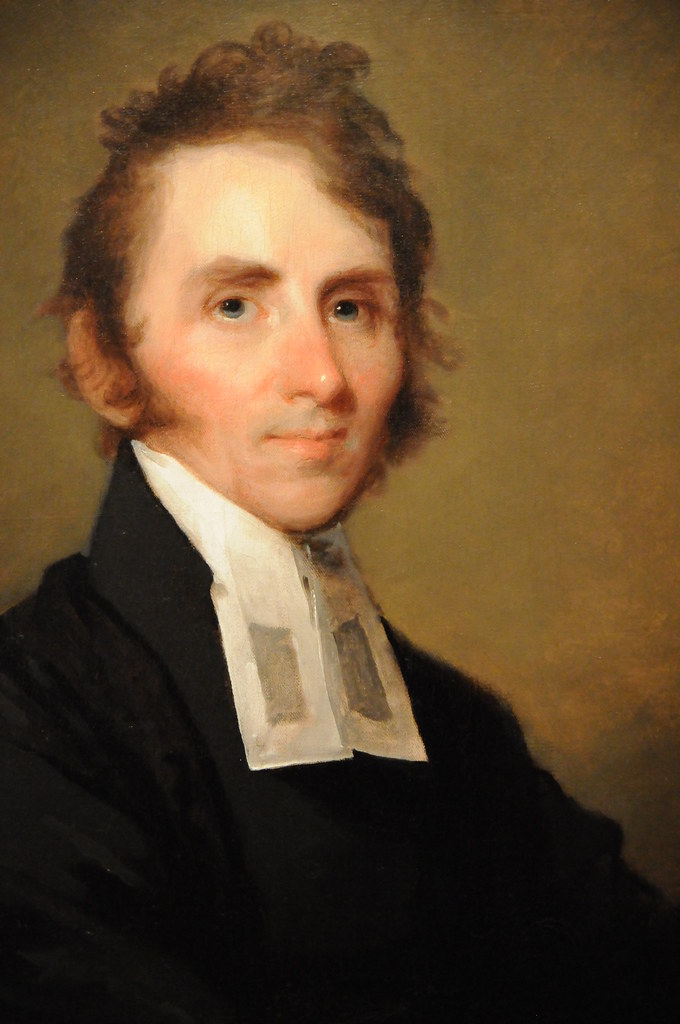
“Every mind was made for growth, for knowledge,” says William Ellery Channing, “and its nature is sinned against when it is doomed to ignorance.” Our capacity for spiritual and intellectual growth was central for Channing. It was a theological stake in the ground for him.
Channing preached his Baltimore Sermon two hundred years ago in 1819 – on May 5, I will add, (so, two hundred years and two weeks ago.) Six years later, in 1825 – on May 25, I will add – the Unitarians organized themselves into the American Unitarian Association. The month of May is particularly rife with institutional dates for us.
More importantly, there are some key points in that Baltimore Sermon which carry forward to today, which have shaped out religious identity as Unitarians and Unitarian Universalists over the decades. “Every mind was made for growth,” Channing said.
“What does God sound like?” my oldest child once asked me.
So, of course, I dragged my then 5-year-old child outside and sat with them in the grass and said, “Listen. What do you hear?”
“Wind.”
“Good. What else.”
We were quiet for a moment. “chirping.”
“Yes, that’s birds and squirrels. What else.”
Silence stretched as we listened. “I hear insects buzzing.”
“Good. Yes. All this is what you are listening for.”
“So, God sounds like nature?”
“Yes.” I replied, “But is there anything else you hear”
“Well, cars out on the road… And you and me talking.”
I grinned. “Yes. All of that. Everything.”
I don’t remember exactly what prompted this conversation between us. I do not remember what we talked about next. And honestly, I only remember the conversation because they reminded me of it some years later. It was part of the sense of wonder they picked up as a child which still feeds their sense of what it means to be part of the universe, what it means to participate in the holy, a starting point from whence their sense of God has matured as the years have gone by.
In retrospect, I think I was striving to instill wonder and curiosity rather than instill a fact. I was endeavoring to not “stamp [my] own mind upon the young, but too stir up their own.” (STL #652) I’m not sure our conversation then is representative of my theology now. But it was a snapshot for both of us, a moment in my evolving understanding and in theirs.
How was it for you? What opened you up to awe and wonder as a child or at a point when you were younger? Where did things open for you? Is there a moment or two you can recall that serve as a launching point for your intellectual or spiritual curiosity?
These questions matter; because who you were when you were 5, asking questions and awakening to wonder, is still there in you. As Sandra Cisneros says (in her poem eleven) “Because the way you grow old is kind of like an onion or like the rings inside a tree trunk.” It’s why our Family Ministry program is for all the people in the congregation and beyond – not just our children. Because we all have our questioning childhood selves within us still.
So how was it for you? Where did things open up for you? “Every mind was made for growth,” Channing said.
William Ellery Channing is considered the founder of American Unitarianism for his landmark sermon, “Unitarian Christianity” in 1819. He broke new ground. He brought forth a new identity. He was a reformer. Channing’s Baltimore Sermon, as it is better known because that is where he was when he delivered it, outlined the radical beliefs that were coalescing within a number of liberal religious communities in New England. He delineated the theological rejections and affirmations that characterized the group of people who soon after became known as Unitarians.
Conrad Wright, editor of the book, Three Prophets of Religious Liberalism: Channing Emerson, Parker characterized it this way: “Channing took the liberal wing of New England congregationalism, fastened a name to it, and forced it to overcome its reluctance to recognize that it had become, willy-nilly, a separate and distinct Christian body.” (p3)
This sermon was a two-part sermon of which most people recall only the second part. I will pause here a moment to reflect that while most sermons run about 15-20 minutes, Channing talked for over an hour. (Mendelsohn, Reluctant Radical 160) It was a long sermon. Primarily, the first part of the sermon emphasizes reason as the best tool for the study of scripture. “We are particularly accused,” Channing writes, “of making an unwarranted use of reason in the interpretation of Scripture.”
Channing, in the second half of the sermon, then lists out several doctrines found in scripture when reason is so applied. The first two sound like this:
In the first place, we believe in the doctrine of God’s UNITY, or that there is one God, and only one.… [Secondly,] We believe that Jesus is one mind, one soul, one being, as truly we are, and equally distinct from the one God. We complain of the doctrine of the Trinity; that, not satisfied with making God three beings, it makes Jesus Christ two beings, and thus introduces infinite confusion into our conceptions of his character.
And while this is the heart of why we have the name Unitarian, this is not the heart of what has carried forward through the decades as our religious identity. Modern-day Unitarian Universalists are not doctrinally wedded to the theology of God’s unity. We have a plurality of beliefs about the nature of God. What has followed through as a thread to today is the theology Channing elucidated about what it means to be human.
William Ellery Channing preached a radical theology of human nature. This was a rebellion from the Calvinist theology of the day, a theology that spoke of humanity as being totally depraved and in need of God’s grace, of a humanity bound to sin and with no power by which to change the situation. Only though the grace of the all-powerful God above could a person be saved.
In his sermon, Likeness to God, Channing writes,
What, then, is religion? I answer; it is not the adoration of a God with whom we share no common properties; of a distinct, foreign, separate being; but of an all-communicating parent. It recognizes and adores God, as a being whom we know through our souls, who has made man in his image, who is the perfection of our own spiritual nature, who has sympathies with us as kindred beings … (He goes on to say,) Above all, adore his unutterable goodness. But remember, that this attribute is particularly proposed to you as your model; that God calls you, both by nature and revelation, to a fellowship in his philanthropy; that he has placed you in social relations, for the very end of rendering you ministers and representatives of his benevolence…
Channing, here demonstrates how radical his Christianity was at that time, indeed it might still seem radical to most Christians today. God is a model of goodness. We are beings who do good because we have within us the image of God, who is “unutterable good.” We are not disobedient sinners, flawed creatures, depraved souls bound to sin with no good in us. We each have what Channing called the Divine Seed within.
Channing didn’t claim we did only good deeds. He saw in us the connection of God; he didn’t claim we were God. That came later, through Emerson and others after him. Channing and the other Unitarian Christians of that time were Arminians. Arminianism is the doctrinal position that denies election and original sin, and supports the doctrine of free will. It is basically anti-Calvinism, if you will. Jacob Arminius was a Dutch reformed theologian from the 1500’s who said that people could respond to divine grace. He basically said everyone could be saved. John Calvin was saying, “No, only a select few could be saved, a pre-selected few in fact.”
One could characterize it this way: Calvinists believed that every human being was born in original sin. It is like saying you begin life on a train speeding toward hell, totally depraved and unredeemable, and only a few have a chance of getting off. Arminianism – and the formative Unitarian theology of Channing – says you start your life on the platform and can choose which train you get on, and perhaps you can even change trains during the trip. There is no limit to the number of folks who can get a ticket for the heaven bound train.
Unitarianism’s message of the innate dignity and goodness of human beings grew from the Channing’s early articulation of Unitarianism. The first of our current Seven Principles of Unitarian Universalism: “to affirm and promote the inherent worth and dignity of every person,” is an echo through the decades of Channing’s theology of human nature.
When Channing said “Every mind was made for growth,” he was declaring that to be our precious inheritance as human beings. It is not sin that we inherit, but our capacity to grow and become closer to God in our goodness. He asserted that the ‘Image of God’ we all carry is our essential capacity of the mind. My favorite line from the Baltimore Sermon is when Channing says: “God has given us a rational nature, and we will be held to account for it.”
I often hear from you who worship here that you appreciate a sermon that gives you something to think about, that stirs your intellect. Do you recall what opened you up to curiosity and wonder as a child? Is there a moment or two you can recall that serve as a launching point for your intellectual or spiritual curiosity? How was it for you?
That responsive reading in our hymnal (SLT #652) by Channing comes from a talk he gave in 1837 to the Sunday School Society. It is his vision of religious education, and it still serves to this day as our vision for Family Ministry. Indeed, it serves as the vision I have for my preaching. “The great end in religious instruction is … Not to make them see with our eyes, but to look inquiringly and steadily with their own; not to give them a definite amount of knowledge, but to inspire a fervent love of truth.”
The journey continues. Let us move forward boldly.
In a world without end,
May it be so.
Easter Homily
from A Samaritan Easter
Homily by Rev. Douglas Taylor
Tell them to rise with me, Jesus says in the poem by Edwina Gateley. Tell the people to rise with me.
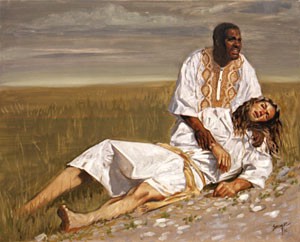
But let me start with the Samaritan story. From there I’ll circle around Easter and Passover and back to Edwina Gateley. But let me begin where we began, with the Samaritan’s Story because the story of the Good Samaritan is the essential teaching of Jesus. This is important and if nothing else connects for you today, let this be your one ‘take away’: The Good Samaritan story is the central message of the religion of Jesus. He says, “You shall love the Lord your God with all your heart, and with all your soul, and with all your strength, and with all your mind; and you shall love your neighbor as yourself.” And then to illustrate that point, we hear the Samaritan Story. A man gets beaten by robbers, a priest and a Levite refuse to help and then a dreaded Samaritan steps up and offers the needed assistance. The lesson is: be like the Samaritan.
There is an interpretation of the Good Samaritan story that I want to argue against, as a setup to tell you about an interpretation that I think is very helpful. There is an interpretation that says the Jewish religious leaders were bad. By this interpretation, Jesus was telling us about how awful these elitist priests and Levites were because they were so worried about ritual purity. There were religious laws about keeping yourself clean before performing ritual, and touching that beaten man would have defiled them ahead of the rituals. Being so worried as they were about laws around the rituals, they miss the greater law of love!
But that interpretation misses something important. Aileen was showing me a Jewish interpretation that talked about how the Samaritan story is using a common trope in the Jewish storytelling from that time period which we might recognize today as a version of the rule of three. There were a bunch of stories back them in which first a priest walks by, then a Levite, and finally an Israelite. This was a common trope back then. People back then would have recognized what Jesus was doing after hearing about the first two characters. They expected the third character to do the right thing. What they didn’t expect was who the third person would be. It’s supposed to be an Israelite. It’s supposed to be someone the hearer will identify with. “Oh, that’s like me, I’m an Israelite.’
What Jesus does is subvert the ending. The important part of the story is the identity of last person, not the first two. The first two are not mentioned for the purpose of being disparaged. They are mentioned to set up the expectation which is then subverted. Israelites and Samaritans at that time were like Palestinians and Jews today, like Republicans and Democrats today, like neo-Nazis and black people. They were in deep conflict each other. But according to the trope, the hearer is supposed to identify with the third character, that’s how the story trope works. Jesus adds a twist, a surprise to the usual trope. We’re all listening along, we know where this story is headed, and suddenly it is not what we expected. What Jesus does is subvert the ending.
You may know another story where Jesus does that. It’s Easter today. The Easter story does this as well. We’re all listening along. Jesus starts doing his thing, healing people, performing miracles, challenging the Roman oppressors and the corrupt religious leaders … and we know what’s coming next.
He gets arrested, he goes through a trial which is a bit of a farce, he is put to death. It’s happened before, it happened to so many people back then. It’s still happening in places around the world today. We recognize the story line, it’s how tyrannical governments work, it is how oppressive systems keep the dissidents in check. It’s the playbill of every dictator through the ages.
But then something else happens, Jesus subverts the ending. Easter is the twist ending, the subverting of the expected narrative. The resurrection is not what normally happens. Somehow, hope continues. Somehow, death is not the final answer. I know most of the people gathered do not believe in the literal resurrection of Jesus. I also know a few of the people here gathered do. I’m not suggesting we limit this conversation to doctrines and beliefs and who is right and who is wrong. Sometimes truth is a bigger issue than the question of ‘did it really happen?’ Sometimes truth is found in asking what does this story mean? and does it help me be a better person?
Now, hold that thought! Because if the Easter story does not connect for your spirituality, let me circle around to Passover. To understand Jesus, it is important to first understand the Jewish context of his message. Last month I attended Jewish Seder meal for non-Jews. It was hosted jointly by Temple Concord and Temple Israel with support from the Children of Abraham interfaith group. We had a Jewish host at each table to help explain the elements and the rituals. Passover began this past Friday evening at sundown. Judaism’s story of Passover is a story of liberation and freedom.
It is a time when Jewish people remember what it was like to be slaves in Egypt. It is a time to seek liberation for all those in bondage today “for we remember” the people recite in the Haggadah. “We remember what it was like to be slaves.” It is a call to treat the foreigner and stranger with dignity and compassion, for we have been foreigners and strangers ourselves.
And isn’t that essentially what the Samaritan story is all about? Treat the foreigner and stranger with dignity and compassion is simply another version of ‘Love your neighbor as yourself.’
Passover, which began this weekend, is the story of freedom and liberation of the Jewish people; it is also the call to seek freedom and liberation for others. Easter is today; it is a story for every soul that ever faced the tragic choice of love and hopelessness in the face of the world’s madness. It is a story that says even if we feel beaten down, abused, denied, and overlooked – something unexpected can still rise.
Tell them, Jesus says, to rise with me. In the poem by Edwina Gateley, we hear Jesus imploring Mary. Tell the people to rise with me. This is not just a story of something that happened thousands of years ago. It is happening today. It is our story too. Ask yourself: Who is in my path? Who should I help now? Rise. Reach out and help your neighbor. Show your compassion – that is the heart of the Easter message, Rise. Rise.
In a world without end, may it be so.
A Samaritan Easter

“A Samaritan Easter”
Rev. Douglas Taylor
A multi-generational Easter worship service rooted in the parable of the Good Samaritan. Also, it was Passover and nearly Earth Day, reflections upon those holidays are included.
Welcome and Announcements
Good morning. Welcome to the _____ Unitarian Universalist Congregation where we join together in the search for deeper meaning and richer connections. Our service today is about Jesus’ message of the Good Samaritan, the central message of Jesus.
Egg #1 (see note at bottom of this script)
Passing the Peace
Prelude Choir
Opening Words ee cummings
(Note: we did this in three voices, it is equally delightful with one dramatic voice)
A i thank You God for most this amazing day:
B for the leaping greenly spirits of trees and a blue true dream of sky;
A and for everything which is natural which is infinite which is yes
B (i who have died am alive again today,
A and this is the sun’s birthday;
B this is the birth day of life and of love and wings:
A and of the gay great happening illimitably earth)
B how should
A tasting touching hearing seeing breathing
B any
A –lifted from the no of all nothing—
B human
A merely
B being doubt unimaginable You?
A (now the ears of my ears awake and
B now the eyes of my eyes are opened)
*Doxology (#381 SLT) Composite based on Isaac Watts
From all that dwell below the skies
Let songs of hope and faith arise;
Let peace, goodwill on earth be sung
Through every land, by every tongue
*Covenant (#473 SLT) by James Vila Blake (adapted)
Love is the spirit of this congregation, and service is its life.
This is our great covenant: to dwell together in peace,
To seek the truth in love, and to help one another.
Chalice Lighting by Elizabeth Strong
We light this chalice to remember the sorrow, the loss, and the joy that are within this season of the year.
The Passover, that brought freedom from slavery and bondage for the Jewish people, continues to bring light into the world.
Palm Sunday, Good Friday, and Easter, that brought joy and the triumph of life over death for the Christian people, still bring the light of that joy to the world.
The spring equinox, that brings new life bursting forth on the land each year, brings lengthened days of sunlight to all life.
Passover for freedom, Easter for life, spring for rebirth.
We light our chalice for all three.
(Light the chalice)
Hymn (#38 SLT) Morning Has Broken
Egg #2
Story ‘The Good Samaritan” Luke 10:25-37 (NASB)
(adapted from “ministry-to-children.com”)
Note: We called for 6-8 people to come forward to help dramatize the story. We had some simple costumes and offered very general staging instructions. This took about 2-4 minutes to organize in the moment.)
Characters
Jesus – speaking part -liturgist
Lawyer / man – speaking part -minister
Robbers (at least 2) – non-speaking part
Priest – non-speaking part
Levite – none-speaking part
Samaritan – speaking part (line written
out on cue card)
Innkeeper – non-speaking part
(Jesus and Lawyer stand to the side of the stage while others are at the other side of the stage)
Jesus (to congregation) – A lawyer stood up and put Jesus to the test.
Lawyer – Teacher, what shall I do to inherit eternal life?
Jesus – What is written in the Law? How does it read to you?
Lawyer – You shall love the Lord your God with all your heart, and with all your soul, and with all your strength, and with all your mind; and your neighbor as yourself.
Jesus – You have answered correctly; do this and you will live.
Lawyer – And who is my neighbor?
(lawyer becomes ‘man’; enter robbers)
Jesus – A man was going
down from Jerusalem to Jericho, and fell among robbers, and they stripped him
and beat him, and went away leaving him half dead.
(robbers can pretend to hit the man and the man can fall down like he’s really hurt)
(exit robbers – enter priest)
Jesus – And by chance a priest was going down on that road, and when he saw him, he passed by on the other side. (priest can make sure that he goes far away from the man)
(exit priest – enter Levite)
Jesus – Likewise a Levite also, when he came to the place and saw him, passed by on the other side. (Levite can make sure that he goes far away from the man)
Jesus – But a Samaritan, who was on a journey, came upon him; and when he saw him, he felt compassion, and came to him and bandaged up his wounds, pouring oil and wine on them; and he put him on his own beast, and brought him to an inn and took care of him.
(Samaritan can take good care of the man and bring him to the opposite side of the stage from where Jesus and the Lawyer is standing)
(enter innkeeper at the inn)
Jesus – On the next day he took out two denarii and gave them to the innkeeper.
Samaritan – Take care of him; and whatever more you spend, when I return I will repay you.
(innkeeper can nod in agreement – then exits)
Jesus – Which of these three do you think proved to be a neighbor to the man who fell into the robbers’ hands?
Lawyer – The one who showed mercy toward him.
Jesus – Go and do the same.
—
Egg #3
Offertory
Egg #4
Prayer
Eternal Spirit
From whom all things come and to whom all things return
We who gather this morning are a people of faith in search of life’s deeper meanings and richer blessings. This is a sacred time for many of our religious siblings around the world. We would honor the stories and the meaning they find in this season, while striving to uncover resources for ourselves as well. We hold that in each of our neighbor’s religions there can be found deep understanding and life-giving truth.
We hear the story of a Samaritan, a story of how we could lead our lives with kindness and compassion toward others. We hear the story and know deep in our bones that this story is a lesson we need to keep hearing, to keep taking in, to keep trying to live out.
And in this Samaritan story we hear the echoes the larger stories of the season. In this Samaritan story we hear the echoes of our modern day lives. May our hearts be opened anew through this old story of compassion.
When we feel lost and abandoned, O Spirit, visit us and renew our faith
When we are fearful, endow us with courage
When we face painful trials, grant that we may see the possibility of new life born again within
Grant that the blessings of compassion and wisdom fill our days beyond measure. Encourage us in our times of hardship to discover anew the power within to embrace again the world and the work which yet awaits our attention. In learning to let go, to trust both ourselves and unexpected kindness, may we uncover the hidden reservoirs of hope.
This we pray in the name of all that is holy
May it be so
Amen
Silence
Meditative Hymn (#396 SLT) I Know This Rose Will Open
Egg #5
Reading Tell Them By Edwina Gately
Breaking through the powers of darkness
bursting from the stifling tomb
he slipped into the graveyard garden
to smell the blossomed air.
Tell them, Mary, Jesus said,
that I have traveled far
into the darkest deeps I’ve been
in nights without a star.
Tell them, Mary, Jesus said,
that fear will flee my light
that though the ground will tremble
and despair will stalk the earth
I hold them firmly by the hand
Through terror to new birth.
Tell them, Mary, Jesus said,
the globe and all that’s made
is clasped to God’s great bosom
they must not be afraid
for though they fall and die, he said,
and black earth wrap them tight
they will know the warmth
of God’s healing hands
in the early morning light.
Tell them, Mary, Jesus said,
smelling the blossomed air,
tell my people to rise with me
to heal the Earth’s despair.
Anthem Choir
Egg #6
Homily by Rev. Douglas Taylor
Tell them to rise with me, Jesus says in the poem by Edwina Gateley. Tell the people to rise with me.
But let me start with the Samaritan story. From there I’ll circle around Easter and Passover and back to Edwina Gateley. But let me begin where we began, with the Samaritan’s Story because the story of the Good Samaritan is the essential teaching of Jesus. This is important and if nothing else connects for you today, let this be your one ‘take away’: The Good Samaritan story is the central message of the religion of Jesus. He says, “You shall love the Lord your God with all your heart, and with all your soul, and with all your strength, and with all your mind; and you shall love your neighbor as yourself.” And then to illustrate that point, we hear the Samaritan Story. A man gets beaten by robbers, a priest and a Levite refuse to help and then a dreaded Samaritan steps up and offers the needed assistance. The lesson is: be like the Samaritan.
There is an interpretation of the Good Samaritan story that I want to argue against, as a setup to tell you about an interpretation that I think is very helpful. There is an interpretation that says the Jewish religious leaders were bad. By this interpretation, Jesus was telling us about how awful these elitist priests and Levites were because they were so worried about ritual purity. There were religious laws about keeping yourself clean before performing ritual, and touching that beaten man would have defiled them ahead of the rituals. Being so worried as they were about laws around the rituals, they miss the greater law of love!
But that interpretation misses something important. Aileen was showing me a Jewish interpretation that talked about how the Samaritan story is using a common trope in the Jewish storytelling from that time period which we might recognize today as a version of the rule of three. There were a bunch of stories back them in which first a priest walks by, then a Levite, and finally an Israelite. This was a common trope back then. People back then would have recognized what Jesus was doing after hearing about the first two characters. They expected the third character to do the right thing. What they didn’t expect was who the third person would be. It’s supposed to be an Israelite. It’s supposed to be someone the hearer will identify with. “Oh, that’s like me, I’m an Israelite.’
What Jesus does is subvert the ending. The important part of the story is the identity of last person, not the first two. The first two are not mentioned for the purpose of being disparaged. They are mentioned to set up the expectation which is then subverted. Israelites and Samaritans at that time were like Palestinians and Jews today, like Republicans and Democrats today, like neo-Nazis and black people. They were in deep conflict each other. But according to the trope, the hearer is supposed to identify with the third character, that’s how the story trope works. Jesus adds a twist, a surprise to the usual trope. We’re all listening along, we know where this story is headed, and suddenly it is not what we expected. What Jesus does is subvert the ending.
You may know another story where Jesus does that. It’s Easter today. The Easter story does this as well. We’re all listening along. Jesus starts doing his thing, healing people, performing miracles, challenging the Roman oppressors and the corrupt religious leaders … and we know what’s coming next.
He gets arrested, he goes through a trial which is a bit of a farce, he is put to death. It’s happened before, it happened to so many people back then. It’s still happening in places around the world today. We recognize the story line, it’s how tyrannical governments work, it is how oppressive systems keep the dissidents in check. It’s the playbill of every dictator through the ages.
But then something else happens, Jesus subverts the ending. Easter is the twist ending, the subverting of the expected narrative. The resurrection is not what normally happens. Somehow, hope continues. Somehow, death is not the final answer. I know most of the people gathered do not believe in the literal resurrection of Jesus. I also know a few of the people here gathered do. I’m not suggesting we limit this conversation to doctrines and beliefs and who is right and who is wrong. Sometimes truth is a bigger issue than the question of ‘did it really happen?’ Sometimes truth is found in asking what does this story mean? and does it help me be a better person?
Now, hold that thought! Because if the Easter story does not connect for your spirituality, let me circle around to Passover. To understand Jesus, it is important to first understand the Jewish context of his message. Last month I attended Jewish Seder meal for non-Jews. It was hosted jointly by Temple Concord and Temple Israel with support from the Children of Abraham interfaith group. We had a Jewish host at each table to help explain the elements and the rituals. Passover began this past Friday evening at sundown. Judaism’s story of Passover is a story of liberation and freedom.
It is a time when Jewish people remember what it was like to be slaves in Egypt. It is a time to seek liberation for all those in bondage today “for we remember” the people recite in the Haggadah. “We remember what it was like to be slaves.” It is a call to treat the foreigner and stranger with dignity and compassion, for we have been foreigners and strangers ourselves.
And isn’t that essentially what the Samaritan story is all about? Treat the foreigner and stranger with dignity and compassion is simply another version of ‘Love your neighbor as yourself.’
Passover, which began this weekend, is the story of freedom and liberation of the Jewish people; it is also the call to seek freedom and liberation for others. Easter is today; it is a story for every soul that ever faced the tragic choice of love and hopelessness in the face of the world’s madness. It is a story that says even if we feel beaten down, abused, denied, and overlooked – something unexpected can still rise.
Tell them, Jesus says, to rise with me. In the poem by Edwina Gateley, we hear Jesus imploring Mary. Tell the people to rise with me. This is not just a story of something that happened thousands of years ago. It is happening today. It is our story too. Ask yourself: Who is in my path? Who should I help now? Rise. Reach out and help your neighbor. Show your compassion – that is the heart of the Easter message, Rise. Rise.
In a world without end, may it be so.
Antiphonal Reading: “We Believe in Life”
Liturgist: In the days and weeks ahead,
Congregation: May we remember our courage and our faith
Children: We believe in Life
Liturgist: The Passover story reminds us of the struggle for freedom, and the promise leading us into the journey
Congregation: May we have courage and strength through the struggle
Children: We believe in life
Liturgist: The Easter story reminds us of the transformative power of love, and hope leading us onward
Congregation: May we have faith and trust through adversity
Children: We believe in life
Liturgist: Let these holy stories remind us that love is strong than death, & that a path to freedom, though fraught with difficulty, is open to us.
Congregation: May we be inspired to live our lives with courage and with faith
Children: We believe in life
Egg #7
*Closing Hymn (#269 SLT) Lo the Day of Days Is here
Chalice Extinguishing (#456 SLT) (Unison) by Elizabeth S. Jones
We extinguish tis flame, but not the light of truth,
The warmth of community, or the fire of commitment.
These we carry in our hearts until we are together again.
Egg #8
Benediction by William Murry
Now let us go forth with the faith that life is worth living, that defeat and adversity can be transformed into victory and hope, that love is eternal, and that life is stronger than death.
And may that faith inspire us to live out lives with dignity, love, and courage in the days and weeks ahead.
Postlude
—
Eight plastic Easter Eggs each with one of these small stories inside:
During the service, when it calls for an egg, we would step out with the basket
and ask for a volunteer to come open one and read it. We gave preference to
children.
(Prep note: 6 weeks earlier we had proposed a ‘Kindness Challenge’ to the congregation. “Notice the small kindnesses you give and receive over the next month,” we said. “Write a few sentences about it and send it to us at the church office,” we requested. Upon receiving the small stories, we paraphrased them and made them anonymous.)
—
Many years back I remember having a terrible time at work, it stretched for weeks. At one point a coworker came up and patted me on the back, smiled and said something encouraging I no longer recall. But I’ve always remembered how that small act of kindness made all the difference in the world to me.
—
My kindness report: I was given a gift of a bag of yarn from a friend. She was happy to get rid of it I think, but it was so wonderful for me because I love knitting.
—
This is actually two stories. A few decades ago, my wife and I helped a friend get out of a bad relationship by selling her a car for whatever pocket change she had in her purse at the time. It helped her get away from the abuse and change the path of her life. Fast forward to this past year, my car was dying and I was having trouble finding the funds to get another vehicle. A fellow congregant overheard my trouble and offered me a sum of money there on the spot. I am deeply moved by this person’s generosity every time I think about it. I’ve been on the giving and receiving end of this kindness. It is truly amazing.
—
I haven’t bestowed much kindness to others over the past month, between my illness and a family situation, but what I have received has been truly amazing – – flowers, cards, hugs, emails, invitations to talk over coffee. How wonderful.
—
A friend has been going through something very difficult. I wanted to help but felt there was nothing I could do. I sent a simple message letting them know I wanted to help but didn’t know what to offer. We met and talked for a bit. I’ve followed up like that as things continue to be difficult, just keeping the conversation going. I didn’t really help, just offered comfort and a listening ear.
—
I have developed the habit of paying attention to strangers when I’m out in public. It’s not hard to see when someone is having a hard day. I have stopped strangers and said, “You look like you could use a hug. I’ll give you one if you’d like.” It is amazing how often people respond with appreciation and even tears.
—
I have been helping a neighbor deal with a problem with their mail. They have so much they have to deal with for their health and other things. It is a small act of kindness I can do to help.
—
I needed cilantro for a recipe I was making for dinner. In the produce section of the supermarket there was only one bunch left and I was lucky enough to grab it. Then I noticed a woman next to me with many children in tow. It became obvious to me that she too needed cilantro, and though she looked we both know there was no more loft. I know I was not going to need all the cilantro in the bunch so I unbundled it and gave her half.
Racism in Religion

Racism in Religion
(The Promise and the Practice)
Rev. Douglas Taylor
4-14-19, UUCB
A member of another Unitarian Universalist congregation shared with me a story many years ago. His story is about one of those visits from a religious proselytizer bringing news about God, truth, and how to be a better person by converting to the visitor’s religion. Early in the conversation, the visitor pulled out a picture of a family with a stunning mix of ethnicities saying this is the promise of the future: black, white, Hispanic, Asian, and more – all together as one family of believers. The visitor spoke in glowing terms about what might be possible if we all become one people of belief, practicing one religion together.
At this point, the Unitarian Universalist stepped away from the door for a moment and returned with a very similar photograph with one significant distention: The man holding the photograph was in the picture. The visitor was surprised and disbelieving, “Where did you get such a photograph?” I no longer remember the exact details of the family and the photograph but essentially through a previous marriage and an adoption, all three of his children were of different ethnicities. And the three adult children now lived around the world and had married into the different communities where they lived, so the grandchildren were also of various races and ethnicities. The photo had been taken when the whole family had come home to Minnesota for Christmas.
What the visitor’s picture offered was the promise of a multi-ethnic and racially diverse future. What the other photograph offered was the practice of a multi-ethnic and racially diverse present-day reality. When I reflect upon the promise and the practice of Unitarian Universalism in regards to Anti-racism and Multiculturalism, this story comes to mind. When I reflect on myself with regard to this same promise and practice, this story also comes to mind. And I think about why I feel the need to reach for this experience of diversity and Anti-racism. Why does it matter?
In the story, the visitor wanted that racially diverse reality for religious reasons. The visitor was explicit about it: this is the future to which God calls us. In other words, we should be Anti-racist because of our religious beliefs. As for the Unitarian Universalist Minnesotan who told me this story many years back, I’m not sure why it mattered to him. I didn’t think to ask at that time. I would guess he wanted that racially diverse reality simply because he loved his family, or because he’d been taught as a child to see past a person’s skin color, or maybe he had travelled the world when he was younger and thus his sense of identity was more global … I don’t know.
What would be your reason? I don’t want to assume that every one of you here this morning is committed to that vision of becoming an anti-racist, multi-ethnic, racially diverse community … Actually, I do want to assume that … but I’ll ask the question this way just in case. What would be your reason for wanting such a community?
There could be any number of reasons. I don’t think it is necessary to say one reason is better or more noble than any other. I just think it’s important to know why you care about something. I think it’s worth investigating.
You may want to be Anti-racist and be part of a diverse community because you are a person of color and my goodness it would be a relief to worship and belong in such a community. Or because most of your family is already racially diverse and becoming anti-racist or belonging to more racially diverse communities is where you are more naturally drawn. Or because you feel it is the politically-correct response given the current political climate, and you like to be on the right side of history. Or because your religious beliefs lead you to recognize racism as a sin, as separation from God and your siblings in faith. Or because you are outraged that a basic request for police to stop harming and killing black people without cause has been met in our culture with a bizarre fetishization of the police instead of with common sense. Or because spiritually you are yearning for wholeness and this is an obvious aspect of your life where you can put your spiritual energy to make a difference. Or because you are stirred up by the injustices and inequality you see and want to do your part to make it better.
Why are you interested in moving from the promise into the practice? Why are you involved in this Anti-racism and Multiculturism work? Why are you showing up for a worship service about grappling with White Supremacy?
For me, I will cast my vote as someone who does this for religious and spiritual reasons. I believe we Unitarian Universalists have a calling to become the Beloved Community, to use our penchant for pluralism to keep expanding the circle of welcome to include all humanity. And spiritually, I have found I am nurtured by difference and diversity. Spiritually, I come closer to wholeness when I can encourage and be encouraged by those who are necessarily like me.
As I mentioned the phrase a few paragraphs back, I’ll circle back for a moment and spend a few minutes on it. The phrase “White Supremacy” seems to trigger some people negatively. Some folks take issue with the phrase. We had a big “White Supremacy Teach-In” two years back and since then, throughout Unitarian Universalism, the phrase keeps popping up.
“I’m not a white supremacist!” You may be one of the people who experiences a reaction to the phrase, “I don’t wear bed sheets and burn crosses in people’s lawn.” Okay. Did you know that many people in Nazi Germany were not Nazis? They were just caught up as German citizens in the culture around them. So it is with the culture of white supremacy.
I’m not calling anyone here a white supremacist. What I said – specifically in the promotional description of this sermon – is this: “Unitarian Universalism is grappling mightily with institutional racism and the culture of white supremacy.” You may want to distance yourself from it. You may want to say, “That has nothing to do with me.” Unfortunately, no one gets to do that. We can choose how we respond to it; we can ignore it, we can enjoy it, we can fight against it, we can seek to transform it. The one thing we can’t do it not be part of it. The culture we live in is like the water a fish swims in.
If the description of our culture as ‘white supremacy’ makes you uncomfortable, I suggest you spend more time, not less, figuring it out. You don’t need to take it personally. As a person whose identity aligns considerably with the dominant culture, I have learned to be okay with that particular discomfort. I use it as fuel to pay better attention to the stories of oppressed.
Earlier this week, I was talking with today’s Worship Associate Karen about the topic. We were circling around to some good starting points for the congregation and it occurred to me … we’ve actually started this conversation so many times over the past dozen years or so. We’ve had guest speakers and special programs, instigating sermons and classes led by staff and lay-people.
We brought in Thandeka for a day-long workshop and a few years later we had Mark Morrison-Reed here for a weekend leading a workshop, preaching, and promoting his history books. A little after that Matt Meyers was here with a workshop on music and culture. We’ve done several workshops and classes: that White Supremacy Teach-in two years ago, Robin DiAngelo’s video about White Privilege, discussions on Michelle Alexander’s book about “The New Jim Crow” and Ta-Nehisi Coates’ book “Between the World and Me.” We’ve had the speaker, the book, the class, the workshop, the sermon. Now what?
As we heard in DeReau K. Farrar’s reflection https://smallscreen.uua.org/videos/a-parable-of-privilege-by-dereau-farrar-for-the-promise-and-the-practice, now is not the time for us to sit back thinking “Well done good and faithful Social Action Advocate.” No. Now is the time to go deeper. To build on what has been, creating something sustaining and fulfilling.
Over the past two years I’ve been nurturing some deeper connections with the Christian clergy in the area. I’ve been part of a group called MICAH – Moving in Congregations, Acting in Hope. We are a mix of clergy and lay people, white allies and people of color. We’ve done a class on racism together, we hosted a movie discussion, we sat down with the mayor to talk about the downtown area. In February, we had a big ecumenical worship service about Racial Unity. We brought in the Dorothy Cotton Jubilee Singers from Ithaca. Aileen and I each had a part in the service. Two other people from this congregation showed up, which was disheartening. But by and large, the event was – for many people from many communities – an amazing starting point into the conversation that a handful of us have been having for a while.
Let’s do more than start again. Let’s do more than begin the conversation once more. We can re-form the anti-racism task force as one of the new Social Action Teams. I’ll start a list for you to indicate interest in doing something more with this conversation.
At the beginning of this sermon I asked you to think about why you show up for a sermon like this. Why are you drawn to become an anti-racist and to help build a diverse community? Recognizing that it is uncomfortable, recognizing that there is a good deal of brokenness in the past and probably a lot of heartbreak coming still as we move forward, recognizing it is hard, it is important you and I be able to name why we feel compelled to jump in to this work. I’m in it because I am called to build Beloved Community and because my spirit longs to be more whole. Why are you leaning in?
If we want justice to roll, we need to get in there and roll with it. We need to join that mighty stream and take part in what’s going on. Now is the time for us to do more than just start the conversation again.
I’m in it because I want to be whole. I want to pour gold into the cracks of my spirit, the cracks of my faith, the cracks of my country; and bring something both beautiful and functional back to the table. My spirit longs to be part of that healing conversation so that we can then fill that broken bowl to overflowing. I invite you to join with me as we bring our practice into closer alignment with the noble promise of our faith.
In a world without end,
May it be so.
The Masks We Live In

The Masks We Live In
Rev Douglas Taylor
3-17-19
A few months ago, back in the fall, Bill Thorpe spoke from this pulpit about the power masks have to conceal and also to reveal aspects of ourselves. Sometimes we try on ways of being even though it is not (or not yet) our real selves. Over the years I have often talked about wanting to create space here for us to become our better selves, our more authentic selves. Masks hide our faces. And, as Bill Thorpe shared back in the fall, this is not good or bad, it just is a way for us to be in the world, a way to step into certain experiences.
Today, however, I do want to talk about the negative aspects of the masks we wear. And in particular, the masks men wear and how that impacts all people. Those masks men wear sometimes are hyper-masculine and harmful.
The term ‘toxic masculinity’ has grown in prominence lately. My awareness of the term has paralleled by awareness of the #metoo movement as if the two pieces of social commentary are entangled. Masculinity itself is good, but there is a toxic version that perpetuates harm. That’s what I want to talk about today, the mask of toxic masculinity.
A few years ago, I had someone here in the congregation stop me after a program or event and ask if I might consider offering a class for men on how to be a feminist.
Most of the time, feminism is considered to be obviously a women’s issue and of interest to women. Most progressive women have a positive opinion of feminism – of course depending on various definitions of what feminism is. Generally, I think in terms of an early, classic definition that feminism is about supporting equal rights and equal access to opportunities for women.
I remember being a teenager and thinking to myself, ‘yeah, I’m a feminist. I think women and men are equal.’ I was flummoxed by the notion that the definition of a feminists was someone who thought women were superior to men. To me, that just sounded like someone was trying to flip the old concept saying someone has to be better. That’s nobody’s definition of feminism unless you’re trying to argue against feminism.
I was raised by the women in my family. I am the youngest of four. My parents separated when I was four and divorced two years later. My older brother was distant and then absent as well when I was growing up. Part of my story is the story of alcoholism, but over the years I have come to understand how my upbringing has impacted my understanding of gender roles. I was raised by my mother and my two sisters.
Have you ever bumped into a tough woman who credits having been the youngest raised by a family of boys? I lived the reverse of that cliché. Early on I noticed how our society has grown to value masculine girls and women but not feminine boys and men.
What really cracked things open for me and allowed me to take a significant step toward wholeness was a class in Family Systems I took while in seminary. One task for this course was to build a genogram, which is like an annotated family tree. You draw a chart showing the relationships up and down the generations, and then you add commentary and extra symbols to show more information. Who had close relationships, who was distant? Where are the family secrets, what are the patterns?
One particular insight I found is relevant to this conversation about men and feminism. I discovered that I had distanced myself from the men in my family. One layer of detail I put on my genogram was that the women in my family tree tended to be teachers while the men in my family tree tended to be alcoholics … as if those two categories were mutually exclusive! Until I saw it on my paper, I had not seen the way I had put people from my family into these categories in my mind. And, ministry, in my mind, was in keeping with the trend of teachers, thus the women in my family.
I began to notice that it wasn’t just teaching, but other qualities I emulated. I didn’t identify with many of the traits and characteristics I saw in the other men in my family. I had, as you might reasonably expect, done all I could to not identify as an alcoholic, as violent, as unpredictable, unreliable, dangerous, angry, and aggressive. I had also done all I could to not identify as strong, charismatic, charming, powerful, protective, or loud.
Now, I’ve been through some therapy and I’ve processed a lot of this over the years. I’ve had some very profound conversations with my father. Through insight, grace, and forgiveness, I’ve done a lot of work. My point for today is that I actively practiced my way into traits that I’d labeled in my head as masculine. Traits, I will add, that society encouraged me to label as masculine. They didn’t happen naturally. I choose them.
I’ve worked at having a strong balance of both masculine and feminine aspects in my identity. And I will step back a moment here and clarify that I am not talking about my gender identity vis a vis the experience of being transgender. I identify as a cis-man. What I’m talking about is the set of traits and characteristics our society attributes to men or women such as protective vs nurturing, breadwinner vs homemaker, ‘does the dishes’ vs ‘changing the oil in the car’. That sort of stuff. Dare I say, the ‘stereotypical’ men’s sphere and women’s sphere of interest and control. Old school patriarchy stuff.
This is that mask of toxic masculinity I mentioned earlier = or least it leads to it. It is the mask that says men don’t cry and they don’t like the color pink. It is the mask that says men have license to use violence to protect and when nothing at the moment needs to be protected, they can use that violence for fun. It is the mask that says a man’s strength is his best quality and men are praised for how we dominate and lead. It is what led Margret Atwood to say, “At core, men are afraid women will laugh at them, while at core, women are afraid men will kill them.”
That is not the only way to be a man. And I am not the only one to suggest that this version of manliness is harmful to both women and men. Most of the people in my life see and resist toxic masculinity. Most of the people in my circle of connections are supporters of progressive values. Most people I know are even a few steps beyond so basic a concept, seeing and resisting various oppressions as they intersect.
The Equal Pay Act, for example, was passed as federal law in 1963. Of course, there have continued to be problems as recently as in the past ten years in the fight for equal pay. I just saw news that the actor Benedict Cumberbatch will only accept future movie proposals in which his female co-leads are being paid the same rate he is being paid.
I don’t watch television a lot but when I catch a show, I’m reminded how our society continues to sell us our gender roles with each getting special colors, scents, activities, concerns, and responsibilities.
People talk about a ‘pink tax’ as a way to show how women’s hygiene products tend to be priced up compared to similar men’s hygiene products. An obvious if ironic example is the Gillette razor for men vs the Venus razor for women (Gillette and Venus are the same company.) A quick check on line shows the pink razors are almost twice the price.
Gillette made their ad because they felt it would be profitable for them to do so, not because they wanted to stake out some higher moral ground or to sway public opinion. It really was, of course, all about sales. How many of you had seen or at least heard about the Gillette ad I played earlier in the service? https://www.youtube.com/watch?v=koPmuEyP3a0
It aired during the Superbowl a few months back. The response from many men was rather negative. How dare this razor company suggest that bullying is somehow a problem that men are particularly positioned to do something about. One of my favorite responses to the Gillette ad saying men can do better is #notallmen.
I want to be whole. I want balance. I want to choose what I like and what my interests are based on what I like and what interests me rather than my gender or genitalia.
There is a passage in one of Paul’s letters (Galatians; 3:28) where he says in Christ there is neither Jew nor gentile. In the full wholeness of the spirit, there is neither man nor woman. The life we live tends to be divided but there is a wholeness we are striving for. It is unfortunate that religion has a tendency to become a tool of social control and status quo. Religion has a way of perpetuating gender norms or the culture.
This is why there are books about finding the names of the women unnamed in the Jewish scripture. This is why there are seminars and discussions about the roll of women in Islam. This is why ordaining women has been an issue among Christians. Religion can become a tool to of social control. And ‘gender expectations’ is one of those powerful ways in which we are controlled.
But the spirit is not served by subservience or domination. The spirit is not served by one group being made inferior and another group claiming to be superior. No. The spirit is served by each person living as their most authentic self. The spirit is served by each of us having a choice of our masks until we arrive together in the day when no masks are needed.
So, go experience your life. Try the masks that seem to fit, that excite and enliven. Be wary of the masks that promise power through dominance and fear. Be wary of the toxic ones.
If you are looking for more healthy masks of masculinity, try being a man like Steve Erwin the Crocodile Hunter, or Bob Ross the painter, or Levar Burton who hosted the Reading Rainbow children’s program. There are a multitude of role models for men who lift up the positive aspects of masculinity for us to emulate. I will smile at myself here for a moment and notice that the celebrity examples I have chosen to lift up are all teachers.
There are many, many role models you can look to for yourself, find the ones you respect. Try on a few masks. Choose your masks with care. And know that the Spirit calls us toward wholeness.
In a world without end,
May it be so.

