
Beatific Vision

Beatific Vision
September 30, 2018
Rev. Douglas Taylor
Let me tell you about my vision.
First, let me tell you a story. As part of the process of becoming a minister, we take a battery of psychological inventories, personality styles, leadership styles, conflict styles; this includes the classic MMPI-2. I was part of a group weekend event, and at one point I was talking with another young man from an evangelical tradition. He had just come out of the big interview with the Psychologist where they talk with each of us about the flags that come up in the inventories and assessments. He was shaken. He complained about one question in particular. The question asked, ‘Do you see things that others do not see?’ My friend had answered “yes.” The psychologist leading the interviews flagged that as a concern.
“You don’t understand,” my friend said to me after, I imagine, a frustrating conversation with the psychologist. “In my tradition, it is expected. I’ve seen the Beatific Vision! If I don’t have a vision of God’s Kingdom, how am I supposed to lead the people into it? Of course, I see something others do not see. That’s why I am going into ministry!”
I’ve carried that conversation with me these past two decades; thinking about what I see, what I am wanting the world to see, trying to show others what we can be together as people of faith. That conversation with my friend about his misinterpretation of the MMPI-2’s question (or the misinterpretation of his answer,) was not the first or last time I’ve had this concept brought to my attention, but it is the most memorable.
So, from time to time I ask myself, “What is my vision for our congregation? What do I see that others perhaps do not see?” This practice of asking myself this question has shaped my ministry over the years.
In his essay, “Natural History of Intellect,” Ralph Waldo Emerson commented on this sort of experience. Emerson, you may recall, had been a Unitarian minister before launching himself as an essayist and lecturer for the transcendentalist movement. He wrote:
What is life but the angle of vision? A man is measured by the angle at which he looks at objects. What is life but what a man is thinking of all day? This is his fate and his employer. Knowing is the measure of the man. By how much we know, so much we are.
Or as Sue Monk Kidd has said: “We become what we pay attention to.” Or, to put even more mundanely, “We are what we eat.” “What is life but the angle of vision?” So, let me tell you about my angle of vision, about what I have been paying attention to.
Let me tell you about my vision.
I see us becoming a living version of the Beloved Community. The vision I have for this congregation – although not exclusively for this congregation – is to live into the experience of being a community of justice, compassion, grace, and mercy. The details involve us engaging across our differences, being together in joy, serving needs beyond our walls, demonstrating resilience and grace to a world polarized and paralyzed by fear. “We become what we pay attention to.” “What is life but the angle of vision?” That’s what I am aiming for. That’s what I see, what I long for us to become.
Last week our Ministerial Intern, Aileen Fitzke preached about vision. She offered a quote from Jennifer Nordstrom’s book Justice on Earth about having a vision that I want to repeat in part: Nordstrom writes:
I hold a vision of Beloved Community beyond the horizon of my own knowing. In this community of human and nonhuman beings, we live with each other and the earth… We have diverse, flourishing cultures that cooperate with respect, and learn from one another without prejudice and hierarchy… We live in tune with the rhythms of our own hearts.
As a side note, I will share with you that Nordstrom’s book will be the UUA Common Read this year. Watch for an invitation from Aileen who has agreed to lead a discussion about the book alter this fall.
Dr. Martin Luther King Jr. spoke about Beloved Community a lot. I found a clear definition of King’s vision through The King Center in Atlanta GA, the memorial institution founded by Coretta Scott King to further the goals of Dr. King.
Dr. King’s Beloved Community is a global vision in which all people can share in the wealth of the earth. In the Beloved Community, poverty, hunger and homelessness will not be tolerated because international standards of human decency will not allow it. Racism and all forms of discrimination, bigotry and prejudice will be replaced by an all-inclusive spirit of sisterhood and brotherhood.
This idea of becoming a Beloved Community is deeply resonate across multiple religious and spiritual perspectives. The idea is not rooted in a concrete example from the past, instead it is more loosely based on the values we want to carry us into the future: Respect, Compassion, Justice, Decency, and Grace.
Now, I must warn you, this morning’s sermon is meant to be the Capital Campaign kick-off, my “Sermon on Amount,” that inspirational talking-to that gets us all in the mood to generously support the financial endeavors of the congregation – in particular: the Capital Campaign!
To accomplish the blending of an inspirational homily on money with all this talk of vision and Beloved Community, let me tell you another story.
Last week, as I mentioned a moment ago, Aileen Fitzke preached about vision. I sat near the back that Sunday. When it came time for the hymns I tried to not sing too loud. It is different singing up front as I usually do. Usually I try to sing a little louder so as to help lead the hymn, not to show off but to help everyone find their way into the song. But when I am in the congregation, in the back, I need to be quieter, to blend in rather than stand out.
I don’t need to stand out because our congregation is a ‘singing congregation.’ I have visited other congregations who do not sing the way we do. We are comfortable with singing. Other congregations, I can barely hear them singing above the sound of the piano or organ. I’m not knocking those congregations – they are amazing at other things. Here, music is important to us and we like to sing, we enjoy it and that shows.
I know there are some people in our congregation who are not great singers. There are some who do not sing when we do the hymns, or who mumble along, or just hum. And there are some here with professional training, some who sing in the choir regularly, some who sing solos, or play as guest musicians. We have a range of abilities and levels of participation – but as a whole, we are a ‘singing congregation.’
That’s what this Capital Campaign will be like for us.
Yes, we have some soloists, there will be large donors. Yes, we will have some guest musicians, we’ve already received a generous check from a former member. Yes, there will be a core group of people who, like the choir, do a lot of the giving because that is one way they can give and receive joy. The people who sing in the choir do so because they love to sing. They offer the gift of their voices and, for them, it is a gift to offer it. And… there are people for whom that is what it is like with money.
And … ours is a singing congregation. The singing is not done only by the song leaders and the choir. We all sing in our own ways.
The Capital Campaign began with a vision. The team asked us to dream a little. Then the team asked us to put a few particulars on paper. Over time we have pulled that dream closer to reality and practicality. And that has brought us to today. Tomorrow morning, we launch the official two-month focused portion of the years-long endeavor: the Capital Campaign – the actual raising of the pledges.
The Capital Campaign vision has narrowed into two stated goals. First, there is a dollar amount. We are aiming to raise one-and-a-quarter million dollars. Second there is a participation amount. We are aiming for 100% participation from members. I am paying attention to the second goal. That’s the one I care about.
If we reach that first goal and do not reach the second goal, if we raise the money but not everyone participates – we will have a big party and people will be happy… We will build and renovate this place into what we have been dreaming about … And yet … something will feel off. We will have reached the financial goal, but we will not have reached it together. It is not enough to raise the money if we miss the goal of full participation.
I would be far more comfortable reaching the second goal if we only get to reach one of them. Of course, I hope we reach both. Of course, I am going to do what I can to reach both the financial goal and the participation goal. But I want you to know which goal is my priority.
I want every member to be able to walk into the building after we’re done and be able to look around with pride and ownership. It is important to me that each one of us be able to look back and say “We did this.”
We have a variety of voices among us. Some will sing solos, many are in the choir. Some will only hum or mumble along. But all of us are in the song together. Ours is a singing congregation.
In our reading, Rev. Patrick O’Neill shared that when he visited the great Chartres Cathedral, he was amazed by the windows.
“These windows, many of them,” said my guide, “were given one mosaic at a time, piece by piece, coin by coin, by people who wanted to contribute something beautiful to last the ages.”
My vision is not about where we end up, but of how we get there. My visionary goal is not about a result, it is a about the process of arriving at that result. It is less about the amazing window and more about the “coin by coin.” Because, let me tell you about my vision: My vision is for us to live into a version of the Beloved Community together. And to do that, we can’t wait until after the Capital Campaign – that is how we have to do the Capital Campaign.
The only way to become a Beloved Community is to behave a little more each day as people living in a Beloved Community; cleaving to our values of Compassion, Justice, Decency, and Grace.
The only way we will accomplish this Capital Campaign is by doing it in integrity as the community we are and in alignment with the community we long to become. That means we will all move forward together: knowing that we each will take part as we are able, and also knowing that in the end we will have done this together.
In a world without end,
May it be so.
Healing Your Religious Past
 Healing Your Religious Past
Rev. Douglas Taylor
September 16, 2018
Think back to a belief you used to hold, maybe when you were a child, but that you no longer hold to be true. Call to mind, if you can, something you used to believe. Maybe it is about God or what it means to be human. Maybe it is about magic, or how sex or politics work, or the meaning of life or how you fit into it all. Call to mind a belief you used to hold, maybe when you were a child, but that you no longer hold to be true. (pause)
Got something in mind? Maybe? Okay. Hold that thought, we’ll come back to it.
There is a story we tell ourselves about Unitarian Universalism being a “chosen faith.” We say we are a discovered faith. We say that people find Unitarian Universalism and choose to join, typically after having grown up in a different tradition. There is a piece of this story that is deeply true about us and there are some ways that is it painfully inaccurate.
Just out of curiosity, by a show of hands here in the room this morning, how many of you were raised Unitarian Universalist? (Rough estimate from that morning: 10.) Which means everyone else either came to Unitarian Universalism from either a different religious background or no religious background, or you just don’t like voting – which is a different problem we can talk about next month.
A 1997 survey of Unitarian Universalists revealed that almost 10% were lifelong UUs. https://www.uua.org/data/demographics I am one of those 10% who grew up Unitarian Universalist. But for today, I want to sit with the old story for a few minutes, the one that is essentially true for the majority of Unitarian Universalists.
Over the years, I have noticed that Unitarian Universalism serves as a place of healing for people who have been wounded by the religion of their upbringing. And that is primarily who I have been thinking about as I prepared for this morning’s service.
“But Douglas,” you may be thinking, “I’m not one of those people. I have no hang ups about the religion of my childhood!” Okay, bear with me as I outline the basics of what we’re about this morning. There will be something for you as well; Something about what we keep and what we leave behind as we grow up religiously, as we mature spiritually.
Remember that belief you used to hold as a child or when you were younger? Take a moment and consider: What changed? What happened that you no longer hold that belief? Can you identify the circumstances in which you shifted from believing to not believing? (pause) Okay? Alright. Again, hold that thought – we’ll come back to it.
Back in August as I was setting up my preaching schedule and finding topics and themes, I was thinking about this sermon. It was at that time the report was issued about the massive Catholic cover up in Pennsylvania of child sexual abuse by more that 300 priests over a span of 70 years. https://www.nytimes.com/2018/08/14/us/catholic-church-sex-abuse-pennsylvania.html That, more than anything, is what sparked my thinking for this morning’s service.
I remember reading an essay posted online about it from an English Professor I know down at Penn State. She had grown up Catholic, but had left the Catholicism of her childhood. She and her wife had been members here for a few years before returning to Pennsylvania. She knew several of those priests in the report by name. She posted about it in an eloquent manner. https://threadreaderapp.com/thread/1029784097869193216.html
She had not, herself, been abused by the priests. Instead she wrote about the grief she was feeling. Grief for the communities the priests destroyed along with the particular lives they shattered. This former-Catholic was working through how to hold onto the good she’d received over her childhood from these priests while in no way condoning or excusing or forgiving the abuse. In condemning the abusive priests and the systemic cover-up, she refused to throw out all the blessings she had received from her childhood among them. That is not an easy nuance to hold.
I was reading a book about relationships by David Richo, When the Past Is Present. I was struck by how applicable some of the content was for this conversation. In particular, Richo talked about the four places fear catches us, four ways in which we get stuck.
David Richo’s book is about romantic relationships. I am talking about our relationships with organized religion, or in particular, the religious and spiritual communities we have belonged to over our lives. But it is interesting to consider the overlap.
Richo talks about the “Four Hurdles” as places we get stuck, ways in which we stop growing and end up simply recycling old patterns and trouble. The four hurdles are found in our recurring experiences of:
Coming and Going
Giving and Receiving
Being Accepted and Being Rejected
Letting Go and Moving On
You can check out the book for how this plays out in romantic relationships, When the Past Is Present. But for today, consider your experiences in religious communities. I don’t want to walk through all four, let me just talk about one of the four through this lens.
Consider how “giving and receiving” can present as either a way into deeper connection or as a hurdle for your spiritual or religious growth. Perhaps this is about money – how was giving and receiving of money handled? Perhaps this is about the sharing of power and authority, or participation in the sacraments and other ministries. Who was in control of the giving and receiving? What was your part, were you expected to only give or only receive? Do those experiences positively or negatively shade how you experience giving and receiving in this community?
The other hurdles (or opportunities) might be at play for your experiences instead. “Coming and going,” “Being accepted and being rejected.” “Letting go and moving on.”
Over the years, I have bumped into a lot of people who say they don’t like organized religion. Some of these people are here in the room right now. It seems to me, many of the stories I hear are tangled up with these four hurdles. And remember, I am not saying we Unitarian Universalists get these things right when others get it wrong. What we have going for us is our express desire to be open and accepting of people.
We could spend a fair while parsing this out, but perhaps that is something you can do in conversation with others later on, on in a class on this topic, or call me and set a time to work through something if you wish.
Many people come to Unitarian Universalism with wounds from their past experiences of religion. And … many come with the grace-filled experiences as well, experiences that nourish them still today even as they disbelieve the doctrines and rituals that framed those experiences. The experiences we carry from our childhood, good or bad, are ours forever. What we do with those experiences as we grow helps shape our capacity to navigate the troubled waters of today.
And I am not intending to single out Catholicism. I brought up a former members response to that news story about Catholic priests, but really that was one example among many. People find their ways into Unitarian Universalism from Judaism, Lutheranism, Mormonism, Fundamentalist Christianity, Jehovah’s Witness and other strict, dogmatic traditions. There is no monopoly on this. Truthfully, Unitarian Universalism has done its share of harm to people over the years as well.
And here is the nuance that makes this all real rather than merely a complaint against the wounds of our past. All of these traditions and communities have also offer positive experiences to people – perhaps to you – that we carry to this day; experiences that nourish us, that we yearn to recreate, that we turn to when we are in need.
I asked you earlier to think of a belief you no longer hold. I also asked you to think about why is changed. Now, I wonder if you can call to mind a nourishing experience – maybe from that same time in your life or maybe from another time. Is there something positive and precious you carry forward from a religion that is no longer your religion? Can you think of such an experience?
When Ferd Haverly and I were planning and talking about this service earlier this week as Worship Associate and Worship Leader, Ferd brought a particular reading to share. I didn’t see quite how it fit with my topic. But then he shared with my why he brought this reading. Then it made sense to me and it fit. I’ve asked him to share the reading, and his reason with you all.
In a moment I will read a prayer of praise and desire by Leonard Cohen taken from his Book of Mercy. I asked Douglas if I could read these mysterious words because they, like much of Cohen’s work, capture a spiritual sensibility that I find profoundly moving. They make me feel less alone – part of a shared pilgrimage into the holy.
Douglas’s sermon topic has helped me consider and better understand the Catholic roots of my spiritual interest and longing.
The seven-year-old boy having God placed on his tongue. The meditative transport of the rosary. Floating down George Street, a foot above the ground, after having my soul cleansed by Confession. Dissolving into the wonder of a Gregorian chant. Kyrieileison.
Deep, powerful, myth-laden rituals that will always be a part of me and, perhaps, make me more open to be moved by the mystical musings of Leonard Cohen. Words that echo my ongoing remembrance of, and longing for Holy Communion.
You let me sing, You lifted me up you gave my soul a beam to travel on. You folded your distance back into my heart. You drew tears back to my eyes. You hid me in the mountain of your word. You gave the injury a tongue to heal itself. You covered my head with my teachers care, you bound my arm with my grandfather’s strength. O beloved speaking, O comfort whispering in the terror, unspeakable explanation of the smoke and cruelty, undo the self-conspiracy, let me dare the boldness of joy.
-Leonard Cohen – Book of Mercy
It’s complicated. I think what we want is a way to heal from the wounds we may have received from the religion we no longer claim, but also to be able to carry forward the blessings we received from the past as well. And it is not easy to both love and hate what we have left behind.
Often when we have left one religion and find ourselves in another, we are asked to make a full break with all that had been. In Unitarian Universalism, we strive, instead, for integration; to acknowledge the good and the bad, to endure what has been that we may retain what is still precious.
Here is the heart of it all. Are there experiences that were positive and precious that you carry forward from a religion that is no longer your religion? The work is not only in letting go and moving on from the negative elements. It is also in knowing what you carry forward, maybe in simply recognizing there are positive things you want to carry forward.
In the end, it is less about why you left behind and all about what you still want carry. Even if you are one of the handful who never left, you still do well to know and name the nourishing pieces you carry forward as we create our version of a religious community together.
In a world without end,
May it be so.
Fake Fights and Healthy Conflict

Fake Fights and Healthy Conflict
Rev. Douglas Taylor
August 26, 2018
One of the reasons I attend the annual gathering of Unitarian Universalists known as General Assembly is for the great worship services. UUs gather once a year from across the country and around the world to conduct business, share programs, create a little justice, and do worship. One highlight is always the Sunday morning worship open to the public and attended by thousands of Unitarian Universalists.
My sermon this morning is inspired by the Sunday morning General Assembly worship service from two years back. In 2016, GA was in Columbus, OH and the preacher for Sunday was the Reverend Nancy McDonald Ladd. Her title was “In All Thy Getting, Get Understanding.” (https://www.uua.org/ga/past/2016/worship/sunday) The reading from this morning (https://www.uua.org/worship/words/reading/tapping-out-fake-fights) is an excerpt of that sermon.
She began the sermon with a personal story, with great humor and style, of a conflict she experienced as a child in the church where she grew up. She also shared the process of resolution for that conflict, offering it as a template for resolution in any conflict. In the reading, we mostly heard her concern about how we Unitarian Universalists waste our energy on fake fights while the real fight beckons.
What did she mean by this phrase ‘fake fight’? A great example I see that keeps popping up in the news is the “war on Christmas.” It is a fake fight. The debate between “Happy Holidays” vs “Merry Christmas” is a constructed complaint. Rev. Ladd said a fake fight usually conceals a real fight about our values and relationships. In this example, I would suggest the real fight concealed behind the trumped-up fight about “Merry Christmas” and “Happy Holidays” centers around the fear of conservative Christians that Christianity is losing its central seat in the religious life of our country. Perhaps you’ve heard the analysis recently that from a position of privilege, equality can feel like oppression.
It may be helpful to recognize Rev. Ladd’s analysis when you bump into something that feels like a fake fight to you. She said a fake fight often conceals a real fight about our values and relationships.
Where did you learn how to have a healthy fight? When were you given the resources for resolving conflicts in your life?
I did learn some useful skills in my family of origin, but it was a mixed bag. I imagine that is the case for most people. Growing up, my family was good a conflict avoidance, leaving things to simmer. I later learned this is a classic technique in a home touched by alcoholism. We simply denied the existence of the awful tension, hoping it would not explode. One useful skill I learned in that setting was some pretty subtle de-escalation skills.
Later, with some training in psychology in general and Family Systems in particular, I figured out how to have conflict rather than avoid it. And I discovered those childhood defense skills were also useful as relationship skills in healthy settings. Where did you learn how to have a healthy fight? When were you given the resources for resolving conflicts in your life? For me it was through some particular trainings and some reevaluation of what my family of origin taught me.
But conflicts are not just for families! Congregations and churches can have conflict too! Our congregation has periodically hosted a Healthy Communication class for our leaders. This class – and others like it – offer some of the techniques and skills for navigating conflict and differences. A lot of Healthy Communications work is rooted in Family Systems and Congregational Systems theory.
Ed Friedman was a rabbi, therapist, leadership consultant and author of several books including the seminal work on Congregational Systems Generation to Generation. He would say the trick to navigating conflict is to “stay connected while changing yourself.” He wrote,
“The colossal misunderstanding of our time is the assumption that insight will work with people who are unmotivated to change. If you want your child, spouse, client, or boss to shape up, stay connected while changing yourself rather than trying to fix them.” (A Failure of Nerve)
Start from your own integrity. Lean into the conflict, while staying centered and true to your integrity. The truism stands, “We cannot change others, only ourselves.” The ultimate responsibility of any leader or change agent is to take charge of yourself. The work is not to motivate, move, or manipulate others. Friedman said, “Stay connected while changing yourself.” That doesn’t mean giving in to whatever someone else wants. That means listening to what they want, hearing them, and then responding from your own centered position.
It is an art to disagree with someone and stay connected with them. Our consumeristic society does not encourage it. When we are constantly buying the next thing because we are dissatisfied with the old thing, it is easy for that attitude to seep into our relationship. The commercials bombard us with the upgrade, the improvement, the better version – they sell us dissatisfaction. Often what we are buying is a feeling that we are not enough or we do not have enough or our current product is not good enough. They sell dissatisfaction. Not every commercial does this, but it is a classic sales technique. And it can become a mentality, a consumerist mentality, which pervades other aspects of our life as well, including relationships. After all, why would you hang out with people you don’t really get along with? Thus, relationships become disposable. And it is an art to disagree with someone and stay connected with them.
And this is exactly the point Rev. Ladd made in the first part of her sermon. Back at the Sunday morning GA worship service in Columbus, OH two years back. I mentioned already that she began the sermon with a personal story of a conflict she experienced as a child in the church where she grew up. And, she also shared the process of resolution for that conflict. The resolution essentially was that she and the other person stayed in relationship through their disagreement. Technically, what she said was they were stuck together – neither getting exactly what they initially wanted, but eventually growing on each other.
Their disagreement did not go away, but neither did they. She said “[the] friction of our difference is what made change passible.” By staying in relationship, something new developed. Rev. Ladd offered this quote from Evangelical and Social Activist Micky ScottBey Jones,
Relationship is the sandpaper that wears away our resistance to change. Relationship is the abrasion that agitates enough to make a way forward. Relationship – consistent and ongoing encounter with people and perspectives different than our own – it smooths the way for the sacred, even as it rubs us raw.
When we stay in relationship with people who are different from us, who hold opposing opinions from us, who have different identities and perspectives from us, then we open ourselves to the possibility of real encounter. We may not resolve the disagreement, but the disagreement may become less important when we begin to understand the values at stake underneath the conflict.
Now, as I’ve been talking about fake fights and church conflicts, perhaps you’ve started pondering your own experiences here in our beloved congregation. Perhaps you’ve even started to wonder if I would risk naming a few recent or even current topics for consideration as ‘fake fights.’ The answer is, ‘Yes.’ I will take that risk.
Joys and Sorrows. We have had some conflict together about how we do Joys and Sorrows as a congregation. I mentioned at Kit H.’s memorial service a month ago that Kit and I had a difference of opinion on how Joys and Sorrows was being done that nearly did damage to our relationship. The way through was in listening to the values behind our different positions. The way forward was in seeing the shared values we held despite the differing conclusions we held. The blending of written and spoken Joys and Sorrows is a compromise borne of hearing the values beneath the disagreement.
Here’s another one. Do you still use the word ‘church’ when naming or describing our building? Our official name is the Unitarian Universalist Congregation of Binghamton, NY. We changed the “C” in “UUCB” from “Church” to “Congregation” decades back to be more inclusive. But the word ‘congregation’ is usually referring to the people. What do you call the building? And do you get into disagreements about it with people? Do you correct people? Now consider, what are the values and relationships at stake in this? I tend to use both. I almost see it as akin to the Merry Christmas vs Happy Holidays fight. Different people connect to different words.
Now, this is quite at the level of a ‘fight’ here. Ours is a fairly healthy congregation and I’m having to dig a little to get to this stuff. Some congregations fight about money or justice issues. Here we go after other things.
Change often breeds conflict. And we are in the midst of some major changes in several aspects of the life of this congregation right now. I was away on sabbatical this past winter. During that time, we were actively shifting into this new Family Ministry model and took steps to hire a new staff person as Director of Family Ministry. With the expanded seating capacity in the sanctuary we went from two to one worship service on Sunday mornings starting in January. We also, while I was away on sabbatical, hosted major conversations about renovations and a capital campaign. There was a lot going on! Do you know what I heard about when I returned in May? Which issue stirred up conflict? It was the problem of what time the worship service would start.
We are making radical changes to our religious education program. We are actually doing that capital campaign we keep saying we want to do but somehow have avoided doing until now. I was gone for 4 months, usually that’s plenty of time for conflict against the minister to ferment. And what rises to the top of our concern? The start time of our worship service.
Okay, remember – a fake fight is usually concealing a real fight just below the surface. Do you want to know what the real fight is? Do you want to know what all of these fake fights are really about? People are asking themselves, “Am I still included? If we pick an early start time and I can’t make it, will they notice? Is my voice important? Do I matter here if I am not one of the new family or if I am not volunteering all the time or if I am not one of the big givers? Do I matter? Am I still part of this community?”
The fake fight is about lighting a candle or dropping a stone in water for Joys and Sorrows. The fake fight is about 10:00 or 11:00. The fake fight is about the word ‘Congregation’ or ‘Church.’ The real conflict is a question about how much you matter in this community. “Does this community still care about me?”
I hear you. I see you out there. And to be clear, “Yes.”
In her sermon, Rev. Nancy McDonald Ladd signaled her unwillingness to linger in the fake fights, the distractions, when there was significant work to be done. Rev. Ladd said, “The world does not need another place for like-minded liberal leading people to hang out together and fight about who’s in charge.”
What the world needs is progressive religious communities like ours who take seriously our mission. You all keep showing up on Sundays to have encounters with the holy – by which I mean encounters with other people, with the world, and with the mystery that undergirds life. We keep showing up to be authentic, to heal, to grow and to serve. We don’t come for the fight. We come for the joy and we come for the truth. We are here to carry each other – to meet each other across our differences, through our shared values.
Senator John McCain (1936-2018) said, “Our shared values define us more than our differences. And acknowledging those shared values can see us through our challenges today if we have the wisdom to trust in them again.”
It is an art to disagree with someone and stay connected with them. Earlier this week Bill T. said “I hated taking the pews out. I loved those pews. I was against selling them. Now, I love the chairs and I’m glad I lost that vote.” Ron C. says much the same about a vote we had about the windows in the sanctuary 20 years ago. It is important for each of us to speak up. To have differences. To express, with integrity, where we stand even if the rest of the congregation disagrees. Disagreements and conflict are part of the cost of our freedom. It means we are doing something important together.
The trick is not to avoid all conflict. The trick is to acknowledge conflict when it arises and not let it break our relationships. It is to listen for the values underneath the conflict that can lead to compromise. It is to attend to the life-saving mission of our congregation in all things. And to not get distracted from the higher calling we have to be a beacon of love and justice to a world in desperate need of our message.
In a world without end
May it be so.
Image 7: The Bull Transcended
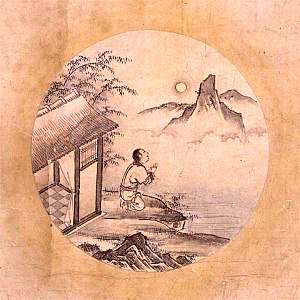
Image 7: The Bull Transcended
Rev. Douglas Taylor
8-19-18
Mark DeWolfe, in our opening hymn (SLT #295), tells us to “Sing out praises for the journey.” He says we are pilgrims traveling a wild road in search of our soul’s yearning. What is your soul’s yearning? What calls you into the journey? I don’t just mean wanderlust here. I mean that deeper journey we each take in becoming who we are.
The opening line of Mary Oliver’s poem The Journey http://www.phys.unm.edu/~tw/fas/yits/archive/oliver_thejourney.html says: “One day you finally knew what you had to do, and began.” Was it like that for you? Maybe you were 24 or 54, or simply 4 – and one day, you just knew. And you began. Maybe it happened when you were in that particular class back in school, or when you were hit by that particular loss of a loved one, or when you left that job or moved across the country, or when you hit your ‘rock bottom,’ realizing something different needed to happen. “One day you finally knew what you had to do, and began.”
Can you name a turning point? An inception of the journey? A launch date? I can’t. I am sure for some of you this concept connects, maybe connects strongly. But it doesn’t work for me. And trust me, I’ve tried to make it work because I’m a minister and I have a calling and a ‘call story’ is supposed to have a beginning – a Damascus moment where I’m struck from my horse like Paul as described in the book of Acts. But I have no such moment. I never have.
I most certainly have been on the journey, but I cannot describe a single starting point for it all. I have no “One day” in which I finally knew. I had been walking the path for a while before I realized what I was doing.
I recently saw a friend post about the word “Coddiwomple.” It is an Old English word meaning: “To travel in a purposeful manner towards a vague destination.” Coddiwomple. I feel like I was doing something along those lines. I coddiwompled my way into ministry. “One day I finally recognized what I had been aiming at, and that I had begun some time back.” I have said before that I do not feel like I’d gotten a “call” so much as a series of whispers into ministry.
It is like I can look back and recognize several versions of Image 2 of the Ten Bulls – the one where the person ‘sees signs of the ox’ – but I didn’t understand them as signs at the time. And, perhaps because of that, I can’t recall that moment of Image 1 in which the person begins the search for the ox. https://en.wikipedia.org/wiki/Ten_Bulls But for you, it may be different.
The Ox herding pictures are meant to be about the journey of meditation into enlightenment. I am trying to expand from that more broadly, using them to talk about any journey of self-discovery. There are many forms out there of the journey of self-discovery. They are all variations of a road map for the journey of becoming who you are.
Essentially, the forms offer a template for our own experiences. Real life is messier than any story crafted to explain or entertain. You know: the map is not the territory, it is merely a representation of what it might be like. Useful, but not actual. I’ve mentioned my own experience to highlight this point. You also may find Mary Oliver’s poem personally meaningful like I do even though it doesn’t fit your actual experience, like it does not fit mine – at least the first part. Most of the rest of the poem is spot on for me.
Oliver talks about these voices crying out for our attention, old hurts, old patterns, old stories about who I am and what I can be. That part still fits my experience. My journey has always been a movement away from those negative voices. It has always been a movement into wilderness. And that’s in keeping with Mary Oliver’s poem.
In our prelude piece from James Taylor (Carolina On My Mind) there is a good description of the wild road:
Dark and silent, late last night,
I think I might have heard the highway call.
He mentions “signs that might be omens” saying it is time to be on the journey. There is an ominous feel to that verse. It is comfortable back home, but the road calls to us. Mark DeWolf, in that hymn, offers that there are wayside stopping points for us built by our ancestors who “know wild roads.” And Mary Oliver cautions us, saying:
It was already late
enough, and a wild night,
and the road full of fallen
branches and stones.
What sort of trouble have you lived through? What are the wild roads you have travelled? Lucille Clifton, a poet and educator from Buffalo, NY once wrote: “Every pair of eyes facing you has probably experienced something you could not endure.” Everybody is going through something. But that suffering is not the whole story, not when you are on the journey.
I was talking with someone this week about some hard things this person was going through. And they also talked about doing the thing they love – and how when they are absorbed in that work the worry and the suffering fades to the background. Musicians and athletes talk about this sort of experience a lot. It is what that 6th image must feel like – riding the ox home, playing your flute, in control of the situation and finding joy in the process.
Mary Oliver says it like this:
But little by little,
as you left their voice behind,
the stars began to burn
through the sheets of clouds,
and there was a new voice
which you slowly
recognized as your own,
At the top of this sermon I named it “Becoming who you are.” It is about finding your voice, your calling, your passion or purpose – yes. But at the heart of it, we’re talking about finding your voice and becoming who you are. You are nor defined by who your family was – for good or for ill. You and I are not defined by the negative voices in our heads. We are not defined by our mistakes. You are not defined by your past. Yes, all that stuff is a part of you, probably has consequences you’ll need to deal with; but your voice – your voice is who you are. This shows in both the Mary Oliver poem and the ox-herding pictures. What I search for, what you search for is your true self, your voice, perhaps even enlightenment.
The western storytelling would probably end at the triumphant image 6 in the Ox-Herding pictures. The person went searching, saw signs, spotted the ox, caught and then tamed the ox. And finally, in image 6 we see the person riding the ox home. But the set of pictures are not showing us the “call to adventure.” They show us how we can become who we truly are. That’s why it doesn’t end with image 6.
Image 7 shows the story as it continues. Once the goal is obtained, life continues. To take this more solidly in the direction of spirit and a quest for deeper understanding – image 7 shows success to be not the pinnacle, but another step toward something more. Image 7 is a return to the beginning. And even that is not the end.
Mary Oliver ends her poem saying you find yourself:
determined to do
the only thing you could do —
determined to save
the only life that you could save.
The Ox-Herding pictures are, likewise, focused on your enlightenment – your personal journey to get it all figured out. But notice the last image, image 10. The figure has returned to the world as a bodhisattva, a Buddha-figure, present and open to the world in need. This enlightenment business, this salvation business, so focused on the individual and on my private experience of healing and wholeness … yet here at the end of the Ox-herding pictures, we see the figure arriving back in the world to care for the brokenness, to offer the path to others.
In the end, we’re all in this together, no matter what we do in our private spiritual lives. As Pat Humphries reminds us (From our Anthem Swimming to the Other Side):
We are swimming in this stream together
Some in power, some in pain
Even for me, a minister, I am on my own journey. My voice, who I am becoming, is all tangled up with these topics of enlightenment and salvation. But I can’t save anyone. I am not up here to make you a better person or to make you happy or to bring you to enlightenment. I can open some doors, point things out, highlight a path or two that might help – but you need to uncover your own voice and walk your own path, search for your own ox and ride it home. We all are on our own journeys. And yet – we are swimming in this stream together … it makes sense for us to help each other along the way, right?
I want to figure out my own stuff, but I don’t want that to stop me from figuring out ways to help others along the way. And that is what the final image is about in the 10 ox-herding pictures. Returning to the broken world. Because the broken world needs our attention too.
And as I said earlier, real life is messy. Life does not follow the ordered progression of a story, a poem, or an elegant set of ten pictures. Image 10 may be closer to your current starting point leading into the journey. I don’t know. You may be living this in a different order than I have been living it.
I want to figure out my own stuff, but I don’t want that to stop me from figuring out ways to help others along the way. You may be spending your time helping others, hoping to eventually figure your own stuff out along the way. Your voice, your path – that’s the journey.
Meanwhile, we are all one human family, together on our beautiful earth/home. We are here to make life better, kinder – to build our share of “roadside hostels” on the wild roads of the spirit for the next traveler on the journey behind us.
May we have courage in the wild night of our searching. May we have compassion for all our fellow travelers. And may any insights, epiphanies, understandings, or ox taming moments that come out way – lead us back into the world with blessings in our hands.
In a world without end
May it be so.
Shades of Non-Violence

Shades of Non-Violence
Rev. Douglas Taylor
6-17-18
Part I
Joan Baez is an Absolute Pacifist, her pacifism is a personal, principled conviction. (Our reading was from Joan Baez’s book Daybreak http://www.ppu.org.uk/learn/infodocs/st_what_if.html )
And this is what most people assume the word pacifism means. An Absolute Pacifist will not use violence, will not advocate the use of violence in any situation – even self-defense. When you imagine a pacifist, you may call to mind a stereotype of some sort, or you might call to mind a friend, someone here in the congregation, you may even consider yourself to be so identified. You, like Joan Baez, may say “I am a pacifist.” “I’ll take Gandhi’s nonviolent resistance.”
Interesting fact: Gandhi was not a pacifist in this sense. Gandhi was not an Absolute Pacifist. He advocated for the use of self-defense. After India won its independence, he encouraged people to fight in the Boer War. Gandhi was a Conditional Pacifist – a pacifist for strategic reasons. He used non-violence because it worked. People have said he ‘weaponized’ nonviolence. Gandhi used nonviolence as a tool to fight his country’s oppressors. He did not insist that all his followers adopt pacifism as a way of life, as a principled ideal for all situations. He advocated, instead, that his followers use nonviolence because it was more effective than violence given their political situation. He was a Pragmatic Pacifist, suggesting there are some situations where nonviolence is a better choice and there are other situations where violence is preferred.
People like the interviewer in the dramatic reading with Joan Baez, will insist that there is only one way to be a pacifist, and, further, that this one way is wrong-headed. But there are shades of nonviolence. I’ve used several different adjectives for Gandhi’s sort of pacifism: Conditional, Pragmatic. Let me unpack a little of the way I am using these terms. Conditional Pacifism is really a large umbrella term for any kind of pacifism that is not Absolute Pacifism.
Absolute Pacifists say no violence is ever justified, that violence is always wrong. Conditional Pacifists say it depends. Under the term Conditional, there are several sub-categories, nuanced arguments about how or why it depends. A Pragmatic Pacifist will argue for nonviolence because the use of violence will make the situation worse. It’s not that all violence is always wrong, it’s that violence in this situation will not be effective. I’ve never been an Absolute Pacifist. In recent years, I think I am becoming a Pragmatic Pacifist.
As a youth, however, I was more of a Technological Pacifist, or as it was known then – a Nuclear Pacifist. This subcategory of Conditional Pacifism argues that modern warfare has grown too indiscriminate and too overwhelming. Our technology has outpaced our morality.
A recent report from UNICEF (https://www.unicef.org/graca/patterns.htm) highlighted the change in wartime casualties over the past century. One statistic from that report shows that civilian casualties climbed from around 5% in 1900, to 15% during WWI, 65% during WWII, and 90% in 1990. Civilians are now the bulk of those killed or injured in war. Partly, we have changed how we do wars, we no longer line up on different sides of a field wearing different-colored uniforms. Also, while our weapons have become more technologically precise, but they have also become vastly more destructive.
As a youth I was deeply opposed to a potential nuclear war, not because I thought all wars were wrong, but that there would be no coming back from a nuclear war. It would be too destructive to humanity as a whole, to the earth as a whole.
It is interesting to me that when I was teenager in the 80’s, the classic image of a pacifist was a 1960’s hippie. Yet today, I look back and see how clearly I was a 1980’s, no-nukes pacifist. I attended the rallies, I watched and discussed the movies, wrote letters to President Reagan, carried signs, and identified strongly with that song from Sting: I Hope the Russians Love Their Children Too.
There are a few other versions of Conditional Pacifism, but I think they begin to blend in with the others: Fallibility Pacifism says violence can be used if it is justifiable, for example if a war abides by the Just War Theory of St. Augustine. However, the Just War Theory is a fairly high bar and it has been a while since any war has met the criteria. Therefore, Fallibility Pacifists argue modern wars fail to be justified and should not be fought.
And there are Selective Pacifists and Collective Pacifists … there is a pretty good “Stuff You Should Know” podcast on the topic which I found interesting, you might too. I’ll include the link when I post this sermon. (https://www.stuffyoushouldknow.com/podcasts/how-pacifism-works.htm)
So, what kind of pacifist are you? I used to be a Nuclear Pacifist myself and over the past decade or so I’ve shifted into a Pragmatic Pacifist. How about you? Have you ever considered yourself a pacifist? What are your opinions and convictions about peace and the use of civil resistance? Where do you find yourself in the taxonomy of nonviolence?
I invite you to ponder that as we move into our next hymn.
Part II
Video (the first 5 minutes of this TED talk)
https://rationalinsurgent.com/2013/11/04/my-talk-at-tedxboulder-civil-resistance-and-the-3-5-rule/
I got a new book which I started reading over my sabbatical. It is about “how nonviolent revolt is shaping the twenty-first century.” It is called This Is an Uprising (2016) by Mark and Paul Engler. http://thisisanuprising.org/ It is a thick book, but surprisingly engaging. The introduction, for example, has this paragraph,
Decade after decade, unarmed mobilizations have created defining moments. In the United States, these include the sit-down strikes in Michigan auto plants in the 1930’s, the antiwar and campus free-speech movements on the 1960’s, the welfare and women’s rights protests of the 1970’s, the nuclear freeze campaigns and AIDS activism of the 1980’s, direct action to protect old-growth forests and oppose corporate globalization in the 1990’s, and demonstrations against the Iraq War in the early years of the new century. Internationally, strategic nonviolent conflict has been critical in helping to overthrown undemocratic rulers in a litany of countries, from Chili and Poland, to the Philippines and Serbia, to Benin and Tunisia. (This Is an Uprising, p xv-xvi)
I originally thought the book would be a historical review of non-violent movements from the past century. That would have been enough to keep my interest. But it also has some fascinating “how to start an uprising” elements. It breaks down some of the behind the scenes and pre-work people had done leading up to the Gandhian Salt March, the Selma to Montgomery campaign, Arab Spring leading to Tahrir Square, and how Saul Alinsky’s methods differ from those of Frances Fox Piven.
The book acknowledges the distinction between Absolute Pacifism and Conditional Pacifism and seems to keep returning to the idea that in Pragmatic Pacifism: we can plan for the spark that ignites, we can foster the conditions that lead to a nonviolent uprising.
How many of you in the room have heard of Gene Sharp? Sharp is the founder of the Albert Einstein Institute, where they “advance the worldwide study and strategic use of nonviolent action in conflict.” https://www.aeinstein.org/about/mission-statement/
If you’ve never heard of Gene Sharp, it is not too surprising. He is a researcher of nonviolence rather than an activist. His impact has been monumental, though largely unheralded. He comes up quite a bit in this book I’ve been reading, especially at the beginning of the book as a starting point. Sharp is known as the “Machiavelli of nonviolence,” and has been called the “dictator slayer.” His thin book from Dictatorship to Democracy was written in 1993 to help dissidents in Burma. But the book has turned up all over the world since then. It was read by Serbian students against Slobodan Milosevic and circulated in Arabic throughout Egypt in 2011. You can download your own copy from the Albert Einstein Institute website for free.
Sharp studied nonviolent actions from a pragmatic view. He has a report, for example, written during the 60’s about Gandhi, not as a spiritual Mahatma, but as a political strategist. Sharp’s research showed him again and again that nonviolent resistance movements were not random and spontaneous – they are predictable and can even be created. While the Catholic Workers movement favored symbolic, attention-getting actions and often quoted the axiom: “Jesus never told us to be successful, only to be faithful”; Sharp would counter with what he called “political jiu-jitsu” and suggested, ‘why not be faithful and effective?’
He collected a list of nonviolent actions people could use against repressive regimes. It is a famous list now. Some people mistakenly think Sharp wrote the list but he insists he merely collected it from examples he studied and witnessed. The list is sometimes known as the “198 Tactics.” https://www.aeinstein.org/nonviolentaction/198-methods-of-nonviolent-action/ And it is simply that: a list of 198 ways to resist. The classics that spring to mind are things like Sit-ins, Boycotts, Marches, Speeches, Petitions, Hunger Strikes, and Walk-outs. Sharp set these all into over a dozen broad categories such as Formal Statements, Symbolic Public Acts, Economic Boycotts, Physical Interventions, Noncooperation, and several more.
What can you do? Here’s another school shooting. Here’s a fear-inducing ‘bathroom bill.’ Here’s a parade of White Supremacists. What can we do? Here’s a story about children being taken from their families at the border. Here’s a headline about a politician grabbing power. Here’s an outrage. Here’s an atrocity. What are we going to do? Well, here is a list of 198 actions we could take.
Ask each other about the Poor People’s Campaign. Talk about PRIDE events. Share news with each other about that rally happening at a politician’s office. Follow the indictments coming out of the federal special prosecutor’s office. Watch for the next #BlackLivesMatter event. Take part. Show up. Or if you stay home, help in the planning or read up more – study what is possible when we support each other in making the world a better place. Consider how powerful and effective a tool we have together in nonviolent civil resistance.
Nonviolent resistance has a long and increasingly frequent and surprisingly successful history in human society – in our society. What kind of world do we want to create? This is not a rhetorical question. This is our country. This is our world. All the world’s people are our people. Another uprising is happening. The resistance is here.
In a world without end,
May it be so.

