
Interfaith Prayer for Standing Rock
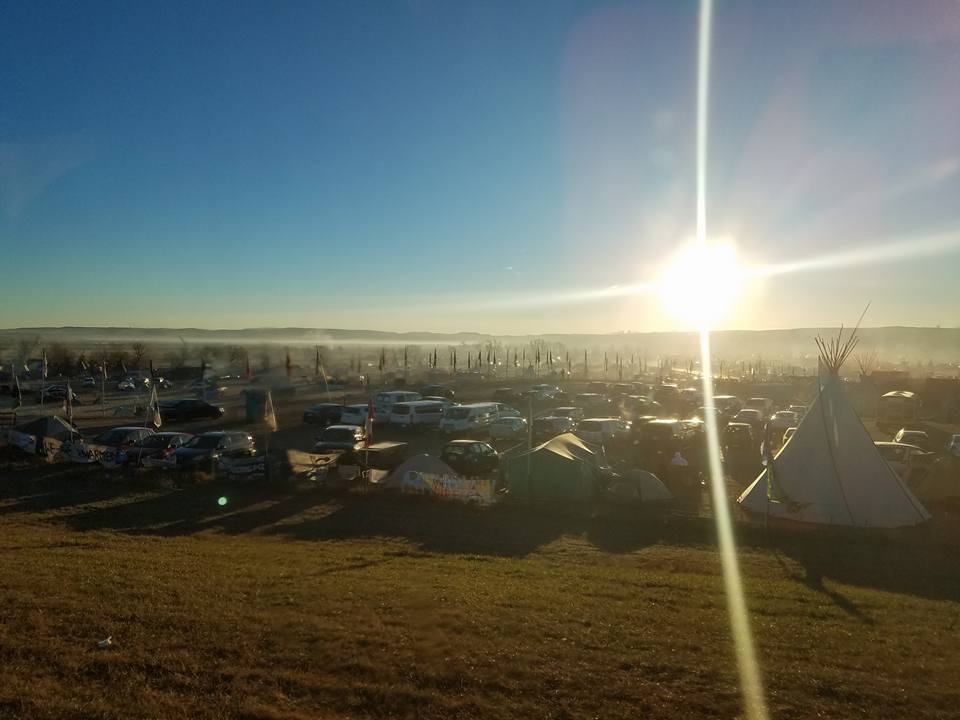
Interfaith Prayer for Standing Rock
Eternal Spirit
From whom all things come and to whom all things return
We gather today as religious people from various traditions;
We gather as people reaching across our difference
Sharing our commitment to compassion and truth
In this silent moment let us give thanks for the blessings in our lives.
For the gift of earth we receive as food and water each day, we give thanks
For home and family, for faith and meaningful work, we give thanks.
For our ability to gather in this way as people of peace, we give thanks.
In this silent moment we lift up those places in our own lives
and in our own hearts where burdens reside.
May there be peace, may there be grace, may there be support
In this silent moment let us cry out for the suffering of our world.
In particular, we cry out
for the land and the water that is threatened in Cannonball ND
for the American Indians usually forgotten on the margins
for all those who suffer at the hands of police militarization
and corporate greed
We cry out for the distrust and disconnection that has taken root
between the people and our government
between the people and our police
between the people and our mother earth
This is not the way it should be.
Oh, Spirit of life and of love, hear our cry.
Hear our cry, of spirit, and help us to become instruments of thy love.
Let us speak up with those who go unheard.
Let us show up in solidarity with all those on the margins.
Let us be like the Water Protectors of Standing Rock
and commit ourselves to Protect what is Sacred.
Let us be emissaries of justice,
ambassadors of compassion,
agents of thee, O Spirit
In the name of all that is holy
may it be so
What my church taught me as a child about gay people

Normal People of Blessing
My first year serving in the new congregation I was asked to be a speaker at the People of Blessing service, the annual interfaith worship service affirming the place of LGBTQ+ people in our faith communities. That year we gathered in a Lutheran congregation. Methodists, United Church of Christ, Presbyterian, Jewish, and Unitarian Universalist congregations have taken turns hosting over the years.
I learned that several members of my new congregation had been instrumental in starting the annual event several years before I showed up. (It was part of what drew my interest early on.) Our congregation had served as the first host. There had even been protesters out on the sidewalk – many people in our congregation were rather proud of that.
As one of the speakers my first year, I shared a story from my childhood. I grew up in a Unitarian Universalist. My mother worked on staff at the church. One of the perks for me was I got to take piano lessons from the church organist. Frank was a phenomenal musician and a very good teacher. Each week my mom would drive me over to my piano lesson. I would settle on the piano bench next to Frank while my mom sat in the kitchen talking with Frank’s partner, Glenn.
That was my introduction to homosexuality. It was normal. It was two people in a committed relationship. This was the 1980’s. AIDS and HIV were a painful reality I didn’t know much about at that point. I have since learned quite a bit about it. Religious discrimination against gay people was rampant, but that was also something I didn’t personally see. Instead, my experiences were of seeing lesbian and gay couples around me, around my family, around my church. As a kid, I was both told and shown that being gay was simply another version of normal.
Far too often religion is used as a weapon to exclude and injure and condemn. That is not what religion is for. There are real problems in life, adding undue shame is not needed. Too often, religion does not lift up and affirm gay, lesbian, bisexual, queer, and transgender people. LGBTQ+ people are one of the few identity groups still singled out and hated for religious reasons. Religion should stand for love more than judgment.
That’s what I shared at the People of Blessing service my first year. I simply told them what my church had taught me as a child.
The Long, Hard Bend toward Justice

The Long, Hard Bend toward Justice
About 150 years ago, Unitarian minister Theodore Parker wrote in one of his great sermons, “Look at the facts of the world. You see continual and progressive triumph of right. I do not pretend to understand the moral universe, the arc is a long one, my eye reaches but little ways. I cannot calculate the curve and complete the figure by the experience of sight; I can divine it by conscience. But from what I see I am sure it bends toward justice.”
About forty years ago, the Reverend Dr. Martin Luther King, Jr. summed up the same sentiment saying, “the arc of the moral universe is long, but it bends toward justice.” After a polite pat on the back for being able to claim (yet again) a religious lineage to powerful movers and wordsmiths in our nation’s history, I wonder if this sentiment can possibly be true. What do you think?
I’ve been worried lately. I’m not one much for worrying, but there is much afoot these days to make anyone worried. I’m too young to be this cynical about the world. Yet I am occasionally struck by the sense of apathy around me and by the feelings of powerlessness within me. What can I do to make a difference? As a Unitarian Universalist minister, I am supposed to be a purveyor of high principles, a dealer in good deeds, a merchant of meaningfulness, a huckster for hope. Yet too often I look at the facts of the world and fail to see a bending of the moral arc.
Of course, much of this depends on what you are looking for. Much also depends on what you are doing for your part in the grand story of the moral universe! At times when I feel I cannot see what Parker and King saw, I submerge myself in the work: I look people in the eye, I listen to my children’s dreams, I smile at strangers, I write letters to the newspaper and my government representatives, I look and I listen and I smile and I write and then I listen some more. Indeed, I lack evidence to bolster my perspective, and sometimes I doubt my own conclusions – but what else can I do?
There is work to do, people to love, worlds to save, justice to manifest! At times, I feel that all I can attest is that the moral arc is long with no line on which way it bends. Occasionally, though, I look and I do see the long, hard bend toward justice! I see it in us and others who care. Perhaps, the moral arc bends as it does because you and I and others with us through the ages are pulling hard to make it so.

Listening for Common Ground

Listening for Common Ground
It was the 15th anniversary of the September 11th terror attacks in the evening. I had the honor to be one of the speakers under the tent at the Islamic Organization of the Southern Tier. Someone told me all the area politicians were at the larger 9/11 event over in Highland Park. Our event had all the prominent religious leaders. We were Jewish, Muslim, Catholic, Orthodox, Protestant, and Unitarian Universalist.
Many of my colleagues began their remarks with a personal account of their experience of the tragedy. Many offered prayers and spoke of unity and of peace. I did much the same. Instead of a personal story though, I shared a different story to help make the point that we all have choices in how we respond to traumas and tragedies. I shared the cricket story.
Once, two friends were walking down the sidewalk of a busy city street during rush hour. There was all sorts of noise in the city; car horns honking, feet shuffling, people talking! And amid all the noise, one of the friends turned to the other and said, “I hear a cricket.”
As I was telling this story under the tent outside of the mosque, there was an actual cricket chirping just off to the side, clearly audible throughout my remarks. No one had really noticed it before my story called our attention to it. People asked me after how I had worked that trick – I confess that I just smiled and said, “I’m magic.” Anyway, the story continues … “I hear a cricket.”
“No way,” her friend responded. “How could you possible hear a cricket with all of this noise? You must be imagining it. Besides, I’ve never seen a cricket in the city.”
“No, really, I do hear a cricket. I’ll show you.” She stopped for a moment, then led her friend across the street to a big concrete planter with a tree in it. Pushing back some leaves she found a little brown cricket.
“That’s amazing!” said the friend. “You must have super-human hearing. What’s your secret?”
“No, my hearing is just the same as yours. There’s no secret,” the first woman replied. “Watch, I’ll show you.” She reached into her pocket, pulled out some loose change, and threw it on the sidewalk. Amid all the noise of the city, everyone within thirty feet turned their head to see where the sound of money was coming from.
“See,” she said. “It’s all a matter of what you are listening for.”
[Elisa Davy Pearlmain, ed., Doorways to the Soul, (1998) p14]
So what are you listening for? What do you hear and what occupies your attention? For I tell you that in part, what you listen for will determine what you hear and what, in turn, you amplify out into the world around you.
Our world is filled with noise. In the story it is the noise of the car honks and the people shuffling and muttering on the busy street. In our world today it is the noise of fear and ignorance, of anger and violence. So much of the news – particularly the political news lately – is filled with negative content. It is like the background of our personal lives is a crackling static of hostility. And yet our world is filled with the sounds of hope and of courage as well. And yet the cricket was really there. What are you listening for? It makes a difference to the people around you and to your own heart.
 Rev. Douglas Taylor